Kategorie: Schule

  • Sherlock and the lost drum (A1, beginner,50)


    to go to – to travel to a place

    to climb – to go up something (a tree, stairs)

    to fall out of – to drop from something (a bed, a window)

    to leave – to go away from a place

    to find – to see something you were looking for

    to bump – to hit something by accident [ to touch something hard without wanting to ]

    to look for – to try to find something

    to jump into – to move into something with a jump (a pool, a car)

    #####################

    GermanWordDefinition
    gehen nach / fahren zuto go toto travel to a place
    hochklettern / hinaufgehento climbto go up something (a tree, stairs)
    herausfallen / runterfallento fall out ofto drop from something (a bed, a window)
    weggehen / verlassento leaveto go away from a place
    finden / entdeckento findto see something you were looking for
    stoßen / anstoßento bumpto hit something by accident
    suchen / nach etwas schauento look forto try to find something
    hineinspringen / springen into jump intoto move into something with a jump (a pool, a car)

    #####################
    Match word – definition:

    Words

    1. to go to
    2. to climb
    3. to fall out of
    4. to leave
    5. to find
    6. to bump
    7. to look for
    8. to jump into

    Definitions

    A. to go away from a place
    B. to try to find something
    C. to drop from something
    D. to move into something with a jump
    E. to travel to a place
    F. to hit something by accident
    G. to see something you searched for
    H. to go up something

    ———————–

    Answers:
    1–E, 2–H, 3–C, 4–A, 5–G, 6–F, 7–B, 8–D

    #########

    Story 1


    Sherlock Groans goes to the river to find his drum.
    He walks down the small hill to the water.
    He looks for the drum on the ground and in the trees.
    Suddenly, he hits a big rock.He sees something in the water and jumps in.
    The drum falls from a tree into his hands.
    Sherlock Groans is very happy. He finds his drum and leaves the river.


    [PS: to groan= to make a sad or unhappy sound]

    ——————————
    True / False:

    1. ☐ True ☐ False – Sherlock Groans goes to the river.
    2. ☐ True ☐ False – He climbs up the big hill.
    3. ☐ True ☐ False – He looks for the drum in the trees.
    4. ☐ True ☐ False – He bumps into a small rock.
    5. ☐ True ☐ False – He sees something in the water.
    6. ☐ True ☐ False – The drum falls into the river.
    7. ☐ True ☐ False – Sherlock Groans is very happy.
    8. ☐ True ☐ False – He dances near the river.

    ###############


    Answsers:

    1. Sherlock Groans goes to the river. ✅
    2. He climbs up the big hill. ❌
    3. He looks for the drum in the trees. ✅
    4. He bumps into a small rock. ❌
    5. He sees something in the water. ✅
    6. The drum falls into the river. ❌
    7. Sherlock Groans is very happy. ✅
    8. He dances near the river. ❌

    ✅ = True
    ❌ = False

    ####################
    Which is correct? Answer in complete sentences:


    1. Sherlock Groans goes to the river to find his drum.

    • Does Sherlock Groans go to the park or to the river?
    • Does Sherlock Groans go to find a drum or a rock?
    • Who goes to the river? Sherlock Groans or the drum?

    2. He walks down the small hill to the water.

    • Does he walk up the hill or down the hill?
    • Does he go to the water or to the tree?
    • Where does he walk? To the hill or to the water?

    3. He looks for the drum on the ground and in the trees.

    • Does he look for the drum on the ground or in the river?
    • Does he look for the drum in the trees or on the rock?
    • What does he look for? The drum or the river?

    4. Suddenly, he hits a big rock.

    • Does he hit a small rock or a big rock?
    • Does he hit the drum or the rock?
    • What does he hit? The rock or the tree?

    5. He sees something in the water and jumps in.

    • Does he see something in the water or in the tree?
    • Does he jump in the water or on the rock?
    • Where does he jump? In the river or on the hill?

    6. The drum falls from a tree into his hands.

    • Does the drum fall from a tree or from the river?
    • Where does the drum fall? Into his hands or on the rock?
    • What falls into his hands? The drum or the rock?

    7. Sherlock Groans is very happy.

    • Is Sherlock Groans happy or sad?
    • Who is happy? Sherlock Groans or the drum?

    8. He finds his drum and leaves the river.

    • Does he find his drum or a rock?
    • Does he leave the river or the hill?
    • What does he find? The drum or the water?

    —————————————–

    Correct answers:


    1. Sherlock Groans goes to the river to find his drum.

    • Does Sherlock Groans go to the park or to the river? – Sherlock Groans goes to the river.
    • Does Sherlock Groans go to find a drum or a rock? – Sherlock Groans goes to find a drum.
    • Who goes to the river? Sherlock Groans or the drum? – Sherlock Groans goes to the river.

    2. He walks down the small hill to the water.

    • Does he walk up the hill or down the hill? – He walks down the hill.
    • Does he go to the water or to the tree? – He goes to the water.
    • Where does he walk? To the hill or to the water? – He walks to the water.

    3. He looks for the drum on the ground and in the trees.

    • Does he look for the drum on the ground or in the river? – He looks for the drum on the ground.
    • Does he look for the drum in the trees or on the rock? – He looks for the drum in the trees.
    • What does he look for? The drum or the river? – He looks for the drum.

    4. Suddenly, he hits a big rock.

    • Does he hit a small rock or a big rock? – He hits a big rock.
    • Does he hit the drum or the rock? – He hits the rock.
    • What does he hit? The rock or the tree? – He hits the rock.

    5. He sees something in the water and jumps in.

    • Does he see something in the water or in the tree? – He sees something in the water.
    • Does he jump in the water or on the rock? – He jumps in the water.
    • Where does he jump? In the river or on the hill? – He jumps in the river.

    6. The drum falls from a tree into his hands.

    • Does the drum fall from a tree or from the river? – The drum falls from a tree.
    • Where does the drum fall? Into his hands or on the rock? – The drum falls into his hands.
    • What falls into his hands? The drum or the rock? – The drum falls into his hands.

    7. Sherlock Groans is very happy.

    • Is Sherlock Groans happy or sad? – Sherlock Groans is very happy.
    • Who is happy? Sherlock Groans or the drum? – Sherlock Groans is happy.

      ————end of audio file———-

    8. He finds his drum and leaves the river.

    • Does he find his drum or a rock? – He finds his drum.
    • Does he leave the river or the hill? – He leaves the river.
    • What does he find? The drum or the water? – He finds the drum.

    ####################

    ####################

    Story 2

    Sherlock Groans goes to the river to look for his lost drum.
    He climbs down the small hill and walks to the water.
    He looks for the drum in the trees and on the ground.
    Suddenly, he bumps into a big rock.
    He sees something in the water. He jumps into the river.
    The drum falls out of a tree and into his hands!
    Sherlock Groans is very happy. He finds his drum and leaves the river.

    ————————————–

    1. True or False

    1. Sherlock goes to the river.
    2. Sherlock climbs a mountain.
    3. The drum is in the tree.
    4. Sherlock is happy at the end.
    5. He walks to the city.
    6. Sherlock walks to the river.
    7. The drum is on the ground.
    8. Sherlock sees a rock.
    9. He climbs down a small hill.
    10. Sherlock is sad at the end.

    True: 1,3,4,6,8,9


    2. Multiple Choice

    1. Where does Sherlock go?
      a) River
      b) Mountain
      c) House
    2. What is lost?
      a) Ball
      b) Drum
      c) Bag
    3. What does Sherlock see in the water?
      a) Drum
      b) Fish
      c) Rock
    4. How does Sherlock feel?
      a) Happy
      b) Sad
      c) Angry
    5. What does Sherlock do first?
      a) Jump
      b) Walk to the river
      c) Find the drum
    6. What falls from the tree?
      a) Rock
      b) Drum
      c) Fish
    7. Where is the drum at the end?
      a) In the tree
      b) In Sherlock’s hands
      c) In the water
    8. What does Sherlock bump into?
      a) Tree
      b) Rock
      c) River
    9. How does Sherlock feel after finding the drum?
      a) Happy
      b) Tired
      c) Angry

    ______________________

    Answers:

    1. a) River – Sherlock goes to the river.
    2. b) Drum – The lost object is a drum.
    3. a) Drum – Sherlock sees the drum in the water.
    4. a) Happy – Sherlock feels happy.
    5. b) Walk to the river – First, Sherlock walks to the river.
    6. b) Drum – The drum falls from the tree.
    7. b) In Sherlock’s hands – At the end, the drum is in Sherlock’s hands.
    8. b) Rock – Sherlock bumps into a rock.
    9. a) Happy – Sherlock feels happy after finding the drum.

    ################


    3. Fill in the blanks


    bumps, river, hands, drum, jumps,
    hill, happy, sees, ground, trees


    Sentences:

    1. Sherlock walks to the ______.
    2. He climbs a small ______.
    3. He looks at the ______ and the sky.
    4. He falls on the ______.
    5. He is very ______.
    6. Sherlock finds the ______ on the ground.
    7. Suddenly, he ______ into a rock.
    8. He ______ into the water.
    9. He takes the drum in his ______.
    10. He ______ a shiny [something that is bright,has light on it] thing in the river.

    Answer Key:

    1. river
    2. hill
    3. trees
    4. ground
    5. happy
    6. drum
    7. bumps
    8. jumps
    9. hands
    10. sees

    4. Vocabulary Match


    Words:

    1. Drum
    2. River
    3. Hill
    4. Rock
    5. Happy
    6. Tree
    7. Water
    8. Jump
    9. Find
    10. Walk


    Meanings:

    a) go up or down quickly
    b) plant
    c) music
    d) get something you look for
    e) small mountain
    f) stone
    g) water
    h) move with your legs
    i) smile
    j) river

    ____________________
    Answers:

    1. c, 2. j, 3. e, 4. f, 5. i, 6. b, 7. g, 8. a, 9. d, 10. h

    ##############


    5. Simple Questions – answer in a complete sentence:

    1. Who is in the story?
    2. What does he look for?
    3. Where does he jump?
    4. How does he feel?
    5. Where does he go first?
    6. What does he bump into?
    7. What falls into Sherlock’s hands?
    8. Where does Sherlock look first?
    9. What does Sherlock do after he finds the drum?
    10. Is Sherlock happy at the end?

    ——————————–

    Answers:

    Who is in the story? – The story is about Sherlock.

    What does he look for? – He looks for the drum.

    Where does he jump? – He jumps into the river.

    How does he feel? – He is happy.

    Where does he go first? – He goes to the river first.

    What does he bump into? – He bumps into a rock.

    What falls into Sherlock’s hands? – The drum is in his hands.

    Where does Sherlock look first? – He looks in the trees first.

    What does Sherlock do after he finds the drum? – He leaves the river after he finds the drum.

    Is Sherlock happy at the end? – Sherlock is happy at the end.

    #################

  • Musicians & instruments (A1, beginner, 48)

    1. boyfriend – a boy or man you love
    2. play – to do something for fun, like a game or music
    3. sister – a girl who has the same parents as you
    4. concert – a live show with music
    5. dance – to move your body to music
    6. don’t worry – it’s okay; everything will be fine
    7. job – work you do to earn money
    8. perfect – very good; without any mistakes
    9. carry – to hold and move something with your hands
    10. stand on something – to have your feet on something
    11. tongue – the part inside your mouth that helps you talk and taste
    12. touch – to put your hand or finger on something
    13. walk on – to move with your feet on something
    14. wiggle – to move slightly from side to side
    15. drink – to take liquid (like water or juice) into your mouth
    16. hundred – the number 100
    17. in one go – to do something all at once, without stopping
    18. is that so? – really? / oh, is that true?
    19. this is me – I am this person
    20. economy – the system of money, jobs, and trade in a country
    21. hospital – a place where sick or injured people go for care
    22. laugh – to make a happy sound when something is funny
    23. pocket money – a small amount of money children get from their parents
    24. pound – money in the UK (£) or a unit of weight (about 0.45 kg)
    25. profit – the money you make after paying your costs
    26. school canteen – a place in a school where students eat
    27. table – furniture with a flat top and legs
    28. teacher – a person who helps students learn
    29. uncle – your mother’s or father’s brother
    30. wash – to clean with water (and sometimes soap)
    31. nothing – not anything; zero
    32. be sorry – to feel bad about something wrong or sad

    ##################
    Match word defintion:


    A. Words

    1. a boyfriend
    2. to play
    3. a sister
    4. a concert
    5. to dance
    6. don’t worry
    7. a job
    8. perfect
    9. to carry
    10. to stand on something
    11. a tongue
    12. to touch
    13. to walk on
    14. to wiggle
    15. to drink
    16. hundred
    17. in one go
    18. is that so?
    19. this is me
    20. economy
    21. a hospital
    22. to laugh
    23. pocket money
    24. pound
    25. profit
    26. a school canteen
    27. a table
    28. a teacher
    29. an uncle
    30. to wash
    31. nothing
    32. to be sorry

    Definition:

    a. a show with music
    b. to clean with water (and sometimes soap)
    c. not anything; zero
    d. very good; without mistakes
    e. your mother’s or father’s brother
    f. I am this person
    g. money you get after you pay your costs
    h. to move a little from side to side
    i. the system of money, jobs, and trade in a country
    j. the part inside your mouth that helps you talk and taste
    k. to take liquid (like water or juice) into your mouth
    l. work that you do to get money
    m. furniture with a flat top and legs
    n. really? / oh, is that true?
    o. to have your feet on something
    p. to make a happy sound when something is funny
    q. money in the UK (£) or a unit of weight
    r. a boy or man you love
    s. it’s okay; everything is fine
    t. a place in a school where students eat
    u. to put your hand or finger on something
    v. the number 100
    w. to move your body with music
    x. a little money children get from their parents
    y. a person who helps students learn
    z. a girl who has the same parents as you
    aa. to feel bad for something wrong or sad
    bb. to do something all at one time, not stopping
    cc. a place where sick or hurt people go
    dd. to do something for fun (like a game or music)
    ee. to hold and move something with your hands


    ##################

    1-r, 2-dd, 3-z, 4-a, 5-w, 6-s, 7-l, 8-d, 9-ee, 10-o, 11-j, 12-u, 13-(same as 10) o, 14-h, 15-k, 16-v, 17-bb, 18-n, 19-f, 20-i, 21-cc, 22-p, 23-x, 24-q, 25-g, 26-t, 27-m, 28-y, 29-e, 30-b, 31-c, 32-aa
    ###################

    1. a boyfriend – a boy or man you love
    2. to play – to do something for fun (like a game or music)
    3. a sister – a girl who has the same parents as you
    4. a concert – a show with music
    5. to dance – to move your body with music
    6. don’t worry – it’s okay; everything is fine
    7. a job – work that you do to get money
    8. perfect – very good; without mistakes
    9. to carry – to hold and move something with your hands
    10. to stand on something – to have your feet on something
    11. a tongue – the part inside your mouth that helps you talk and taste
    12. to touch – to put your hand or finger on something
    13. to walk on – to have your feet on something
    14. to wiggle – to move a little from side to side
    15. to drink – to take liquid (like water or juice) into your mouth
    16. hundred – the number 100
    17. in one go – to do something all at one time, not stopping
    18. is that so? – really? / oh, is that true?
    19. this is me – I am this person
    20. economy – the system of money, jobs, and trade in a country
    21. a hospital – a place where sick or hurt people go
    22. to laugh – to make a happy sound when something is funny
    23. pocket money – a little money children get from their parents
    24. pound – money in the UK (£) or a unit of weight (about 0.45 kg)
    25. profit – money you get after you pay your costs
    26. a school canteen – a place in a school where students eat
    27. a table – furniture with a flat top and legs
    28. a teacher – a person who helps students learn
    29. an uncle – your mother’s or father’s brother
    30. to wash – to clean with water (and sometimes soap)
    31. nothing – not anything; zero
    32. to be sorry – to feel bad for something wrong or sad

    ####################

    Deutsch – English list:

    Opps, something’s wrong [PROFOT – error]:


    • FIND THE MISTAKES:
    • a boyfried
    • to play
    • a concert
    • to dence
    • a table
    • to be sorry
    • a hospitol
    • don’t worry
    • a teachor
    • to wiggle
    • pocket mony
    • an unclo
    • to wash
    • a sister
    • to tuch
    • a job
    • hundred
    • to dance
    • profot
    • a school canteen
    • this is me
    • to stand on somthing
    • to cary
    • pound
    • a tongue
    • in one go
    • perfect
    • is that so?
    • economy
    • a boyfriend
    • a tabl
    • to drink
    • to walk on

    _____________________
    Correct version:

    a boyfriend
    to play
    a concert
    to dance
    a table
    to be sorry
    a hospital
    don’t worry
    a teacher
    to wiggle
    pocket money
    an uncle
    to wash
    a sister
    to touch
    a job
    hundred
    to dance
    profit
    a school canteen
    this is me
    to stand on something
    to carry
    pound
    a tongue
    in one go
    perfect
    is that so?
    economy
    a boyfriend
    a table
    to drink
    to walk on

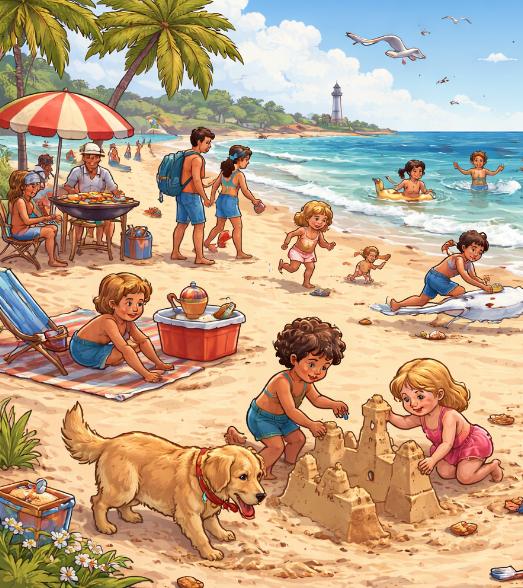
  • 😱🥰🙌What are people doing, now, when we see them, at the moment of speaking 🙌🥰😱(present continuous/progressive, basics, revised (A1))


    Used when actions are happening at the present moment, now, at the moment of speaking.

    I, You, etc.am, is, areVerb + ing
    Iameating
    Youarerunning
    He/She/Itissleeping
    Wearetalking
    Theyareplaying

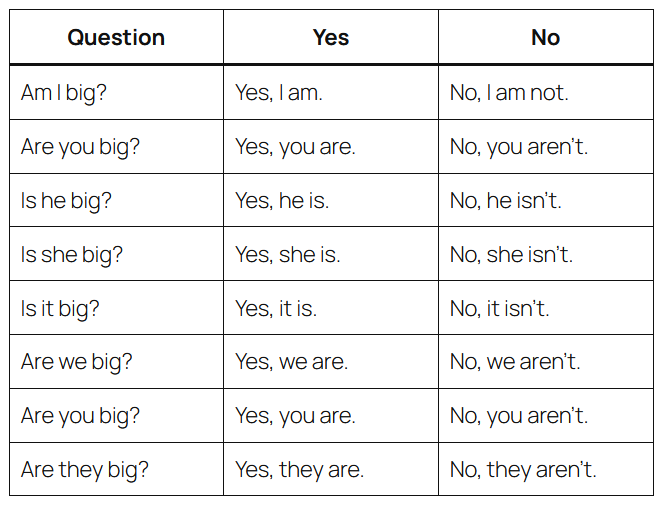
    PronounNegativeQuestion
    II am not eatingAm I eating?
    YouYou are not runningAre you running?
    HeHe is not sleepingIs he sleeping?
    SheShe is not readingIs she reading?
    ItIt is not rainingIs it raining?
    WeWe are not talkingAre we talking?
    YouYou are not playingAre you playing?
    TheyThey are not workingAre they working?


    Describe, as many sentences as possible.
    (send me your sentences, I’ll have a look at them:
    SMFrockZ@gmx.at


    Picture 1:

    Picture 2:

    Picture 3:


    The people are sitting in a park. The sun is shining and the grass is very green. A little girl is sitting on the grass. She is wearing a white T-shirt and blue shorts. She is looking at the other people. A man is sitting next to her. He is looking at his phone. A woman is sitting on a bench. She is holding a notebook. The people are relaxing and are enjoying the nice day. Other people are sitting in the background. Everyone is happy and calm.

    #################

    People are walking along the path.

    Some individuals are sitting on the grass.

    A person is holding a phone.

    Others are chatting with each other.

    A group is lying on a blanket.

    Someone is drinking from a bottle.

    A couple is walking hand in hand.

    People are relaxing under the trees.

    A person is wearing a red shirt.

    Another individual is carrying a backpack.

    Some are enjoying the sunny weather.

    A person is looking at a laptop.

    Others are sitting in small groups.

    Someone is adjusting their cap.

    People are spreading out picnic items.

    A group is walking towards the distance.

    Someone is taking a photo.

    Individuals are wearing colorful clothes.

    People are enjoying the park environment.

    Picture 4:


    People are eating now. They are sitting at tables. The tables are outside. Green trees are around them. Waiters are standing and helping. One waiter is talking to people. Girls are drinking and talking. A man is using a laptop. Everyone is enjoying the food. The sun is shining. Flowers are on the tables. It is a happy time. People are smiling and eating. The place is beautiful and green.

    #################
    Picture 5:

    People are sitting at a table.
    They are eating food.
    They are talking and smiling.
    A waiter is standing and helping.
    Pink flowers are hanging above.
    Green leaves are growing around.
    Girls are drinking water.
    Men are using forks.
    The sun is shining now.
    Everyone is enjoying the meal.
    The garden is beautiful and everybody is having fun.

  • Irregular plurals (A1 intermediate)

    SingularPlural
    childchildren
    manmen
    womanwomen
    toothteeth
    footfeet
    mousemice
    personpeople
    goosegeese
    sheepsheep
    fishfish
    deerdeer
    knifeknives
    wifewives
    leafleaves
    loafloaves
    calfcalves
    thiefthieves
    potatopotatoes
    tomatotomatoes
    diedice

    ###############

    What is the plural of…………….

    fish: ________________________________

    knife: ________________________________

    mouse: ________________________________

    child: ________________________________

    loaf: ________________________________

    man: ________________________________

    tooth: ________________________________

    sheep: ________________________________

    woman: ________________________________

    foot: ________________________________

    potato: ________________________________

    leaf: ________________________________

    goose: ________________________________

    wife: ________________________________

    die: ________________________________

    calf: ________________________________

    thief: ________________________________

    tomato: ________________________________

    person: ________________________________

    deer: ________________________________

    fish: _______________________________


    #################

    Answers:

    knife – knives
    mouse – mice
    child – children
    loaf – loaves
    man – men
    tooth – teeth
    sheep – sheep
    woman – women
    foot – feet
    potato – potatoes
    leaf – leaves
    goose – geese
    wife – wives
    die – dice
    calf – calves
    thief – thieves
    tomato – tomatoes
    person – people
    deer – deer
    fish – fish
    ##################
    Vocabulary:

    • knife – a tool [a thing that you use with your hands to do a job.] to cut things
    • mouse – a small animal with a long tail [long part at the back of an animal’s body.]
    • child – a young boy or girl
    • loaf – a whole bread
    • man – an adult male person
    • tooth – a hard part in your mouth for chewing [to use your teeth to break food into small pieces]
    • sheep – an animal with wool
    • woman – an adult female person
    • foot – the part of the body at the end of your leg
    • potato – a round vegetable that grows in the ground
    • leaf – the green part of a tree or plant
    • goose – a large bird that lives near water
    • wife – a married woman
    • die [pl. dice] – a small cube [shape with 6 equal square sides] with numbers for games
    • calf – a young cow
    • thief – a person who takes things that are not theirs
    • tomato – a red vegetable or fruit
    • person – a human being
    • deer – a wild animal with antlers [horns]
    • fish – an animal that lives in water and swims

    ################

    Match-the-word-with-definition:


    Words:

    1. child
    2. goose
    3. tomato
    4. mouse
    5. knife
    6. woman
    7. thief
    8. loaf
    9. deer
    10. foot
    11. potato
    12. calf
    13. tooth
    14. person


    Definitions:

    a. a human being
    b. a young cow
    c. a small animal with a long tail
    d. a tool to cut things
    e. a young boy or girl
    f. an adult female person
    g. a wild animal with antlers
    h. a red vegetable or fruit
    i. a part of the body at the end of the leg
    j. a person who takes things that are not theirs
    k. a large bird that lives near water
    l. a whole bread
    m. a round vegetable that grows in the ground
    n. a hard part in your mouth for chewing


    ______________________

    Answers: 1-e, 2-k, 3-h, 4-c, 5-d, 6-f,
    7-j, 8-l, 9-g, 10-i, 11-m, 12-b, 13-n, 14-a

    ______________________

    Correct version:


    child – a young boy or girl
    goose – a large bird that lives near water
    tomato – a red vegetable or fruit
    mouse – a small animal with a long tail
    knife – a tool to cut things
    woman – an adult female person
    thief – a person who takes things that are not theirs
    loaf – a whole bread
    deer – a wild animal with antlers
    foot – a part of the body at the end of the leg
    potato – a round vegetable that grows in the ground
    calf – a young cow
    tooth – a hard part in your mouth for chewing
    person – a human being

    ##############


    Fill in:

    1. The ______ play in the garden. (child)
    2. The ______ swim on the lake. (goose)
    3. I eat ______ every day. (tomato)
    4. The ______ run after the cheese. (mouse)
    5. They cut the bread with ______. (knife)
    6. The ______ work in the garden. (woman)
    7. The ______ steal things quietly. (thief)
    8. I buy ______ from the bakery. (loaf)
    9. The ______ run in the forest. (deer)
    10. We wash our ______ every morning. (foot)
    11. We cook ______ for dinner. (potato)
    12. The farmer has young ______ in the field. (calf)
    13. I brush my ______ twice a day. (tooth)
    14. The ______ walk to school. (person)
    15. The ______ laugh and play outside. (child)
    16. The ______ eat grass in the field. (sheep)
    17. The ______ help each other. (man)
    18. The ______ sing in the forest. (goose)
    19. Many ______ grow on the trees. (leaf)
    20. The ______ bake bread in the oven. (woman)

    ———————————-

    Correct answers:

    1. The children play in the garden.
    2. The geese swim on the lake.
    3. I eat tomatoes every day.
    4. The mice run after the cheese.
    5. They cut the bread with knives.
    6. The women work in the garden.
    7. The thieves steal things quietly.
    8. I buy loaves from the bakery.
    9. The deer run in the forest.
    10. We wash our feet every morning.
    11. We cook potatoes for dinner.
    12. The farmer has young calves in the field.
    13. I brush my teeth twice a day.
    14. The people walk to school.
    15. The children laugh and play outside.
    16. The sheep eat grass in the field.
    17. The men help each other.
    18. The geese sing in the forest.
    19. Many leaves grow on the trees.
    20. The women bake bread in the oven.
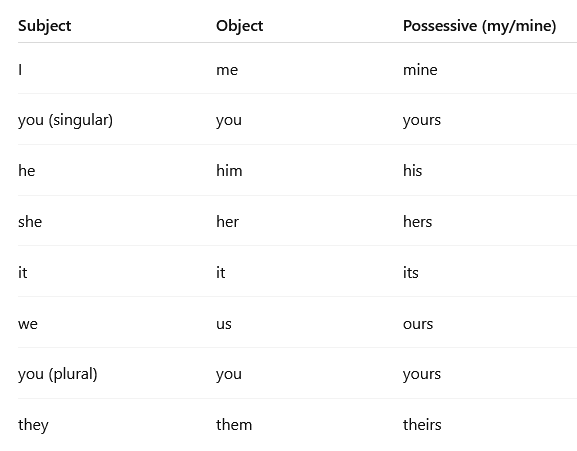
  • Personal pronouns, possessive pronouns, possessive adjectives (A1, beginner, revised version)

    Example Pattern

    • I have a house.
    • It is my house.
    • It is mine.
    • It belongs to me.

    Practice Sentences

    You

    • You have a bike.
    • It is your bike.
    • It is yours.
    • It belongs to you.

    He

    • He has a car.
    • It is his car.
    • It is his.
    • It belongs to him.

    She

    • She has a book.
    • It is her book.
    • It is hers.
    • It belongs to her.

    It

    • It has a tail.
    • It is its tail.
    • The tail is its.
    • It belongs to it.

    We

    • We have a garden.
    • It is our garden.
    • It is ours.
    • It belongs to us.

    They

    • They have a dog.
    • It is their dog.
    • It is theirs.
    • It belongs to them.

    ###################

    • cat – a small animal that people often keep as a pet
    • bag – something you use to carry things
    • shoes – things you wear on your feet
    • room – a part of a house or building with walls and a door
    • ball – a round object used for playing games
    • pen – something you use to write
    • car – a vehicle that people drive
    • hat – something you wear on your head
    • books – objects with pages that you read
    • wallet – a small case for money and cards
    • house – a building where people live
    • dog – an animal often kept as a pet
    • kitchen – a room where people cook food
    • dress – clothes that women or girls wear
    • newspaper – pages with news that people read
    • chair – something you sit on
    • phone – a device for calling or texting people
    • table – furniture with a flat top used for working or eating
    • book – an object with pages that you read


    ###################


    ✏️ Fill in the blanks:

    1. This is _her_ cat. (she)
    2. That is _____ bag. (I)
    3. He is wearing _____ shoes. (he)
    4. We are cleaning _____ room. (we)
    5. They are playing with _____ ball. (they)
    6. This is _____ pen. (you)
    7. That is _____ car. (I)
    8. She loves _____ hat. (she)
    9. They forgot _____ books. (they)
    10. He found _____ wallet. (he)
    11. This is _____ house. (we)
    12. That is _____ dog. (you)
    13. We are cooking in _____ kitchen. (we)
    14. She can’t find _____ dress. (she)
    15. He is reading _____ newspaper. (he)
    16. This is _____ chair. (I)
    17. They are cleaning _____ room. (they)
    18. That is _____ phone. (you)
    19. This is _____ table. (we)
    20. She is holding _____ book. (she)

    _______________
    ✅ Answers:

    1. This is her cat. (she)
    2. That is my bag. (I)
    3. He is wearing his shoes. (he)
    4. We are cleaning our room. (we)
    5. They are playing with their ball. (they)
    6. This is your pen. (you)
    7. That is my car. (I)
    8. She loves her hat. (she)
    9. They forgot their books. (they)
    10. He found his wallet. (he)
    11. This is our house. (we)
    12. That is your dog. (you)
    13. We are cooking in our kitchen. (we)
    14. She can’t find her dress. (she)
    15. He is reading his newspaper. (he)
    16. This is my chair. (I)
    17. They are cleaning their room. (they)
    18. That is your phone. (you)
    19. This is our table. (we)
    20. She is holding her book. (she)

    ###################


    ✏️ Fill in the blanks:

    1. This bag is _hers_ (she).
    2. That pen is ___________ (I).
    3. These shoes are ___________ (he).
    4. This hat is ___________ (you).
    5. That house is ___________ (we).
    6. These books are ___________ (they).
    7. This cat is ___________ (she).
    8. That dog is ___________ (he).
    9. This table is ___________ (I).
    10. Those chairs are ___________ (we).
    11. This phone is ___________ (you).
    12. These keys are ___________ (they).
    13. This dress is ___________ (she).
    14. That wallet is ___________ (he).
    15. This car is ___________ (we).
    16. These cups are ___________ (I).
    17. This bag is ___________ (you).
    18. That ball is ___________ (they).
    19. This book is ___________ (he).
    20. These shoes are ___________ (she).

    —————————–

    Answers:

    1. This bag is hers. (she)
    2. That pen is mine. (I)
    3. These shoes are his. (he)
    4. This hat is yours. (you)
    5. That house is ours. (we)
    6. These books are theirs. (they)
    7. This cat is hers. (she)
    8. That dog is his. (he)
    9. This table is mine. (I)
    10. Those chairs are ours. (we)
    11. This phone is yours. (you)
    12. These keys are theirs. (they)
    13. This dress is hers. (she)
    14. That wallet is his. (he)
    15. This car is ours. (we)
    16. These cups are mine. (I)
    17. This bag is yours. (you)
    18. That ball is theirs. (they)
    19. This book is his. (he)
    20. These shoes are hers. (she)

    ###################


    ✏️ Fill in the blanks;

    1. This is my bag and that is __your__ (you) bag.
    2. This is my pen and that is ________ (he) pen.
    3. This is my book and that is ________ (she) book.
    4. This is my chair and that is ________ (we) chair.
    5. This is my ball and that is ________ (they) ball.
    6. This is your house and that is ________ (I) house.
    7. This is your phone and that is ________ (she) phone.
    8. This is your dog and that is ________ (he) dog.
    9. This is your car and that is ________ (we) car.
    10. This is your table and that is ________ (they) table.
    11. This is his bike and that is ________ (I) bike.
    12. This is his hat and that is ________ (you) hat.
    13. This is his bed and that is ________ (she) bed.
    14. This is her dress and that is ________ (he) dress.
    15. This is her cup and that is ________ (we) cup.
    16. This is her bag and that is ________ (they) bag.
    17. This is our room and that is ________ (you) room.
    18. This is our garden and that is ________ (she) garden.
    19. This is our cat and that is ________ (he) cat.
    20. This is their toy and that is ________ (I) toy.


    Answers:

    1. This is my bag and that is your (you) bag.
    2. This is my pen and that is his (he) pen.
    3. This is my book and that is her (she) book.
    4. This is my chair and that is our (we) chair.
    5. This is my ball and that is their (they) ball.
    6. This is your house and that is my (I) house.
    7. This is your phone and that is her (she) phone.
    8. This is your dog and that is his (he) dog.
    9. This is your car and that is our (we) car.
    10. This is your table and that is their (they) table.
    11. This is his bike and that is my (I) bike.
    12. This is his hat and that is your (you) hat.
    13. This is his bed and that is her (she) bed.
    14. This is her dress and that is his (he) dress.
    15. This is her cup and that is our (we) cup.
    16. This is her bag and that is their (they) bag.
    17. This is our room and that is your (you) room.
    18. This is our garden and that is her (she) garden.
    19. This is our cat and that is his (he) cat.
    20. This is their toy and that is my (I) toy.

    ###############


    ✏️ Fill in the blanks with the correct possessive pronoun

    1. This is my bag, it is _mine_ (I).
    2. This is your pen, it is __________ (you).
    3. This is his book, it is __________ (he).
    4. This is her chair, it is __________ (she).
    5. This is our ball, it is __________ (we).
    6. This is their house, it is __________ (they).
    7. This is my phone, it is __________ (I).
    8. This is your dog, it is __________ (you).
    9. This is his car, it is __________ (he).
    10. This is her cup, it is __________ (she).
    11. This is our table, it is __________ (we).
    12. This is their bike, it is __________ (they).
    13. This is my hat, it is __________ (I).
    14. This is your bag, it is __________ (you).
    15. This is his bed, it is __________ (he).
    16. This is her dress, it is __________ (she).
    17. This is our room, it is __________ (we).
    18. This is their cat, it is __________ (they).
    19. This is my shoes, it is __________ (I).
    20. This is your toy, it is __________ (you).

    ———————–


    Answers :

    1. This is my bag, it is mine (I).
    2. This is your pen, it is yours (you).
    3. This is his book, it is his (he).
    4. This is her chair, it is hers (she).
    5. This is our ball, it is ours (we).
    6. This is their house, it is theirs (they).
    7. This is my phone, it is mine (I).
    8. This is your dog, it is yours (you).
    9. This is his car, it is his (he).
    10. This is her cup, it is hers (she).
    11. This is our table, it is ours (we).
    12. This is their bike, it is theirs (they).
    13. This is my hat, it is mine (I).
    14. This is your bag, it is yours (you).
    15. This is his bed, it is his (he).
    16. This is her dress, it is hers (she).
    17. This is our room, it is ours (we).
    18. This is their cat, it is theirs (they).
    19. This is my shoes, it is mine (I).
    20. This is your toy, it is yours (you).

    ####################


    ✏️ Fill in the blanks

    1. This is _my_ (I) bag. It belongs to _me_ (I). It is not _theirs_ (they).
    2. This is _______ (you) pen. It belongs to _______ (you). It is not _______ (he).
    3. This is _______ (he) book. It belongs to _______ (he). It is not _______ (she).
    4. This is _______ (she) chair. It belongs to _______ (she). It is not _______ (we).
    5. This is _______ (we) ball. It belongs to _______ (we). It is not _______ (they).
    6. This is _______ (they) house. It belongs to _______ (they). It is not _______ (I).
    7. This is _______ (I) phone. It belongs to _______ (I). It is not _______ (you).
    8. This is _______ (you) dog. It belongs to _______ (you). It is not _______ (he).
    9. This is _______ (he) car. It belongs to _______ (he). It is not _______ (she).
    10. This is _______ (she) cup. It belongs to _______ (she). It is not _______ (we).
    11. This is _______ (we) table. It belongs to _______ (we). It is not _______ (they).
    12. This is _______ (they) bike. It belongs to _______ (they). It is not _______ (I).
    13. This is _______ (I) hat. It belongs to _______ (I). It is not _______ (you).
    14. This is _______ (you) bag. It belongs to _______ (you). It is not _______ (he).
    15. This is _______ (he) bed. It belongs to _______ (he). It is not _______ (she).
    16. This is _______ (she) dress. It belongs to _______ (she). It is not _______ (we).
    17. This is _______ (we) room. It belongs to _______ (we). It is not _______ (they).
    18. This is _______ (they) cat. It belongs to _______ (they). It is not _______ (I).
    19. These are _______ (I) shoes. They belong to _______ (I). They are not _______ (you).
    20. This is _______ (you) toy. It belongs to _______ (you). It is not _______ (he).

    ————————


    ✅ Answers:

    This is my bag. It belongs to me. It is not theirs.

    This is your pen. It belongs to you. It is not his.

    This is his book. It belongs to him. It is not hers.

    This is her chair. It belongs to her. It is not ours.

    This is our ball. It belongs to us. It is not theirs.

    This is their house. It belongs to them. It is not mine.

    This is my phone. It belongs to me. It is not yours.

    This is your dog. It belongs to you. It is not his.

    This is his car. It belongs to him. It is not hers.

    This is her cup. It belongs to her. It is not ours.

    This is our table. It belongs to us. It is not theirs.

    This is their bike. It belongs to them. It is not mine.

    This is my hat. It belongs to me. It is not yours.

    This is your bag. It belongs to you. It is not his.

    This is his bed. It belongs to him. It is not hers.

    This is her dress. It belongs to her. It is not ours.

    This is our room. It belongs to us. It is not theirs.

    This is their cat. It belongs to them. It is not mine.

    These are my shoes. They belong to me. They are not yours.

    This is your toy. It belongs to you. It is not his.

    ##################


    ✏️ Fill in the blanks

    1. This is not _my_ (I) bag. It belongs to _them_ (they). It is not _mine_ (I), but _theirs_ (they).
    2. This is not ______ (you) pen. It belongs to ______ (he). It is not ______ (you), but ______ (he).
    3. This is not ______ (he) book. It belongs to ______ (she). It is not ______ (he), but ______ (she).
    4. This is not ______ (she) chair. It belongs to ______ (we). It is not ______ (she), but ______ (we).
    5. This is not ______ (we) ball. It belongs to ______ (they). It is not ______ (we), but ______ (they).
    6. This is not ______ (they) house. It belongs to ______ (I). It is not ______ (they), but ______ (I).
    7. This is not ______ (I) phone. It belongs to ______ (you). It is not ______ (I), but ______ (you).
    8. This is not ______ (you) dog. It belongs to ______ (he). It is not ______ (you), but ______ (he).
    9. This is not ______ (he) car. It belongs to ______ (she). It is not ______ (he), but ______ (she).
    10. This is not ______ (she) cup. It belongs to ______ (we). It is not ______ (she), but ______ (we).
    11. This is not ______ (we) table. It belongs to ______ (they). It is not ______ (we), but ______ (they).
    12. This is not ______ (they) bike. It belongs to ______ (I). It is not ______ (they), but ______ (I).
    13. This is not ______ (I) hat. It belongs to ______ (you). It is not ______ (I), but ______ (you).
    14. This is not ______ (you) bag. It belongs to ______ (he). It is not ______ (you), but ______ (he).
    15. This is not ______ (he) bed. It belongs to ______ (she). It is not ______ (he), but ______ (she).
    16. This is not ______ (she) dress. It belongs to ______ (we). It is not ______ (she), but ______ (we).
    17. This is not ______ (we) room. It belongs to ______ (they). It is not ______ (we), but ______ (they).
    18. This is not ______ (they) cat. It belongs to ______ (I). It is not ______ (they), but ______ (I).
    19. This is not ______ (I) phone. It belongs to ______ (you). It is not ______ (I), but ______ (you).
    20. This is not ______ (you) toy. It belongs to ______ (he). It is not ______ (you), but ______ (he).


    —————————–
    Answers:


    1. This is not my bag. It belongs to them. It is not mine, but theirs.
    2. This is not your pen. It belongs to him. It is not yours, but his.
    3. This is not his book. It belongs to her. It is not his, but hers.
    4. This is not her chair. It belongs to us. It is not hers, but ours.
    5. This is not our ball. It belongs to them. It is not ours, but theirs.
    6. This is not their house. It belongs to me. It is not theirs, but mine.
    7. This is not my phone. It belongs to you. It is not mine, but yours.
    8. This is not your dog. It belongs to him. It is not yours, but his.
    9. This is not his car. It belongs to her. It is not his, but hers.
    10. This is not her cup. It belongs to us. It is not hers, but ours.
    11. This is not our table. It belongs to them. It is not ours, but theirs.
    12. This is not their bike. It belongs to me. It is not theirs, but mine.
    13. This is not my hat. It belongs to you. It is not mine, but yours.
    14. This is not your bag. It belongs to him. It is not yours, but his.
    15. This is not his bed. It belongs to her. It is not his, but hers.
    16. This is not her dress. It belongs to us. It is not hers, but ours.
    17. This is not our room. It belongs to them. It is not ours, but theirs.
    18. This is not their cat. It belongs to me. It is not theirs, but mine.
    19. This is not my phone. It belongs to you. It is not mine, but yours.
    20. This is not your toy. It belongs to him. It is not yours, but his.

    #################

  • Anna’s schoolday in winter (A1, present simple, listening comprehension, 12)

    listen carefully, then answer questions


    ################


    True or false?

    1. She wears jeans and a red T-shirt to school in winter.
    2. Anna drinks tea for breakfast.
    3. Anna wakes up at seven o’clock.
    4. She takes the bus to school every day.
    5. School starts at eight thirty..
    6. In the morning, Anna has English, math, and science.
    7. At midday, she eats lunch in the school canteen.
    8. Anna always eats lunch at home.
    9. In the afternoon, she has history and art.
    10. Anna does not like art class.
    11. School finishes at three o’clock.
    12. At home, she does her homework.
    13. In the evening, Anna eats dinner with her parents.
    14. After dinner, she sometimes watches TV.
    15. Anna goes to bed at ten o’clock.
    16. She wears a warm coat, scarf, and gloves in winter.

    Answer key
    1 F, 2 T, 3 T, 4 F, 5 F, 6 T, 7 T, 8 F, 9 T, 10 F, 11 T, 12 T, 13 T, 14 T, 15 F, 16 T
    __________________________

    What are Anna’s activities at:

    7:00:________________________

    8:00:________________________

    12:00:________________________

    15:00:________________________

    21:00:________________________

    7:00 = 7 o’clock……….

    Answers:

    #################


    Listen again to the text, choose the correct answer (a, b, or c).


    1. What time does Anna wake up?
      a) 7:00
      b) 6:30
      c) 8:00
    2. What does Anna eat for breakfast?
      a) Sandwich and juice
      b) Cereal and milk
      c) Bread and tea
    3. What does she wear to school in winter?
      a) Shorts and a T-shirt
      b) Jeans and a jacket
      c) Warm school uniform, coat, scarf, gloves
    4. How does Anna go to school?
      a) Walks
      b) Rides a bike
      c) Takes the bus
    5. What time does school start?
      a) 9:00
      b) 8:00
      c) 7:30
    6. What lessons does Anna have in the morning?
      a) Music and sports
      b) History and art
      c) English, math, science
    7. Where does Anna eat lunch?
      a) In a café outside
      b) In the school canteen
      c) At home
    8. What does Anna do after school?
      a) Does homework at home
      b) Plays outside
      c) Watches TV all the time
    9. What lessons does she have in the afternoon?
      a) Art and history
      b) English and math
      c) Music and PE
    10. What does she do in the evening after dinner?
      a) Plays football outside
      b) Watches TV or talks with her mother
      c) Goes to bed immediately
    11. What food does Anna often eat for dinner?
      a) Soup, rice, and vegetables
      b) Pizza and soda
      c) Sandwiches and juice
    12. What time does Anna go to bed?
      a) 20:00
      b) 22:00
      c) 21:00

    Answers:

    1 a, 2 c, 3 c, 4 a, 5 b, 6 c, 7 b, 8 a, 9 a, 10 b, 11 a, 12 c


    #################

    Listen again, and then fill in:

    Anna __________ at seven o’clock.

    She wears her warm school uniform, __________, scarf, and gloves.

    She eats bread and tea for __________ and walks to school.

    School starts at eight o’clock with English, math, and ___________.

    At midday, she eats lunch in the school __________.

    In the afternoon, she has _________ and art, which she enjoys.

    School finishes at __________ o’clock.

    At home, Anna does her __________.

    In the evening, she __________ dinner with her parents and sometimes __________ TV.

    She goes to __________ at nine o’clock.

    —————————————-

    Listen again

    Anna wakes up at seven o’clock.
    She wears her warm school uniform, coat, scarf, and gloves.
    She eats bread and tea for breakfast and walks to school.
    School starts at eight o’clock with English, math, and science.
    At midday, she eats lunch in the school canteen.
    In the afternoon, she has history and art, which she enjoys.
    School finishes at three o’clock.
    At home, Anna does her homework.
    In the evening, she eats dinner with her parents and sometimes watches TV.
    She goes to bed at nine o’clock.

    #################

    #################

    #################

    Anna’s Winter School Day

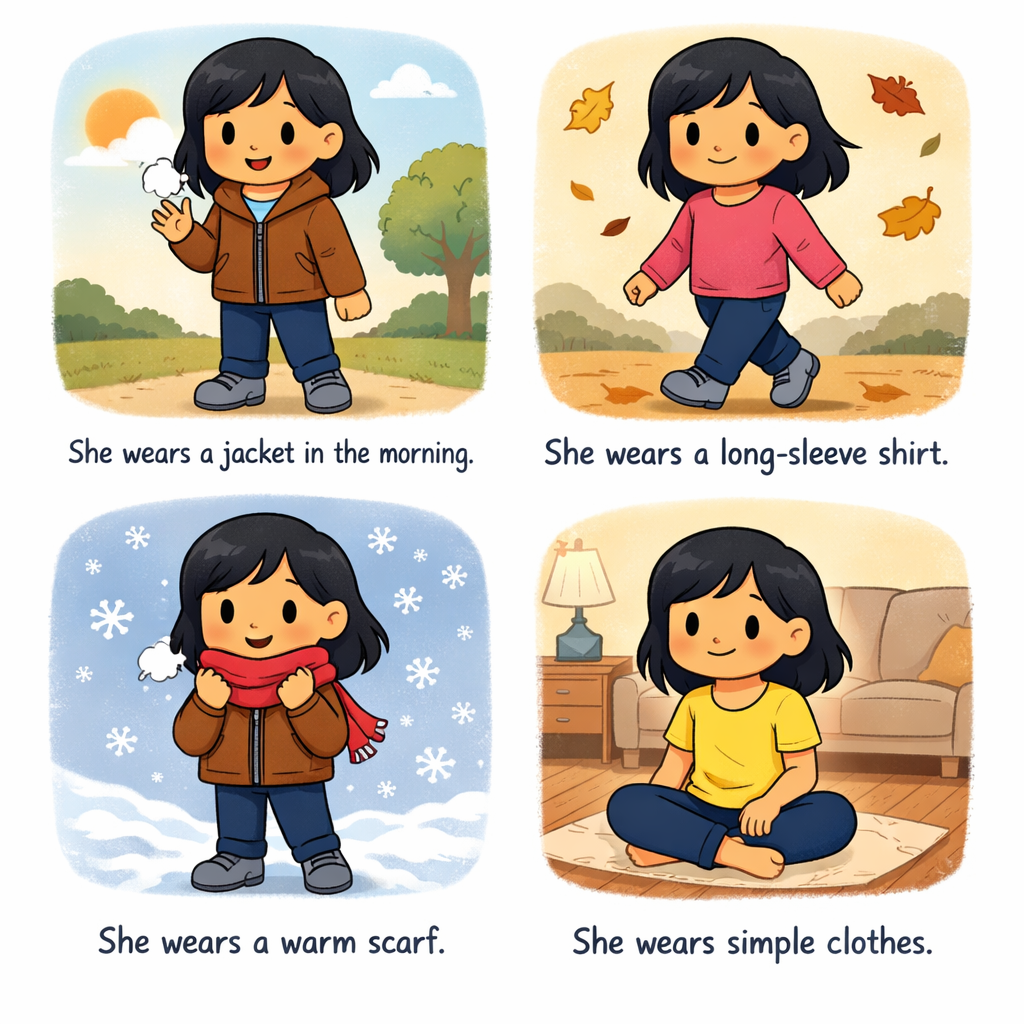
    Anna is a student. In winter, her school day starts early. She wakes up at seven o’clock. It is cold outside, so she puts on her warm school uniform: a white shirt, a blue sweater, and a dark skirt. She also wears a coat, scarf, and gloves.

    At half past seven, Anna eats breakfast with her family. She usually has bread and tea. Then she walks to school. The streets are sometimes snowy, and Anna likes the white trees.

    School starts at eight o’clock. In the morning, Anna has English, math, and science. At midday, she eats lunch in the school canteen. In the afternoon, she has history and art. Anna enjoys drawing in art class.

    At three o’clock, school finishes. Anna goes home and does her homework. She writes in her notebook and reads a book for English.

    In the evening, Anna has dinner with her parents. They often eat soup, rice, and vegetables. After dinner, she sometimes watches TV or talks with her mother.

    At nine o’clock, Anna goes to bed. She feels tired after her school day. Outside, the winter night is cold, but Anna is warm in her bed.

    #################

    #################
  • Why English is cool (A1, beginner)

    Easy reasons to learn English every day

    English is important because it is used in many countries.
    People use English to talk, travel, and work.
    Learning English helps you meet new friends from other countries.
    You can watch movies, listen to songs, and read books in English.
    English is also useful for the internet, schools, and jobs.
    Many companies want people who can speak English.
    If you know English, you can understand more and communicate better.
    It opens new chances for learning and work.
    English is easy to start, and with practice, you can speak and understand it better every day.
    ________________________
    Vocabulary:

    • to be cool – to be nice, fun, or popular
    • to be important – to matter, to be needed
    • a country – a place with its own people, land, and rules
    • to talk – to use words to speak with someone
    • to travel – to go to different places
    • to work – to do a job
    • to meet friends – to see and talk with friends
    • to watch a movie – to see a story on a screen
    • to listen to a song – to hear music and words
    • to read a book – to look at words in a book and understand them
    • to be useful – to help you, to be good for something
    • a company – a business where people work
    • people (in a company) – the workers in a company
    • to understand – to know the meaning of something
    • to communicate – to share ideas or talk with someone
    • to open a chance – to make a new opportunity possible
    • with practice – by doing something many times to get better

    #################
    Multiple-choice test, one answer correct:


    1. What does “to be cool” mean?
    a) to be nice, fun, or popular
    b) to be tired
    c) to be old

    2. What does “to be important” mean?
    a) to be small
    b) to matter, to be needed
    c) to be fast

    3. What is “a country”?
    a) a place with its own people, land, and rules
    b) a type of food
    c) a small toy

    4. What does “to talk” mean?
    a) to run fast
    b) to use words to speak with someone
    c) to sleep

    5. What does “to travel” mean?
    a) to stay at home
    b) to go to different places
    c) to eat a lot

    6. What does “to work” mean?
    a) to sleep
    b) to play
    c) to do a job

    7. What does “to meet friends” mean?
    a) to eat food alone
    b) to see and talk with friends
    c) to read a book

    8. What does “to watch a movie” mean?
    a) to see a story on a screen
    b) to listen to music
    c) to draw

    9. What does “to listen to a song” mean?
    a) to sleep
    b) to hear music and words
    c) to write

    10. What does “to read a book” mean?
    a) to talk
    b) to look at words in a book and understand them
    c) to listen to a song

    11. What does “to be useful” mean?
    a) to help you, to be good for something
    b) to be boring
    c) to be expensive

    12. What is “a company”?
    a) a place to sleep
    b) a school
    c) a business where people work

    13. Who are people (in a company)?
    a) children at school
    b) animals
    c) the workers in a company

    14. What does “to understand” mean?
    a) to forget
    b) to run
    c) to know the meaning of something

    15. What does “to communicate” mean?
    a) to eat
    b) to sleep
    c) to share ideas or talk with someone

    16. What does “to open a chance” mean?
    a) to close a door
    b) to watch TV
    c) to make a new opportunity possible


    ✅ Correct answers:
    1-a, 2-b, 3-a, 4-b, 5-b, 6-c, 7-b,
    8-a, 9-b, 10-b, 11-a, 12-c,
    13-c, 14-c, 15-c, 16-c


    #######################

    Gap fill exercise, one answer correct:

    1. I like to ______ my friends after school.
      a) read a book
      b) talk to
      c) travel
    2. She wants to ______ to different countries next summer.
      a) work
      b) travel
      c) listen to a song
    3. Tom is very ______. Everyone likes him.
      a) cool
      b) useful
      c) important
    4. We can ______ a movie on TV tonight.
      a) watch
      b) talk to
      c) read
    5. John wants to ______ a new book in English.
      a) meet
      b) listen
      c) read
    6. Learning English is ______ for school and jobs.
      a) cool
      b) travel
      c) important
    7. A company is a place where many ______ work.
      a) people
      b) countries
      c) songs
    8. I like to ______ to music when I am happy.
      a) listen
      b) travel
      c) talk to
    9. We can ______ new friends at school.
      a) watch
      b) understand
      c) meet
    10. If you practice every day, you can ______ English better.
      a) understand
      b) travel
      c) be cool
    11. Speaking English helps you ______ with people in other countries.
      a) read
      b) work
      c) communicate
    12. Learning a language can ______ new chances for learning and work.
      a) open
      b) meet
      c) listen

    Answer Key (Balanced):
    1-b, 2-b, 3-a, 4-a, 5-c, 6-c, 7-a, 8-a, 9-c, 10-a, 11-c, 12-a

    _________________________


    1. I like to talk to my friends after school.
    2. She wants to travel to different countries next summer.
    3. Tom is very cool. Everyone likes him.
    4. We can watch a movie on TV tonight.
    5. John wants to read a new book in English.
    6. Learning English is important for school and jobs.
    7. A company is a place where many people work.
    8. I like to listen to music when I am happy.
    9. We can meet new friends at school.
    10. If you practice every day, you can understand English better.
    11. Speaking English helps you communicate with people in other countries.
    12. Learning a language can open new chances for learning and work.

    #####################

    Match the words with the correct meaning:

    Words

    1. to travel
    2. to work
    3. to meet friends
    4. to watch a movie
    5. to listen to a song
    6. to read a book
    7. to be important
    8. a country
    9. a company
    10. to understand

    Definitions:
    a) to see and talk with friends
    b) to go to different places
    c) a place with its own people, land, and rules
    d) to do a job
    e) to look at words in a book and know the meaning
    f) to know the meaning of something
    g) a business where people work
    h) to be needed, to matter
    i) to hear music and words
    j) to see a story on a screen

    ______________________________


    Answer Key:
    1-b, 2-d, 3-a, 4-j, 5-i, 6-e, 7-h, 8-c, 9-g, 10-f


    #######################


    True or False?

    1. English is useful for school and jobs.
    2. You can use English only for eating.
    3. Many companies want people who speak English.
    4. If you know English, you can understand more.
    5. English is spoken in only one country.
    6. You cannot watch movies in English.
    7. English is not good for travel.
    8. Learning English helps you meet new friends.
    9. English is easy, and with practice, you get better.
    10. People never use English to work.
    11. English opens new chances for learning and work.
    12. People use English to talk and travel.

    Answers:
    1-True, 2-False, 3-True, 4-True, 5-False, 6-False, 7-False, 8-True, 9-True, 10-False, 11-True, 12-True


    ####################

    Find the words in the text – which phrase are we looking for?


    ________________________________
    Correct words:
    important
    meet
    friends
    better
    know
    internet
    songs
    watch
    schools
    countries
    ________________________________

    Cloze story

    Fill in the blanks with the correct words from the box:

    Word box:
    travel, work, friends, watch, listen, read, important, country, understand, communicate


    Hello! My name is Anna. I like to ______ to different places. I also like to meet new ______.

    Every day, I ______ a book in English to learn new words. I also ______ to songs and ______ movies.

    English is very ______. It helps me to ______ with people from other countries. I can also ______ more in school and at my ______.

    Learning English is fun and with practice, I can ______ better every day.


    Answer Key:

    1. travel
    2. friends
    3. read
    4. listen
    5. watch
    6. important
    7. communicate
    8. understand
    9. work
    10. understand


    ##################


    Cloze story – fill in:


    cool, important, company, watch, talk to, be useful, listen, meet, travel, understand


    Hello! My name is Sara. My English teacher says it is very ______ to learn English.

    I like to ______ my classmates after school. They are very ______, and we have fun together.

    On the weekend, I like to ______ a movie or ______ to music.

    English can ______ me at work in a big ______. I can also ______ new people when I ______ to other countries.

    With practice, I can ______ more and speak better every day.


    Answer Key:

    1. important
    2. talk to
    3. cool
    4. watch
    5. listen
    6. be useful
    7. company
    8. meet
    9. travel
    10. understand

  • Von der Volksschule ins Gymnasium – neues Spiel, neues Glück 😉

    • Tipps

    Der Übergang von der Volksschule in eine weiterführende Schule wie das Gymnasium ist eine der bedeutendsten Veränderungen in der Schullaufbahn. Hier ist eine extrem ausführliche und detaillierte Anleitung, wie man diese Herausforderung meistern und von Beginn an erfolgreich sein kann.

    Phase 1: Die Vorbereitung (Noch vor dem ersten Schultag)

    • Materialcheck:
      • Besorge nicht nur die Grundausstattung, sondern denke an die Details: einen hochwertigen Taschenrechner (evtl. mit Ersatzbatterien), einen robusten, übersichtlichen Jahresplaner (nicht nur ein Heft), verschiedenfarbige Stifte zum Markieren, Textmarker in mehreren Farben, Post-it-Zettel für Notizen, einen Locher und einen Tacker für die Ordnerführung.
      • Richte für jedes Fach einen eigenen, farblich gekennzeichneten Ordner (z.B. Blau für Mathematik, Grün für Deutsch) mit Registerkarten ein. Die Kategorien könnten sein: „Unterrichtsnotizen“, „Arbeitsblätter“, „Tests & Klausuren“, „Eigene Zusammenfassungen“.
    • Mentaler Check:
      • Sprich mit älteren Schülern oder Geschwistern. Frage sie nach ihren Erfahrungen: Was war die größte Umstellung? Was würden sie anders machen?
      • Mache dir bewusst, dass Fehler und anfängliche Unsicherheit absolut normal und erwartet sind. Niemand erwartet, dass du vom ersten Tag an alles perfekt beherrschst.
      • Sieh die neue Schule als Chance: Neue Freunde, neue Interessen, neue Fächer und die Möglichkeit, deine Persönlichkeit weiterzuentwickeln.


    Phase 2: Organisation & System – Das Fundament deines Erfolgs

    • Der Planer (Dein Kommandostand):
      • Trage nicht nur Hausaufgaben ein, sondern auch die voraussichtlichen Termine für Tests und große Projekte, sobald sie angekündigt werden.
      • Nutze ihn für langfristige Planung. Siehst du, dass in einer Woche drei Tests anstehen, musst du die Lernzeit bereits in der Vorwoche einplanen.
      • Schreibe auch private Termine (Sport, Geburtstage) hinein, um Überschneidungen und Überlastung zu vermeiden.
    • Das perfekte Heft/Der perfekte Ordner:
      • Mitschrift-Techniken: Lerne, nicht jedes Wort des Lehrers mitzuschreiben. Entwickle Abkürzungen und eigene Symbole (z.B. „→“ für „führt zu“, „⚡“ für „wichtig“). Schreibe Stichpunkte, nicht ganze Sätze.
      • Struktur: Lasse nach jeder Stunde eine Zeile frei und beginne die nächste Stunde mit einem neuen Datum. So behältst du die Übersicht.
      • Korrekturen: Hebe Fehler in Tests und Hausaufgaben farbig hervor und notiere dir daneben die richtige Lösung. Diese Fehler sind deine persönliche Lernkartei für die nächste Prüfung.
    • Die Schultasche:
      • Entwickle eine Routine: Jeden Abend, nachdem die Hausaufgaben erledigt sind, wird die Tasche für den nächsten Tag gepackt. Der Stundenplan ist deine Checkliste.
      • Halte die Tasche sauber! Räume sie einmal pro Woche komplett aus und entsorge unnötigen Müll.


    Phase 3: Lernstrategien & Wissensmanagement – Vom Auswendiglernen zum Verstehen

    • Die Hausaufgaben:
      • Ort & Zeit: Suche dir einen festen, ruhigen Arbeitsplatz ohne Ablenkungen (Handy weg!). Fange jeden Tag zur ähnlichen Zeit an. Die „Pomodoro-Technik“ (25 Min. konzentriert arbeiten, 5 Min. Pause) kann Wunder wirken.
      • Priorisierung: Erledige zuerst die schwierigen oder unangenehmen Aufgaben („Eat the frog first“). So hast du danach ein Erfolgserlebnis und mehr Motivation für den Rest.
    • Aktives vs. Passives Lernen:
      • Passiv (ineffektiv): Einfaches Durchlesen des Stoffs, Markieren ohne System.
      • Aktiv (extrem effektiv):
        • Selbsterklärung: Erkläre den Stoff laut, als wärst du der Lehrer. Nutze eine Whiteboard oder einfach ein Blatt Papier.
        • Karteikarten (digital oder analog): Perfekt für Vokabeln, Formeln, Definitionen und Jahreszahlen. Apps wie Anki oder Quizlet nutzen spaced repetition, um den Stoff im Langzeitgedächtnis zu verankern.
        • Zusammenfassungen schreiben: Fasse den Stoff in deinen eigenen Worten zusammen. Das zwingt dich, ihn zu durchdringen.
        • Übungsaufgaben: Besorge dir zusätzliche Übungsbücher oder finde Aufgaben online. Anwendung ist der beste Weg zum Verständnis.
    • Vorbereitung auf Leistungsnachweise:
      • Früh anfangen: Beginne mindestens eine Woche vor einem Test mit der intensiven Vorbereitung.
      • Lernplan erstellen: Teile den Stoff in Portionen auf und weise jedem Tag ein Thema zu. Der letzte Tag vor dem Test ist nur für Wiederholung reserviert.
      • Alte Tests durchgehen: Wenn möglich, löse alte Prüfungen unter Zeitdruck, um ein Gefühl für die Fragestellungen zu bekommen.


    Phase 4: Soziales & Verhalten – Die Kunst des Miteinanders

    • Umgang mit Mitschülern:
      • Initiative zeigen: Gehe auf andere zu. Stelle Fragen („Was hattet ihr denn in Mathe auf?“). Ein Lächeln und Augenkontakt wirken Wunder.
      • Gruppenarbeit: Sei ein verlässlicher Partner. Erledige deine Teile der Arbeit termingerecht und zuverlässig. Bringe dich konstruktiv ein, höre anderen aber auch zu.
      • Mobbing: Sei kein Zuschauer. Wenn du mitbekommst, dass jemand gemobbt wird, suche das Gespräch mit dem Betroffenen und wende dich an eine Vertrauensperson (Klassenlehrer, Schulpsychologen).
    • Umgang mit Lehrpersonen:
      • Respektvolles Auftreten: Pünktlichkeit, Aufmerksamkeit im Unterricht und Höflichkeit (Siezen!) sind die Grundlage.
      • Sprechstunden nutzen: Das ist deine Chance! Gehe hin, wenn du etwas nicht verstehst, Fragen zu einer Note hast oder Feedback zu deiner Leistung möchtest. Das zeigt großes Engagement.
      • Ehrlichkeit wahren: Eine vergessene Hausaufgabe einzuräumen und nachzureichen ist immer besser, als sich eine lahme Ausrede auszudenken.


    Phase 5: Work-Life-Balance & Gesundheit

    • Pausen und Erholung: Dein Gehirn braucht Pausen, um Gelerntes zu verarbeiten. Plane bewusst freie Zeit ein, in der du nicht an die Schule denkst.
    • Schlafhygiene: Schlaf ist nicht verhandelbar. 8-9 Stunden qualitativer Schlaf sind essentiell für Konzentration, Gedächtnis und psychische Gesundheit. Vermeide Bildschirme mindestens eine Stunde vor dem Schlafengehen.
    • Ernährung und Bewegung: Ein gesundes Frühstück und ausreichend Wasser trinken während der Schule halten dein Energielevel hoch. Sport und Bewegung bauen Stress ab und sorgen für einen klaren Kopf.
    • Digital Detox: Lege feste Zeiten fest, in denen das Handy aus oder in einem anderen Raum ist – besonders während der Lernphasen. Benutze es nicht als Ablenkung in kurzen Pausen.


    Phase 6: Mindset & Einstellung

    • Growth Mindset: Verabschiede dich vom Gedanken „Darin bin ich einfach schlecht“. Denke stattdessen: „Noch habe ich es nicht verstanden, aber ich kann es lernen.“ Herausforderungen sind Chancen zu wachsen.
    • Fehlerkultur: Siehe Fehler nicht als Niederlage, sondern als die wertvollste Feedback-Methode. Sie zeigen dir genau, wo du noch Schwächen hast und was du verbessern musst.
    • Hilfe annehmen: Du musst nicht alles alleine schaffen. Suche dir Hilfe bei Lehrern, Mitschülern, älteren Geschwistern oder Nachhilfelehrern, wenn du merkst, dass du in einem Fach den Anschluss verlierst. Das ist ein Zeichen von Stärke, nicht von Schwäche.


    Diese Umstellung erfordert Zeit und Geduld. Probiere die verschiedenen Tipps aus und finde das System, das perfekt für dich funktioniert. Viel Erfolg auf deiner neuen spannenden Reise!

  • Was sind Unterschiede zwischen Volksschule und Gymnasium?

    Ein paar Gedanken

    Die Unterschiede zwischen Volksschule und Gymnasium sind beträchtlich und betreffen nicht nur den Lernstoff, sondern die gesamte Art zu lernen.


    ### 1. Fächer und Fachlehrer:in

    * **Volksschule:** Meistens unterrichtet eine Klassenlehrerin oder ein Klassenlehrer den Großteil der Fächer. Die Kinder haben eine feste Bezugsperson.

    * **Gymnasium:** Für jedes Fach gibt es eine eigene, spezialisierte Lehrkraft. Das bedeutet, dass man an einem Tag viele verschiedene Lehrer:innen sieht. Man muss sich daran gewöhnen, dass jede:r Lehrer:in andere Methoden, Regeln und Erwartungen hat.

    ### 2. Stoffumfang und Tempo

    * **Volksschule:** Der Stoff wird oft gemeinsam und in einem langsameren Tempo erarbeitet. Es wird viel Wert auf Wiederholung und Festigung gelegt.

    * **Gymnasium:** Das Tempo ist deutlich höher. Es wird mehr Stoff in kürzerer Zeit durchgenommen. Von den Schüler:innen wird erwartet, dass sie dem Unterricht folgen können und sich auch selbstständig neues Wissen aneignen.

    ### 3. Anforderungen an die Selbstständigkeit

    Das ist einer der größten Unterschiede:
    * **Volksschule:** Die Hausaufgaben werden oft gemeinsam besprochen und kontrolliert. Die Lehrer:innen erinnern aktiv an anstehende Tests.

    * **Gymnasium:** Die Schüler:innen sind selbst für ihre Organisation verantwortlich. Sie müssen sich ihren Lernstoff eigenständig einteilen, Hausaufgaben ohne ständige Erinnerung erledigen und sich rechtzeitig auf Tests und Schularbeiten vorbereiten. Ein Hausaufgabenheft oder Planner wird unverzichtbar!

    ### 4. Arbeitsweise und Denken

    * **Volksschule:** Der Fokus liegt oft auf dem **Wissen** und **Verstehen**: „Was ist passiert?“

    * **Gymnasium:** Der Fokus verschiebt sich zum **Analysieren**, **Interpretieren** und **Bewerten**: „Warum ist es passiert?“, „Welche Folgen hatte das?“, „Wie bewerte ich das?“. In Deutsch liest man nicht nur Geschichten, sondern interpretiert sie. In Geschichte lernt man nicht nur Daten, sondern diskutiert über Ursachen und Zusammenhänge.


    ### 5. Leistungsdruck und Noten

    * **Volksschule:** Die Noten sind oft noch etwas großzügiger, und der Druck hält sich in Grenzen.

    * **Gymnasium:** Die Bewertung ist strenger und objektiver. Es gibt mehr Tests und Schularbeiten, die einen größeren Stoffumfang abdecken. Die Noten sind für den weiteren Bildungsweg (z.B. Matura) entscheidend, was den Druck erhöhen kann.

    ### 6. Neue Fächer

    Am Gymnasium kommen viele neue, anspruchsvolle Fächer dazu, die es so in der Volksschule nicht gab:

    * **Zweite Lebende Fremdsprache** (meist Französisch, Italienisch oder Spanisch)
    * **Physik, Chemie, Biologie** werden als eigene Fächer unterrichtet (statt nur „Sachunterricht“)
    * **Geographie** und **Geschichte** werden getrennt und viel detailreicher unterrichtet.
    * **Informatik** oder **Philosophie** können dazukommen.

    ### 7. Soziales Umfeld

    * **Volksschule:** Die Klasse besteht meist aus Kindern aus dem direkten Wohnumfeld.

    * **Gymnasium:** Die Kinder kommen aus der gesamten Stadt oder dem gesamten Bezirk. Es ist eine Chance, viele neue Freund:innen mit unterschiedlichen Hintergründen kennenzulernen, erfordert aber auch, sich in einer neuen, größeren Gruppe zurechtzufinden.

    ### Tipps für den Start im Gymnasium:

    * **Organisation ist alles:** Besorge dir einen Kalender oder nutze eine App, um alle Termine, Hausaufgaben und Tests im Blick zu behalten.
    * **Trau dich, Fragen zu stellen:** Alle anderen sind auch neu und haben die gleichen Fragen.
    * **Finde eine Lerngruppe:** Gemeinsam mit anderen zu lernen, macht nicht nur mehr Spaß, sondern hilft auch, den Stoff besser zu verstehen.
    * **Scheu dich nicht, um Hilfe zu bitten:** Wenn es in einem Fach hakt, sprich frühzeitig mit der Lehrkraft oder den Eltern. Nachhilfe ist keine Schande, sondern zeigt Verantwortungsbewusstsein.
    * **Nicht den Mut verlieren:** Die ersten Noten sind vielleicht schlechter als in der Volksschule. Das ist normal! Man muss sich erst an das neue System und die neuen Anforderungen gewöhnen.


    Der Wechsel ist eine große Veränderung, aber auch eine fantastische Chance, Neues zu lernen und zu entdecken.

    Viel Erfolg für den Start!

    Anmerkung:
    Das Wort „Gymnasium“ stammt aus dem Griechischen „gymnasion“ (γυμνάσιον), was „Schule“ oder „Übungsplatz“ bedeutet.
    Es leitet sich von „gymnos“ (γυμνός), was „nackt“ heißt, ab, da in der Antike die körperlichen Übungen oft ohne Kleidung durchgeführt wurden. Ursprünglich war ein Gymnasium in der griechischen Kultur ein Ort für körperliche Ausbildung und sportliche Aktivitäten, wie sie in den Olympischen Spielen üblich waren.
    Im Laufe der Zeit entwickelte sich der Begriff weiter. In der hellenistischen und römischen Ära wurde das Gymnasium auch ein Ort für geistige Bildung, insbesondere für die Oberschicht.
    Im modernen deutschen Sprachgebrauch bezeichnet „Gymnasium“ eine bestimmte Art von Schule, die auf eine akademische Ausbildung und den Hochschulzugang (Matura) ausgerichtet ist.
    Der Begriff wurde im 16. Jahrhundert in Europa, besonders durch die Humanisten, wiederbelebt, um Schulen zu beschreiben, die sich an den antiken Bildungsidealen orientierten.

    *********************************


    *********************************

    Summary in English (A1)

    School Changes: New School, New Rules

    Soon, you will start a new school called Gymnasium. It is different from your old school.

    First, you will have a new teacher for every subject. You will meet many teachers in one day.

    Second, you must be more organized. You need to remember your homework and tests by yourself. Write everything in a planner.

    Third, you will learn new and harder subjects like Physics, Chemistry, and a new foreign language.

    Fourth, the lessons are faster. You need to learn more things quickly. The teachers will ask „why“ more than „what“.

    Finally, you will meet many new children from different places. It is a chance to make new friends.

    It is normal to feel nervous. Ask your teachers questions if you don’t understand. Be organized and you will do well!

    Good luck!


  • Have you/Has she got, have/has got, haven’t/hasn’t got….. (A1,24/25)

    “Pets, toys, and more: have you got…….?”


    Story: “Tom and His New Friends”

    Tom is at school. He meets a new friend, Anna.

    Tom: “Hi! Have you got a pet?”
    Anna: “Yes! I have got a cat. And you?”
    Tom: “No, I haven’t got a pet. But I have got a bike.”
    Anna: “Have you got a bike?”
    Tom: “Yes! I have got a red bike.”

    Then they meet Sam.
    Tom: “Hi Sam! Have you got a dog?”
    Sam: “No, I haven’t got a dog. But I have got a hamster.”

    In the playground, they meet Lily.
    Tom: “Hi Lily! Have you got a ball?”
    Lily: “Yes, I have got a blue ball. Have you got a ball?”
    Tom: “No, I haven’t got a ball.”
    Anna: “Have you got a doll?”
    Lily: “Yes, I have got a doll. Have you got a doll, Sam?”
    Sam: “No, I haven’t got a doll.”

    Then Tom sees his teacher.
    Tom: “Have you got a dog, Mr. Brown?”
    Mr. Brown: “Yes, I have got a dog. And I have got a cat too!”

    ####################


    Exercise 1 – Fill in the blanks

    Complete the sentences with have got / haven’t got / Have you got:

    1. Tom: “___ a pet?”
    2. Anna: “Yes, ___ a cat.”
    3. Tom: “No, ___ a pet. But ___ a bike.”
    4. Anna: “___ a bike?”
    5. Tom: “Yes! ___ a red bike.”
    6. Tom: “Hi Sam! ___ a dog?”
    7. Sam: “No, ___ a dog. But ___ a hamster.”
    8. Tom: “Hi Lily! ___ a ball?”
    9. Lily: “Yes, ___ a blue ball. ___ you got a doll?”
    10. Sam: “No, ___ a doll.”

    Answers :

    1. Have you got
    2. I have got
    3. I haven’t got / I have got
    4. Have you got
    5. I have got
    6. Have you got
    7. I haven’t got / I have got
    8. Have you got
    9. I have got / Have
    10. I haven’t got

    ################


    Exercise 2 – Matching

    Match the person to what they have got:

    1. Tom → a ___
    2. Anna → a ___
    3. Sam → a ___
    4. Lily → a ___

    Options:
    a) blue ball
    b) hamster
    c) cat
    d) red bike
    ____________________

    Answers – Exercise 2:
    1 → d (red bike)
    2 → c (cat)
    3 → b (hamster)
    4 → a (blue ball)

    ###############


    Exercise 3 – Make your own story

    Complete 10 dialogues using Have you got / I have got / I haven’t got:

    1. A: “___ a pet?” B: “Yes, ___ a cat.”
    2. A: “___ a bike?” B: “No, ___ a bike.”
    3. A: “___ a ball?” B: “Yes, ___ a ball.”
    4. A: “___ a doll?” B: “No, ___ a doll.”
    5. A: “___ a hamster?” B: “Yes, ___ a hamster.”
    6. A: “___ a kite?” B: “No, ___ a kite.”
    7. A: “___ a pencil?” B: “Yes, ___ a pencil.”
    8. A: “___ a notebook?” B: “No, ___ a notebook.”
    9. A: “___ a dog?” B: “Yes, ___ a dog.”
    10. A: “___ a toy car?” B: “No, ___ a toy car.”

    Answers – Exercise 3:

    1. Have you got / I have got
    2. Have you got / I haven’t got
    3. Have you got / I have got
    4. Have you got / I haven’t got
    5. Have you got / I have got
    6. Have you got / I haven’t got
    7. Have you got / I have got
    8. Have you got / I haven’t got
    9. Have you got / I have got
    10. Have you got / I haven’t got

    A: “Have you got a pet?”
    B: “Yes, I have got a cat.”

    A: “Have you got a bike?”
    B: “No, I haven’t got a bike.”

    A: “Have you got a ball?”
    B: “Yes, I have got a ball.”

    A: “Have you got a doll?”
    B: “No, I haven’t got a doll.”

    A: “Have you got a hamster?”
    B: “Yes, I have got a hamster.”

    A: “Have you got a kite?”
    B: “No, I haven’t got a kite.”

    A: “Have you got a pencil?”
    B: “Yes, I have got a pencil.”

    A: “Have you got a notebook?”
    B: “No, I haven’t got a notebook.”

    A: “Have you got a dog?”
    B: “Yes, I have got a dog.”

    A: “Have you got a toy car?”
    B: “No, I haven’t got a toy car.”

    ######################

    Have or has?

    Here is the updated version with pet instead of ruler:

    1. _______ Tom and Susan got a dog?
      No, they _______n’t got a dog.
      _______ Susan got a dog?
      No, she _______n’t got a dog.
      _______ Tom got a dog?
      Yes, he _______ got a dog. But his neighbours _______n’t got a dog.
    2. _______ Tom and Susan got a pet?
      No, they _______n’t got a pet.
      _______ Susan got a pet?
      No, she _______n’t got a pet.
      _______ Tom got a pet?
      Yes, he _______ got a pet. But his neighbours _______n’t got a pet.
    3. _______Tom and Susan got a notebook?
      No, they _______n’t got a notebook.
      _______ Susan got a notebook?
      No, she _______n’t got a notebook.
      _______ Tom got a notebook?
      Yes, he _______ got a notebook. But his neighbours _______n’t got a notebook.
    4. _______Tom and Susan got a toy car?
      No, they _______n’t got a toy car.
      _______ Susan got a toy car?
      No, she _______n’t got a toy car.
      ________Tom got a toy car?
      Yes, he _______ got a toy car. But his neighbours _______n’t got a toy car.
    5. _______ Tom and Susan got a ball?
      No, they _______ n’t got a ball.
      _______ Susan got a ball?
      No, she _______ n’t got a ball.
      _______ Tom got a ball?
      Yes, he _______ got a ball. But his neighbours _______ n’t got a ball.

    ——————————-

    Full version:

    1. Have Tom and Susan got a dog?
      No, they haven’t got a dog.
      Has Susan got a dog?
      No, she hasn’t got a dog.
      Has Tom got a dog?
      Yes, he has got a dog. But his neighbours haven’t got a dog.
    2. Have Tom and Susan got a pet?
      No, they haven’t got a pet.
      Has Susan got a pet?
      No, she hasn’t got a pet.
      Has Tom got a pet?
      Yes, he has got a pet. But his neighbours haven’t got a pet.
    3. Have Tom and Susan got a notebook?
      No, they haven’t got a notebook.
      Has Susan got a notebook?
      No, she hasn’t got a notebook.
      Has Tom got a notebook?
      Yes, he has got a notebook. But his neighbours haven’t got a notebook.
    4. Have Tom and Susan got a toy car?
      No, they haven’t got a toy car.
      Has Susan got a toy car?
      No, she hasn’t got a toy car.
      Has Tom got a toy car?
      Yes, he has got a toy car. But his neighbours haven’t got a toy car.
    5. Have Tom and Susan got a ball?
      No, they haven’t got a ball.
      Has Susan got a ball?
      No, she hasn’t got a ball.
      Has Tom got a ball?
      Yes, he has got a ball. But his neighbours haven’t got a ball.