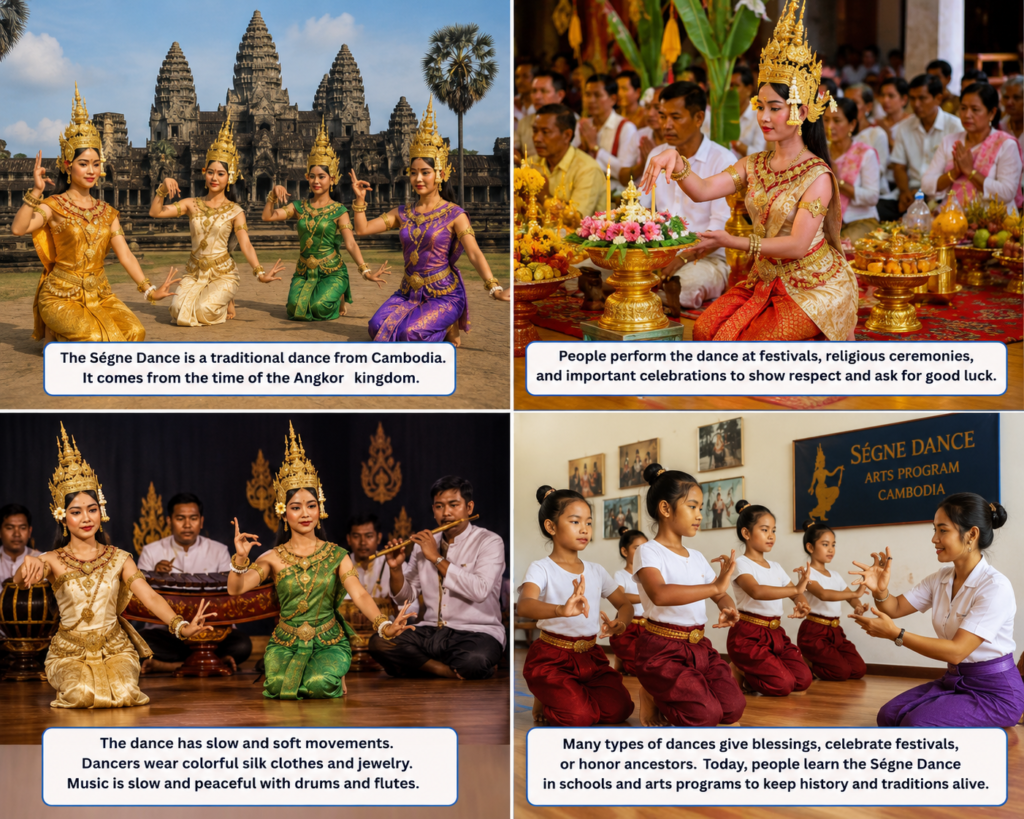
The Cambodian Ségne Dance is a traditional dance from Cambodia. It is very old and has been part of Cambodian culture for many centuries. It comes from the time of the Angkor kingdom, which was a long time ago.
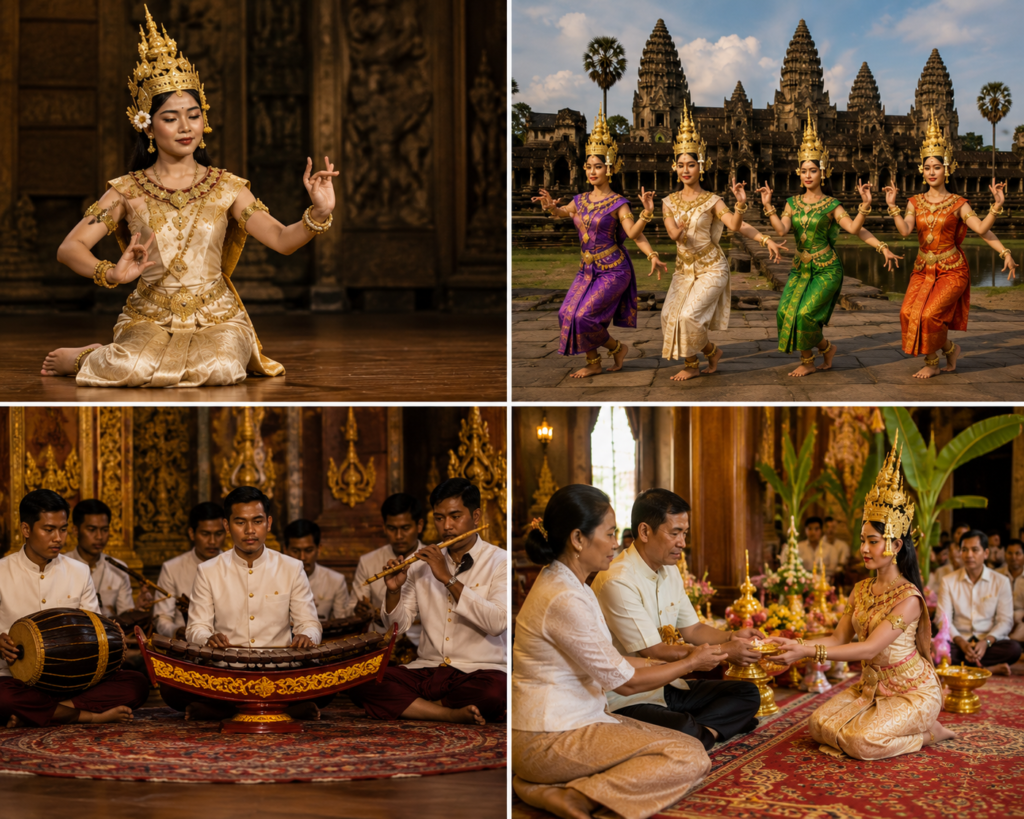
People perform the Ségne Dance at special events. It is used during festivals, religious ceremonies, and important celebrations. It is also performed when people want to show respect or ask for good luck. Many people in Cambodia see the dance as something special.
The dance has slow and soft movements. The dancers move their hands, arms, and fingers in careful ways. The hand movements are very important because they help show meaning. The dance does not use fast steps. It is calm and quiet.
The dancers wear traditional clothes. These clothes are often made from silk and are very colorful. They also wear jewelry like necklaces and bracelets. Some dancers wear a special head decoration. The clothes are important because they make the dance look beautiful.
Music is played during the dance. The music is slow and peaceful. It uses traditional instruments like drums and flutes. The music and dance go together.
There are different types of Ségne Dance. Some dances are used to give blessings for a new house or temple. Some are used to celebrate festivals. Some are used to honor ancestors and family members.
Today, the Ségne Dance is still important in Cambodia. People learn it in schools and arts programs. It is also shown at cultural events for visitors. It helps people remember their history and traditions.
_________________________
Vocabulary:
traditional: something from the past that people still use or do
a century: 100 years
a kingdom: a country ruled by a king or queen
to perform a dance: to do a dance in front of people
a special event: an important occasion
a ceremony: a formal event for a special reason
a celebration: a happy event for something special
to show respect: to be polite and show you value someone
soft movements: slow and gentle body actions
to show meaning: to express an idea or message
to be calm: to be quiet and relaxed
to wear traditional clothes: to put on clothes from a culture or the past
to be made from silk: to be produced using silk fabric
a necklace: jewelry you wear around your neck
a bracelet: jewelry you wear around your wrist
a head decoration: something worn on the head for decoration
peaceful: quiet, calm, and not noisy
a flute: a musical instrument you blow into
to give a blessing: to wish someone good luck or protection
to honor an ancestor: to show respect to family members from the past
a family member: someone in your family
an arts program: a school or activity where people learn art, music, or dance
to remember: to keep something in your mind or not forget it
#################
Match the words to the definitions
Words
traditional
a century
a kingdom
to perform a dance
a special event
a ceremony
a celebration
to show respect
soft movements
to show meaning
to be calm
to wear traditional clothes
to be made from silk
a necklace
a bracelet
a head decoration
peaceful
a flute
to give a blessing
to honor an ancestor
a family member
an arts program
to remember
Definitions
A. to keep something in your mind or not forget it B. a musical instrument you blow into C. slow and gentle body actions D. a happy event for something special E. something from the past that people still use or do F. to show you value and are polite to someone G. a country ruled by a king or queen H. a formal event for a special reason I. jewelry you wear around your wrist J. someone in your family K. to wish someone good luck or protection L. to express an idea or message M. 100 years N. quiet, calm, and not noisy O. to do a dance in front of people P. something worn on the head for decoration Q. a school or activity where people learn art, music, or dance R. jewelry you wear around your neck S. to be produced using silk fabric T. an important occasion U. to show respect to family members from the past V. to be calm and relaxed W. clothes from a culture or the past X. a quiet and peaceful feeling
something from the past that people still use or do
100 years
a country ruled by a king or queen
to do a dance in front of people
an important occasion
a formal event for a special reason
a happy event for something special
to be polite and show you value someone
slow and gentle body actions
to express an idea or message
to be quiet and relaxed
to put on clothes from a culture or the past
to be produced using silk fabric
jewelry you wear around your neck
jewelry you wear around your wrist
something worn on the head for decoration
quiet, calm, and not noisy
a musical instrument you blow into
to wish someone good luck or protection
to show respect to family members from the past
someone in your family
a school or activity where people learn art, music, or dance
to keep something in your mind or not forget it
Words
A. a flute B. to remember C. a ceremony D. traditional E. a bracelet F. peaceful G. to give a blessing H. to show meaning I. a celebration J. a kingdom K. a head decoration L. a century M. to perform a dance N. soft movements O. a necklace P. to honor an ancestor Q. a special event R. to be calm S. a family member T. to show respect U. an arts program V. to be made from silk W. to wear traditional clothes
The dance is still taught in schools and arts programs today.
The Ségne Dance is a traditional dance from Cambodia.
The dance is only performed once every hundred years in secret tunnels. True is: It is performed at festivals, ceremonies, and special cultural events.
It is used in important celebrations.
Dancers usually wear modern sports uniforms made of plastic. True is: Dancers wear colorful traditional silk clothes with jewelry and head decorations.
Traditional music uses instruments like drums and flutes.
Jewelry such as necklaces and bracelets is worn by dancers.
The dance originated in South America in recent decades. True is: It comes from the time of the Angkor kingdom in Cambodia.
Hand movements are very important in the dance.
The dance includes slow and soft movements.
It comes from the time of the Angkor kingdom.
Loud rock concerts are the traditional setting for the dance. True is: It is performed at cultural festivals, religious ceremonies, and celebrations.
It is performed at festivals and ceremonies.
Movements focus on running at high speed across the stage. True is: The dance uses slow, calm, and careful movements.
Dancers wear colorful traditional silk clothes.
The dance is used to train professional chefs in cooking skills. True is: It is used for blessings, ceremonies, celebrations, and honoring ancestors.
It is performed at special cultural events.
Electronic video game sounds replace all traditional music. True is: Traditional instruments like drums and flutes are used.
The dance is performed only during sports competitions. True is: It is performed during festivals, ceremonies, and important celebrations.
The dance includes calm, careful movement rather than fast steps.
#################
Odd one out:
flute – bracelet – computer – silk clothes
basketball – ceremony – celebration – festival
peaceful – noisy – calm – respectful
Cambodia – Thailand – necklace – Angkor kingdom
to show respect – to cook pasta – to honor an ancestor – to remember
slow steps – hand gestures – sprinting – soft movements
The Cambodian Ségne Dance is a traditional dance from Cambodia from the time of the Angkor __________. It is performed at special __________ such as ceremonies, celebrations, and festivals. People perform the dance to show __________, give blessings, and honor ancestors and family members. The dancers use soft movements and slow steps to show __________. They try to be __________ while performing the dance. Dancers wear traditional clothes made from __________. They also wear a __________, a bracelet, and a head decoration. The clothing makes the __________ more beautiful. The music is __________ and uses instruments like a flute and drums. There are different types of dances for different purposes, such as giving blessings or honoring __________. Today, the dance is still taught in __________ and schools. It helps people __________ their history and traditions in Cambodia.
———————————
Correct version:
The Cambodian Ségne Dance is a traditional dance from Cambodia from the time of the Angkor kingdom. It is performed at special events such as ceremonies, celebrations, and festivals. People perform the dance to show respect, give blessings, and honor ancestors and family members. The dancers use soft movements and slow steps to show meaning. They try to be calm while performing the dance. Dancers wear traditional clothes made from silk. They also wear a necklace, a bracelet, and a head decoration. The clothing makes the performance more beautiful. The music is peaceful and uses instruments like a flute and drums. There are different types of dances for different purposes, such as giving blessings or honoring ancestors. Today, the dance is still taught in arts programs and schools. It helps people remember their history and traditions in Cambodia.
###############
Match question with answer:
Questions
What is the Ségne Dance?
Where does it come from?
When does it happen?
Why does it take place?
Who is part of it?
How do dancers move?
What feeling is in the dance?
What do dancers wear?
What appears on dancers’ bodies?
What is on the head of dancers?
What is the music like?
Which instruments appear in the music?
Answers
A. It sounds slow and peaceful. B. It comes from Cambodia and the Angkor kingdom. C. It shows respect and gives blessings. D. It includes ancestors and family members. E. It uses drums and flutes. F. It takes place during festivals and ceremonies. G. It belongs to Cambodian culture as a traditional dance. H. They have necklaces and bracelets. I. It creates a calm and peaceful feeling. J. They wear traditional silk clothes. K. They add head decoration. L. They use slow and soft movements.
Sala Baï Hotel School is a hotel school in Siem Reap. The school helps young people from poor families by giving them training for jobs in hotels and restaurants. This year, 461 students applied for the new class. After the first checks, 391 students came to the final step: the motivation interview.
Before the interview, social workers visit the students’ families in different parts of Cambodia. They study the family situation carefully to make sure the students really need support. Only the students who pass this process can attend the motivation interview.
During the interview, teachers ask one important question: “Why do you want this?” At Sala Baï, motivation is one of the two most important qualities the school looks for. The reason is simple: the training programme is long and difficult. Students must study many hours, learn many skills, and also work in the school restaurant. Hospitality work needs energy, discipline, and hard work every day.
Motivation is like fuel. It gives students the strength to continue when the programme becomes difficult. The school provides good teachers and professional training, but training alone is not enough. Students also need strong personal motivation to succeed.
Sala Baï wants students who truly want to learn and improve their lives. With motivation and training, students can finish the programme, find good jobs, and become independent. They can also support their families and leave poverty behind.
For this reason, the question “Why do you want this?” is very important. It helps the school choose students who are ready to work hard and build a better future in the hospitality industry.
_______________________
Vocabulary:
motivation: the reason you want to do something
to apply for a new class: to ask to join a new group of students
a check: an examination or control to see something is correct
a final step: the last part of a process
a social worker: a person who helps people in difficult life situations
to need support: to need help
to pass a process: to finish all steps successfully
to attend an interview: to go to a meeting where people ask you questions
to learn skills: to gain abilities to do something
hospitality: work in hotels, restaurants, and tourism
discipline: control and good behavior to follow rules
fuel: something that gives energy
strength: power to do something difficult
to provide training: to teach people how to do a job
to succeed: to achieve a good result
to improve life: to make life better
to finish a programme: to complete a course of study or training
to become independent: to live and manage life without help from others
poverty: the state of being very poor
to be ready to work hard: to be prepared to do difficult work
hospitality industry: businesses like hotels and restaurants that serve guests
####################
Match the words with the correct definitions
Words:
motivation
to apply for a new class
a check
a final step
a social worker
to need support
to pass a process
to attend an interview
to learn skills
hospitality
discipline
fuel
strength
to provide training
to succeed
to improve life
to finish a programme
to become independent
poverty
hospitality industry
Definitions:
A. the last part of a process B. to achieve a good result C. work in hotels and restaurants D. to go to a meeting where you answer questions E. the reason you do something F. power to do something difficult G. to gain abilities H. to ask to join a new class I. help given to people in need J. the state of being very poor K. a person who helps people in difficult situations L. to complete a course M. to make life better N. control and good behavior O. to need help P. energy source Q. to finish all steps successfully R. to teach job skills S. to live without help from others T. an examination or control
businesses like hotels and restaurants that serve guests
Words :
A. discipline B. poverty C. to improve life D. hospitality E. to apply for a new class F. fuel G. a check H. to become independent H. motivation I. to succeed J. to attend an interview K. a social worker L. to pass a process M. strength N. to learn skills O. hospitality industry P. a final step Q. to provide training R. to finish a programme S. to need support
The motivation interview is the final step of the selection process.
The motivation interview happens before any family checks. True is: The school visits students’ families before the motivation interview.
Students can finish the programme without working hard. True is: Students must work hard to finish the programme.
The school believes both training and motivation are important for success.
Hospitality jobs do not require energy or effort. True is: Hospitality jobs require energy and effort every day.
Only selected students can attend the motivation interview.
Students must study many hours during the programme.
The school trains students for jobs in hotels and restaurants.
Motivation is not important for success at the school. True is: Motivation is very important for success at the school.
Students also gain practical experience by working in the school restaurant.
The school guarantees jobs without any training. True is: Students need training to find jobs in the hospitality industry.
Social workers visit students’ families before the final selection.
Students who finish the programme can find jobs and support their families.
Teachers ask many different questions in the interview, but not about motivation. True is: Teachers ask about motivation in the interview.
All students at the school come from rich families. True is: The school helps young people from poor families.
Motivation helps students continue when the programme is difficult.
The interview focuses on the question “Why do you want this?”
The school accepts every applicant without selection. True is: The school selects students carefully through several steps.
Sala Baï Hotel School helps young people from poor families in Cambodia.
Students only study theory and never do practical work. True is: Students also do practical work in the school restaurant.
####################
Give short answers:
Where is Sala Baï Hotel School located? YOU WRITE: Siem Reap, Cambodia
Who does the school help?
What kind of families do most students come from?
How many people applied this year?
What happens after the first selection checks?
When is the motivation interview held in the selection process?
Who visits the students’ families before the interview?
Why do social workers visit families before the interview?
What is the main question asked in the motivation interview?
Why is this question important for the school?
How important is motivation at Sala Baï Hotel School?
What do students do during the training programme?
Which skills do students learn at the school?
Why is the training programme difficult for students?
What does “motivation is like fuel” mean in the text?
How do students work in the school besides studying?
What does the school provide to help students succeed?
What can students achieve after finishing the programme?
How can students support their families after graduating?
What is the goal of the school in training students for hospitality jobs?
___________________________
Correct answers:
Where is Sala Baï Hotel School located? – Siem Reap, Cambodia
Who does the school help? – Young people from poor families
What kind of families do most students come from? – Poor families
How many people applied this year? – 461
What happens after the first selection checks? – 391 selected for final step
When is the motivation interview held in the selection process? – Final step
Who visits the students’ families before the interview? – Social workers
Why do social workers visit families before the interview? – Check family situation / need for support
What is the main question asked in the motivation interview? – “Why do you want this?”
Why is this question important for the school? – To see motivation
How important is motivation at Sala Baï Hotel School? – Very important / key factor
What do students do during the training programme? – Study + work in restaurant
Which skills do students learn at the school? – Hospitality skills / job skills
Why is the training programme difficult for students? – Many hours + hard work + long programme
What does “motivation is like fuel” mean in the text? – Motivation gives energy to continue
How do students work in the school besides studying? – Practical work in restaurant
What does the school provide to help students succeed? – Training + teachers
What can students achieve after finishing the programme? – Good jobs / independence
How can students support their families after graduating? – Support families / earn money
What is the goal of the school in training students for hospitality jobs? – Help students get jobs / better future
###################
Matching causes and results
Causes:
A. Students are motivated B. The training is difficult C. Social workers visit families D. Students finish the programme E. The school provides training F. Students work in the restaurant G. Students want to change their lives H. The school selects students carefully I. Students attend the motivation interview J. Students study many hours every day
Results:
Students understand their family situation is checked
Students can get jobs in hotels and restaurants
Students gain real work experience
Students need strong energy and discipline
Students improve their future opportunities
Students can support their families
Students are chosen for the programme
Students answer the question “Why do you want this?”
A. Students are motivated – Students become independent B. The training is difficult – Students need strong energy and discipline C. Social workers visit families – Students understand their family situation is checked D. Students finish the programme – Students can support their families E. The school provides training – Students develop skills and knowledge F. Students work in the restaurant – Students gain real work experience G. Students want to change their lives – Students improve their future opportunities H. The school selects students carefully – Students are chosen for the programme I. Students attend the motivation interview – Students answer the question “Why do you want this?” J. Students study many hours every day – Students can get jobs in hotels and restaurants ##################
Order the process (put in correct order)
Students attend the motivation interview
Students apply for the school
Social workers visit families
Students receive training
Students are selected for the final step
Students work in the school restaurant
Students are checked by the school
Students learn job skills
Students finish the programme
Students can get jobs in hotels and restaurants
_____________________________
Answer : 2, 3, 7, 5, 1, 4, 8, 6, 9, 10
#####################
Odd one out: find the word that does not fit in each group.
banana – motivation – discipline – fuel
apply – pencil – attend – support
hotel – football – restaurant – hospitality
interview – classroom – interview – interview
training – skills – computer – learning
rich – poverty – poor – school
apply – select – pizza – check
energy – chair – work – effort
notebook – families – social worker – visit
succeed – improve – finish – mango
____________________________
Answers:
Odd One Out (with explanation)
banana – motivation – discipline – fuel The odd one is: banana — it is a fruit, the others are ideas about energy and learning.
apply – pencil – attend – support The odd one is: pencil — it is an object, the others are actions.
hotel – football – restaurant – hospitality The odd one is: football — it is a sport, the others are related to services and hospitality.
interview – classroom – interview – interview The odd one is: classroom — it is a place, the others are a type of meeting.
training – skills – computer – learning The odd one is: computer — it is a device, the others are processes or knowledge.
rich – poverty – poor – school The odd one is: school — it is a place, the others describe financial situation.
apply – select – pizza – check The odd one is: pizza — it is a food, the others are actions in a process.
energy – chair – work – effort The odd one is: chair — it is an object, the others are ideas or actions.
notebook – families – social worker – visit The odd one is: notebook — it is an object, the others are people or actions.
succeed – improve – finish – mango The odd one is: mango — it is a fruit, the others are verbs of progress.
#####################
Odd One Out (with explanation)
banana – motivation – discipline – fuel The odd one is: banana — it is a fruit, the others are ideas about energy and learning.
apply – pencil – attend – support The odd one is: pencil — it is an object, the others are actions.
hotel – football – restaurant – hospitality The odd one is: football — it is a sport, the others are related to services and hospitality.
interview – classroom – interview – interview The odd one is: classroom — it is a place, the others are a type of meeting.
training – skills – computer – learning The odd one is: computer — it is a device, the others are processes or knowledge.
rich – poverty – poor – school The odd one is: school — it is a place, the others describe financial situation.
apply – select – pizza – check The odd one is: pizza — it is a food, the others are actions in a process.
energy – chair – work – effort The odd one is: chair — it is an object, the others are ideas or actions.
notebook – families – social worker – visit The odd one is: notebook — it is an object, the others are people or actions.
succeed – improve – finish – banana The odd one is: banana — it is a fruit, the others are verbs of progress.
###################
Fill in, words below:
motivation – skills – apply – support – attend – poor – provides – final step – difficult – practice
Sala Baï Hotel School is in Siem Reap, Cambodia. The school helps young people from __________ families. It gives training for jobs in hotels and restaurants. Students __________ for a new class at the school. They go through simple checks before the _________ Social workers visit families to understand their situation. Students __________ a motivation interview. They answer the question “Why do you want this?” __________ is very important at the school. Students need motivation to finish a __________ programme. They study many hours every day. They learn __________ for hospitality work. They also work in the school restaurant to get __________. The school __________ training and teachers to help students. After finishing the programme, students can get jobs and __________ their families. They can improve their life and become more independent.
———————————— Correct version:
Sala Baï Hotel School is in Siem Reap, Cambodia. The school helps young people from poor families. It gives training for jobs in hotels and restaurants. Students apply for a new class at the school. They go through simple checks before the final step. Social workers visit families to understand their situation. Students attend a motivation interview. They answer the question “Why do you want this?” Motivation is very important at the school. Students need motivation to finish a difficult programme. They study many hours every day. They learn skills for hospitality work. They also work in the school restaurant to get practice. The school provides training and teachers to help students. After finishing the programme, students can get jobs and support their families. They can improve their life and become more independent. #################
Match question and answer:
Questions
Where is Sala Baï Hotel School located?
Who does the school help?
What kind of jobs does the school prepare students for?
Why do social workers visit families?
When do students attend the motivation interview?
Which question do teachers ask in the interview?
How does motivation help students?
What do students do during the programme?
What skills do students develop at the school?
What else does the school provide besides teachers?
What can students achieve after the programme?
How can students become independent after graduation?
Answers:
A. They gain hospitality and job skills. B. They can get good jobs and support their families. C. “Why do you want this?” D. It offers professional training. E. It supports young people from poor families. F. They check the family situation. G. It is in Siem Reap, Cambodia. H. They earn money and build a better future. I. They go there after the first checks. J. It gives them energy to continue difficult work and study. K. They study many hours and work in the school restaurant. L. It trains them for work in hotels and restaurants.
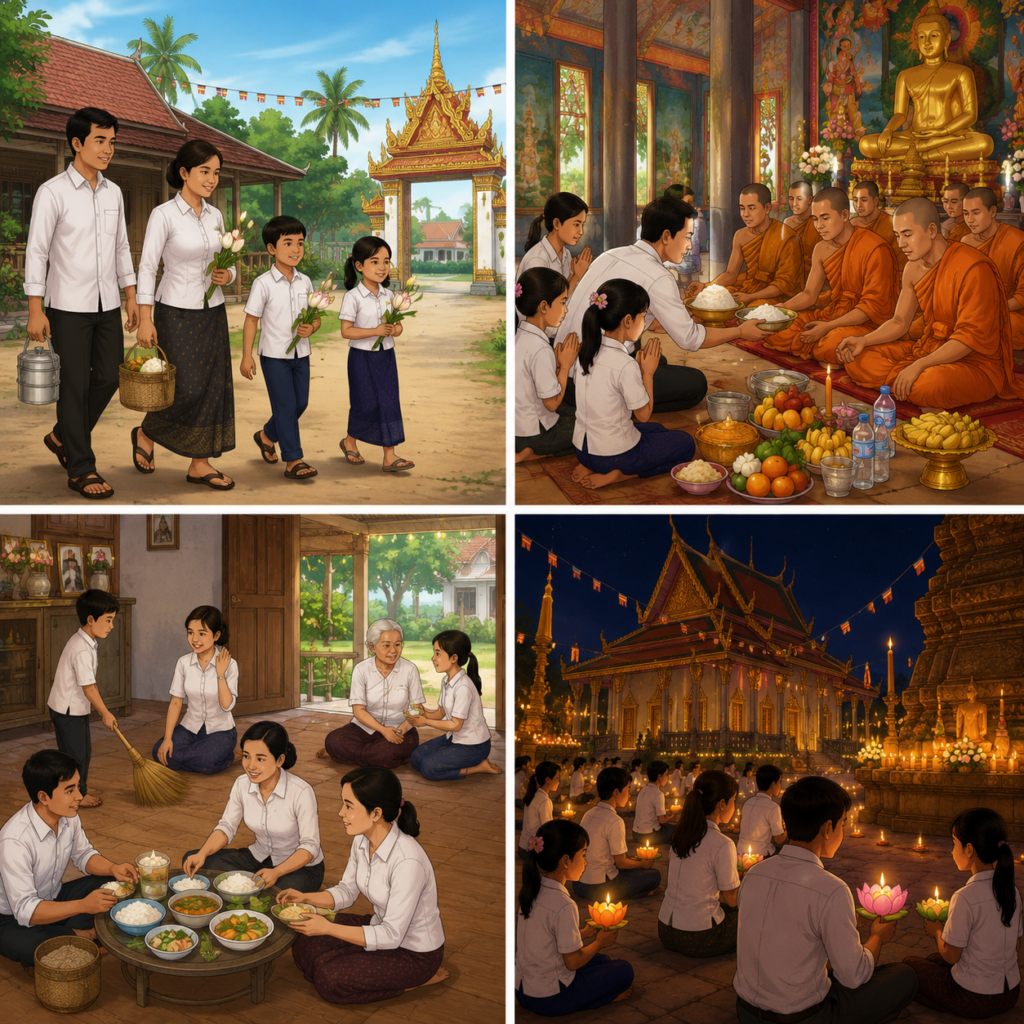
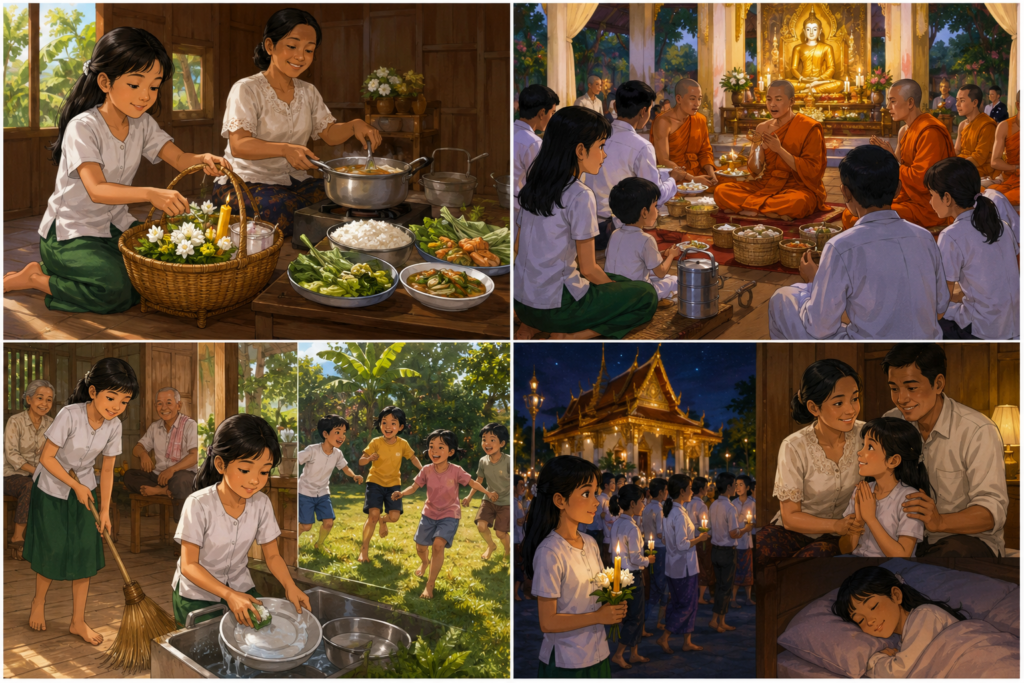
Visak Bochea Day is an important day in Cambodia. Many people know this day. Buddhist people celebrate it every year. On this day, people wake up early in the morning. They wash, eat breakfast, and get ready to go out. Many people wear white clothes. They go to the pagoda with their family.
At the pagoda, people see many monks. The pagoda is quiet and clean. People bring rice, fruit, water, flowers, and candles. They give food to the monks. Then they sit and listen. The monks talk to the people. Many people pray quietly.
Children also go to the pagoda. They stay with their parents and grandparents. Some children carry flowers or candles. They feel happy to be there.
In the afternoon, families go home. They eat food together and talk. Some people clean the house or help old people. In the evening, people light candles and pray again.
Visak Bochea Day is a calm and special day. People feel happy, peaceful, and close to their family.
______________________
Vocabulary:
to be important — to be very special or needed
to celebrate — to do something happy for a special day
to wake up — to stop sleeping
to get ready — to prepare to go somewhere or do something
to wear clothes — to have clothes on your body
a pagoda — a Buddhist holy place
a monk — a Buddhist man who lives and works in a pagoda
to be quiet — to make little or no noise
a candle — a small stick with fire for light
to pray quietly — to speak to God or Buddha in a soft voice
to stay with one’s parents — to be together with mother and father
grandparents — the mother and father of your mother or father
afternoon — the time after lunch and before evening
to clean the house — to make the house clean
to light a candle — to make a candle burn with fire
to be calm — to feel relaxed and not worried
to be peaceful — to be quiet and calm
to be close to one’s family — to love and spend time with family members
#################
Match word and defintion:
to be important
to celebrate
to wake up
to get ready
to wear clothes
a pagoda
a monk
to be quiet
a candle
to pray quietly
to stay with one’s parents
grandparents
afternoon
to clean the house
to light a candle
to be calm
to be peaceful
to be close to one’s family
Definition:
a. to make little or no noise b. to have clothes on your body c. to feel relaxed and not worried d. a Buddhist holy place e. to make the house clean f. to prepare to go somewhere or do something g. to stop sleeping h. the mother and father of your mother or father i. to make a candle burn with fire j. to be very special or needed k. to be together with mother and father l. a Buddhist man who lives and works in a pagoda m. a small stick with fire for light n. to do something happy for a special day o. to speak to God or Buddha in a soft voice p. the time after lunch and before evening q. to be quiet and calm r. to love and spend time with family members
a. to be important b. to celebrate c. to wake up d. to get ready e. to wear clothes f. a pagoda g. a monk h. to be quiet i. a candle j. to pray quietly k. to stay with one’s parents l. grandparents m. afternoon n. to clean the house o. to light a candle p. to be calm q. to be peaceful r. to be close to one’s family
Correct answers: People travel to the city on this day. True is: People go to the pagoda on this day.
Monks talk about peace and kindness.
The day is quiet and peaceful.
People go to the beach on this day. True is: People go to the pagoda on this day.
People wear white clothes.
Children do exams in the pagoda. True is: Children go to the pagoda with their family.
People bring flowers and candles.
Monks sing loud pop songs in the street. True is: Monks talk about peace and kindness.
Visak Bochea Day is in Cambodia.
People eat only pizza at the pagoda. True is: People bring rice, fruit, and food to the pagoda.
Families stay together on this day.
People swim in the ocean at midnight. True is: People pray at home or at the pagoda.
Schools are open and students study all day. True is: People go to the pagoda and celebrate.
People give food to monks.
People go to the pagoda on this day.
The day is very loud and full of traffic. True is: The day is quiet and peaceful.
################
The odd one out – try to find it:
banana / monk / candle / pagoda
flowers / incense / candles / white clothes
pray / eat / listen / think
calm / peaceful / noisy / quiet
morning / afternoon / candle / evening
family / parents / teacher / grandparents
sit / swim / give food / light candle
rice / school / fruit / water
stand / sit / listen / pray
happy / kind / peaceful / loud
______________________
Correct answers:
banana – monk – candle – pagoda Odd one: banana Why: banana is a fruit, the others are in a pagoda or used there.
flowers – incense – candles – white clothes Odd one: white clothes Why: white clothes are worn, the others are things you give or burn at a pagoda.
pray – eat – listen – think Odd one: eat Why: the others are mental or spiritual actions, eat is a physical action for food.
calm – peaceful – noisy – quiet Odd one: noisy Why: the others mean no sound or soft feeling, noisy is loud.
morning – afternoon – candle – evening Odd one: candle Why: the others are times of day, candle is an object.
family – parents – teacher – grandparents Odd one: teacher Why: the others are family members, teacher is not family.
sit – swim – give food – light candle Odd one: swim Why: the others are actions done at the pagoda, swim is not.
rice – school – fruit – water Odd one: school Why: the others are food or drink, school is a place.
stand – sit – listen – pray Odd one: pray Why: the others are simple body actions, pray is a religious action.
happy – kind – peaceful – loud Odd one: loud Why: the others are positive feelings, loud is about sound.
###############
Give short answers:
Where is Visak Bochea Day?
YOU WRITE: It is in Cambodia.
When do people celebrate Visak Bochea Day?
What do people wear on this day?
What do people bring to the pagoda?
Who goes to the pagoda with children?
Who lives in a pagoda?
What do monks do at the pagoda?
Why do people go to the pagoda?
How do people feel on this day?
Is the pagoda noisy?
Do people give food to monks?
Do people light candles?
Can children go to the pagoda?
Do families stay together?
Are people quiet at the pagoda?
Does everyone wear white clothes?
Do monks eat pizza?
Do people swim in the ocean that day?
Are there many candles at the pagoda?
Do people think about kindness?
_____________________
Correct answers:
Where is Visak Bochea Day? It is in Cambodia.
When do people celebrate Visak Bochea Day? People celebrate it in May.
What do people wear on this day? People wear white clothes.
What do people bring to the pagoda? People bring flowers and candles.
Who goes to the pagoda with children? Families go to the pagoda with children.
Who lives in a pagoda? Monks live in a pagoda.
What do monks do at the pagoda? Monks talk and pray.
Why do people go to the pagoda? People go to the pagoda to pray.
How do people feel on this day? People feel calm and happy.
Is the pagoda noisy? The pagoda is not noisy.
Do people give food to monks? People give food to monks.
Do people light candles? People light candles.
Can children go to the pagoda? Children can go to the pagoda.
Do families stay together? Families stay together.
Are people quiet at the pagoda? People are quiet at the pagoda.
Does everyone wear white clothes? People wear white clothes.
Do monks eat pizza? Monks do not eat pizza.
Do people swim in the ocean that day? People do not swim in the ocean that day.
Are there many candles at the pagoda? There are many candles at the pagoda.
Do people think about kindness? People think about kindness.
###############
Fill in, words below:
monks – peaceful – important – grandparents – candles – family – stay – pray – pagoda – kindness
Visak Bochea Day is__________in Cambodia. People wake up and get ready. They go to the _________ with family. People wear white clothes. They bring flowers, __________, fruit, rice, and water. People give food to monks. __________ live in a pagoda. People sit, listen, and __________ quietly. Monks talk about __________, peace, and good actions. Children stay with parents and __________. In the afternoon, families go home. Families __________ together. In the evening, people light candles and pray. The day is calm, __________, and quiet. People feel happy and close to __________.
—————————
Correct version:
Visak Bochea Day is important in Cambodia. People wake up and get ready. They go to the pagoda with family. People wear white clothes. They bring flowers, candles, fruit, rice, and water. People give food to monks. Monks live in a pagoda. People sit, listen, and pray quietly. Monks talk about kindness, peace, and good actions. Children stay with parents and grandparents. In the afternoon, families go home. Families stay together. In the evening, people light candles and pray. The day is calm, peaceful, and quiet. People feel happy and close to family.
#############
Interview with a monk on Visak Bochea Day – find the correct answers:
Questions:
Where do you live?
What do you do every day?
What do people bring to you today?
What food do people give you?
Why do people come here?
What do you tell people?
Who comes with the people?
Do children come here?
What clothes do people wear?
Is the pagoda quiet today?
Do you feel happy today?
What do you do with candles?
Do you eat pizza?
What is this day for you?
Answers:
a. I speak about kindness and peace. b. Yes, children arrive with parents. c. People come for prayer. d. I stay in a pagoda. e. People have white clothes. f. It is a calm and important day. g. I feel happiness. h. People bring flowers and candles. i. No, I do not eat pizza. j. People make light from candles. k. I pray and speak to people. l. Yes, the pagoda has quiet. m. Families come together. n. People give rice, fruit, and water.
If you are not too familiar with past simple, try that text/exercise first => LINK
On Visaka Bochea Day, Samnang visited her parents in their village in May 2025. It was an important Buddhist day. She woke up early in the morning. She felt happy.
Her mother cooked rice, vegetables, and soup for the monks. Samnang helped her mother. She put food, flowers, and candles in a basket.
After breakfast, the family walked to the temple. Many people wore white clothes. They carried flowers and candles.
At the temple, the monks prayed. They talked about the life of the Buddha in simple words. Samnang listened.
People gave food to the monks. They lit candles near the Buddha image.
Visaka Bochea Day is a special day for Buddhists. People remember the Buddha. They think about being kind and calm.
In the afternoon, Samnang visited her grandparents. She helped clean the house. She swept the floor and washed dishes.
Later, she played with her cousins in the garden. They laughed and ran together. Everyone was happy.
In the evening, Samnang went back to the temple with her parents. People walked slowly around the temple. They held candles and flowers.
The night was quiet. Samnang felt calm and happy. She liked spending time with her family and helping others on this special day.
She said thank you to her parents. She learned about kindness. She went home and slept early because she was tired but happy.
She was glad to spend the day with her family and friends at the temple and at home.
It was a good day for Samnang.
__________________
Vocabulary:
kindness: being kind and good to others
to wake up: to stop sleeping
to feel happy: to have a good feeling
to cook vegetables: to make vegetables ready to eat with heat
a monk: a man who lives in a temple and prays
a candle: a stick that gives light when it burns
a basket: a container to carry things
to wear clothes: to have clothes on your body
to carry something: to hold and take something with you
to pray: to talk to God or the Buddha
to listen to something: to hear and pay attention
to light a candle: to make a candle burn
a Buddha image: a picture or statue of the Buddha
to be kind: to be nice and good to people
to be calm: to be quiet and not worried
to sweep the floor: to clean the floor with a broom
to wash the dishes: to clean plates and cups
to be quiet: to make no noise
to spend time with the family: to stay and do things with your family
##############
#Regular verbs in past simple
Rules:
Most verbs: add -ed play → played
Verbs ending in -e: add -d live → lived
Verbs ending in consonant + y: change y to i and add -ed study → studied
Short verbs ending in vowel + consonant: double the final consonant and add -ed stop → stopped
Irregular verbs change their form in the past tense. They do not add “-ed.”
Examples:
go → went
eat → ate
have → had
see → saw
come → came
##############
Verbs in text:
Infinitive
Past simple
A1 definition
be
was / were
to exist or to be in a place or state
visit
visited
to go and see someone
wake up
woke up
to stop sleeping
feel
felt
to have a feeling
cook
cooked
to make food with heat
help
helped
to give support
put
put
to place something somewhere
walk
walked
to move on foot
wear
wore
to have clothes on your body
carry
carried
to take something in your hands
pray
prayed
to talk to God or the Buddha
talk
talked
to speak with someone
listen
listened
to hear and pay attention
give
gave
to offer something to someone
light
lit
to make a candle burn
remember
remembered
to keep something in your mind
think
thought
to use your mind about something
clean
cleaned
to make something not dirty
sweep
swept
to clean the floor with a broom
wash
washed
to clean with water
play
played
to do games or fun activities
laugh
laughed
to make a happy sound
run
ran
to move very fast on foot
go
went
to move from one place to another
hold
held
to take something in your hands
like
liked
to enjoy something
spend
spent
to use time doing something
say
said
to speak words
learn
learned
to get knowledge or skills
sleep
slept
to rest in bed at night
################
Match the words to the correct definitions:
Words
kindness
to wake up
to feel happy
to cook vegetables
a monk
a candle
a basket
to wear clothes
to carry something
to pray
to listen to something
to light a candle
a Buddha image
to be kind
to be calm
to sweep the floor
to wash the dishes
to be quiet
Definitions:
A. to stop sleeping B. a stick that gives light when it burns C. to clean plates and cups D. to talk to God or the Buddha E. to have a good feeling F. a picture or statue of the Buddha G. to be quiet and not worried H. a container to carry things I. to carry something with you by holding it J. to hear and pay attention K. to make vegetables ready to eat with heat L. to have clothes on your body M. to clean the floor with a broom N. to make a candle burn O. to be kind and good to people P. a man who lives in a temple and prays Q. being kind and good to others R. to make no noise
A. to cook vegetables B. to be calm C. to pray D. to wear clothes E. a candle F. to wash the dishes G. to be kind H. a Buddha image I. to sweep the floor J. to feel happy K. to wake up L. a monk M. to light a candle N. to carry something O. to listen to something P. a basket Q. to be quiet R. kindness
On Visaka Bochea Day, Samnang _________ (visit) her parents’ village, _________ (wake up) early, and _________ (feel) happy on this special Buddhist day.
Her mother _________ (cook) vegetables, rice, and soup for monks while Samnang _________ (help) and _________ (carry) food, flowers, and candles in a basket.
The family _________ (wear) white clothes, _________ (walk) to the temple, and _________ (carry) candles and flowers with care.
At the temple, monks _________ (pray), and Samnang _________ (listen) carefully, _________ (see) a Buddha image, and _________ (light) a candle.
People _________ (give) food to monks, and everyone tried to be kind, calm, and quiet during the ceremony.
In the afternoon, Samnang _________ (visit) her grandparents, _________ (help) _________ sweep the floor, and _________ (wash) dishes at home.
Later, she _________ (spend) time with her family, _________ (play) with her cousins, _________ (laugh), and _________ (feel) very happy together.
In the evening, she _________ (go) back to the temple, _________ (walk) slowly, and _________ (hold) a candle in her hand.
The night _________ (be) quiet, and Samnang _________ (feel) calm, thankful, and happy before she _________ (go) home to sleep early.
_____________________
Correct version:
On Visaka Bochea Day, Samnang visited her parents’ village, woke up early, and felt happy on this special Buddhist day.
Her mother cooked vegetables, rice, and soup for monks while Samnang helped and carried food, flowers, and candles in a basket.
The family wore white clothes, walked to the temple, and carried candles and flowers with care.
At the temple, monks prayed, and Samnang listened carefully, saw a Buddha image, and lit a candle.
People gave food to monks, and everyone tried to be kind, calm, and quiet during the ceremony.
In the afternoon, Samnang visited her grandparents, helped sweep the floor, and washed dishes at home.
Later, she spent time with her family, played with her cousins, laughed, and felt very happy together.
In the evening, she went back to the temple, walked slowly, and held a candle in her hand.
The night was quiet, and Samnang felt calm, thankful, and happy before she went home to sleep early.
################
Odd one out – which word does not belong to that group?
Odd one out (based on the text)
1. temple – school – basket – village
2. visited – woke up – cooked – felt
3. rice – candle – flower – monk
4. prayed – shouted – listened – carried
5. calm – kind – angry – happy
6. washed – swept – played – cleaned
7. Buddha image – television – candle – flowers
8. afternoon – morning – evening – temple
9. held – carried – flew – lit
10. family – monks – hospital – cousins
_________________
Answers:
1. temple – school – basket – village school — because it is not a place from the story or related to the temple or family village activities, while the others are connected to the setting.
2. visited – woke up – cooked – felt cooked — because it is done by the mother in the story, while the others describe Samnang’s actions or feelings.
3. rice – candle – flower – monk monk — because it is a person, while the others are objects used or offered on Visaka Bochea Day.
4. prayed – shouted – listened – carried shouted — because it is a noisy action, while the others are calm or respectful temple activities.
5. calm – kind – angry – happy angry — because it is a negative feeling, while the others are positive or peaceful feelings.
6. washed – swept – played – cleaned played — because it is a leisure activity, while the others are cleaning actions done in the house.
7. Buddha image – television – candle – flowers television — because it is not mentioned in the story or used in the temple, while the others are related to worship.
8. afternoon – morning – evening – temple temple — because it is a place, while the others are times of the day.
9. held – carried – flew – lit flew — because it is not related to temple actions, while the others are actions with candles or objects.
10. family – monks – hospital – cousins hospital — because it is not part of the story setting, while the others are people or groups in the family/temple context.
##############
True or false:
Samnang went to school in the morning.
People at the temple behaved quietly and respectfully.
The monks danced and sang loudly during the ceremony.
Samnang helped with cleaning activities at home.
The temple was empty on that day.
The family shared food with Buddhist monks.
Samnang broke objects during the visit.
The family took part in religious activities at a temple.
Everyone shouted and ran inside the temple.
Samnang visited her grandparents during the day.
The day had no connection to Buddhist traditions.
Samnang spent time with relatives and played with children.
People carried objects when they went to the temple.
Samnang reflected on being kind during the day.
The family ignored the monks completely.
Samnang stayed alone all day without seeing anyone.
The day included both family time and temple activities.
Samnang returned home after visiting the temple again.
People ate meat during the temple visit.
Samnang refused to help her family at home.
_____________
True: 2,4,6,8,10,12,13,14,17,18
_____________
Correct version:
False: Samnang went to school in the morning. True is: Samnang visited her parents’ village and went to the temple with her family.
People at the temple behaved quietly and respectfully.
False: The monks danced and sang loudly during the ceremony. True is: The monks prayed and talked about the Buddha in simple words.
Samnang helped with cleaning activities at home.
False: The temple was empty on that day. True is: Many people were at the temple on Visaka Bochea Day.
The family shared food with Buddhist monks.
False: Samnang broke objects during the visit. True is: Samnang behaved respectfully and helped her family and others.
The family took part in religious activities at a temple.
False: Everyone shouted and ran inside the temple. True is: People behaved calmly and quietly at the temple.
Samnang visited her grandparents during the day.
False: The day had no connection to Buddhist traditions. True is: The day was a Buddhist festival called Visaka Bochea Day.
Samnang spent time with relatives and played with children.
People carried objects when they went to the temple.
Samnang reflected on being kind during the day.
False: The family ignored the monks completely. True is: The family respected the monks and gave them food.
False: Samnang stayed alone all day without seeing anyone. True is: Samnang spent the day with her family and friends.
The day included both family time and temple activities.
Samnang returned home after visiting the temple again.
False: People ate meat during the temple visit. True is: People offered food respectfully to the monks and followed Buddhist practice.
False: Samnang refused to help her family at home. True is: Samnang helped her family with cleaning and activities.
###############
Sentence ordering – based on story, correct order is?
A. Samnang felt happy during the special Buddhist day. B. The family went to the temple. C. Monks prayed and spoke about the Buddha. D. Samnang woke up early in the morning. E. Samnang helped her mother at home. F. Samnang played with her cousins in the garden. G. The family returned to the temple in the evening. H. Samnang went home and slept early.
_____________________
Correct Order
D. Samnang woke up early in the morning. A. Samnang felt happy during the special Buddhist day. E. Samnang helped her mother at home. B. The family went to the temple. C. Monks prayed and spoke about the Buddha. F. Samnang played with her cousins in the garden. G. The family returned to the temple in the evening. H. Samnang went home and slept early.
###############
Short answers wanted:
Where did Samnang go on Visaka Bochea Day?
2. When did Samnang wake up?
3. Why did Samnang feel happy in the morning?
4. What did her mother cook for the monks?
5. Who helped her mother in the kitchen?
6. What did Samnang put in the basket?
7. Which clothes did the family wear to the temple?
8. Where did the family walk after breakfast?
9. Who prayed at the temple?
10. What did Samnang do while monks were speaking?
11. What did people give to the monks?
12. What did Samnang do at her grandparents’ house in the afternoon?
13. How did Samnang help clean the house?
14. What did Samnang do with her cousins in the garden?
15. How did Samnang feel at the end of the day?
16. Why did Samnang go to bed early?
_______________________
Answers:
Where did Samnang go on Visaka Bochea Day? She went to her parents’ village and the temple.
When did Samnang wake up? She woke up early in the morning.
Why did Samnang feel happy in the morning? Because it was a special Buddhist day.
What did her mother cook for the monks? She cooked rice, vegetables, and soup.
Who helped her mother in the kitchen? Samnang helped her mother.
What did Samnang put in the basket? She put food, flowers, and candles.
Which clothes did the family wear to the temple? They wore white clothes.
Where did the family walk after breakfast? They walked to the temple.
Who prayed at the temple? The monks prayed.
What did Samnang do while monks were speaking? She listened carefully.
What did people give to the monks? They gave food.
What did Samnang do at her grandparents’ [a Saxon genitive, for details see below] house in the afternoon? She helped clean the house.
How did Samnang help clean the house? She swept the floor and washed dishes.
What did Samnang do with her cousins in the garden? She played with them.
How did Samnang feel at the end of the day? She felt calm and happy.
Why did Samnang go to bed early? Because she was tired but happy.
#################
Saxon genitive (’s) – showing possession
The Saxon genitive shows that something belongs to someone. We add >> ’s << to a name or noun.
Basic rule:
👉 person/animal + ’s + thing
Examples:
John’s book = the book belongs to John
Anna’s bag = the bag belongs to Anna
The cat’s food = the food belongs to the cat
If the name ends in -s (like James):
We still usually add ’s:
James’s book = the book belongs to James
James’s car = the car belongs to James
Plural nouns:
If the word is plural and already ends in -s, we just add an apostrophe ’:
the boys’ room = the room of the boys
the teachers’ office = the office of the teachers
Easy way to remember:
Instead of saying “the book of John”, we say: 👉 John’s book
#################
Rewrite with Saxon genitive
the book of James → __________ YOU WRITE: James’s book
On Visaka Bochea Day, Samnang __________ early, felt happy, and visited her parents in their __________ for the special Buddhist celebration.
Her mother __________ vegetables, rice, and soup for the monks, and Samnang helped __________ food, flowers, and candles in a __________.
After breakfast, the family __________ white clothes, walked to the temple, and carried __________ and flowers with many other people.
At the temple, the monks __________ and talked about the Buddha, and Samnang listened carefully near the Buddha _________ during the ceremony.
People __________ candles, gave food to the monks, and tried to be kind, __________, and quiet on this important day.
In the afternoon, Samnang __________ the floor, washed dishes, spent time with her family, played with __________, and learned about kindness before going home __________ but happy.
————————————-
Full version:
On Visaka Bochea Day, Samnang woke up early, felt happy, and visited her parents in their village for the special Buddhist celebration.
Her mother cooked vegetables, rice, and soup for the monks, and Samnang helped carry food, flowers, and candles in a basket.
After breakfast, the family wore white clothes, walked to the temple, and carried candles and flowers with many other people.
At the temple, the monks prayed and talked about the Buddha, and Samnang listened carefully near the Buddha image during the ceremony.
People lit candles, gave food to the monks, and tried to be kind, calm, and quiet on this important day.
In the afternoon, Samnang swept the floor, washed dishes, spent time with her family, played with cousins, and learned about kindness before going home tired but happy.
################# Match question and answer:
Questions
Where did you spend Visaka Bochea Day?
When did you get up in the morning?
Why were you happy that day?
Who prepared food for the monks?
What did you place in the basket?
Which clothes did your family have on at the temple?
How did your family travel to the temple?
Whose house did you visit in the afternoon?
What did the monks talk about?
How did you act during the ceremony?
What did people give to the monks?
Which activity did you do to help clean the house?
Who played with you in the garden?
How did you feel at the end of the day?
_________________
Answers:
A. I stayed calm and quiet.
B. My mother made rice, vegetables, and soup.
C. We had white clothes on our bodies.
D. I put flowers, food, and candles inside it.
E. My cousins ran and laughed with me.
F. I was calm, thankful, and tired.
G. I stayed in my parents’ village and at the temple.
H. It was an important Buddhist celebration.
I. I spent time at my grandparents’ home.
J. They offered food and respect.
K. I left my bed very early.
L. We went there on foot together.
M. They spoke about the Buddha’s life.
N. I swept the floor and washed dishes.
_______________________
Full version:
Where did you spend Visaka Bochea Day? I stayed in my parents’ village and at the temple. G
When did you get up in the morning? I left my bed very early. K
Why were you happy that day? It was an important Buddhist celebration. H
Who prepared food for the monks? My mother made rice, vegetables, and soup. B
What did you place in the basket? I put flowers, food, and candles inside it. D
Which clothes did your family have on at the temple? We had white clothes on our bodies. C
How did your family travel to the temple? We went there on foot together. L
Whose house did you visit in the afternoon? I spent time at my grandparents’ home. I
What did the monks talk about? They spoke about the Buddha’s life. M
How did you act during the ceremony? I stayed calm and quiet. A
What did people give to the monks? They offered food and respect. J
Which activity did you do to help clean the house? I swept the floor and washed dishes. N
Who played with you in the garden? My cousins ran and laughed with me. E
How did you feel at the end of the day? I was calm, thankful, and tired. F
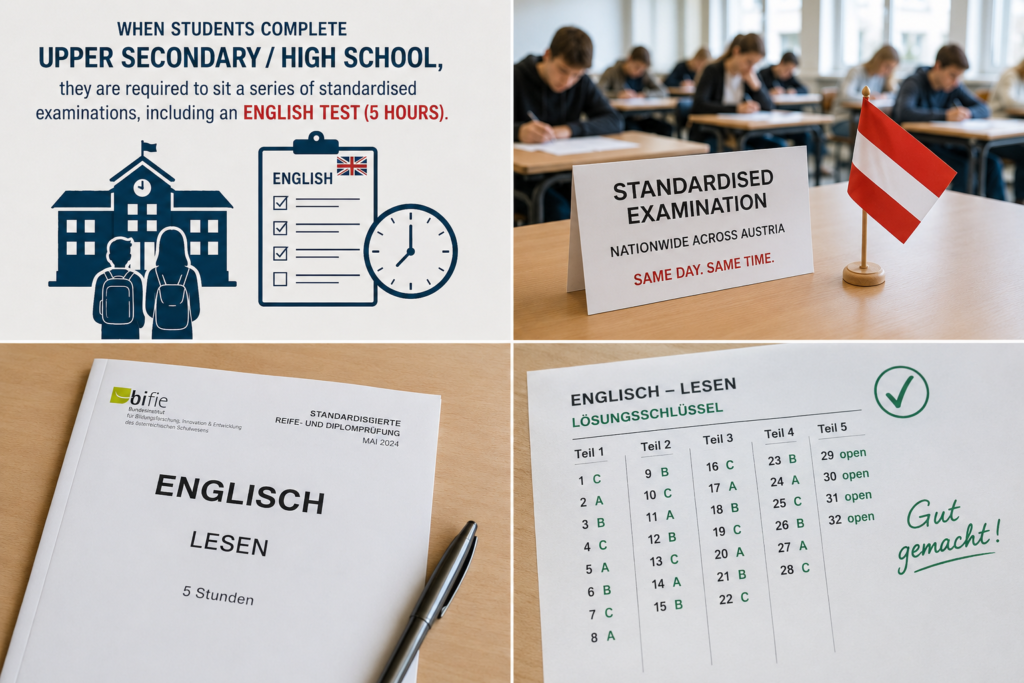
When students complete upper secondary/high school, they are required to sit a series of standardised examinations, including an English test (5 hours). This assessment is administered nationwide across Austria on the same day and at the same time. Attached you will find the reading (LESEN) paper, while the second PDF contains the answer key, allowing you to check and evaluate your own performance.
Mobile phones are very common today. Many people have a mobile phone. Children, students, workers, and old people use them every day. Mobile phones help people in many ways, but they also bring some problems.
One good thing about mobile phones is talking to people. People can call family and friends very fast. They can also send text messages. A person can talk to someone in another city or another country. This helps people stay close to family and friends.
Mobile phones also help people at school and work. Students can look for information on the internet. They can read and learn new things. Workers can read emails and talk to people from work. Many people use phones to check the time, write notes, or use a map.
Another good thing is help in danger. If a person has a problem, they can call for help quickly. For example, after a car accident, a person can call the police or a doctor. This can save time and help people stay safe.
People also use mobile phones for fun. They can listen to music, watch videos, play games, and take photos. Many people enjoy sharing photos with family and friends. Phones can make free time more fun.
However, mobile phones also have bad sides. One problem is that some people use them too much. They look at the phone all day and do not talk much to people near them. Some children play games for many hours and do not study enough.
Another problem is health. Looking at a phone for a long time can hurt the eyes. Some people sleep late because they use the phone at night. This can make them tired in the morning.
Mobile phones can also cost a lot of money. New phones are often very expensive. People also pay money every month for internet and calls. Some families do not have enough money for this.
There is also danger on the internet. Some people send bad messages or try to take money from others online. Because of this, people must be careful when they use mobile phones and the internet.
In conclusion, mobile phones are useful in many ways. They help people talk, learn, work, and have fun. At the same time, they can bring problems with health, money, and too much use. People should use mobile phones in a smart and careful way.
__________________
Vocabulary:
to be common — to happen often or exist in many places
in many ways — in different manners or forms
to bring problems — to cause difficulties
to stay close to somebody — to remain near a person
to check the time — to look at a clock or phone to know the hour
to write a note — to write a short message or reminder
to use a map — to look at a map [picture or drawing that shows places, roads, or directions]for directions
help in danger — assistance when someone is in a risky situation
an accident — an unexpected bad event, often causing damage or injury
to save time — to make something quicker or use less time
to stay safe — to avoid danger or harm
to enjoy sharing photos — to like posting or showing pictures to others
free time — time when you are not working or studying
however — but; used to show contrast
enough — as much as needed
health — the condition of your body and mind
to hurt the eyes — to cause pain or discomfort in the eyes
to be tired — to feel that you need rest or sleep
to be expensive — to cost a lot of money
in conclusion — finally; to finish an opinion [what a person thinks or believes about something] or text
to use in a smart way — to use carefully and effectively
in a careful way — with attention and caution
#############
Match the words with the definitions:
Words
to be common
in many ways
to bring problems
to stay close to somebody
to check the time
to write a note
to use a map
help in danger
an accident
to save time
to stay safe
to enjoy sharing photos
free time
however
enough
health
to hurt the eyes
to be tired
to be expensive
in conclusion
to use in a smart way
in a careful way
Definitions
A. to cause difficulties B. to remain near a person C. to look at a clock or phone to know the hour D. to write a short message or reminder E. assistance when someone is in a risky situation F. to make something quicker or use less time G. to avoid danger or harm H. an unexpected bad event, often causing damage or injury I. to like posting or showing pictures to others J. but; used to show contrast K. as much as needed L. the condition of your body and mind M. to cause pain or discomfort in the eyes N. to feel that you need rest or sleep O. to cost a lot of money P. finally; to finish an opinion or text Q. to use carefully and effectively R. in different manners or forms S. to happen often or exist in many places T. time when you are not working or studying U. doing something slowly and safely so you do not make mistakes or get hurt
Email, sandwich, work, office — Odd one: sandwich (others are related to work or communication)
Family, chatting, television, friends — Odd one: television (others involve people or communication)
Save time, fast, chair, quick — Odd one: chair (others describe speed or efficiency)
Safe, danger, book, careful — Odd one: book (others relate to safety or risk)
#############
Match the halves (based on the text)
A
Mobile phones are very common today because…
People can stay close to family and friends by…
Students use mobile phones to…
Mobile phones can help in danger because…
People use mobile phones in free time to…
One problem of mobile phones is that…
Mobile phones should be used in a smart way because…
B
A. they are useful in modern life. B. calling and sending messages. C. learn and find information. D. enjoy music, videos, and games. E. they can call for help after an accident. F. they can hurt the eyes if used too much. G. they help people in many ways.
Answer Key
1-G, 2-B, 3-C, 4-E, 5-D, 6-F, 7-A
#############
Mobile phones are very a) common b) broken c) rare
People use phones to stay a) far b) close c) asleep
Students use mobile phones to a) sleep b) cook c) learn
Mobile phones can help in a) danger b) weather c) lunch
Free time is when people are a) working b) relaxing c) driving
A map is used to find a) food b) music c) places
Mobile phones can help to a) lose b) save c) waste
Too much phone use can hurt the a) books b) shoes c) eyes
Workers use phones to read a) chairs b) emails c) sandwiches
Mobile phones help people stay a) heavy b) slow c) safe
People can use phones to a) eat b) send c) build messages
In danger, people can a) call b) sing c) draw
Phones are useful in a) no b) many c) few ways
In conclusion, mobile phones are very a) useful b) broken c) useless
Mobile phones help people a) stay b) forget c) leave close to others
Students can a) learn b) sleep c) cook from mobile phones
A phone can be used to a) check b) break c) hide the time
Mobile phones are used for a) games b) stones c) water and music
People use phones to send a) tables b) messages c) chairs
Mobile phones can be a) natural b) dangerous c) useless if used too much
Today, many people use mobile phones every day. Mobile phones help people talk to family and friends, learn new things, and have fun. They are very important for school, work, and free time. However, some people think mobile phones can also bring problems. In this dialogue, Anna and Mark talk about the good and bad sides of mobile phones. Mark likes mobile phones very much, but Anna is more careful and does not like some things about them.
Anna: Hi Mark! What are you doing on your phone?
Mark: Hi Anna! I am watching a video. I love my mobile phone. I use it every day.
Anna: Really? I do not like mobile phones very much.
Mark: Why not? Mobile phones are very useful.
Anna: Sometimes yes, but sometimes they are bad too.
Mark: I think they are great. I can call my family and friends very fast. Yesterday I called my cousin in Spain.
Anna: Yes, that is good. I also call my grandmother every week. But many people use phones too much.
Mark: Maybe, but phones help people stay close. I talk to my friends every day.
Anna: But do you talk face to face?
Mark: Yes, of course! I talk face to face and on the phone too.
Anna: Some people only look at their phones. At lunch they do not talk. They only look at the screen.
Mark: That is true for some people, but not for everyone.
Anna: My little brother plays games on his phone for many hours. He does not do his homework first.
Mark: I understand. Too many games are not good. But games can also be fun after school.
Anna: Yes, maybe for a short time.
Mark: Phones also help at school. I use my phone to read and learn English words.
Anna: I sometimes use my phone for school too. I look for information on the internet.
Mark: You see? Phones are helpful!
Anna: Yes, but there are also dangers on the internet.
Mark: What kind of dangers?
Anna: Bad people can send bad messages. Some people want money from others online.
Mark: That is true. People must be careful.
Anna: Also, phones are very expensive now. New phones cost a lot of money.
Mark: Yes, some phones are very expensive. But people do not always need a new phone.
Anna: My friend buys a new phone every year.
Mark: That is too much. I use my phone for many years.
Anna: Another problem is sleep. Many people use phones late at night.
Mark: I sometimes do that too. Then I feel tired in the morning.
Anna: You see! Phones can cause problems.
Mark: Yes, but many things can cause problems if people use them too much.
Anna: Maybe you are right.
Mark: Phones can also help in danger. One time my father had a car problem, and he called for help with his phone.
Anna: That is very useful. In an emergency, phones are very important.
Mark: Phones also have maps. When I visit a new place, I use my phone to find streets and shops.
Anna: I use maps too. They help me a lot in big cities.
Mark: And I love taking photos with my phone.
Anna: Me too! I take photos of my dog every day.
Mark: So maybe you like mobile phones a little.
Anna: Maybe a little! I think phones are good when people use them in a smart way.
Mark: I agree. Phones are very useful, but people must not use them all day.
Anna: Yes. People need time for family, friends, sports, and school too.
Mark: That is true. A mobile phone is good, but life without the phone is important too.
Anna: I like that idea.
Mark: Me too!
#############
BONUS DIALOGUE in B2
Today, mobile phones play a significant role in modern society. People rely on them for communication, education, entertainment, and work-related tasks. They make it possible to stay in contact with others instantly, access information online, and complete many daily activities more efficiently. Nevertheless, despite their numerous advantages, mobile phones also have certain disadvantages that concern many people. In this conversation, Anna and Mark exchange their opinions about the positive and negative effects of mobile phones. Mark strongly appreciates the benefits they provide, whereas Anna is more critical and believes that excessive phone usage can create serious problems.
Anna: Hi Mark! What are you doing on your phone?
Mark: Hi Anna! I’m watching a video online. I absolutely love my mobile phone and use it constantly throughout the day.
Anna: Really? To be honest, I’m not particularly fond of mobile phones.
Mark: Why do you feel that way? In my opinion, mobile phones are incredibly practical and convenient.
Anna: They certainly have advantages, but they can also cause a variety of problems.
Mark: Personally, I think they are excellent devices. For example, I can communicate with my family and friends immediately whenever I want. Yesterday, I even called my cousin who lives in Spain.
Anna: I agree that this is very beneficial. I also call my grandmother regularly every week. However, many individuals spend an unreasonable amount of time using their phones.
Mark: That might be true in some cases, but mobile phones allow people to maintain close relationships even when they live far away. I communicate with my friends daily because of my phone.
Anna: But do you still interact with people in person and have real face-to-face conversations?
Mark: Of course I do! I enjoy speaking to people directly as well as communicating digitally.
Anna: Unfortunately, some people become completely absorbed in their phones. For instance, during meals they ignore everyone around them and focus entirely on their screens instead of having conversations.
Mark: I admit that this happens quite often, but it certainly does not apply to everybody.
Anna: My younger brother spends several hours playing games on his phone every day. Instead of concentrating on his homework, he wastes time online.
Mark: I understand your concern. Excessive gaming can definitely become unhealthy. Nevertheless, playing games occasionally after school can still be entertaining and relaxing.
Anna: Perhaps, but only in moderation.
Mark: Mobile phones can also be extremely useful in education. I frequently use mine to read articles and improve my English vocabulary.
Anna: I sometimes use my phone for academic purposes as well. I often search the internet for information when I need to complete school assignments.
Mark: Exactly! That clearly demonstrates how helpful mobile phones can be.
Anna: That may be true, but the internet also contains many dangers and risks.
Mark: What kind of dangers are you referring to?
Anna: Some dishonest individuals send harmful or threatening messages online, while others attempt to deceive people in order to steal money from them.
Mark: You’re absolutely right. People need to behave carefully and responsibly when they use the internet.
Anna: Another issue is the price of modern smartphones. Many new models are extremely expensive nowadays.
Mark: I completely agree. Some phones cost far too much money, although I don’t think people need to replace their phones so frequently.
Anna: One of my friends buys a brand-new phone every single year.
Mark: In my opinion, that’s completely unnecessary. I usually keep the same phone for many years before replacing it.
Anna: Lack of sleep is another serious problem connected to mobile phones. Many people spend hours using them late at night.
Mark: I sometimes make the same mistake myself, and then I feel exhausted and unable to concentrate the following morning.
Anna: Exactly! That proves mobile phones can negatively affect people’s daily lives.
Mark: That’s true, but almost anything can become harmful if people use it excessively and without self-control.
Anna: Perhaps you have a point.
Mark: Mobile phones can also be extremely valuable in emergency situations. Once, my father experienced car trouble and immediately used his phone to call for assistance.
Anna: That’s definitely very useful. In emergencies, mobile phones can be absolutely essential.
Mark: They also provide navigation and maps. Whenever I travel to an unfamiliar place, I use my phone to locate streets, shops, and restaurants.
Anna: I use map applications as well, especially when I visit large cities. They make travelling much easier.
Mark: Another thing I enjoy is taking photographs with my phone.
Anna: Me too! I take pictures of my dog almost every day because he always does something funny.
Mark: So perhaps you actually like mobile phones more than you admit.
Anna: Maybe just a little! I believe phones are beneficial as long as people use them wisely and responsibly.
Mark: I completely agree with you. Mobile phones are extremely useful tools, but people should not spend their entire lives staring at screens.
Anna: Exactly. People also need to dedicate time to their families, friends, education, hobbies, and physical activities.
Mark: That’s absolutely true. Although mobile phones are important and practical, life beyond technology is equally important.
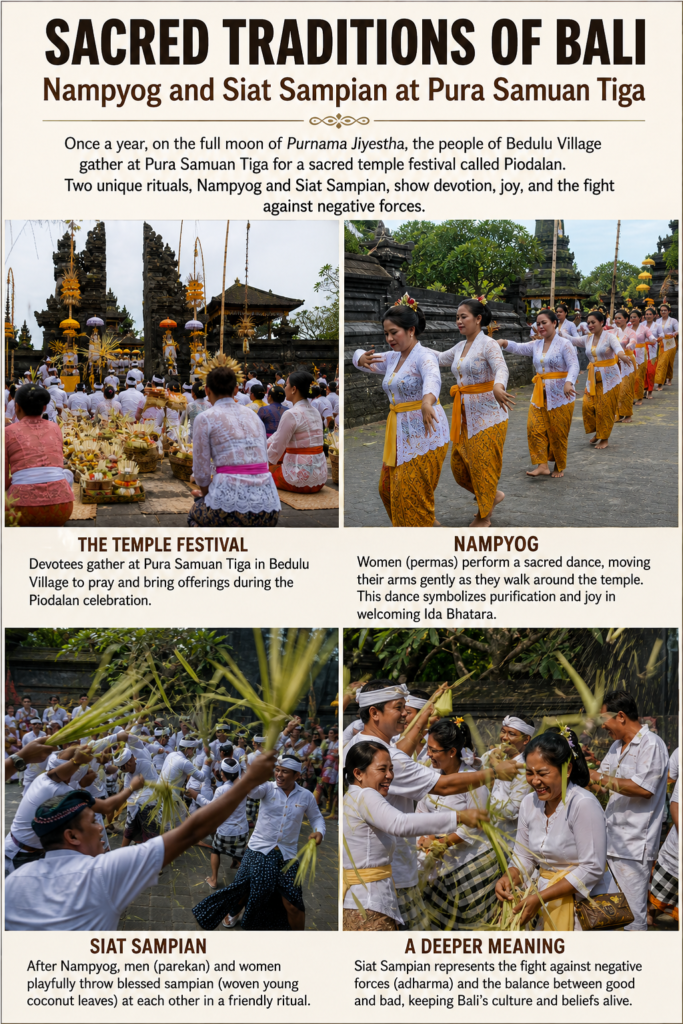
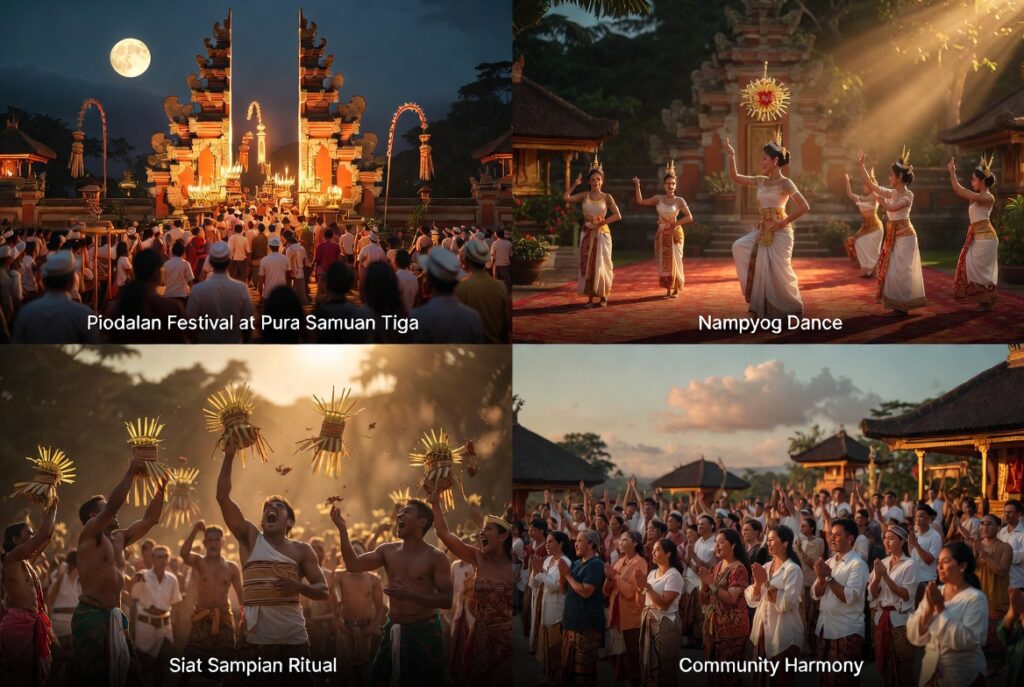
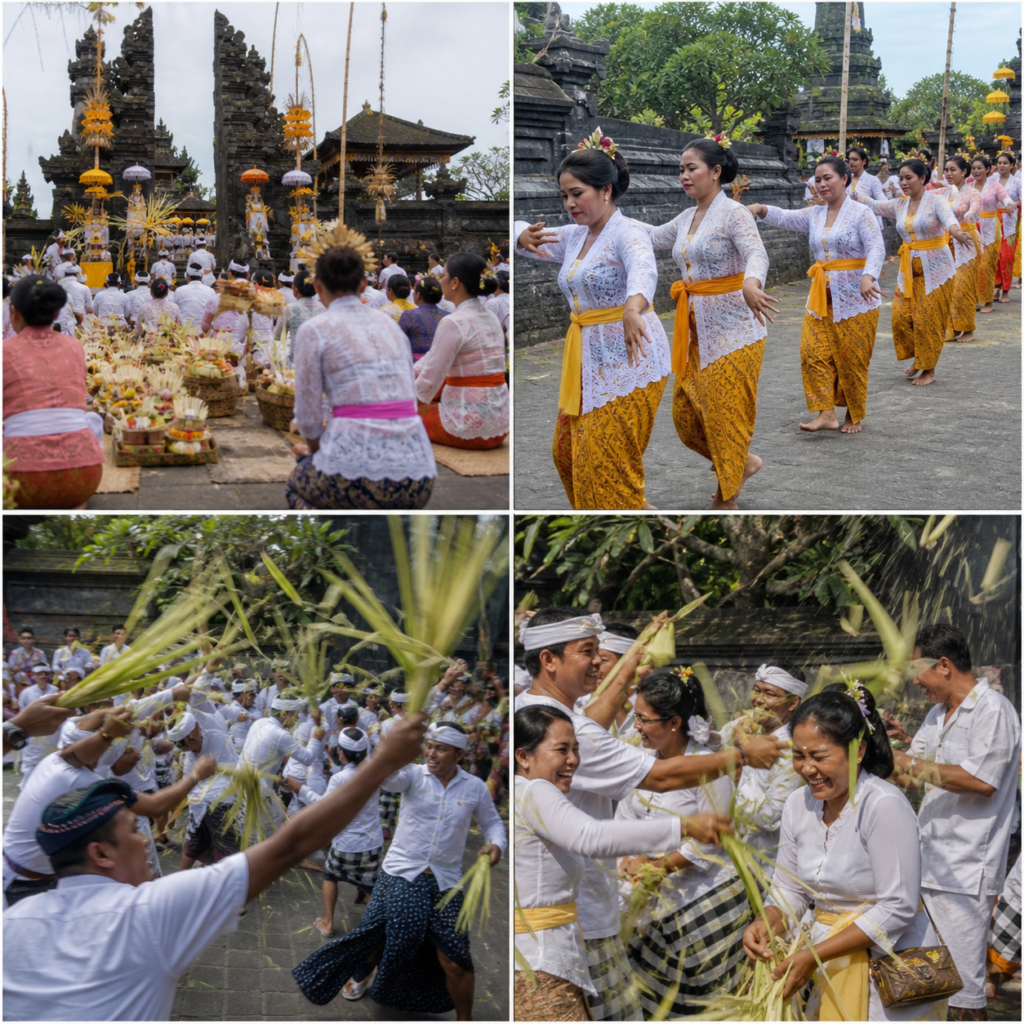
The Nampyog and Siat Sampian traditions are rituals in Bali. They take place at Pura Samuan Tiga in Bedulu village. People do these rituals once a year. The festival is called Piodalan. It happens on the full moon of Purnama Jiyestha. Many people come to the temple. They come to pray together. They wear traditional clothes. They bring offerings for the temple. The temple becomes very busy. People come from nearby villages. They come to see the festival.
Nampyog is a dance. Women do this dance. The women are called permas. They move their arms slowly. They walk around the temple. They walk in a straight line. The dance is simple. The dance is beautiful. It shows respect. It shows clean body and mind. The women welcome the gods. The gods are called Ida Bhatara. The music is soft and calm. People feel peaceful when they watch the dance.
After Nampyog, there is Siat Sampian. Men and women join this ritual. The men are called parekan. They use sampian. Sampian are made from young coconut leaves. The sampian are blessed before use. People throw the sampian at each other. It looks like a fight. But it is not dangerous. It is playful. It is safe for everyone. Children also watch the ritual.
Siat Sampian shows a fight against bad things. Bad things are called adharma. The ritual shows balance between good and bad. It is important for the community. These traditions help people remember their culture. They bring people together every year. People feel happy during the event. Everyone joins together. In a simple way.
_____________________________
Vocabulary:
a ritual = a special action people do for religion or tradition
traditional clothes = clothes from a culture or tradition
to bring offerings = to give special things for prayer or respect
to become busy = to have many people or activities
a straight line = a line with no curves
to show respect = to act politely and kindly
a clean mind = peaceful and good thoughts
to feel peaceful = to feel calm and relaxed
to join a ritual = to take part in a ritual
a leaf (pl. leaves) = the green part of a plant or tree
to be blessed = to receive holy or good wishes
to be playful = to be fun and not serious
to show balance between good and bad = to show both good and bad sides equally
a community = a group of people living together or sharing something
to remember = to keep something in your mind
to join together = to come together as a group
##################
Match word and defintion:
Words:
a ritual
traditional clothes
to bring offerings
to become busy
a straight line
to show respect
a clean mind
to feel peaceful
to join a ritual
a leaf
to be blessed
to be playful
to show balance between good and bad
a community
to remember
to join together
Definitions:
a. to keep something in your mind b. to come together as a group c. clothes from a culture or tradition d. to receive holy or good wishes e. to have many people or activities f. the green part of a plant or tree g. to feel calm and relaxed h. a line with no curves i. to show both good and bad sides equally j. a special action people do for religion or tradition k. to act politely and kindly l. to take part in a ritual m. peaceful and good thoughts n. to be fun and not serious o. a group of people living together or sharing something p. to give special things for prayer or respect
a special action people do for religion or tradition
clothes from a culture or tradition
to give special things for prayer or respect
to have many people or activities
a line with no curves
to act politely and kindly
peaceful and good thoughts
to feel calm and relaxed
to take part in a ritual
the green part of a plant or tree
to receive holy or good wishes
to be fun and not serious
to show both good and bad sides equally
a group of people living together or sharing something
to keep something in your mind
to come together as a group
Words:
a. to feel peaceful b. to become busy c. to join together d. a leaf e. to show respect f. a community g. a clean mind h. to bring offerings i. traditional clothes j. to be playful k. a ritual l. to remember m. to show balance between good and bad n. to join a ritual o. to be blessed p. a straight line
dangerous – peaceful – respect – balance — dangerous — The ritual is described as safe and peaceful, not dangerous
ritual – festival – game – dance — game — The activities are cultural/religious, not a game
gods – men – women – children — gods — Gods are not human participants in the event like the others
loud – slow – calm – peaceful — loud — The dance music is described as soft and calm, not loud
market – temple – village – festival — market — The event takes place in a temple and village, not a market
sell goods – pray together – bring offerings – join together — sell goods — People come to pray and perform rituals, not to sell goods
##############
Fill in, words below:
straight – pray – community – rituals – offerings – leaves – playful – village – performed – peaceful – full moon
The Nampyog and Siat Sampian traditions are __________ in Bali. They take place at Pura Samuan Tiga in Bedulu __________ during the festival Piodalan on the __________ of Purnama Jiyestha. People come to __________ together, wear traditional clothes, and bring __________, so the temple becomes busy. Nampyog is a dance __________ by women called permas. The women move in a __________ line and show respect, a clean mind, and __________ feelings for Ida Bhatara. Siat Sampian uses sampian made from __________. It looks __________ but shows balance between good and bad. The ritual helps the __________ remember to join together every year.
___________________
Correct version:
The Nampyog and Siat Sampian traditions are rituals in Bali. They take place at Pura Samuan Tiga in Bedulu village during the festival Piodalan on the full moon of Purnama Jiyestha. People come to pray together, wear traditional clothes, and bring offerings, so the temple becomes busy. Nampyog is a dance performed by women called permas. The women move in a straight line and show respect, a clean mind, and peaceful feelings for Ida Bhatara. Siat Sampian uses sampian made from leaves. It looks playful but shows balance between good and bad. The ritual helps the community remember to join together every year.
###############
Match question and answer:
What do people call the ritual?
Where do people celebrate the ritual?
When do people hold the festival?
Why do many people come to the temple?
Which clothes do people put on at the festival?
Which things do people give to the temple?
Is Nampyog a dance or a game?
Who performs the Nampyog dance?
How do the women walk during the dance?
Which feeling does the dance give?
Is Siat Sampian serious or playful?
How do people make sampian?
Can children watch the ritual?
Why do people like the ritual?
a. Young coconut leaves become sampian. b. The event takes place at Pura Samuan Tiga in Bedulu village. c. People know it as Nampyog and Siat Sampian. d. People think it is playful. e. Women called permas take part in it. f. They wear traditional clothes. g. The festival comes once a year. h. They move slowly in a straight line. i. Yes, children also enjoy the event. j. They want to pray together. k. People feel respect and peace from it. l. It helps people keep their culture and stay together. m. People see it as a beautiful dance. n. They bring offerings to the temple.
In 2026, Waisak Day was on May 1. My name is Indra, and I want to tell my story. This year, I went to Borobudur. It is a very big and famous temple. I felt excited and a little nervous.
I woke up very early in the morning. The sky was still dark. My family and I walked with many people. Everyone wore white clothes. The air was quiet and calm. I could see many candles and soft lights.
When we arrived, I looked at the temple. It was very big and beautiful. There were many steps and stone statues. I stayed close to my parents. I felt small, but happy to be there.
The monks started the ceremony. They chanted slowly. The sound was soft and peaceful. I did not understand all the words, but I felt calm inside. I closed my eyes and listened.
I had flowers and a candle. I put the flowers near the temple and lit my candle. I thought about being kind and helping others. I wanted to be a better person.
Later, we sat down quietly. I tried to meditate. My mind moved a lot, but I tried to focus. I took slow breaths. After some time, I felt more peaceful.
At night, we walked together with candles. There were so many lights. It looked like stars on the ground. I smiled and looked around. Everyone was calm and kind.
When we went home, I felt tired but very happy. This Waisak Day was special for me. I will always remember my time at Borobudur.
_____________________
Vocabulary:
a festival: a special day or event for celebration
to feel excited: to feel very happy and full of energy
to wake up: to stop sleeping
the sky: the space above the Earth where clouds and sun are
to be quiet: to make no noise
to be calm: to feel relaxed and not worried
a candle: a stick that gives light when it burns
a soft light: gentle light that is not bright
to stay close to somebody: to be near someone
a monk: a religious man who lives simply and prays
a ceremony: a formal event for a special reason
to chant: to say words or prayers again and again in a rhythm
to be peaceful: to feel very calm and happy inside
to feel calm: to feel relaxed and not stressed
to light a candle: to make a candle start burning
to be kind: to be nice and helpful to others
to meditate: to sit quietly and clear your mind
to focus on something: to give attention to one thing
to take a slow breath: to breathe in and out slowly
to feel tired: to need rest or sleep
to remember: to think again about something from the past
Match word/s with definition:
WORDS
a festival
to feel excited
to wake up
the sky
to be quiet
to be calm
a candle
a soft light
to stay close to somebody
a monk
a ceremony
to chant
to be peaceful
to feel calm
to light a candle
to be kind
to meditate
to focus on something
to take a slow breath
to feel tired
to remember
DEFINITIONS
A. to make no noise B. to think again about something from the past C. a formal event for a special reason D. to feel relaxed and not worried E. a stick that gives light when it burns F. to give attention to one thing G. to stop sleeping H. to sit quietly and clear your mind I. to be near someone J. space above the Earth where clouds are K. to be nice and helpful L. to feel very happy and full of energy M. to feel need for sleep or rest N. a religious man who lives simply and prays O. to breathe in and out slowly P. a special day or event for celebration Q. gentle light that is not bright R. to say prayers or words again and again in rhythm S. to feel relaxed and not stressed T. to make a candle start burning U. very calm and happy inside
A. to meditate B. a monk C. to feel tired D. a festival E. to light a candle F. to be kind G. to chant H. the sky I. to take a slow breath J. to feel calm K. to wake up L. a soft light M. to remember N. to be quiet O. to feel excited P. a ceremony Q. to be peaceful R. to stay close to somebody S. to focus on something T. a candle U. to be calm
Irregular verbs change their form in the past tense. They do not add “-ed.”
Examples:
go → went
eat → ate
have → had
see → saw
come → came
################
Regular/irregular verbs in text:
Infinitive
Past form
Definition (A1)
be
was / were
to exist or to be in a place or situation
tell
told
to give information or say something to someone
go
went
to move from one place to another
feel
felt
to experience an emotion or physical state
wake up
woke up
to stop sleeping
walk
walked
to move on foot
wear
wore
to have clothes on your body
see
saw
to notice with your eyes
arrive
arrived
to reach a place
look
looked
to use your eyes to see something
stay
stayed
to remain in a place
start
started
to begin
chant
chanted
to say words or prayers in rhythm
understand
understood
to know the meaning of something
close
closed
to shut something
listen
listened
to hear carefully
have
had
to possess or hold something
put
put
to place something somewhere
light
lit
to make something burn and give light
think
thought
to use your mind to consider something
want
wanted
to feel desire for something
sit down
sat down
to lower your body and rest on a seat or ground
try
tried
to attempt to do something
meditate
meditated
to sit quietly and clear your mind
move
moved
to change position
focus
focused
to give attention to one thing
take
took
to carry or bring something with you
smile
smiled
to show happiness with your mouth
remember
remembered
to bring information back into your mind
###############
Fill in the correct form of past simple:
Indra __________ (go) to Borobudur for Waisak Day in 2026.
He __________ (wake up) early when the sky was still dark.
His family __________ (walk) with many people wearing white clothes.
Indra __________ (feel) excited and a little nervous.
He __________ (see) the big and beautiful temple.
They __________ (arrive) at Borobudur in the morning.
Indra __________ (look) at the stone statues and many steps.
He __________ (stay) close to his parents during the visit.
The monks __________ (start) the ceremony and __________ (chant) slowly.
Indra __________ (listen) to the soft and peaceful sounds.
He __________ (close) his eyes to feel calm inside.
Indra __________ (put) flowers near the temple and __________ (light) a candle.
He __________ (think) about being kind and helping others.
He __________ (try) to meditate, __________ (focus) on breathing, and __________ (take) slow breaths.
—————————–
Correct version:
Indra went to Borobudur for Waisak Day in 2026.
He woke up early when the sky was still dark.
His family walked with many people wearing white clothes.
Indra felt excited and a little nervous.
He saw the big and beautiful temple.
They arrived at Borobudur in the morning.
Indra looked at the stone statues and many steps.
He stayed close to his parents during the visit.
The monks started the ceremony and chanted slowly.
Indra listened to the soft and peaceful sounds.
He closed his eyes to feel calm inside.
Indra put flowers near the temple and lit a candle.
He thought about being kind and helping others.
He tried to meditate, focused on breathing, and took slow breaths.
True or false:
Indra went to Borobudur temple.
Indra felt angry during the visit.
The monks chanted slowly.
Indra woke up in the afternoon.
People wore white clothes.
The chanting was fast and loud.
Indra lit a candle and put flowers near the temple.
The sky was still dark in the morning.
Indra traveled alone without family.
The atmosphere was quiet and calm.
Indra tried to meditate and focus on breathing.
Waisak Day in the story was on May 5, 2026.
Borobudur is a very big and famous temple.
Indra stayed close to his parents.
Indra was running around instead of sitting quietly.
Indra’s family walked with many people.
The ceremony was led by teachers instead of monks.
At night, they walked with candles.
Indra felt excited and a little nervous.
The temple was small and modern.
The monks started the ceremony.
Indra woke up early in the morning.
Indra did not bring flowers or candles.
The sky was bright and sunny in the morning.
The monks chanted slowly.
Indra stayed far away from his parents.
Indra felt excited and a little nervous.
The atmosphere was loud and chaotic.
Indra went to Borobudur temple.
They went home before sunset.
_______________ Correct answers:
Indra went to Borobudur temple.
Indra felt angry during the visit. True is: Indra felt excited and a little nervous.
The monks chanted slowly.
Indra woke up in the afternoon. True is: Indra woke up early in the morning.
People wore white clothes.
The chanting was fast and loud. True is: The monks chanted slowly.
Indra lit a candle and put flowers near the temple.
The sky was still dark in the morning.
Indra traveled alone without family. True is: Indra’s family walked with many people.
The atmosphere was quiet and calm.
Indra tried to meditate and focus on breathing.
Waisak Day in the story was on May 5, 2026. True is: Waisak Day was on May 1, 2026.
Borobudur is a very big and famous temple.
Indra stayed close to his parents.
Indra was running around instead of sitting quietly. True is: Indra tried to meditate and focus on breathing.
Indra’s family walked with many people.
The ceremony was led by teachers instead of monks. True is: The monks started the ceremony.
At night, they walked with candles.
Indra felt excited and a little nervous.
The temple was small and modern. True is: Borobudur is a very big and famous temple.
The monks started the ceremony.
Indra woke up early in the morning.
Indra did not bring flowers or candles. True is: Indra lit a candle and put flowers near the temple.
The sky was bright and sunny in the morning. True is: The sky was still dark in the morning.
The monks chanted slowly.
Indra stayed far away from his parents. True is: Indra stayed close to his parents.
Indra felt excited and a little nervous.
The atmosphere was loud and chaotic. True is: The atmosphere was quiet and calm.
Indra went to Borobudur temple.
They went home before sunset. True is: At night, they walked with candles.
###################
Answer in complete sentences:
Did Indra go to Borobudur temple or Prambanan temple?
YOU WRITE: Indra went to Borobudur temple.
Did Indra feel angry or excited during the visit?
Did the monks chant slowly or loudly?
Did Indra wake up in the afternoon or early in the morning?
Did people wear white or red clothes?
Was the chanting fast and loud or slow and peaceful?
Did Indra light a candle and bring flowers or bring food?
Was the sky dark or bright in the morning?
Did Indra travel with his family or alone?
Was the atmosphere quiet and calm or loud and chaotic?
Did Indra meditate or run around?
Was Waisak Day on May 5 or May 1, 2026?
Is Borobudur a big famous temple or a small modern building?
Did Indra stay close to his parents or far away?
Was Indra sitting quietly or running around?
Did Indra’s family walk with many people or stay at home?
Was the ceremony led by monks or teachers?
Did they walk with candles at night or in the afternoon?
Did Indra feel nervous or bored?
Was the temple big and famous or small and modern?
Did the monks start the ceremony or cancel it?
Did Indra wake up early or late?
Did Indra bring flowers and a candle or nothing?
Was the sky dark or sunny in the morning?
Did the monks chant or stay silent?
Did Indra stay close to his parents or far away?
Did Indra feel excited or angry?
Was the atmosphere calm or chaotic?
Did Indra go to Borobudur or stay at home?
Did they go home at night or before sunset?
________________________
Correct answers:
Did Indra go to Borobudur temple or Prambanan temple? Indra went to Borobudur temple.
Did Indra feel excited or angry during the visit? Indra felt excited during the visit.
Did the monks chant slowly or loudly? The monks chanted slowly.
Did Indra wake up early or late? Indra woke up early in the morning.
Did people wear white or red clothes? People wore white clothes.
Was the chanting slow and peaceful or fast and loud? The chanting was slow and peaceful.
Did Indra light a candle and bring flowers or bring food? Indra lit a candle and brought flowers.
Was the sky dark or bright in the morning? The sky was dark in the morning.
Did Indra travel with his family or alone? Indra traveled with his family.
Was the atmosphere quiet and calm or noisy and chaotic? The atmosphere was quiet and calm.
Did Indra meditate or run around? Indra meditated.
Was Waisak Day on May 1 or May 10, 2026? Waisak Day was on May 1, 2026.
Is Borobudur a big famous temple or a small modern building? Borobudur is a big famous temple.
Did Indra stay close to his parents or far away? Indra stayed close to his parents.
Was Indra sitting quietly or running around? Indra was sitting quietly.
Did Indra’s family walk with many people or stay at home? Indra’s family walked with many people.
Was the ceremony led by monks or teachers? The ceremony was led by monks.
Did they walk with candles at night or in the afternoon? They walked with candles at night.
Did Indra feel nervous or bored? Indra felt nervous.
Was the temple big and famous or small and modern? The temple was big and famous.
Did the monks start the ceremony or cancel it? The monks started the ceremony.
Did Indra wake up early or late? Indra woke up early.
Did Indra bring flowers and a candle or nothing? Indra brought flowers and a candle.
Was the sky dark or sunny in the morning? The sky was dark in the morning.
Did the monks chant or stay silent? The monks chanted.
Did Indra stay close to his parents or far away? Indra stayed close to his parents.
Did Indra feel excited or angry? Indra felt excited.
Was the atmosphere calm or chaotic? The atmosphere was calm.
Did Indra go to Borobudur or stay at home? Indra went to Borobudur.
Did they go home at night or before sunset? They went home at night.
##################
Odd one out:
football – candle – flower – temple
CORRECT: Football is the odd one because it is a sport, while the others are related to the ceremony and place.
monk – airplane – ceremony – chant
calm – noisy – peaceful – quiet
wake up – walk – sleep – run
white – blue – clothes – candle
supermarket – temple – steps – statue
meditate – shout – focus – breathe
night – candle – darkness – light
family – monk – parents – children
happy – angry – excited – nervous
candle – flower – book – light
temple – statue – car – steps
calm – quiet – loud – peaceful
meditate – run – breathe – focus
parents – teacher – family – children
________________________
Correct answers:
football – candle – flower – temple → Football is the odd one because it is a sport, while the others are related to the ceremony and place.
monk – airplane – ceremony – chant → Airplane is the odd one because it is a transport, while the others are part of a religious event.
calm – noisy – peaceful – quiet → Noisy is the odd one because it means loud, while the others describe peaceful feelings.
wake up – walk – sleep – run → Sleep is the odd one because it is a resting action, while the others are active movements.
white – blue – clothes – candle → Candle is the odd one because it is an object, while the others are related to clothing or color.
supermarket – temple – steps – statue → Supermarket is the odd one because it is a shopping place, while the others are parts of Borobudur.
meditate – shout – focus – breathe → Shout is the odd one because it is loud, while the others are calm actions.
night – candle – darkness – light → Candle is the odd one because it is an object, while the others describe time or conditions.
family – monk – parents – children → Monk is the odd one because it is a religious role, while the others are family members.
happy – angry – excited – nervous → Angry is the odd one because it is negative, while the others are feelings from excitement or emotion.
candle – flower – book – light → Book is the odd one because it is not used in the ceremony.
temple – statue – car – steps → Car is the odd one because it is a vehicle, while the others are parts of the temple.
calm – quiet – loud – peaceful → Loud is the odd one because it is noisy, while the others are peaceful states.
meditate – run – breathe – focus → Run is the odd one because it is fast movement, while the others are calm actions.
parents – teacher – family – children → Teacher is the odd one because it is a school role, while the others are family members.
##################
Short answers, past simple, basics:
Example Sentence
Yes
No
I learned letters.
Yes, I did.
No, I didn’t.
You read signs.
Yes, you did.
No, you didn’t.
He spoke English.
Yes, he did.
No, he didn’t.
She watched TV.
Yes, she did.
No, she didn’t.
It helped me.
Yes, it did.
No, it didn’t.
We used an app.
Yes, we did.
No, we didn’t.
You read words.
Yes, you did.
No, you didn’t.
They made mistakes.
Yes, they did.
No, they didn’t.
Questions (Past Simple)
Question
Yes
No
Did I learn letters?
Yes, I did.
No, I didn’t.
Did you read signs?
Yes, you did.
No, you didn’t.
Did he speak English?
Yes, he did.
No, he didn’t.
Did she watch TV?
Yes, she did.
No, she didn’t.
Did it help me?
Yes, it did.
No, it didn’t.
Did we use an app?
Yes, we did.
No, we didn’t.
Did you read words?
Yes, you did.
No, you didn’t.
Did they make mistakes?
Yes, they did.
No, they didn’t.
Was / Were
Question
Yes
No
Was I happy?
Yes, I was.
No, I wasn’t.
Were you happy?
Yes, you were.
No, you weren’t.
Was he happy?
Yes, he was.
No, he wasn’t.
Was she happy?
Yes, she was.
No, she wasn’t.
Was it good?
Yes, it was.
No, it wasn’t.
Were we happy?
Yes, we were.
No, we weren’t.
Were you happy?
Yes, you were.
No, you weren’t.
Were they happy?
Yes, they were.
No, they weren’t.
################# Short answers:
He practiced intense conversation during meditation time. YOU WRITE: No, he didn’t.
The monks chanted slowly and peacefully.
The temple had modern glass walls instead of stone structures.
He put flowers near the temple and lit a candle.
He woke up late in the afternoon.
Waisak Day 2026 happened on May 1.
The sky was bright and sunny at sunrise.
He closed his eyes and listened to the chanting.
He felt small but happy at Borobudur.
He went alone to Borobudur.
The temple has many steps and stone statues.
He understood every word of the chanting.
His family walked with many other people.
The ceremony had bright electric lighting.
He arrived in the afternoon.
Everyone wore white clothes.
The monks started the ceremony.
The walk at night was loud and chaotic.
The sky was still dark when he woke up.
He went home feeling tired but happy.
He talked continuously during meditation time.
The air was quiet and calm.
The temple was small and modern.
At night they walked together with candles.
He felt angry during the ceremony.
The monks chanted very fast and loudly.
________________________ Correct version:
He practiced intense conversation during meditation time. No, he didn’t.
The monks chanted slowly and peacefully. Yes, they did.
The temple had modern glass walls instead of stone structures. No, it didn’t.
He put flowers near the temple and lit a candle. Yes, he did.
He woke up late in the afternoon. No, he didn’t.
Waisak Day 2026 happened on May 1. Yes, it did.
The sky was bright and sunny at sunrise. No, it wasn’t.
He closed his eyes and listened to the chanting. Yes, he did.
He felt small but happy at Borobudur. Yes, he did.
He went alone to Borobudur. No, he didn’t.
The temple has many steps and stone statues. Yes, it does.
He understood every word of the chanting. No, he didn’t.
His family walked with many other people. Yes, they did.
The ceremony had bright electric lighting. No, it didn’t.
He arrived in the afternoon. No, he didn’t.
Everyone wore white clothes. Yes, they did.
The monks started the ceremony. Yes, they did.
The walk at night was loud and chaotic. No, it wasn’t.
The sky was still dark when he woke up. Yes, it was.
He went home feeling tired but happy. Yes, he did.
He talked continuously during meditation time. No, he didn’t.
The air was quiet and calm. Yes, it was.
The temple was small and modern. No, it wasn’t.
At night they walked together with candles. Yes, they did.
He felt angry during the ceremony. No, he didn’t.
The monks chanted very fast and loudly. No, they didn’t.
################# Match question and answer:
Questions
Where did you go on Waisak Day?
When did you wake up?
Who was with you at the temple?
What did you see around you?
Why did you feel nervous?
How did you go to the temple area?
Which people were near you?
What time did the ceremony begin?
What did you have in your hands?
Where did you put your flowers?
What did you think about during the ceremony?
How did you feel inside during the chanting?
What did you do after sitting down?
What did you see at night?
How did you feel at the end of the day?
Answers:
A. I held flowers and a candle. B. I was tired but very happy. C. My family and many other people were there. D. I practiced meditation with slow breaths. E. I placed them near the temple. F. It was very early, before the sun came. G. I wanted to be kind and help others. H. We walked together in a big group. I. I was calm and peaceful. J. There were many small lights like stars. K. I visited Borobudur with my family. L. My parents were close to me all the time. M. I noticed candles, white clothes, and stone statues. N. The monks started it in the morning. O. It was my first time there, so I felt a bit unsure.