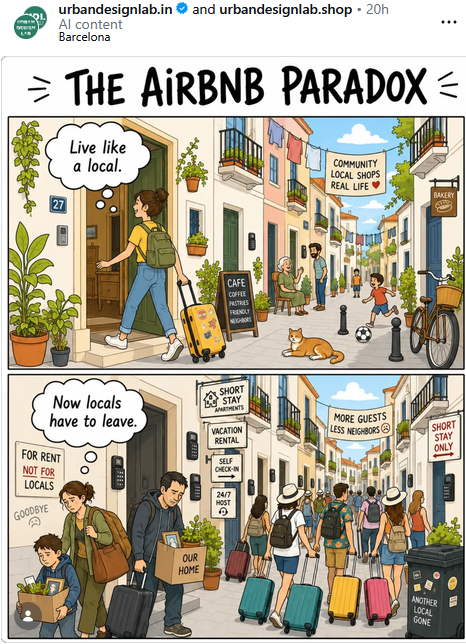
Tourists love to visit beautiful cities. They want to live like a local person. They open the Airbnb app and book a nice flat. They walk in the old streets with their bags. They see plants on the walls and clothes hanging outside. They sit in small cafés and drink coffee. They talk to old people and watch children play football. They buy bread from the bakery and look at local shops. It feels real and happy. The city looks full of life and community.
But soon the city changes a lot. Many people who own flats stop renting to local families. They put the flats on Airbnb for short stays. Tourists pay more money for a few nights. The owners make bigger profits this way. Local people look for a home to rent but the prices are too high. Young couples and families with children cannot pay the rent. They pack their boxes and leave the neighbourhood. They say goodbye to their friends and the place they love.
Now the streets look different. There are many tourists with colourful suitcases. They walk in groups and take photos. Signs say “short stay only” and “self check-in”. There are fewer neighbours and fewer local shops. The community is gone. Old people sit alone. Children do not play outside as much. The city feels empty of real life.
Tourists still come and want to live like a local. But the real local people are not there anymore. They had to move far away because they cannot afford the high prices. This is the Airbnb paradox. Visitors destroy the thing they come to enjoy. Cities lose their heart when too many homes become holiday flats for guests only. Local life disappears and only tourists remain.
########################
The pros and cons of Airbnb
Airbnb is a popular way to find a place to stay when travelling. People can rent a room, an apartment, or a house from a private person. Airbnb has many good points, but it also has some problems.
One big advantage is the price. An Airbnb can be cheaper than a hotel, especially for families or groups. Guests can also cook their own food, so they do not have to eat in restaurants every day. Another advantage is the large choice. People can find small rooms, modern apartments, houses, and even unusual places to stay.
Airbnb can also give tourists a more local experience. They often stay in normal areas where local people live. This can help visitors see more of everyday life. An apartment can also be more comfortable than a hotel room, especially for a longer holiday. Guests may have a kitchen, a washing machine, and more space.
However, there are also disadvantages. The quality is not always the same. A place may look very good in photos but be different in reality. There can also be problems with cleaning, noise, or the owner. In a hotel, there is usually a reception where guests can ask for help. With Airbnb, this is not always possible.
Another problem is housing. In some cities, many homes are used for tourists instead of local people. This can make it harder for local people to find affordable homes. For this reason, some cities have new rules for Airbnb.
In conclusion, Airbnb can be a cheap and comfortable choice for travellers. It can also offer a more local experience. However, people should read reviews carefully and check the rules before booking.
###################
##################
##################
Please use the box below to write your feedback. Only I can read it. It is not public.
Babies learn a language by listening. They use their ears to hear sounds. Their brain remembers these sounds. Babies connect sounds with people and things. They listen to their parents. Then they copy the sounds they hear. They imitate words. Slowly, babies learn to speak.
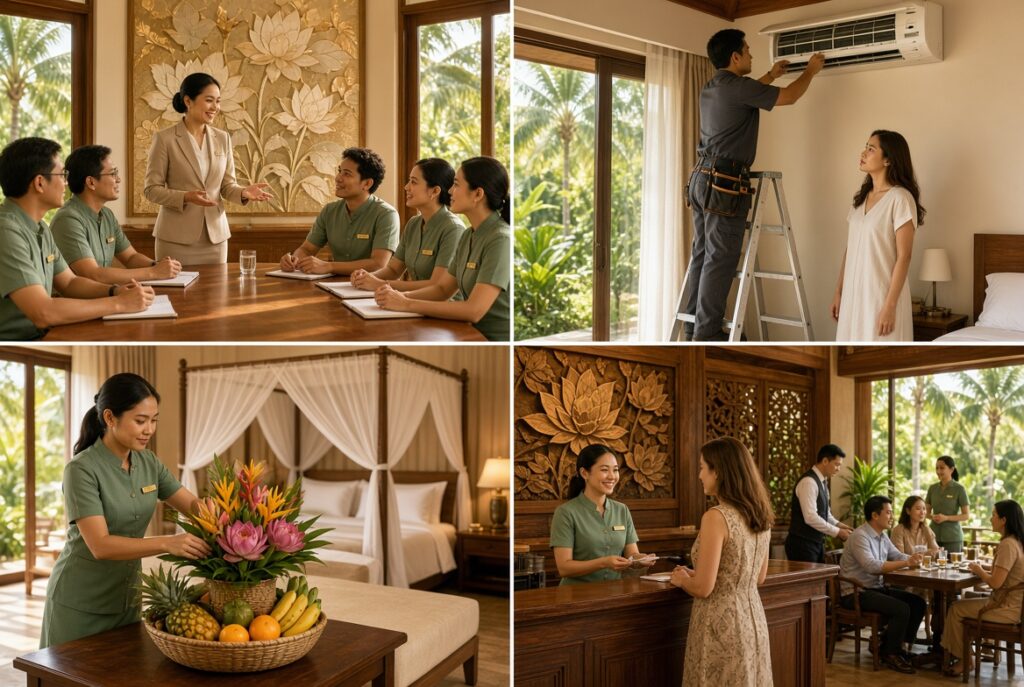
Welcome to our morning briefing. Thank you all for coming on time. This short meeting is important because it helps us start the day well. We can talk about yesterday, look at today’s work, and make sure everyone knows what to do. Good communication is very important in a busy hotel.
Yesterday, we had one small problem. A guest in room 214 complained about the air-conditioning. It was very noisy, and the room was also too warm. The guest was not happy, so we sent a technician to the room in the evening. He checked the air-conditioning and fixed the problem. Today, it is working well again. Please remember to check other rooms if guests tell you that something is not working correctly. Listen carefully and report problems quickly. Small problems can become big problems if we do not act quickly.
Today, the hotel is quite busy. We have 75 percent occupancy. Twelve guests will check in, and eight guests will check out. Most of the new guests will arrive in the afternoon, so the front desk will be busy later.
At two o’clock, we have a special arrival. A couple will come to the hotel for their honeymoon. They are staying in room 501. Please prepare the room very carefully. Put fresh flowers in the room and place a nice fruit basket on the table. We also need a short welcome card. Please make sure everything is ready before they arrive. This is a special moment for the couple, and we want them to have a wonderful first impression of our hotel.
Now I will explain your tasks for this morning.
Sokha, you are working at the front desk. Please welcome every guest with a big smile. Help guests with check-in and answer their questions. Please also explain the spa, the swimming pool, and other hotel facilities when necessary.
Bopha, you are helping in housekeeping today. Please start with rooms 301 to 320. Check every room carefully. Make sure the rooms are clean, tidy, and ready for guests. If you find a problem, tell your supervisor.
Arun, you are supporting the restaurant today. A group of fifteen people will arrive for lunch at half past twelve. Please help the waiters prepare the tables and serve the guests. Be friendly and helpful, especially when the restaurant becomes busy.
If you have any questions, please ask me now.
Is everything clear? Good.
Remember, we are one team. When one person is busy, another person should help if possible. Talk to your colleagues and share information. If we work together, our guests will have a better experience.
Our guests come from many different countries. Some may be tired after a long journey, and some may need extra help. A smile, a friendly greeting, and a little patience can make a big difference.
Let us work hard today, but let us also enjoy our work. Happy staff make happy guests.
I know you can all do a great job. Have a good shift, everyone. Thank you very much.
____________________________
Vocabulary:
Word / phrase
definition
a briefing
a short meeting where you get important information about work
on time
at the correct time; not late
a busy hotel
a hotel with many guests and a lot of work
to complain about something
to say that you are not happy about something
to be noisy
to make a lot of sound
to fix a problem
to repair something or make a problem better
to report a problem quickly
to tell someone about a problem soon
occupancy
the number of rooms in a hotel that have guests
honeymoon
a holiday that a couple takes after they get married
a fruit basket
a basket with different kinds of fruit
an impression of something
the feeling or idea you have about something
to explain
to tell someone how or why something works or happens
a facility
a place or service that a hotel has for guests, such as a pool or gym
to be tidy
to be clean and in the right place
to support somebody
to help somebody
to prepare a table
to put plates, glasses, knives, forks, etc. on a table before a meal
to serve a guest
to give a guest food, drinks, or other help
to remember
to keep something in your mind and not forget it
a colleague
a person who works with you
to share information
to give information to other people
an experience
something that happens to you and that you learn from or remember
to be tired
to need rest or sleep
a journey
a trip from one place to another
patience
the ability to stay calm when something takes a long time
to enjoy work
to like your work
a shift
a period of time when you work, for example from 7 a.m. to 3 p.m.
####################
Match the words with the definitions
a briefing
on time
a busy hotel
to complain about something
to be noisy
to fix a problem
to report a problem quickly
occupancy
honeymoon
a fruit basket
an impression of something
to explain
a facility
to be tidy
to support somebody
to prepare a table
to serve a guest
to remember
a colleague
to share information
an experience
to be tired
a journey
patience
to enjoy work
a shift
Definitions
A. to give information to other people B. a holiday that a couple takes after they get married C. to like your work D. a person who works with you E. a short meeting where you get important information about work F. to make a lot of sound G. the ability to stay calm when something takes a long time H. to tell someone how or why something works or happens I. a basket with different kinds of fruit J. a period of time when you work K. a hotel with many guests and a lot of work L. to help somebody M. to need rest or sleep N. the number of hotel rooms that have guests O. something that happens to you and that you remember or learn from P. to repair something or make a problem better Q. at the correct time; not late R. to say that you are not happy about something S. a place or service in a hotel, such as a pool or gym T. to give a guest food, drinks, or other help U. to keep something in your mind and not forget it V. the feeling or idea you have about something W. to put plates, glasses, knives, forks, etc. on a table before a meal X. to be clean and in the right place Y. to tell someone about a problem soon Z. a trip from one place to another
A short meeting where you get important information about work.
At the correct time; not late.
A hotel with many guests and a lot of work.
To say that you are not happy about something.
To make a lot of sound.
To repair something or make a problem better.
To tell someone about a problem soon.
The number of hotel rooms that have guests.
A holiday that a couple takes after they get married.
A basket with different kinds of fruit.
The feeling or idea you have about something.
To tell someone how or why something works or happens.
A place or service in a hotel, such as a pool or gym.
To be clean and in the right place.
To help somebody.
To put plates, glasses, knives, forks, etc. on a table before a meal.
To give a guest food, drinks, or other help.
To keep something in your mind and not forget it.
A person who works with you.
To give information to other people.
Something that happens to you and that you remember or learn from.
To need rest or sleep.
A trip from one place to another.
The ability to stay calm when something takes a long time.
To like your work.
A period of time when you work.
Words
A. a journey B. to support somebody C. a facility D. to remember E. a shift F. to be noisy G. a colleague H. occupancy I. to enjoy work J. a fruit basket K. to explain L. to complain about something M. a briefing N. to serve a guest O. to be tidy P. a honeymoon Q. patience R. an experience S. to prepare a table T. to fix a problem U. a busy hotel V. to share information W. an impression of something X. to report a problem quickly Y. on time Z. to be tired
The hotel is expecting a large wedding party this morning. The correct statement: The hotel is expecting a group of fifteen people for lunch.
The guest in room 214 complained about the air-conditioning.
Bopha will start with rooms 301 to 320.
The welcome gift for the couple is a large chocolate cake. The correct statement: The hotel will put fresh flowers and a fruit basket in the couple’s room.
The morning briefing helps the team start the day well.
The manager tells staff to avoid helping colleagues who are busy. The correct statement: The manager tells staff to help and support colleagues who are busy.
The honeymoon couple will arrive at two o’clock.
The technician repaired a problem with the swimming pool. The correct statement: The technician repaired a problem with the air-conditioning in room 214.
Twelve guests will check in today.
Sokha will show guests how to use the hotel gym. The correct statement: Sokha will explain the spa and swimming pool to guests.
The hotel has 75 percent occupancy today.
A technician fixed the air-conditioning problem in the evening.
The group coming for lunch has twenty-five people. The correct statement: The group coming for lunch has fifteen people.
The hotel will put fresh flowers in the couple’s room.
The briefing takes place after the hotel closes for the night. The correct statement: The briefing takes place in the morning.
Arun will clean rooms before lunch. The correct statement: Bopha will work in rooms 301 to 320.
Sokha will work at the front desk.
The honeymoon couple will stay at the hotel for one night. The correct statement: The briefing does not say how long the honeymoon couple will stay.
Bopha will prepare food for the restaurant. The correct statement: Arun will support the restaurant team.
####################
Who Does What? Match each task with the correct person:
Sokha – Bopha – Arun
Welcomes guests at the front desk.
Starts work with rooms 301 to 320.
Helps the waiters in the restaurant.
Helps guests with check-in.
Makes sure rooms are clean and tidy.
Helps prepare the restaurant for a group of fifteen people.
Why was the guest in room 214 unhappy? ______________________________
When did the technician fix the air-conditioning? ______________________________
Why is the morning briefing important? ______________________________
What should staff do if a guest says something is wrong? ______________________________
Why should room 501 be prepared carefully? ______________________________
What should Sokha explain to guests? ______________________________
What should Bopha make sure about the rooms? ______________________________
Why will Arun be busy at lunchtime? ______________________________
How should staff help each other when the hotel is busy? ______________________________
Why is it important to be friendly to hotel guests? ______________________________
——————————————-
Answers
Because the air-conditioning was too noisy and the room was warm.
In the evening.
It helps the team start the day well and work together.
They should check the problem and report it quickly.
Because a honeymoon couple will stay there.
The spa and swimming pool.
That the rooms are clean and tidy.
Because a group of fifteen people will come for lunch.
They should talk to each other and support their colleagues.
Because guests want to feel welcome and comfortable.
####################
Who Says / Needs What?
Sokha, Bopha, Arun, the honeymoon couple, the guests, or the team?
Who needs to welcome guests with a big smile? __________
Who needs fresh flowers and a fruit basket? __________
Who needs to start work with rooms 301 to 320? __________
Who needs to help the waiters at lunchtime? __________
Who needs help with check-in? __________
Who needs information about the spa and swimming pool? __________
Who needs clean and tidy rooms? __________
Who needs to work together and support colleagues? __________
Who needs a short welcome card? __________
Who needs to prepare for fifteen people at lunchtime? __________
——————————————-
Answers: 1. Sokha; 2. the honeymoon couple; 3. Bopha; 4. Arun; 5. the guests; 6. the guests; 7. the guests; 8. the team; 9. the honeymoon couple; 10. Arun
####################
Put in correct order
A. Arun helps the restaurant team with the lunch group. B. The manager welcomes the team to the morning briefing. C. The team talks about the air-conditioning problem in room 214. D. Bopha starts work in rooms 301 to 320. E. The manager talks about the hotel’s occupancy and today’s check-ins and check-outs. F. The manager explains the special preparation for the honeymoon couple. G. Sokha works at the front desk and welcomes guests. H. The manager reminds everyone to work together and support colleagues.
The morning briefing starts on time because the hotel is busy. Yesterday, a guest _______ about a room because the air-conditioning was noisy. A technician_______the problem, and staff must _______ problems quickly.
Today, _______ is 75 percent. A couple is arriving for their honeymoon. They will find a fruit _______ in their room, giving them a good _______ of the hotel. Staff will explain the hotel _______ and keep rooms tidy.
Everyone must support _______, prepare tables, and serve guests well. Staff should remember to share information with each colleague. Every _______ should be positive, even when guests are tired after a long journey. _______ is important. Staff should enjoy work during every _______ and help make guests feel welcome and comfortable.
——————————————–
Full version:
The morning briefing starts on time because the hotel is busy. Yesterday, a guest complained about a room because the air-conditioning was noisy. A technician fixed the problem, and staff must report problems quickly.
Today, occupancy is 75 percent. A couple is arriving for their honeymoon. They will find a fruit basket in their room, giving them a good impression of the hotel. Staff will explain the hotel facilities and keep rooms tidy.
Everyone must support colleagues, prepare tables, and serve guests well. Staff should remember to share information with each colleague. Every experience should be positive, even when guests are tired after a long journey. Patience is important. Staff should enjoy work during every shift and help make guests feel welcome and comfortable.
####################
You are the manager of the hotel. Use the cheat sheet below, give the speech, record it on your mobile phone, then listen to your recording……
1. Welcome
good morning
thank you for coming on time
short meeting
start the day well
work together
good communication
2. Yesterday – Problem
room 214
air-conditioning
too noisy
room too warm
guest complained
technician
fixed in the evening
working well now
check other rooms
report problems quickly
3. Today – Hotel
busy day
75% occupancy
12 check-ins
8 check-outs
most arrivals → afternoon
4. Special Guests
2:00 p.m.
honeymoon couple
room 501
prepare carefully
fresh flowers
fruit basket
welcome card
special moment
good first impression
5. Sokha – Front Desk
welcome guests
big smile
check-in
answer questions
explain:
spa
swimming pool
hotel facilities
6. Bopha – Housekeeping
rooms 301–320
clean
tidy
check carefully
ready for guests
problems → tell supervisor
7. Arun – Restaurant
group: 15 people
lunch: 12:30
help waiters
prepare tables
serve guests
friendly
helpful
busy restaurant
8. Teamwork
one team
help each other
share information
talk to colleagues
support busy colleagues
solve problems together
9. Guests
many countries
different needs
tired after travel
answer questions
be patient
friendly greeting
smile
make guests feel welcome
10. Final Message
work hard
enjoy the work
happy staff → happy guests
good job
have a good shift
##################
##################
##################
##################
Please use the box below to write your feedback. Only I can read it. It is not public.
Babies learn a language by listening. They use their ears to hear sounds. Their brain remembers these sounds. Babies connect sounds with people and things. They listen to their parents. Then they copy the sounds they hear. They imitate words. Slowly, babies learn to speak.
An adjective tells us about a person, animal, place or thing.
It tells us what someone or something is like.
a big hotel
a small room
a happy girl
a beautiful town
a cold morning
Adjectives can tell us about:
size: big, small, large
age: young, old
colour: red, blue, green
feelings: happy, sad, tired
temperature: hot, cold, warm
quality: good, bad, nice
appearance: beautiful, clean, dirty
speed: fast, slow
2. Comparing two things
When we compare two people or things, we use the comparative.
With many short adjectives, we add -er.
small → smaller
The first room is small.
The second room is smaller than the first room.
big → bigger
Room 101 is big.
Room 102 is bigger than Room 101.
We often use than after the comparative.
Anna is taller than Maya.
The blue car is faster than the red car.
Today is colder than yesterday.
3. Comparing three or more things
When we compare three or more people or things, we use the superlative.
With many short adjectives, we add -est.
small → smaller → the smallest
Room 101 is small.
Room 102 is smaller.
Room 103 is the smallest.
big → bigger → the biggest
The first room is big.
The second room is bigger.
The third room is the biggest.
We usually use the before the superlative.
She is the tallest girl.
This is the cheapest café.
It is the coldest day.
4. More and most
Some adjectives are longer.
For these adjectives, we usually use more and the most.
beautiful → more beautiful → the most beautiful
The garden is beautiful.
The garden is more beautiful than the park.
This is the most beautiful garden.
comfortable → more comfortable → the most comfortable
This chair is comfortable.
This chair is more comfortable than that chair.
This is the most comfortable chair.
interesting → more interesting → the most interesting
The story is interesting.
The second story is more interesting than the first story.
The third story is the most interesting.
Other examples:
expensive → more expensive → the most expensive
difficult → more difficult → the most difficult
important → more important → the most important
5. Some special adjectives
Some common adjectives are different.
Adjective
Comparative
Superlative
good
better
the best
bad
worse
the worst
far
farther
the farthest
Examples:
The food is good.
The food here is better.
This restaurant has the best food.
6. Story
#1: The school sports day – fill in:
Tom is a student at a small school. One Saturday, the school has a sports day. Tom is very excited because he likes sports.
In the morning, Tom meets his friends in the school yard. They have three races. It is a hot day.
The first race is _____ (short). The second race is _____ (short) than the first race. The third race is the _____ (short).
Tom runs _____ (fast). His friend Ben runs _____ (fast) than Tom. But Alex runs the _____ (fast).
After the races, the students play basketball. Tom thinks basketball is _____ (interesting). Ben thinks football is _____ (interesting) than basketball. Alex thinks basketball is the _____ (interesting) sport.
At lunchtime, the students eat together. Tom’s sandwich is _____ (good), but Ben’s sandwich is _____ (good). Alex has the _____ (good) sandwich.
In the afternoon, the weather gets _____ (hot). The school yard becomes _____ (busy) and _____ (noisy).
At the end of the day, Tom is _____ (tired) but _____ (happy).
„It is the _____ (good) school day!“ he says.
_______________________________ Correct version:
Tom is a student at a small school. One Saturday, the school has a sports day. Tom is very excited because he likes sports.
In the morning, Tom meets his friends in the school yard. They have three races. It is a hot day.
The first race is short. The second race is shorter than the first race. The third race is the shortest.
Tom runs fast. His friend Ben runs faster than Tom. But Alex runs the fastest.
After the races, the students play basketball. Tom thinks basketball is interesting. Ben thinks football is more interesting than basketball. Alex thinks basketball is the most interesting sport.
At lunchtime, the students eat together. Tom’s sandwich is good, but Ben’s sandwich is better. Alex has the best sandwich.
In the afternoon, the weather gets hotter. The school yard becomes busier and noisier.
At the end of the day, Tom is tired but happy.
„It is the best school day!“ he says.
#######################
#2A day at the beach – fill in:
Lucy goes to the beach with her family on Sunday. The beach is _____ (beautiful), and the sea is _____ (blue). It is a _____ (warm) day.
In the morning, Lucy walks along the beach. The sand is _____ (soft). Her brother finds a _____ (big) shell, but Lucy finds a _____ (big) shell. Their father finds the _____ (big) shell.
Later, they swim in the sea. The water is _____ (cold), but the water near the beach is _____ (cold) than the water in the sun. Lucy swims to a quiet place. It is _____ (quiet), but the beach near the café is _____ (quiet).
At lunchtime, the family goes to a small restaurant. Lucy orders a _____ (cheap) meal. Her brother chooses a _____ (cheap) meal, but their father finds the _____ (cheap) meal.
After lunch, they look at three boats. The first boat is _____ (old). The second boat is _____ (old), and the third boat is the _____ (old).
In the afternoon, Lucy sees a beautiful hotel near the beach. Her mother says, „That hotel is _____ (expensive) than our hotel.“ Lucy looks at another hotel.
„That one is the _____ (expensive)!“
The family laughs and walks home. Lucy is tired, but she is _____ (happy). It is a _____ (wonderful) day.
—————————————–
Correct version:
Lucy goes to the beach with her family on Sunday. The beach is beautiful, and the sea is blue. It is a warm day.
In the morning, Lucy walks along the beach. The sand is soft. Her brother finds a big shell, but Lucy finds a bigger shell. Their father finds the biggest shell.
Later, they swim in the sea. The water is cold, but the water near the beach is colder than the water in the sun. Lucy swims to a quiet place. It is quiet, but the beach near the café is quieter.
At lunchtime, the family goes to a small restaurant. Lucy orders a cheap meal. Her brother chooses a cheaper meal, but their father finds the cheapest meal.
After lunch, they look at three boats. The first boat is old. The second boat is older, and the third boat is the oldest.
In the afternoon, Lucy sees a beautiful hotel near the beach. Her mother says, „That hotel is more expensive than our hotel.“ Lucy looks at another hotel.
„That one is the most expensive!“
The family laughs and walks home. Lucy is tired, but she is happy. It is a wonderful day.
#######################
#3 A day at the mountain farm – fill in:
Daniel spends Saturday at his uncle’s farm in the mountains. The farm is _____ (quiet) and _____ (green). The morning is _____ (cool) and _____ (fresh).
Daniel helps his uncle with the animals. There are three horses. The first horse is _____ (young). The second horse is _____ (young), but the third horse is the _____ (young).
Then Daniel feeds three cows. The first cow is _____ (slow). The second cow is _____ (slow), and the third cow is the _____ (slow).
After that, Daniel carries some boxes. One box is _____ (heavy). Another box is _____ (heavy), and the last box is the _____ (heavy).
At lunchtime, Daniel eats some soup. He thinks the soup is _____ (good). His uncle makes a _____ (good) soup, but his grandmother makes the _____ (good) soup.
In the afternoon, Daniel walks up the mountain. The path is _____ (difficult). Another path is _____ (difficult), but the path near the river is the _____ (difficult).
At the top, Daniel sees three houses. One house is _____ (beautiful). Another house is _____ (beautiful), but the house near the lake is the _____ (beautiful).
Daniel takes a photo and smiles. He is _____ (tired), but he feels _____ (happy). It is a _____ (wonderful) day at the farm.
————————————————-
Correct version:
Daniel spends Saturday at his uncle’s farm in the mountains. The farm is quiet and green. The morning is cool and fresh.
Daniel helps his uncle with the animals. There are three horses. The first horse is young. The second horse is younger, but the third horse is the youngest.
Then Daniel feeds three cows. The first cow is slow. The second cow is slower. The third cow is the slowest.
After that, Daniel carries some boxes. One box is heavy. Another box is heavier. The last box is the heaviest.
At lunchtime, Daniel eats some soup. He thinks the soup is good. His uncle makes a better soup, but his grandmother makes the best soup.
In the afternoon, Daniel walks up the mountain. The path is difficult. Another path is more difficult, but the path near the river is the most difficult.
At the top, Daniel sees three houses. One house is beautiful. Another house is more beautiful, but the house near the lake is the most beautiful.
Daniel takes a photo and smiles. He is tired, but he feels happy. It is a wonderful day at the farm.
#######################
Fill in:
Maya is 19 years old. She works at a _____ (small) hotel in a _____ (beautiful) town. The hotel is _____ (near) a _____ (quiet) river and a _____ (large) green park.
Maya arrives at the hotel at seven o’clock. The morning is _____ (cool) and _____. She opens the _____ (big) door and goes inside.
The hotel has three floors. There are ten rooms on each floor.
Maya starts with the rooms on the first floor. Room 101 is _____. (small) Room 102 is _____ (small) than Room 101. Room 103 is the _____ (small) room on the floor.
Then Maya goes to the second floor. The rooms there are _____ (big). Room 201 is big, Room 202 is _____ (big), and Room 203 is the _____ (big) room in the hotel.
Maya likes the big rooms because they are _____ (easy) to clean.
At eight o’clock, Maya goes to the kitchen. She is _____. (hungry) She makes a _____ (simple) breakfast with bread, eggs and fruit.
Her friend Anna works in the kitchen.
„Good morning, Maya!“ Anna says.
„Good morning! How are you?“
„I am _____. (good) How about you?“
„I am _____! (hungry)“
Anna laughs. „I am _____ (hungry) than you!“
They eat breakfast together. The coffee is _____. (hot) Maya’s coffee is _____ (hot) than Anna’s coffee. The cook’s coffee is the _____ (hot) coffee in the kitchen.
At ten o’clock, a family comes to the hotel. They want a _____ (nice) room.
Maya shows them three rooms.
„The first room is _____,“ she says. (nice)
„The second room is even _____.“ (nice)
„And the third room is the _____. (nice)“
The family looks at the third room. It is _____, _____ and _____. (large, clean, comfortable) It has a _____ (beautiful) view of the river.
The father looks at the beds.
„This bed is _____ (comfortable) than the bed in the first room,“ he says.
The mother looks out of the window.
„The view is _____ (beautiful), too.“
Their daughter smiles.
„This is the _____ (beautiful) room!“
The family chooses the third room.
At lunchtime, Maya and Anna go to a _____ (small) café. There are three cafés near the hotel.
The first café is _____. (cheap) The second café is _____ (cheap). The third café is the _____ (cheap).
They choose the _____ (cheap) café.
The food is _____. (good) Maya likes her soup, but Anna’s sandwich is _____. (good)
After lunch, they walk in the park. The park is _____ and _____. (green, quiet)
They see three trees.
The first tree is _____. (tall) The second tree is _____. (tall) The third tree is the _____. (tall)
„Look at that tree!“ Anna says. „It is the _____ (tall) tree in the park.“
They continue walking.
Soon they see a _____ (beautiful) lake. The lake is _____ and _____. (quiet, clean) There are many flowers near the water.
„This place is _____,“ Maya says. (beautiful)
„Yes,“ Anna says. „But the river near our hotel is _____ (beautiful).“
They walk back to the hotel.
At four o’clock, a new guest arrives. He wants a room with a _____ (good) view.
Maya shows him the rooms.
„This room is _____,“ she says. (good) „The room upstairs is _____ (good). But Room 203 has the _____ (good) view.“
The guest looks at Room 203.
„It is _____ (comfortable) than the other rooms,“ he says.
„And it has the _____ (beautiful) view.“
He chooses the room.
At five o’clock, Maya is _____. (tired) but she is _____. (happy) It is a _____ (busy) day at the hotel.
Her manager comes to her.
„Is everything OK?“
„Yes,“ Maya says. „Everything is _____.“ (good)
„Is today _____ (good) than yesterday?“
„Yes. Today is _____ (good) than yesterday.“
„Why?“
„Because the guests are _____, the weather is _____, and the hotel is _____.“ (friendly, good, busy)
The manager smiles.
„Is today the _____ (good) day of the week?“
Maya thinks for a moment.
„Yes. I think it is the _____ (good) day of the week.“
At six o’clock, Maya finishes work. Outside, the street is _____ (quiet) than before. The evening is _____ (cold) than the afternoon.
Maya walks home. She is _____ (tired), but she is _____. (happy)
She thinks about her day.
„The hotel is a _____ (good) place to work,“ she says. „And today is the _____ (good) day of my week!“
———————————————
Full version:
Maya is 19 years old. She works at a small hotel in a beautiful town. The hotel is near a quiet river and a large green park.
Maya arrives at the hotel at seven o’clock. The morning is cool and fresh. She opens the big door and goes inside.
The hotel has three floors. There are ten rooms on each floor.
Maya starts with the rooms on the first floor. Room 101 is small. Room 102 is smaller than Room 101. Room 103 is the smallest room on the floor.
Then Maya goes to the second floor. The rooms there are bigger. Room 201 is big, Room 202 is bigger, and Room 203 is the biggest room in the hotel.
Maya likes the big rooms because they are easier to clean.
At eight o’clock, Maya goes to the kitchen. She is hungry. She makes a simple breakfast with bread, eggs and fruit.
Her friend Anna works in the kitchen.
„Good morning, Maya!“ Anna says.
„Good morning! How are you?“
„I am good. How about you?“
„I am hungry!“
Anna laughs. „I am hungrier than you!“
They eat breakfast together. The coffee is hot. Maya’s coffee is hotter than Anna’s coffee. The cook’s coffee is the hottest coffee in the kitchen.
At ten o’clock, a family comes to the hotel. They want a nice room.
Maya shows them three rooms.
„The first room is nice,“ she says.
„The second room is even nicer.“
„And the third room is the nicest.“
The family looks at the third room. It is large, clean and comfortable. It has a beautiful view of the river.
The father looks at the beds.
„This bed is more comfortable than the bed in the first room,“ he says.
The mother looks out of the window.
„The view is more beautiful, too.“
Their daughter smiles.
„This is the most beautiful room!“
The family chooses the third room.
At lunchtime, Maya and Anna go to a small café. There are three cafés near the hotel.
The first café is cheap. The second café is cheaper. The third café is the cheapest.
They choose the cheapest café.
The food is good. Maya likes her soup, but Anna’s sandwich is better.
After lunch, they walk in the park. The park is green and quiet.
They see three trees.
The first tree is tall. The second tree is taller. The third tree is the tallest.
„Look at that tree!“ Anna says. „It is the tallest tree in the park.“
They continue walking.
Soon they see a beautiful lake. The lake is quiet and clean. There are many flowers near the water.
„This place is beautiful,“ Maya says.
„Yes,“ Anna says. „But the river near our hotel is more beautiful.“
They walk back to the hotel.
At four o’clock, a new guest arrives. He wants a room with a good view.
Maya shows him the rooms.
„This room is good,“ she says. „The room upstairs is better. But Room 203 has the best view.“
The guest looks at Room 203.
„It is more comfortable than the other rooms,“ he says.
„And it has the most beautiful view.“
He chooses the room.
At five o’clock, Maya is tired, but she is happy. It is a busy day at the hotel.
Her manager comes to her.
„Is everything OK?“
„Yes,“ Maya says. „Everything is good.“
„Is today better than yesterday?“
„Yes. Today is better than yesterday.“
„Why?“
„Because the guests are friendly, the weather is good, and the hotel is busy.“
The manager smiles.
„Is today the best day of the week?“
Maya thinks for a moment.
„Yes. I think it is the best day of the week.“
At six o’clock, Maya finishes work. Outside, the street is quieter than before. The evening is colder than the afternoon.
Maya walks home. She is tired, but she is happy.
She thinks about her day.
„The hotel is a good place to work,“ she says. „And today is the best day of my week!“
######################
##################
##################
##################
##################
Please use the box below to write your feedback. Only I can read it. It is not public.
Babies learn a language by listening. They use their ears to hear sounds. Their brain remembers these sounds. Babies connect sounds with people and things. They listen to their parents. Then they copy the sounds they hear. They imitate words. Slowly, babies learn to speak.
meeting guests and serving drinks in a five-star hotel
Dewi works as a bartender in a five-star hotel. She usually starts work in the afternoon. When she arrives, she puts on her uniform and goes to the bar.
First, Dewi checks the bar. She makes sure that the glasses are clean and that everything is in the right place. She checks the bottles and makes sure there are enough drinks. She also prepares ice, cuts fruit and prepares lemons and oranges.
When the bar opens, Dewi welcomes the guests with a smile. She says hello and asks them what they would like to drink. She listens carefully and prepares their drinks.
Dewi often talks to the guests while she works. Some guests ask about the drinks menu. Others want to know about local drinks. Sometimes, they ask Dewi to choose a drink for them. She gives simple advice and helps them choose.
Dewi also talks to guests about their holiday, their day or places to visit. She remembers regular guests and often remembers what they like to drink. She is friendly and polite, but she also gives guests space when they want to relax.
Sometimes, a guest has had too much to drink. Dewi stays calm and speaks to the guest politely. She may offer the guest some water and ask them to sit down. If necessary, she asks her manager for help. She always wants to keep the guest and other people safe.
In the evening, the bar can be very busy. Dewi works quickly, but she stays calm and friendly. She keeps the bar clean and makes sure that the guests have good service.
At the end of her shift, Dewi cleans the bar. She washes the glasses, checks the bottles and puts everything away. Then she changes her clothes and goes home.
Dewi likes her job because she meets people from many different countries. She enjoys talking to guests and making them feel welcome.
____________________________
Vocabulary:
Word / Phrase
Simple A1 definition
reading comprehension
understanding what you read
to serve a drink
to give a drink to a guest
a bartender
a person who works in a bar and makes drinks
in the right place
where something should be
a bottle
a container for drinks
to make sure
to check that something is OK
to prepare a drink
to make a drink ready
the drinks menu
a list of drinks in a bar
to give advice
to tell someone what you think is good
to choose
to say which thing you want
a regular guest
a guest who comes often
to be polite
to be nice and respectful to people
to give somebody space
to let someone be alone
to relax
to rest and feel calm
to stay calm
to not become angry or worried
to speak politely
to speak in a nice and respectful way
to keep somebody safe
to help someone stay safe
a shift
the time when you work
to change clothes
to take off your old clothes and put on other clothes
to enjoy talking
to like talking to people
to make somebody feel welcome
to make someone feel happy and comfortable in a place
######################
Match the words with the definitions
a bartender
to relax
a regular guest
to prepare a drink
to stay calm
a shift
to give advice
a bottle
to serve a drink
to choose
to be polite
the drinks menu
to make sure
to give somebody space
in the right place
to keep somebody safe
reading comprehension
to change clothes
to speak politely
to enjoy talking
to make somebody feel welcome
A. to help someone stay safe B. to like talking to people C. a person who works in a bar and makes drinks D. to check that something is OK E. a list of drinks in a bar F. to let someone be alone G. to take off your old clothes and put on other clothes H. a guest who comes often I. to make a drink ready J. where something should be K. to give a drink to a guest L. a container for drinks M. to say which thing you want N. to rest and feel calm O. the time when you work P. to speak in a nice and respectful way Q. understanding what you read R. to make someone feel happy and comfortable in a place S. to tell someone what you think is good T. to be nice and respectful to people U. to not become angry or worried
to take off your old clothes and put on other clothes
a guest who comes often
to make a drink ready
where something should be
to give a drink to a guest
a container for drinks
to say which thing you want
to rest and feel calm
the time when you work
to speak in a nice and respectful way
understanding what you read
to make someone feel happy and comfortable in a place
to tell someone what you think is good
to be nice and respectful to people
to not become angry or worried
A. to serve a drink B. a bartender C. in the right place D. a bottle E. to make sure F. to prepare a drink G. the drinks menu H. to give advice I. to choose J. a regular guest K. to be polite L. to give somebody space M. to relax N. to stay calm O. to speak politely P. to keep somebody safe Q. a shift R. to change clothes S. to enjoy talking T. to make somebody feel welcome U. reading comprehension
What does Dewi offer a guest who has had too much to drink?
Who can Dewi ask for help?
What does Dewi wash at the end of her shift?
What does Dewi check at the end of her shift?
Who does Dewi enjoy talking to?
___________________________
Answer: 1. Dewi, 2. Dewi, 3. fruit, 4. ice, 5. Some guests, 6. water, 7. her manager, 8. the glasses, 9. the bottles, 10. guests.
###################
Put the events in the correct order
a) Dewi talks to the guests. b) Dewi goes home. c) Dewi checks the bar. d) Dewi cleans the bar. e) Dewi welcomes the guests. f) Dewi prepares ice and cuts fruit. g) Dewi washes the glasses and checks the bottles.
__________________________
Answer: 1-c, 2-f, 3-e, 4-a, 5-d, 6-g, 7-b
###################
Match sentence halves
Dewi works
She prepares
She welcomes
Some guests ask
Dewi remembers
She gives guests
She asks her manager
She washes
Dewi talks
She checks
a) the glasses. b) in a five-star hotel. c) ice and fruit. d) regular guests. e) for help. f) space when they want to relax. g) the guests with a smile. h) about local drinks. i) to guests about their holiday. j) the bottles before the bar opens.
Dewi checks the bar before it opens. What does she do after that? a) She goes home. b) She welcomes the guests. c) She changes her clothes again.
A guest has had too much to drink. What might Dewi do? a) She brings the guest another drink. b) She offers the guest some water. c) She asks the guest to serve other people.
The bar is very busy. What does Dewi do? a) She stops working for a few minutes. b) She asks all the guests to leave. c) She works quickly and stays calm.
A guest asks about local drinks. What does Dewi do? a) She tells the guest to read a book. b) She gives the guest some simple advice. c) She changes the drinks menu.
A regular guest comes to the bar. What does Dewi remember? a) What the guest likes to drink. b) Where the guest lives. c) When the guest goes to work.
A guest wants to relax. What does Dewi do? a) She gives the guest some space. b) She talks to the guest all evening. c) She asks the guest to help her.
Dewi has a problem with a guest. What does she do if she needs help? a) She asks another guest for help. b) She goes home. c) She asks her manager for help.
The bar is going to open. What does Dewi prepare? a) Hotel rooms and beds. b) Ice and fruit. c) Breakfast and lunch.
Dewi finishes her shift. What does she do before she goes home? a) She cleans the bar and washes the glasses. b) She leaves the bar quickly. c) She talks to every guest again.
Dewi talks to guests about their holiday. What else can she talk about? a) Hotel jobs in other countries. b) Places to visit. c) Her plans for the next year.
Dewi checks the bar before it opens. What does she do after that? She welcomes the guests.
A guest has had too much to drink. What might Dewi do? She offers the guest some water.
The bar is very busy. What does Dewi do? She works quickly and stays calm.
A guest asks about local drinks. What does Dewi do? She gives the guest some simple advice.
A regular guest comes to the bar. What does Dewi remember? What the guest likes to drink.
A guest wants to relax. What does Dewi do? She gives the guest some space.
Dewi has a problem with a guest. What does she do if she needs help? She asks her manager for help.
The bar is going to open. What does Dewi prepare? Ice and fruit.
Dewi finishes her shift. What does she do before she goes home? She cleans the bar and washes the glasses.
Dewi talks to guests about their holiday. What else can she talk about? Places to visit.
##################
Yes, no or not in the text
Dewi prepares ice before the bar opens. ___
Dewi works only with guests from her own country. ___
Dewi sometimes talks to guests about their holiday. ___
Dewi has worked at the hotel for ten years. ___
Dewi checks that the glasses are clean. ___
Dewi never helps guests choose a drink. ___
Dewi cuts fruit before the bar opens. ___
Dewi gives every guest the same drink. ___
Dewi sometimes offers water to a guest. ___
Dewi wears a uniform when she works. ___
Dewi remembers some regular guests. ___
Dewi always sits down when the bar is busy. ___
Dewi asks her manager for help when necessary. ___
Dewi talks to guests about places to visit. ___
Dewi cleans the swimming pool after her shift. ___
Dewi washes the glasses at the end of her shift. ___
Dewi goes home by bus after work. ___
Dewi enjoys meeting people from different countries. ___
Dewi checks the weather before she starts work. ___
Dewi has a favourite drink. ___
—————————————
Correct answers:
Dewi prepares ice before the bar opens. YES
Dewi works only with guests from her own country. NO
Dewi sometimes talks to guests about their holiday. YES
Dewi has worked at the hotel for ten years. NOT IN THE TEXT
Dewi checks that the glasses are clean. YES
Dewi never helps guests choose a drink. NO
Dewi cuts fruit before the bar opens. YES
Dewi gives every guest the same drink. NO
Dewi sometimes offers water to a guest. YES
Dewi wears a uniform when she works. YES
Dewi remembers some regular guests. YES
Dewi always sits down when the bar is busy. NO
Dewi asks her manager for help when necessary. YES
Dewi talks to guests about places to visit. YES
Dewi cleans the swimming pool after her shift. NO
Dewi washes the glasses at the end of her shift. YES
Dewi goes home by bus after work. NOT IN THE TEXT
Dewi enjoys meeting people from different countries. YES
Dewi checks the weather before she starts work. NOT IN THE TEXT
Dewi has a favourite drink. NOT IN THE TEXT
#####################
Interview with Dewi – match the questions and answers
Questions
What is your job?
When does your working day begin?
What happens before the bar opens?
How do you greet hotel guests?
What information do visitors sometimes ask for?
How do you help guests with their choice?
What subjects come up in your conversations?
What happens when someone has had too much alcohol?
Who can support you in a difficult situation?
How is the bar in the evening?
What happens when your working time ends?
What do you like about your job?
Answers
a) I listen to them and give simple advice. b) I enjoy meeting people from many countries and making them feel welcome. c) I usually start in the afternoon. d) My manager can help me when necessary. e) I clean the bar, wash the glasses, check the bottles, and put things away. f) I am a bartender in a five-star hotel. g) I stay calm, speak politely, and may give the person some water. h) They sometimes want to know about local drinks and the drinks menu. i) We talk about their holiday, their day, and places to visit. j) It can be very busy, but I work quickly and stay friendly. k) I smile, say hello, and ask what they would like. l) I check the glasses and bottles, prepare ice, and cut fruit.
Interviewer: What does your job involve? Dewi: I work as a bartender in a five-star hotel, where I am responsible for preparing drinks, looking after guests, and maintaining a high standard of service.
Interviewer: What does a typical working day look like for you? Dewi: I usually begin my shift in the afternoon. Before the bar opens, I make sure everything is properly prepared, including the glasses, bottles, ice, and fresh fruit.
Interviewer: How do you approach guests when they arrive? Dewi: I greet them warmly, ask what they would like, and pay close attention to their requests. I try to create a friendly atmosphere from the moment they arrive.
Interviewer: What kind of questions do guests usually ask you? Dewi: Many guests want to know more about the drinks on our menu. They may also ask about local drinks or ask me to recommend something suitable for them.
Interviewer: How do you help guests who are unsure what to order? Dewi: I ask a few simple questions about their preferences and then make a recommendation. I try to give useful advice without making the decision for them.
Interviewer: Do you often have conversations with guests? Dewi: Yes, especially when the bar is not too busy. We might talk about their holiday, their plans for the day, or interesting places they could visit.
Interviewer: How do you deal with regular guests? Dewi: I try to remember their preferences, particularly the drinks they usually order. Guests appreciate it when you remember small details about them.
Interviewer: What do you do if a guest has had too much to drink? Dewi: I remain calm and speak to the guest politely. I may offer some water and suggest that they sit down. If the situation becomes difficult, I ask my manager for assistance.
Interviewer: What is it like when the bar becomes very busy? Dewi: It can be stressful, but I have learned to stay organized and work efficiently. Even during busy periods, I try to remain friendly and give every guest good service.
Interviewer: What do you do at the end of your shift? Dewi: I clean the bar, wash the glasses, check the bottles, and make sure everything is stored properly. After that, I change my clothes and go home.
Interviewer: What do you enjoy most about your profession? Dewi: I particularly enjoy meeting people from different countries. Every guest is different, and I like making people feel comfortable and welcome during their stay.
#################
#################
#################
Please use the box below to write your feedback. Only I can read it. It is not public.
Babies learn a language by listening. They use their ears to hear sounds. Their brain remembers these sounds. Babies connect sounds with people and things. They listen to their parents. Then they copy the sounds they hear. They imitate words. Slowly, babies learn to speak.
We use the Past Simple for an action that started and finished in the past.
Example:
I lived in Cambodia when I was 15.
My father cleaned the rooms.
I went to school at seven o’clock.
1. Regular verbs
For most verbs, add -ed:
Present
Past
work
worked
clean
cleaned
help
helped
visit
visited
want
wanted
Some spelling changes are needed:
like → liked
study → studied
stop → stopped
2. Irregular verbs
Some verbs do not use -ed. You must learn their past forms.
go → went
have → had
eat → ate
come → came
speak → spoke
bring → brought
do → did
3. Positive sentences
Subject + past verb
I worked.
She helped her mother.
We visited the temple.
They went to school.
The past verb is the same for all subjects:
I worked.
He worked.
They worked.
4. Negative sentences
Use did not (didn’t) + infinitive:
I didn’t work.
She didn’t go to school.
We didn’t eat breakfast.
⚠️ After didn’t, use the infinitive, not the past form.
❌ I didn’t went. ✅ I didn’t go.
5. Questions
Use Did + subject + infinitive?
Did you work?
Did she go to school?
Did they visit Cambodia?
Short answers:
Yes, I did.
No, I didn’t.
Yes, I was.
No, they weren’t.
6. When do we use it?
Use the Past Simple when we talk about finished actions or situations in the past.
Common past-time words are:
yesterday
last week
last year
two days ago
when I was 15
in 1980
Example: “I worked at my family’s guesthouse when I was 15.”
The action happened in the past and is finished now.
#####################
Infinitive
Past
A1 definition
be
was / were
to exist or to say what someone or something is
live
lived
to have your home in a place
have
had
to own or to get something
come
came
to move to a place
visit
visited
to go to a person or place for a short time
eat
ate
to put food in your mouth and swallow it
work
worked
to do a job
make
made
to create or prepare something
clean
cleaned
to make something not dirty
help
helped
to do something for another person
get up
got up
to leave your bed
open
opened
to move something so you can enter or see inside
put
put
to move something to a place
ask
asked
to say something when you want information
speak
spoke
to talk in a language
go
went
to move from one place to another
like
liked
to enjoy something
want
wanted
to have a wish for something
talk
talked
to speak with someone
change
changed
to put on different clothes or make something different
bring
brought
to take something with you to a place
do
did
to perform an action or activity
meet
met
to see and talk to someone for the first time or at a planned time
learn
learned
to get new knowledge or skill
__________________________
Vocabulary:
a guesthouse – a small place where people can stay and sleep.
a visitor – a person who comes to a place.
breakfast – the first meal of the day, in the morning.
a cup – a small container for drinking tea, coffee, or water.
sometimes – not always; on some days.
a bag – something you use to carry things.
a bicycle – a vehicle with two wheels. You ride it.
clothes – things you wear, like a shirt, trousers, or a dress.
countries – places like Cambodia, France, Japan, or Australia.
to be tired – to need rest because you have worked or done a lot.
##################
Fill in, past simple:
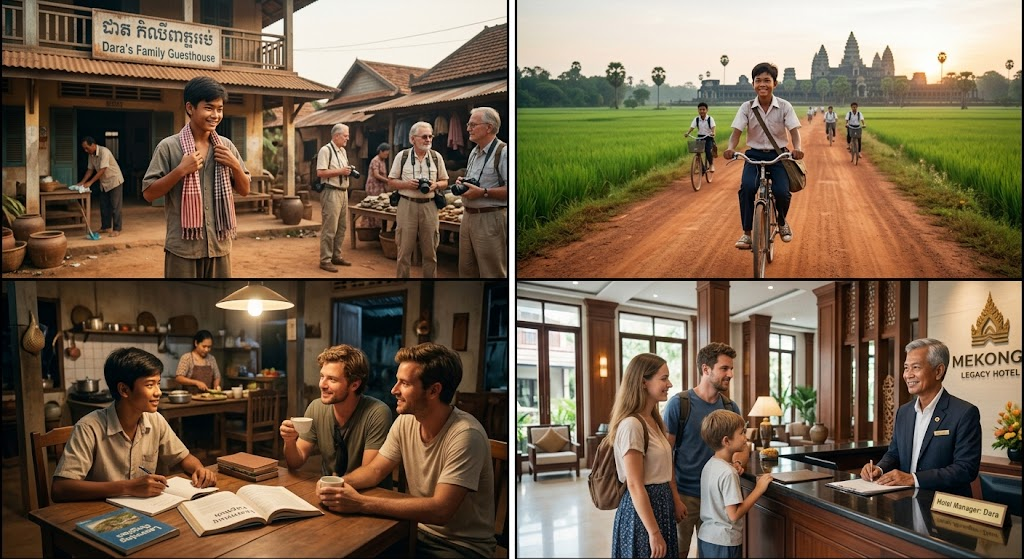
My name is Dara. I am 63 years old. When I _____ (be) 15 years old, I _____ (live) with my family in a small town in Cambodia. Many visitors _____ (come) to our town. They _____ (visit) old temples and _____ (eat) Cambodian food.
My family _____ (have) a small guesthouse. It _____ (be) near the market. We _____ (have) eight rooms. My father and mother _____ (work) there every day. My mother _____ (make) breakfast for the guests. My father _____ (clean) the rooms. My older sister _____ (help) them.
I _____ (get up) at six o’clock every morning. Before school, I _____ (help) my family. First, I _____ (open) the windows. Then I _____ (clean) the tables and chairs. I _____ (put) water and cups in the rooms. Sometimes, I _____ (help) my father with the guests’ bags.
At seven o’clock, I _____ (have) breakfast with my family. Then I _____ (go) to school by bicycle. My school _____ (be) three kilometres from our guesthouse. I like school. I _____ (like) English very much. I _____ (want) to speak English well because some guests _____ (speak) English.
I _____ (come) home at four o’clock. I _____ (change) my clothes and _____ (go) to the guesthouse. I _____ (help) my mother. I _____ (bring) food and drinks to the guests. I also _____ (talk) to them. I _____ (ask) them where they _____ (come) from. I _____ (like) talking to people from other countries.
In the evening, I _____ (do) my homework. Then I _____ (help) my parents again. I _____ (be) sometimes tired, but I _____ (be) happy.
I _____ (like) working at our guesthouse. I _____ (meet) many people and _____ (learn) many new things. I _____ (want) to work in a hotel when I _____ (be) older.
Now I am 63 years old. I work in a hotel. I still like meeting people and helping guests. I am happy with my job.
——————————————-
Correct version:
My name is Dara. I am 63 years old. When I was 15 years old, I lived with my family in a small town in Cambodia. Many visitors came to our town. They visited old temples and ate Cambodian food.
My family had a small guesthouse. It was near the market. We had eight rooms. My father and mother worked there every day. My mother made breakfast for the guests. My father cleaned the rooms. My older sister helped them.
I got up at six o’clock every morning. Before school, I helped my family. First, I opened the windows. Then I cleaned the tables and chairs. I put water and cups in the rooms. Sometimes, I helped my father with the guests’ bags.
At seven o’clock, I had breakfast with my family. Then I went to school by bicycle. My school was three kilometres from our guesthouse. I like school. I liked English very much. I wanted to speak English well because some guests spoke English.
I came home at four o’clock. I changed my clothes and went to the guesthouse. I helped my mother. I brought food and drinks to the guests. I also talked to them. I asked them where they came from. I liked talking to people from other countries.
In the evening, I did my homework. Then I helped my parents again. I was sometimes tired, but I was happy.
I liked working at our guesthouse. I met many people and learned many new things. I wanted to work in a hotel when I was older.
Now I am 63 years old. I work in a hotel. I still like meeting people and helping guests. I am happy with my job.
######################
True or False
Dara asked guests where they came from.
Dara’s father made breakfast for the guests.
Dara did his homework in the evening.
Dara travelled to school by train.
His school was three kilometres from the guesthouse.
Dara is 63 years old now.
The family had twelve rooms.
Dara brought food and drinks to the guests.
Dara played football after school.
His father cleaned the rooms.
Dara wanted to become a doctor.
Some guests spoke English.
Dara studied at home every morning.
Dara wanted to work in a hotel when he was older.
Dara’s mother cleaned the guesthouse rooms.
Dara got up at six o’clock every morning.
Dara never talked to the guests.
His family had a small guesthouse.
Dara now works in a restaurant.
Dara lived in a large city as a teenager.
____________________________
True: 1,3,5,6,8,10,12,14,16,18
___________________________
Correct version:
Dara lived in a large city as a teenager. True is: Dara lived in a small town in Cambodia.
Dara asked guests where they came from.
Dara’s father made breakfast for the guests. True is: Dara’s mother made breakfast for the guests.
Dara did his homework in the evening.
Dara travelled to school by train. True is: Dara went to school by bicycle.
His school was three kilometres from the guesthouse.
Dara is 63 years old now.
The family had twelve rooms. True is: The family had eight rooms.
Dara brought food and drinks to the guests.
Dara played football after school. True is: Dara helped his mother after school.
His father cleaned the rooms.
Dara wanted to become a doctor. True is: Dara wanted to work in a hotel when he was older.
Some guests spoke English.
Dara studied at home every morning. True is: Dara helped his family before school.
Dara wanted to work in a hotel when he was older.
Dara’s mother cleaned the guesthouse rooms. True is: Dara’s mother made breakfast for the guests.
Dara got up at six o’clock every morning.
Dara never talked to the guests. True is: Dara talked to the guests.
His family had a small guesthouse.
Dara now works in a restaurant. True is: Dara now works in a hotel.
Dara lived in a large city as a teenager. True is: Dara lived in a small town in Cambodia.
####################
Match the word with the definition
guesthouse
visitor
breakfast
cup
bag
bicycle
clothes
country
market
guest
tired
school
hotel
room
family
a. a place where people learn b. a person who stays at a hotel or guesthouse c. things you wear d. a place where people can buy and sell things e. a place where people sleep or stay f. a small place where visitors can stay g. a person who comes to a place h. the first meal of the day i. a vehicle with two wheels j. a group of parents and children k. a place such as Cambodia or Japan l. a place where people can stay when they travel m. needing rest n. a container for drinking o. something used to carry things
came · ate · had · went · got up · put · spoke · met · guesthouse · visitor · breakfast · cup · bag · bicycle · clothes · tired · market
Dara _____ at six o’clock every morning.
Many visitors _____ to the town.
They _____ Cambodian food.
Dara’s family _____ eight rooms.
He _____ water and cups in the rooms.
Dara _____ to school by bicycle.
Some guests _____ English.
Dara _____ many people from other countries.
His family had a small _____ near the market.
A _____ is a person who comes to a place.
Dara had _____ with his family at seven o’clock.
He put water in a _____.
Dara helped his father with the guests’ _____.
He changed his _____ after school.
Dara was sometimes _____ in the evening.
—————————————–
Correct version:
Dara got up at six o’clock every morning.
Many visitors came to the town.
They ate Cambodian food.
Dara’s family had eight rooms.
He put water and cups in the rooms.
Dara went to school by bicycle.
Some guests spoke English.
Dara met many people from other countries.
His family had a small guesthouse near the market.
A visitor is a person who comes to a place.
Dara had breakfast with his family at seven o’clock.
He put water in a cup.
Dara helped his father with the guests’ bag.
He changed his clothes after school.
Dara was sometimes tired in the evening.
###################
Answer:
Was Dara 15 or 25 years old when he lived with his family?
YOU WRITE: Dara was 15 years old when he lived with his family.
Did many or few visitors come to his town?
Did his family have eight or ten rooms?
Was the guesthouse near the market or the school?
Did his mother or father make breakfast?
Did his father clean the rooms or the windows?
Did his older sister help him or his parents?
Did Dara get up at six or seven o’clock?
Did he clean the tables or the floors before school?
Did he put water and cups or books in the rooms?
Did he go to school by bicycle or bus?
Was his school three or five kilometres from the guesthouse?
Did Dara like English or French very much?
Did some guests speak English or German?
Did Dara come home at four or five o’clock?
Did he bring food and drinks or books to the guests?
Did he ask the guests where they came from or where they worked?
Did Dara do his homework in the evening or in the morning?
Did he want to work in a hotel or a school when he was older?
Does Dara work in a hotel or a restaurant now?
_________________________
Correct answers:
Dara was 15 years old when he lived with his family.
Many visitors came to his town.
His family had eight rooms.
The guesthouse was near the market.
His mother made breakfast.
His father cleaned the rooms.
His older sister helped his parents.
Dara got up at six o’clock.
He cleaned the tables and chairs before school.
He put water and cups in the rooms.
He went to school by bicycle.
His school was three kilometres from the guesthouse.
Dara liked English very much.
Some guests spoke English.
Dara came home at four o’clock.
He brought food and drinks to the guests.
He asked the guests where they came from.
Dara did his homework in the evening.
He wanted to work in a hotel when he was older.
Dara works in a hotel now.
######################
Short answers, past simple, basics:
Example Sentence
Yes
No
I learned letters.
Yes, I did.
No, I didn’t.
You read signs.
Yes, you did.
No, you didn’t.
He spoke English.
Yes, he did.
No, he didn’t.
She watched TV.
Yes, she did.
No, she didn’t.
It helped me.
Yes, it did.
No, it didn’t.
We used an app.
Yes, we did.
No, we didn’t.
You read words.
Yes, you did.
No, you didn’t.
They made mistakes.
Yes, they did.
No, they didn’t.
Questions (Past Simple)
Question
Yes
No
Did I learn letters?
Yes, I did.
No, I didn’t.
Did you read signs?
Yes, you did.
No, you didn’t.
Did he speak English?
Yes, he did.
No, he didn’t.
Did she watch TV?
Yes, she did.
No, she didn’t.
Did it help me?
Yes, it did.
No, it didn’t.
Did we use an app?
Yes, we did.
No, we didn’t.
Did you read words?
Yes, you did.
No, you didn’t.
Did they make mistakes?
Yes, they did.
No, they didn’t.
Was / Were
Question
Yes
No
Was I happy?
Yes, I was.
No, I wasn’t.
Were you happy?
Yes, you were.
No, you weren’t.
Was he happy?
Yes, he was.
No, he wasn’t.
Was she happy?
Yes, she was.
No, she wasn’t.
Was it good?
Yes, it was.
No, it wasn’t.
Were we happy?
Yes, we were.
No, we weren’t.
Were you happy?
Yes, you were.
No, you weren’t.
Were they happy?
Yes, they were.
No, they weren’t.
#################
Short answers:
Dara brought food and drinks to the guests.
YOU WRITE: Yes, she did.
Dara was 18 years old when he lived in Cambodia.
His father cleaned the rooms.
Dara went to school by bus.
The guesthouse had eight rooms.
Dara’s mother liked talking to people from other countries.
His mother worked in a school.
Dara got up at six o’clock every morning.
His school was five kilometres from the guesthouse.
Dara did his homework in the evening.
Many visitors came to the town.
Dara’s family had a large hotel.
Dara wanted to work in a hotel when he was older.
His older sister helped his parents.
Dara came home at five o’clock.
Some guests spoke English.
Dara put books and pencils in the rooms.
The guesthouse was near the market.
Dara worked in a restaurant when he was young.
Dara asked guests where they came from.
Dara was sometimes tired in the evening.
Dara went to school on foot.
Dara is 63 years old now.
Dara stopped working with guests when he became older.
He still likes meeting people and helping guests.
Dara’s parents were farmers.
___________________________
Correct answers:
Dara brought food and drinks to the guests. Yes, he did.
Dara was 18 years old when he lived in Cambodia. No, he wasn’t.
His father cleaned the rooms. Yes, he did.
Dara went to school by bus. No, he didn’t.
The guesthouse had eight rooms. Yes, it did.
Dara’s mother liked talking to people from other countries. No, she didn’t.
His mother worked in a school. No, she didn’t.
Dara got up at six o’clock every morning. Yes, he did.
His school was five kilometres from the guesthouse. No, it wasn’t.
Dara did his homework in the evening. Yes, he did.
Many visitors came to the town. Yes, they did.
Dara’s family had a large hotel. No, they didn’t.
Dara wanted to work in a hotel when he was older. Yes, he did.
His older sister helped his parents. Yes, she did.
Dara came home at five o’clock. No, he didn’t.
Some guests spoke English. Yes, they did.
Dara put books and pencils in the rooms. No, he didn’t.
The guesthouse was near the market. Yes, it was.
Dara worked in a restaurant when he was young. No, he didn’t.
Dara asked guests where they came from. Yes, he did.
Dara was sometimes tired in the evening. Yes, he was.
Dara went to school on foot. No, he didn’t.
Dara is 63 years old now. Yes, he is.
Dara stopped working with guests when he became older. No, he didn’t.
He still likes meeting people and helping guests. Yes, he does.
Dara’s parents were farmers. No, they weren’t.
####################
Basics in past simple:
Personal Pronoun
Verb (Past)
Object
I
ate
apples
You
ate
apples
He
ate
apples
She
ate
apples
It
ate
apples
We
ate
apples
You (plural)
ate
apples
They
ate
apples
I
played
football
You
played
football
He
played
football
She
played
football
It
played
football
We
played
football
You (plural)
played
football
They
played
football
Personal Pronoun
Verb (Past Negative)
Object
I
did not eat
apples
You
did not eat
apples
He
did not eat
apples
She
did not eat
apples
It
did not eat
apples
We
did not eat
apples
You (plural)
did not eat
apples
They
did not eat
apples
I
did not play
football
You
did not play
football
He
did not play
football
She
did not play
football
It
did not play
football
We
did not play
football
You (plural)
did not play
football
They
did not play
football
Did + Pronoun
Verb
Object
Did I
eat
apples?
Did you
eat
apples?
Did he
eat
apples?
Did she
eat
apples?
Did it
eat
apples?
Did we
eat
apples?
Did you
eat
apples?
Did they
eat
apples?
Did I
play
football?
Did you
play
football?
Did he
play
football?
Did she
play
football?
Did it
play
football?
Did we
play
football?
Did you
play
football?
Did they
play
football?
Didn’t + Pronoun
Verb
Object
Didn’t I
eat
apples?
Didn’t you
eat
apples?
Didn’t he
eat
apples?
Didn’t she
eat
apples?
Didn’t it
eat
apples?
Didn’t we
eat
apples?
Didn’t you
eat
apples?
Didn’t they
eat
apples?
Didn’t I
play
football?
Didn’t you
play
football?
Didn’t he
play
football?
Didn’t she
play
football?
Didn’t it
play
football?
Didn’t we
play
football?
Didn’t you
play
football?
Didn’t they
play
football?
##################
Past simple forms of ‚to be‘:
Person
Past
I
was
You
were
He/She/It
was
We
were
You (pl)
were
They
were
Person
Question
I
Was I …?
You
Were you …?
He/She/It
Was he/she/it …?
We
Were we …?
You (pl)
Were you …?
They
Were they …?
Person
Negative
I
I was not (I wasn’t)
You
You were not (You weren’t)
He/She/It
He/She/It was not (He/She/It wasn’t)
We
We were not (We weren’t)
You (pl)
You were not (You weren’t)
They
They were not (They weren’t)
Person
Negative Question
I
Wasn’t I …?
You
Weren’t you …?
He/She/It
Wasn’t he/she/it …?
We
Weren’t we …?
You (pl)
Weren’t you …?
They
Weren’t they …?
##################
Answer as shown in #1:
Dara was 15 years old when he lived with his family in Cambodia.
YOU WRITE: a) question: Was Dara 15 years old when he lived with his family in Cambodia? b) negation: Dara was not 15 years old when he lived with his family in Cambodia. c) negative question: Wasn’t Dara 15 years old when he lived with his family in Cambodia?
His father cleaned the rooms every day.
Dara got up at six o’clock every morning.
He went to school by bicycle.
His school was three kilometres from the guesthouse.
Some guests spoke English.
Dara brought food and drinks to the guests.
Dara asked guests where they came from.
Dara and his family were happy at the guesthouse.
He wanted to work in a hotel when he was older.
____________________________
Correct version:
Dara was 15 years old when he lived with his family in Cambodia. a) question: Was Dara 15 years old when he lived with his family in Cambodia? b) negation: Dara was not 15 years old when he lived with his family in Cambodia. c) negative question: Wasn’t Dara 15 years old when he lived with his family in Cambodia?
His father cleaned the rooms every day. a) question: Did his father clean the rooms every day? b) negation: His father did not clean the rooms every day. c) negative question: Didn’t his father clean the rooms every day?
Dara got up at six o’clock every morning. a) question: Did Dara get up at six o’clock every morning? b) negation: Dara did not get up at six o’clock every morning. c) negative question: Didn’t Dara get up at six o’clock every morning?
He went to school by bicycle. a) question: Did he go to school by bicycle? b) negation: He did not go to school by bicycle. c) negative question: Didn’t he go to school by bicycle?
His school was three kilometres from the guesthouse. a) question: Was his school three kilometres from the guesthouse? b) negation: His school was not three kilometres from the guesthouse. c) negative question: Wasn’t his school three kilometres from the guesthouse?
Some guests spoke English. a) question: Did some guests speak English? b) negation: Some guests did not speak English. c) negative question: Didn’t some guests speak English?
Dara brought food and drinks to the guests. a) question: Did Dara bring food and drinks to the guests? b) negation: Dara did not bring food and drinks to the guests. c) negative question: Didn’t Dara bring food and drinks to the guests?
Dara asked guests where they came from. a) question: Did Dara ask guests where they came from? b) negation: Dara did not ask guests where they came from. c) negative question: Didn’t Dara ask guests where they came from?
Dara and his family were happy at the guesthouse. a) question: Were Dara and his family happy at the guesthouse? b) negation: Dara and his family were not happy at the guesthouse. c) negative question: Weren’t Dara and his family happy at the guesthouse?
He wanted to work in a hotel when he was older.
a) question: Did he want to work in a hotel when he was older? b) negation: He did not want to work in a hotel when he was older. c) negative question: Didn’t he want to work in a hotel when he was older?
####################
Who + past verb — no “did”
When who is the person who does the action, do not use did.
Who made breakfast?
Who cleaned the rooms?
Who helped Dara?
Who brought the food?
Who opened the windows?
Who worked at the guesthouse?
The structure is:
Who + past verb + …?
❌ Who did make breakfast? ✅ Who made breakfast?
####################
Complete each question with the correct form of the verb in brackets.
Where __________ (live) Dara? YOU WRITE: Where did Dara live?
How old __________ (be) Dara?
What time __________ (get up) Dara?
How __________ (go) Dara to school?
How far __________ (be) his school from the guesthouse?
What __________ (eat) the visitors?
Who __________ (make) breakfast?
How many rooms __________ (have) the family?
When __________ (do) Dara his homework?
What __________ (bring) Dara to the guests?
Who __________ (help) his older sister?
What language __________ (speak) some guests?
What time __________ (come) Dara home?
Who __________ (meet) Dara?
Why __________ (want) Dara to speak English well?
———————————————
Correct questions:
Where did Dara live?
How old was Dara?
What time did Dara get up?
How did Dara go to school?
How far was his school from the guesthouse?
What did the visitors eat?
Who made breakfast?
How many rooms did the family have?
When did Dara do his homework?
What did Dara bring to the guests?
Who did his older sister help?
What language did some guests speak?
What time did Dara come home?
Who did Dara meet?
Why did Dara want to speak English well?
####################
Interview with Dara – match question and answer:
Questions
How old were you when you lived in Cambodia?
Where did you live when you were 15?
What was your family’s business?
How many rooms did you have?
What was your mother’s job?
What was your father’s job?
What time did your day start?
How did you travel to school?
What was your favourite subject?
Why was English important to you?
How did you help your mother after school?
What information did you want from the guests?
How did you spend your evening?
What was your dream for the future?
Where did you work when you were young?
What did you enjoy at the guesthouse?
Answers
a) I brought food and drinks to the guests.
b) I was 15 years old.
c) I wanted to work in a hotel.
d) I liked English very much.
e) I liked meeting people and helping guests.
f) He cleaned the rooms.
g) I lived in a small town in Cambodia.
h) I did my homework and helped my parents.
i) We had eight rooms.
j) I asked them where they came from.
k) Some guests spoke English.
l) She made breakfast for the guests.
m) I got up at six o’clock.
n) I worked at our guesthouse.
o) We had a small guesthouse.
p) I went to school by bicycle.
__________________________
Full dialogue:
Interviewer: How old were you when you lived in Cambodia? Dara:I was 15 years old.
Interviewer: Where did you live when you were 15? Dara:I lived in a small town in Cambodia.
Interviewer: What was your family’s business? Dara:We had a small guesthouse.
Interviewer: How many rooms did you have? Dara:We had eight rooms.
Interviewer: What was your mother’s job? Dara:She made breakfast for the guests.
Interviewer: What was your father’s job? Dara:He cleaned the rooms.
Interviewer: What time did your day start? Dara:I got up at six o’clock.
Interviewer: How did you travel to school? Dara:I went to school by bicycle.
Interviewer: What was your favourite subject? Dara:I liked English very much.
Interviewer: Why was English important to you? Dara:Some guests spoke English.
Interviewer: How did you help your mother after school? Dara:I brought food and drinks to the guests.
Interviewer: What information did you want from the guests? Dara:I asked them where they came from.
Interviewer: How did you spend your evening? Dara:I did my homework and helped my parents.
Interviewer: What was your dream for the future? Dara:I wanted to work in a hotel.
Interviewer: Where did you work when you were young? Dara:I worked at our guesthouse.
Interviewer: What did you enjoy at the guesthouse? Dara:I liked meeting people and helping guests.
###################
##################
##################
Please use the box below to write your feedback. Only I can read it. It is not public.
Babies learn a language by listening. They use their ears to hear sounds. Their brain remembers these sounds. Babies connect sounds with people and things. They listen to their parents. Then they copy the sounds they hear. They imitate words. Slowly, babies learn to speak.
We use the present simple for things that happen regularly, every day, or are generally true.
Lina rides her bicycle every morning.
She studies English every day.
She likes her bicycle.
1. I / You / We / They
Use the basic form of the verb.
I live in a village.
You like English.
We study every day.
They work hard.
2. He / She / It
Usually, add -s.
She lives in a village.
He likes English.
She wants to be a teacher.
It works well.
Most verbs: add -s
Basic verb
He / She / It
live
lives
like
likes
want
wants
work
works
help
helps
read
reads
listen
listens
talk
talks
learn
learns
3. Verbs ending in -y
If a verb ends in consonant + y, change y to ies.
study → studies
try → tries
carry → carries
Examples:
I study English.
She studies English.
They try hard.
He tries hard.
But: vowel [a,e,i,o,u] + y → just add -s
play → plays
stay → stays
enjoy → enjoys
Example:
I play football.
She plays football.
4. Have → Has
Have is different.
I have a bicycle.
You have a bicycle.
We have a bicycle.
They have a bicycle.
She has a bicycle.
He has a bicycle.
It has four legs.
5. Be → am / is / are
Be is also different.
Subject
Be
I
am
You
are
We
are
They
are
He
is
She
is
It
is
Examples:
I am 16 years old.
You are happy.
We are students.
They are from Cambodia.
She is 16 years old.
He is a teacher.
6. Questions
With most verbs, use do or does.
I / you / we / they → DO
Do you like English?
Do they study every day?
he / she / it → DOES
Does Lina like English?
Does she study every day?
Important!
After does, use the basic verb.
❌ Does she studies English? ✅ Does she study English?
❌ Does Lina likes her bicycle? ✅ Does Lina like her bicycle?
7. Negative sentences
Use don’t or doesn’t.
I / you / we / they → don’t
I don’t like English.
They don’t study every day.
he / she / it → doesn’t
She doesn’t like English.
Lina doesn’t study every day.
Again, after doesn’t, use the basic verb.
❌ She doesn’t studies English. ✅ She doesn’t study English.
❌ Lina doesn’t likes her bicycle. ✅ Lina doesn’t like her bicycle.
The most important rule
Positive sentences:
I / You / We / They → basic verb
I study.
He / She / It → verb + s
She studies.
Questions and negatives:
do / does + basic verb
Does she study? She doesn’t study.
Remember:
I study → She studies I live → She lives I like → She likes I have → She has I am → She is
##################
Vocabulary:
a village – a small place where people live, smaller than a town
to ride a bicycle – to sit on a bicycle and move with it
to be far from home – to be a long way from your house
at first – at the beginning
short stories – stories that are not long
to listen to songs – to hear songs carefully
to work hard – to do a lot of work and try very much
to believe in a dream – to think that your dream can happen
to teach English – to help people learn English
a dream comes true – something you want really happens
a small step – a small action that helps you move forward
tomorrow – the day after today
__________________________
My name is Lina. I am 16 years old. I live in a small village with my family.
Every morning, I ride my bicycle to school. My school is far from my home, so I ride many kilometres every day. I like my bicycle very much.
I love English. I want to be an English teacher. I want to help the children in my village.
At first, English is difficult for me. I know only a few English words. But I study every day. I learn new words. I read short English stories. I listen to English songs. When tourists come to my village, I talk to them in English.
I work hard. I am happy when I learn new words. My English gets better every day. I believe in my dream.
Many years later, I come back to my village. I am an English teacher now.
The children are happy to see me. I teach them English. I help them read, write and speak.
I am happy too. I have a good job, and I help the children in my village.
My dream comes true.
####################
Now rewrite the story, make all changes necessary:
Her name is Lina. She _____ (be) 16 years old. She _____ (live) in a small village with her family.
Every morning, Lina _____ (ride) her bicycle to school. Her school is far from her home, so she _____ (ride) many kilometres every day. She _____ (like) her bicycle very much.
Lina _____ (love) English. She _____ (want) to be an English teacher. She _____ (want) to help the children in her village.
At first, English is difficult for Lina. She _____ (know) only a few English words. But she _____ (study) every day. She _____ (learn) new words. She reads short English stories. She listens to English songs. When tourists come to her village, she _____ (talk) to them in English.
Lina _____ (work) hard. She is happy when she _____ (learn) new words. Her English _____ (get) better every day. She _____ (believe) in her dream.
Many years later, Lina _____ (come) back to her village. She is an English teacher now.
The children are happy to see her. Lina _____ (teach) them English. She _____ (help) them read, write and speak.
Lina is happy too. She _____ (have) a good job, and she _____ (help) the children in her village.
Her dream _____ (come) true.
———————————
Correct version:
Her name is Lina. She is 16 years old. She lives in a small village with her family.
Every morning, Lina rides her bicycle to school. Her school is far from her home, so she rides many kilometres every day. She likes her bicycle very much.
Lina loves English. She wants to be an English teacher. She wants to help the children in her village.
At first, English is difficult for Lina. She knows only a few English words. But she studies every day. She learns new words. She reads short English stories. She listens to English songs. When tourists come to her village, she talks to them in English.
Lina works hard. She is happy when she learns new words. Her English gets better every day. She believes in her dream.
Many years later, Lina comes back to her village. She is an English teacher now.
The children are happy to see her. Lina teaches them English. She helps them read, write and speak.
Lina is happy too. She has a good job, and she helps the children in her village.
Her dream comes true.
##################
Match the words and definitions
Words
a village
to ride a bicycle
to be far from home
at first
short stories
to listen to songs
to work hard
to believe in a dream
to teach English
a dream comes true
a small step
tomorrow
Definitions
A. The day after today. B. To help people learn English. C. A small action that helps you move forward. D. To sit on a bicycle and move with it. E. To do a lot of work and try very much. F. Stories that are not long. G. At the beginning. H. To think that your dream can happen. I. A small place where people live, smaller than a town. J. Something you want really happens. K. To hear songs carefully. L. To be a long way from your house.
A small place where people live, smaller than a town.
To think that your dream can happen.
The day after today.
To do a lot of work and try very much.
Something you want really happens.
To sit on a bicycle and move with it.
A small action that helps you move forward.
Stories that are not long.
To help people learn English.
To be a long way from your house.
Words
A. tomorrow B. to work hard C. a dream comes true D. short stories E. to ride a bicycle F. a small step G. to teach English H. a village I. to believe in a dream J. to listen to songs K. to be far from home L. at first
How does Lina feel when she learns new words? – Happy
What does Lina read? – Short English stories
When is English difficult for Lina? – At first
What does Lina want to help the children do? – Read, write and speak
What does Lina do every morning? – Rides her bicycle to school
What happens to Lina’s English? – It gets better every day
Where does Lina teach English? – In her village
What happens to Lina’s dream? – It comes true
##################
Fill in, words below:
tomorrow – tourists – reads – bicycle – dream – children – studies – school – songs – teacher – village – listens – English – teaches – words – stories
Lina lives in a small __________.
Every morning, Lina rides her __________ to school.
Her __________ is far from her home.
Lina loves __________.
She wants to be an English __________.
She wants to help the __________ in her village.
She learns new __________ every day.
Lina __________ short English stories.
She __________ to English songs.
Lina talks to __________ in her village.
Lina believes in her __________.
She __________ English every day.
Lina __________ English to the children.
Her English gets better every day, and her __________ comes true.
A small step today can help make a better __________.
Lina has a good job, and she __________ the children in her village.
————————————-
Full version:
Lina lives in a small village.
Every morning, Lina rides her bicycle to school.
Her school is far from her home.
Lina loves English.
She wants to be an English teacher.
She wants to help the children in her village.
She learns new words every day.
Lina reads short English stories.
She listens to English songs.
Lina talks to tourists in her village.
Lina believes in her dream.
She studies English every day.
Lina teaches English to the children.
Her English gets better every day, and her dream comes true.
A small step today can help make a better tomorrow.
Lina has a good job, and she teaches the children in her village.
#################
Short answers, basics:
Example Sentence
Yes
No
I learn the alphabet.
Yes, I do.
No, I don’t.
You read signs.
Yes, you do.
No, you don’t.
He practices speaking.
Yes, he does.
No, he doesn’t.
She watches cartoons.
Yes, she does.
No, she doesn’t.
It helps us learn English.
Yes, it does.
No, it doesn’t.
We use apps like Duolingo.
Yes, we do.
No, we don’t.
You read labels.
Yes, you do.
No, you don’t.
They make mistakes sometimes.
Yes, they do.
No, they don’t.
Question
Yes
No
Do I learn the alphabet?
Yes, I do.
No, I don’t.
Do you read signs?
Yes, you do.
No, you don’t.
Does he practice speaking?
Yes, he does.
No, he doesn’t.
Does she watch cartoons?
Yes, she does.
No, she doesn’t.
Does it help us learn English?
Yes, it does.
No, it doesn’t.
Do we use apps like Duolingo?
Yes, we do.
No, we don’t.
Do you read labels?
Yes, you do.
No, you don’t.
Do they make mistakes sometimes?
Yes, they do.
No, they don’t.
Question
Yes
No
Am I big?
Yes, I am.
No, I am not.
Are you big?
Yes, you are.
No, you aren’t.
Is he big?
Yes, he is.
No, he isn’t.
Is she big?
Yes, she is.
No, she isn’t.
Is it big?
Yes, it is.
No, it isn’t.
Are we big?
Yes, we are.
No, we aren’t.
Are you big?
Yes, you are.
No, you aren’t.
Are they big?
Yes, they are.
No, they aren’t.
#################
Short answers:
Lina works hard for her dream.
YOU WRITE: Yes, she does.
Lina wants to become a doctor.
Lina is 14 years old.
She comes back to her village many years later.
Lina stops studying when English is difficult.
She talks to tourists in English.
Lina has a bad job when she becomes a teacher.
Lina lives with her family.
She never speaks to tourists.
Lina knows only a few English words at first.
Lina wants to be an English teacher.
The children are angry when Lina returns.
She learns new words every day.
Lina rides a bicycle only on weekends.
Lina forgets her dream after leaving school.
She teaches English in another country.
Lina helps the children read, write and speak.
The children are happy with a great teacher.
_________________________
Correct version:
Lina works hard for her dream. Yes, she does.
Lina wants to become a doctor. No, she doesn’t.
Lina is 14 years old. No, she isn’t.
She comes back to her village many years later. Yes, she does.
Lina stops studying when English is difficult. No, she doesn’t.
She talks to tourists in English. Yes, she does.
Lina has a bad job when she becomes a teacher. No, she doesn’t.
Lina lives with her family. Yes, she does.
She never speaks to tourists. No, she doesn’t.
Lina knows only a few English words at first. Yes, she does.
Lina wants to be an English teacher. Yes, she does.
The children are angry when Lina returns. No, they aren’t.
She learns new words every day. Yes, she does.
Lina rides a bicycle only on weekends. No, she doesn’t.
Lina forgets her dream after leaving school. No, she doesn’t.
She teaches English in another country. No, she doesn’t.
Lina helps the children read, write and speak. Yes, she does.
The children are happy with a great teacher. Yes, they are.
#################
Answer in full sentences:
Who is Lina?
YOU WRITE: Lina is a girl.
How old is Lina?
Where does Lina live?
Who does Lina live with?
How does Lina go to school?
When does Lina ride her bicycle to school?
How far is her school from her home?
What does Lina like very much?
What subject does Lina love?
What does Lina want to be?
Why does Lina want to be an English teacher?
What is difficult for Lina at first?
How many English words does Lina know at first?
What does Lina learn every day?
What does Lina read?
What does Lina listen to?
Who does Lina talk to in English?
How does Lina feel when she learns new words?
When does Lina come back to her village?
What does Lina do for the children
__________________________
Correct answers:
Who is Lina? Lina is a girl.
How old is Lina? Lina is 16 years old.
Where does Lina live? Lina lives in a small village.
Who does Lina live with? Lina lives with her family.
How does Lina go to school? Lina goes to school by bicycle.
When does Lina ride her bicycle to school? Lina rides her bicycle to school every morning.
How far is her school from her home? Her school is far from her home.
What does Lina like very much? Lina likes her bicycle very much.
What subject does Lina love? Lina loves English.
What does Lina want to be? Lina wants to be an English teacher.
Why does Lina want to be an English teacher? Lina wants to help the children in her village.
What is difficult for Lina at first? English is difficult for Lina at first.
How many English words does Lina know at first? Lina knows only a few English words at first.
What does Lina learn every day? Lina learns new words every day.
What does Lina read? Lina reads short English stories.
What does Lina listen to? Lina listens to English songs.
Who does Lina talk to in English? Lina talks to tourists in English.
How does Lina feel when she learns new words? Lina is happy when she learns new words.
When does Lina come back to her village? Lina comes back to her village many years later.
What does Lina do for the children? Lina teaches the children English and helps them read, write and speak.
#################
Answer:
Is Lina a boy or a girl?
YOU WRITE: Lina is a girl.
Does she live in a city or in a village?
Is Lina 16 or 18 years old?
Does Lina live with her family or her friends?
Does she go to school by bicycle or by bus?
Is her school near or far from her home?
Does Lina like her bicycle or her school?
Does Lina love English or maths?
Does Lina want to be an English teacher or a doctor?
Does she want to help the children or the tourists?
Is English easy or difficult for Lina at first?
Does Lina know many English words or only a few?
Does Lina study English every day or every week?
Does she read short English stories or long books?
Does Lina listen to English songs or watch English films?
Does Lina talk to tourists in English or German?
Is Lina happy or sad when she learns new words?
Does Lina come back to her village many years later or the next day?
Does Lina teach English or maths?
Does Lina help the children read, write and speak or only listen?
________________________
Correct version:
Is Lina a boy or a girl? Lina is a girl.
Does she live in a city or in a village? She lives in a village.
Is Lina 16 or 18 years old? Lina is 16 years old.
Does Lina live with her family or her friends? Lina lives with her family.
Does she go to school by bicycle or by bus? She goes to school by bicycle.
Is her school near or far from her home? Her school is far from her home.
Does Lina like her bicycle or her school? Lina likes her bicycle.
Does Lina love English or maths? Lina loves English.
Does Lina want to be an English teacher or a doctor? Lina wants to be an English teacher.
Does she want to help the children or the tourists? She wants to help the children.
Is English easy or difficult for Lina at first? English is difficult for Lina at first.
Does Lina know many English words or only a few? Lina knows only a few English words.
Does Lina study English every day or every week? Lina studies English every day.
Does she read short English stories or long books? She reads short English stories.
Does Lina listen to English songs or watch English films? Lina listens to English songs.
Does Lina talk to tourists in English or German? Lina talks to tourists in English.
Is Lina happy or sad when she learns new words? Lina is happy when she learns new words.
Does Lina come back to her village many years later or the next day? Lina comes back to her village many years later.
Does Lina teach English or maths? Lina teaches English.
Does Lina help the children read, write and speak or only listen? Lina helps the children read, write and speak.
#################
Answer as shown:
Lina is 18 years old.
YOU WRITE: No, she isn’t. She is 16 years old.
Lina lives in a big city.
Lina lives with her friends.
Lina goes to school by bus.
Her school is near her home.
Lina likes her school very much.
Lina loves maths.
Lina wants to be a doctor.
Lina wants to help tourists.
English is easy for Lina at first.
Lina knows many English words at first.
Lina studies English once a week.
Lina reads long English books.
Lina listens to English news.
Lina becomes a doctor many years later.
_______________________
Correct answers:
Lina is 18 years old. No, she isn’t. She is 16 years old.
Lina lives in a big city. No, she doesn’t. She lives in a small village.
Lina lives with her friends. No, she doesn’t. She lives with her family.
Lina goes to school by bus. No, she doesn’t. She goes to school by bicycle.
Her school is near her home. No, it isn’t. Her school is far from her home.
Lina likes her school very much. No, she doesn’t. She likes her bicycle very much.
Lina loves maths. No, she doesn’t. She loves English.
Lina wants to be a doctor. No, she doesn’t. She wants to be an English teacher.
Lina wants to help tourists. No, she doesn’t. She wants to help the children.
English is easy for Lina at first. No, it isn’t. English is difficult for Lina at first.
Lina knows many English words at first. No, she doesn’t. She knows only a few English words.
Lina studies English once a week. No, she doesn’t. She studies English every day.
Lina reads long English books. No, she doesn’t. She reads short English stories.
Lina listens to English news. No, she doesn’t. She listens to English songs.
Lina becomes a doctor many years later. No, she doesn’t. She becomes an English teacher.
####################
Match the first half of each sentence with the correct second half.
A
Lina is 16
She lives in a small
Every morning, Lina rides
Her school is far
Lina loves
She wants to be an English
She wants to help the children
Lina studies English
She reads short English
She listens to English
She talks to tourists
Lina works
Many years later, Lina comes back
She is an English teacher
B
a. in her village. b. every day. c. years old. d. to her village. e. hard. f. her bicycle to school. g. in English. h. from her home. i. stories. j. songs. k. village with her family. l. teacher. m. now. n. English.
YOU WRITE: a) negation: Lina is not 16 years old. b) question: Is Lina 16 years old? c) negative question: Isn’t Lina 16 years old?
She lives in a small village with her family.
Her school is far from her home.
Lina loves English.
She wants to be an English teacher.
English is difficult for Lina at first.
She knows only a few English words.
Lina studies English every day.
She reads short English stories.
She listens to English songs.
Lina talks to tourists in English.
Her English gets better every day.
The children are happy to see Lina.
Lina has a good job.
Her dream comes true.
_________________________________
Correct answers:
Lina is 16 years old. a) negation: Lina is not 16 years old. b) question: Is Lina 16 years old? c) negative question: Isn’t Lina 16 years old?
She lives in a small village with her family. a) negation: She does not live in a small village with her family. b) question: Does she live in a small village with her family? c) negative question: Doesn’t she live in a small village with her family?
Her school is far from her home. a) negation: Her school is not far from her home. b) question: Is her school far from her home? c) negative question: Isn’t her school far from her home?
Lina loves English. a) negation: Lina does not love English. b) question: Does Lina love English? c) negative question: Doesn’t Lina love English?
She wants to be an English teacher. a) negation: She does not want to be an English teacher. b) question: Does she want to be an English teacher? c) negative question: Doesn’t she want to be an English teacher?
English is difficult for Lina at first. a) negation: English is not difficult for Lina at first. b) question: Is English difficult for Lina at first? c) negative question: Isn’t English difficult for Lina at first?
She knows only a few English words. a) negation: She does not know only a few English words. b) question: Does she know only a few English words? c) negative question: Doesn’t she know only a few English words?
Lina studies English every day. a) negation: Lina does not study English every day. b) question: Does Lina study English every day? c) negative question: Doesn’t Lina study English every day?
She reads short English stories. a) negation: She does not read short English stories. b) question: Does she read short English stories? c) negative question: Doesn’t she read short English stories?
She listens to English songs. a) negation: She does not listen to English songs. b) question: Does she listen to English songs? c) negative question: Doesn’t she listen to English songs?
Lina talks to tourists in English. a) negation: Lina does not talk to tourists in English. b) question: Does Lina talk to tourists in English? c) negative question: Doesn’t Lina talk to tourists in English?
Her English gets better every day. a) negation: Her English does not get better every day. b) question: Does her English get better every day? c) negative question: Doesn’t her English get better every day?
The children are happy to see Lina. a) negation: The children are not happy to see Lina. b) question: Are the children happy to see Lina? c) negative question: Aren’t the children happy to see Lina?
Lina has a good job. a) negation: Lina does not have a good job. b) question: Does Lina have a good job? c) negative question: Doesn’t Lina have a good job?
Her dream comes true. a) negation: Her dream does not come true. b) question: Does her dream come true? c) negative question: Doesn’t her dream come true?
###################
Find the word in the story
a person who visits a place → __________
a place where people live → __________
a two-wheeled vehicle → __________
a person who teaches → __________
young persons under 18 → __________
a place where children learn → __________
to get knowledge about something → __________
something you want to do or become in the future → __________
a group of people who live together → __________
to use your eyes to understand words → __________
to hear music or sounds → __________
to give lessons to children → __________
a job that Lina has → __________
————————————-
Correct answers:
a person who visits a place → tourist
a place where people live → village
a two-wheeled vehicle → bicycle
a person who teaches → teacher
young persons under 18 → children
a place where children learn → school
to get knowledge about something → learn
something you want to do or become in the future → dream
a group of people who live together → family
to use your eyes to understand words → read
to hear music or sounds → listen
to give lessons to children → teach
a job that Lina has → teacher
##################
Choose the word that does not belong, the odd one:
bicycle – banana – school – teacher
bicycle – English – stories – songs
village – family – teacher – children
village – read – listen – talk
happy – difficult – school – good
bicycle – English – car – bus
bicycle – teacher – student – tourist
learn – family – study – read
song – village – school – home
children – tourists – family – bicycle
doctor – teacher – student – tourist
bicycle – school – English – village
read – listen – family – talk
city – village – home – school
happy – bicycle – good – difficult
_________________________
Correct answers:
bicycle – banana – school – teacher → banana is the odd one out because it is a fruit.
bicycle – English – stories – songs → bicycle is the odd one out because the other words are connected with English.
village – family – teacher – children → teacher is the odd one out because the other words are connected with people or a place in Lina’s village.
village – read – listen – talk → village is the odd one out because the other words are actions.
happy – difficult – school – good → school is the odd one out because the other words are describing words.
bicycle – English – car – bus → English is the odd one out because the other words are vehicles.
bicycle – teacher – student – tourist → bicycle is the odd one out because the other words are people.
learn – family – study – read → family is the odd one out because the other words are actions.
song – village – school – home → song is the odd one out because the other words are places.
children – tourists – family – bicycle → bicycle is the odd one out because the other words are people.
doctor – teacher – student – tourist → doctor is the odd one out because the other words are in the Lina story.
bicycle – school – English – village → English is the odd one out because the other words are places or things.
read – listen – family – talk → family is the odd one out because the other words are actions.
city – village – home – school → city is the odd one out because Lina lives in a village.
happy – bicycle – good – difficult → bicycle is the odd one out because the other words are describing words.
################
Fill in, words below
songs, teacher, village, dream, words, bicycle, job, tourists, study, children, family, English, stories, learn, school
Lina is 16 years old. She lives in a small __________ with her __________. Every morning, she rides her __________ to __________. Her school is far from her home.
Lina loves __________. She wants to be an English __________ because she wants to help the __________ in her village. At first, English is difficult for her. She knows only a few English __________, but she __________ every day.
Lina reads short English __________ and listens to English __________. She also talks to __________ in English. Her English gets better every day. She __________ new words.
Many years later, Lina comes back to her village. She is an English teacher now. She has a good __________. Her __________ comes true.
————————————–
Correct version:
Lina is 16 years old. She lives in a small <village> with her <family>. Every morning, she rides her <bicycle> to <school>. Her school is far from her home.
Lina loves <English>. She wants to be an English <teacher> because she wants to help the <children> in her village. At first, English is difficult for her. She knows only a few English <words>, but she <studies> every day.
Lina reads short English <stories> and listens to English <songs>. She also talks to <tourists> in English. Her English gets better every day. She <learns> new words.
Many years later, Lina comes back to her village. She is an English teacher now. She has a good <job>. Her <dream> comes true.
#################
Rewrite the interview with Lina as shown below:
Interviewer: How old are you? Lina: I am 16 years old.
Interviewer: Where do you live? Lina: I live in a small village.
Interviewer: Who do you live with? Lina: I live with my family.
Interviewer: How do you go to school? Lina: I go to school by bicycle.
Interviewer: What subject do you love? Lina: I love English.
Interviewer: What do you want to be? Lina: I want to be an English teacher.
Interviewer: Why do you want to be a teacher? Lina: I want to help the children in my village.
Interviewer: What do you do every day? Lina: I study English every day.
Interviewer: What do you do when tourists come to your village? Lina: I talk to them in English.
Interviewer: What is your dream? Lina: My dream is to be an English teacher and help the children.
________________________
Interview with Lina’s friend,
YOU WRITE:
1. Interviewer: How old is she? Friend: She is 16 years old.
2. Interviewer: Where does she live? Friend:_____________
————————————
Correct version:
Interviewer: How old is she? Friend: She is 16 years old.
Interviewer: Where does she live? Friend: She lives in a small village.
Interviewer: Who does she live with? Friend: She lives with her family.
Interviewer: How does she go to school? Friend: She goes to school by bicycle.
Interviewer: What subject does she love? Friend: She loves English.
Interviewer: What does she want to be? Friend: She wants to be an English teacher.
Interviewer: Why does she want to be a teacher? Friend: She wants to help the children in her village.
Interviewer: What does she do every day? Friend: She studies English every day.
Interviewer: What does she do when tourists come to the village? Friend: She talks to them in English.
Interviewer: What is her dream? Friend: Her dream is to be an English teacher.
####################
Bonus text in B1
Her name is Lina, and she is 16 years old. She lives with her family in a small village.
Every morning, Lina cycles to school. Since her school is a long way from home, she rides several kilometres each day. She is very fond of her bicycle.
Lina has always loved English, and she dreams of becoming an English teacher. Her main goal is to help the children in her village have better opportunities.
In the beginning, English is quite difficult for Lina, and she knows only a few words. However, she works hard and studies every day. She learns new vocabulary, reads short English stories and listens to English songs. Whenever tourists visit her village, she takes the opportunity to speak English with them.
Lina is happy when she learns new words, and her English gradually improves. She believes that hard work can help her achieve her dream.
Many years later, Lina returns to her village as a qualified English teacher. The children are delighted to see her. She teaches them English and helps them improve their reading, writing and speaking skills.
Lina is happy with her life. She has a good job, and she can support the children in her village. In the end, her dream becomes a reality.
####################
Please use the box below to write your feedback. Only I can read it. It is not public.
Babies learn a language by listening. They use their ears to hear sounds. Their brain remembers these sounds. Babies connect sounds with people and things. They listen to their parents. Then they copy the sounds they hear. They imitate words. Slowly, babies learn to speak.
Before starting the exercise make sure you are familiar with pastsimple (negation, question, short answer)!
Infinitive
Past
A1 definition
travel
travelled
to go to another place
be
was / were
to exist or to be in a place
have
had
to own or experience something
see
saw
to look at something
hold
held
to have an event
go
went
to move to another place
come
came
to move to a place
wear
wore
to have clothes on your body
lead
led
to guide people
say
said
to speak words
exchange
exchanged
to give something and get something back
pray
prayed
to speak to God
change
changed
to make something different
sit
sat
to be on a chair or seat
take
took
to get or carry something
watch
watched
to look at something for some time
look
looked
to use your eyes to see something
fill
filled
to make a place full
play
played
to make music with an instrument
dance
danced
to move your body to music
move
moved
to change your position
enjoy
enjoyed
to have a good time
walk
walked
to move on your feet
congratulate
congratulated
to say something nice after good news
wish
wished
to want something good for someone
ask
asked
to say something to get an answer
cook
cooked
to make food
prepare
prepared
to make something ready
give
gave
to hand something to someone
talk
talked
to speak with someone
eat
ate
to put food in your mouth
spend
spent
to use time doing something
learn
learned
to get new knowledge
In 2023, I _____ (travel) to Tana Toraja in South Sulawesi, Indonesia. During my visit, I _____ (have) the chance to see a Toraja funeral and a Toraja wedding. It _____ (be) a very special experience. The wedding _____ (have) two parts. First, the couple _____ (have) a Christian wedding ceremony in a church. After that, the family _____ (hold) a traditional Toraja wedding.
In the morning, the bride and groom _____ (go) to the church with their parents and other family members. Many friends and relatives also _____ (come). The bride _____ (wear) a beautiful white dress, and the groom _____ (wear) a dark suit. The pastor _____ (lead) the ceremony. The couple _____ (say) their wedding promises and _____ (exchange) rings. They also _____ (pray) with their families.
After the church ceremony, everyone _____ (go) to the village for the traditional wedding. The bride and groom _____ (change) into traditional Toraja clothes. Their clothes _____ (have) beautiful colours and special designs.
The traditional wedding _____ (take) place in the village square. Around the square, there _____ (be) open huts where local people _____ (sit) and _____ (watch) the celebration. The couple and their parents _____ (sit) on a kind of terrace above the square. From there, they _____ (can) look down at the people below.
Music _____ (fill) the village square. People _____ (play) traditional instruments, and groups of people _____ (dance). The dancers _____ (move) to the music while many people _____ (watch) them. Family members, friends and local people _____ (enjoy) the celebration together.
After the ceremony, the guests _____ (walk) up to the couple. We _____ (congratulate) the bride and groom and _____ (wish) them a happy life together. I _____ (be) the only European guest at the wedding. The family _____ (be) very happy to have me there. They _____ (be) interested in me and _____ (ask) me to take a photo with the couple. I _____ (be) very happy about this special moment.
In the background, many women _____ (be) busy preparing the food for the guests. They _____ (cook) and _____ (prepare) many dishes for the large group of people. Everyone _____ (have) an important job at the wedding.
I really _____ (enjoy) the wedding. It _____ (be) a wonderful way to see Toraja family life, music, dancing and traditions.
____________________________
Correct version:
In 2023, I >travelled< to Tana Toraja in South Sulawesi, Indonesia. During my visit, I >had< the chance to see a Toraja funeral and a Toraja wedding. It >was< a very special experience. The wedding >had< two parts. First, the couple >had< a Christian wedding ceremony in a church. After that, the family >held< a traditional Toraja wedding.
In the morning, the bride and groom >went< to the church with their parents and other family members. Many friends and relatives also >came<. The bride >wore< a beautiful white dress, and the groom >wore< a dark suit. The pastor >led< the ceremony. The couple >said< their wedding promises and >exchanged< rings. They also >prayed< with their families.
After the church ceremony, everyone >went< to the village for the traditional wedding. The bride and groom >changed< into traditional Toraja clothes. Their clothes >had< beautiful colours and special designs.
The traditional wedding >took< place in the village square. Around the square, there >were< open huts where local people >sat< and >watched< the celebration. The couple and their parents >sat< on a kind of terrace above the square. From there, they >could< look down at the people below.
Music >filled< the village square. People >played< traditional instruments, and groups of people >danced<. The dancers >moved< to the music while many people >watched< them. Family members, friends and local people >enjoyed< the celebration together.
After the ceremony, the guests >walked< up to the couple. We >congratulated< the bride and groom and >wished< them a happy life together. I >was< the only European guest at the wedding. The family >was< very happy to have me there. They >were< interested in me and >asked< me to take a photo with the couple. I >was< very happy about this special moment.
In the background, many women >were< busy preparing the food for the guests. They >cooked< and >prepared< many dishes for the large group of people. Everyone >had< an important job at the wedding.
I really >enjoyed< the wedding. It >was< a wonderful way to see Toraja family life, music, dancing and traditions.
___________________________
Vocabulary:
a funeral – a time when people come together after someone dies
a wedding – a day when two people get married
an experience – something that happens to you
a bride – a woman who is getting married
a groom – a man who is getting married
a family member – a person in your family
a relative – a person in your family
a suit – a set of clothes, usually a jacket and trousers
a pastor – a Christian person who leads church services
a wedding promise – words that a couple says at a wedding
a special design – a special way something is made or looks
a village square – an open place in the middle of a village
an open hut – a simple building with a roof and open sides
a celebration – a happy event for a special day
a terrace – a flat area outside or above the ground
in the background – behind the main person or thing in a picture
a dish – food served on a plate or in a bowl
###################
Answer each question with ONE word from the text:
Where did the writer travel in 2023?
>>>YOU WRITE: >>>Tana
Where did the Christian wedding ceremony take place?
Who led the ceremony?
What did the bride wear?
What did the groom wear?
What did the couple exchange?
Where did the traditional wedding take place?
What did the couple wear at the traditional wedding?
What had beautiful colours and special designs?
What was around the village square?
Who sat in the open huts?
Who sat on the terrace?
What filled the village square?
What did people play?
What did groups of people do?
Who congratulated the bride and groom?
Who was the only European guest?
What did the family ask the writer to take?
What did the women prepare?
What did everyone have at the wedding?
_________________________
Correct answers:
Where did the writer travel in 2023? Tana
Where did the Christian wedding ceremony take place? church
Who led the ceremony? pastor
What did the bride wear? dress
What did the groom wear? suit
What did the couple exchange? rings
Where did the traditional wedding take place? square
What did the couple wear at the traditional wedding? clothes
What had beautiful colours and special designs? clothes
What was around the village square? huts
Who sat in the open huts? people
Who sat on the terrace? couple
What filled the village square? Music
What did people play? instruments
What did groups of people do? danced
Who congratulated the bride and groom? We
Who was the only European guest? writer
What did the family ask the writer to take? photo
What did the women prepare? food
What did everyone have at the wedding? job
###################
Find the information in the text and complete the sentences:
The writer travelled to __________ __________ in 2023.
Tana Toraja is in __________ __________.
The writer saw a Toraja funeral and a Toraja __________.
The wedding had __________ parts.
The couple had a Christian wedding ceremony in a __________.
The bride wore a beautiful __________ dress.
The groom wore a dark __________.
The couple exchanged __________.
The traditional wedding took place in the village __________.
The couple changed into traditional Toraja __________.
Around the square, there were open __________.
The couple and their parents sat on a kind of __________.
People played traditional __________.
Groups of people __________.
The writer was the only __________ guest.
The family asked the writer to take a __________ with the couple.
Many women were busy preparing the __________.
The women __________ and prepared many dishes.
Everyone had an important __________ at the wedding.
The writer really __________ the wedding.
—————————————
Correct version:
The writer travelled to Tana Toraja in 2023.
Tana Toraja is in South Sulawesi.
The writer saw a Toraja funeral and a Toraja wedding.
The wedding had two parts.
The couple had a Christian wedding ceremony in a church.
The bride wore a beautiful white dress.
The groom wore a dark suit.
The couple exchanged rings.
The traditional wedding took place in the village square.
The couple changed into traditional Toraja clothes.
Around the square, there were open huts.
The couple and their parents sat on a kind of terrace.
People played traditional instruments.
Groups of people danced.
The writer was the only European guest.
The family asked the writer to take a photo with the couple.
Many women were busy preparing the food.
The women cooked and prepared many dishes.
Everyone had an important job at the wedding.
The writer really enjoyed the wedding.
##################
True or false:
The traditional wedding took place in the village square.
The writer travelled to Tana Toraja during the rainy season.
The bride and groom went to the church alone.
The pastor led the Christian ceremony.
The couple prayed with their families.
The couple and their parents sat below the people in the square.
Many women were preparing food in the background.
The writer was one of several European guests at the wedding.
The bride wore a beautiful red dress.
The family asked the writer to take a photo with the couple.
The writer saw both a Toraja funeral and a Toraja wedding.
The wedding had three parts.
The dancers moved to the traditional music.
The couple exchanged flowers during the church ceremony.
The traditional wedding took place after the church ceremony.
The writer travelled to Tana Toraja in 2025.
The family was very happy to have the writer there.
The women prepared food only for the bride and groom.
The groom wore a white shirt and jeans.
The wedding gave the writer a chance to see Toraja family life and traditions.
________________________
True: 1,4,5,7,10,11,13,15,17,20
________________________
Correct version:
The traditional wedding took place in the village square.
The writer travelled to Tana Toraja during the rainy season. True is: The writer travelled to Tana Toraja in 2023.
The bride and groom went to the church alone. True is: The bride and groom went to the church with their parents and other family members.
The pastor led the Christian ceremony.
The couple prayed with their families.
The couple and their parents sat below the people in the square. True is: The couple and their parents sat on a kind of terrace above the square.
Many women were preparing food in the background.
The writer was one of several European guests at the wedding. True is: The writer was the only European guest at the wedding.
The bride wore a beautiful red dress. True is: The bride wore a beautiful white dress.
The family asked the writer to take a photo with the couple.
The writer saw both a Toraja funeral and a Toraja wedding.
The wedding had three parts. True is: The wedding had two parts.
The dancers moved to the traditional music.
The couple exchanged flowers during the church ceremony. True is: The couple exchanged rings during the church ceremony.
The traditional wedding took place after the church ceremony.
The writer travelled to Tana Toraja in 2025. True is: The writer travelled to Tana Toraja in 2023.
The family was very happy to have the writer there.
The women prepared food only for the bride and groom. True is: The women prepared many dishes for the large group of guests.
The groom wore a white shirt and jeans. True is: The groom wore a dark suit.
The wedding gave the writer a chance to see Toraja family life and traditions.
###################
Match the people (1–10) with the correct actions (a–j):
The pastor
The bride
The groom
The couple
The dancers
Local people
The guests
The family
The writer
The women
a. prepared many dishes b. wore a beautiful white dress c. led the church ceremony d. moved to the music e. wore a dark suit f. asked the writer to take a photo g. played traditional instruments h. exchanged rings i. congratulated the bride and groom j. enjoyed the special moment
____________________________
Answer key: 1 c, 2 b, 3 e, 4 h, 5 d, 6 g, 7 i, 8 f, 9 j, 10 a
____________________________
Full version:
The pastor led the church ceremony.
The bride wore a beautiful white dress.
The groom wore a dark suit.
The couple exchanged rings.
The dancers moved to the music.
Local people played traditional instruments.
The guests congratulated the bride and groom.
The family asked the writer to take a photo with the couple.
The writer was very happy about the special moment.
The women prepared many dishes for the guests.
####################
Number the events from 1–10 in the correct order:
The bride and groom changed into traditional Toraja clothes.
The couple exchanged rings in the church.
The guests congratulated the bride and groom.
The bride and groom went to the church with their families.
The women prepared food for the guests.
The family held the traditional Toraja wedding.
People played traditional instruments and danced.
The couple and their parents sat on a terrace above the square.
The family asked the writer to take a photo with the couple.
The bride and groom went to the church with their families.
The pastor led the church ceremony.
The couple exchanged rings in the church.
The bride and groom changed into traditional Toraja clothes.
The family held the traditional Toraja wedding.
The couple and their parents sat on a terrace above the square.
People played traditional instruments and danced.
The guests congratulated the bride and groom.
The family asked the writer to take a photo with the couple.
The women prepared food for the guests.
##################
What Happened? – Match the Two Halves
In the morning, the bride and groom went to the church
The pastor
The couple said their wedding promises
After the church ceremony, everyone went to the village
The bride and groom changed
The traditional wedding took place
The couple and their parents sat
People played traditional instruments
The dancers moved to the music
After the ceremony, the guests walked up
We congratulated the bride and groom
The family asked the writer
Many women were busy preparing the food
The women cooked and prepared many dishes
a. and wished them a happy life together. b. to take a photo with the couple. c. in the village square. d. with their parents and other family members. e. to traditional Toraja clothes. f. to the couple. g. and groups of people danced. h. and prepared many dishes for the large group of people. i. led the ceremony. j. while many people watched them. k. on a kind of terrace above the square. l. for the traditional wedding. m. for the guests. n. and exchanged rings.
________________________
Answer key: 1 d, 2 i, 3 n, 4 l, 5 e, 6 c, 7 k, 8 g, 9 j, 10 f, 11 a, 12 b, 13 m, 14 h ________________________
Full version:
In the morning, the bride and groom went to the church with their parents and other family members.
The pastor led the ceremony.
The couple said their wedding promises and exchanged rings.
After the church ceremony, everyone went to the village for the traditional wedding.
The bride and groom changed into traditional Toraja clothes.
The traditional wedding took place in the village square.
The couple and their parents sat on a kind of terrace above the square.
People played traditional instruments and groups of people danced.
The dancers moved to the music while many people watched them.
After the ceremony, the guests walked up to the couple.
We congratulated the bride and groom and wished them a happy life together.
The family asked the writer to take a photo with the couple.
Many women were busy preparing the food for the guests.
The women cooked and prepared many dishes for the large group of people.
##################
Interview – match the questions and answers
Questions
Where did you travel in 2023?
What did you see during your visit?
How many parts did the wedding have?
Where was the Christian ceremony?
Who led the ceremony?
What did the couple exchange?
What clothes did the bride and groom wear?
Where did the traditional wedding take place?
What did people do during the celebration?
Who congratulated the bride and groom?
Why did the family ask you to take a photo?
How did you feel about the wedding?
Answers
a. The village square was the place for the traditional wedding. b. The guests gave their congratulations to the bride and groom. c. I was very happy about this special moment. d. Traditional Toraja clothes were their clothes for the second ceremony. e. The pastor was the leader of the ceremony. f. There were two parts to the wedding. g. Traditional music and dancing were part of the celebration. h. A Toraja funeral and a Toraja wedding were part of my visit. i. The family was interested in me and wanted a photo with the couple. j. The Christian ceremony took place in a church. k. The couple exchanged rings. l. My destination was Tana Toraja in South Sulawesi, Indonesia.
_________________________
Answer key: 1 l, 2 h, 3 f, 4 j, 5 e, 6 k, 7 d, 8 a, 9 g, 10 b, 11 i, 12 c ________________________
Correct version:
Interviewer: Where did you travel in 2023? Writer:My destination was Tana Toraja in South Sulawesi, Indonesia.
Interviewer: What did you see during your visit? Writer:A Toraja funeral and a Toraja wedding were part of my visit.
Interviewer: How many parts did the wedding have? Writer:There were two parts to the wedding.
Interviewer: Where was the Christian ceremony? Writer:The Christian ceremony took place in a church.
Interviewer: Who led the ceremony? Writer:The pastor was the leader of the ceremony.
Interviewer: What did the couple exchange? Writer:The couple exchanged rings.
Interviewer: What clothes did the bride and groom wear? Writer:Traditional Toraja clothes were their clothes for the second ceremony.
Interviewer: Where did the traditional wedding take place? Writer:The village square was the place for the traditional wedding.
Interviewer: What did people do during the celebration? Writer:Traditional music and dancing were part of the celebration.
Interviewer: Who congratulated the bride and groom? Writer:The guests gave their congratulations to the bride and groom.
Interviewer: Why did the family ask you to take a photo? Writer:The family was interested in me and wanted a photo with the couple.
Interviewer: How did you feel about the wedding? Writer:I was very happy about this special moment.
##################
Fill in, words below:
travelled · wedding · two · church · led · exchanged · village · clothes · square · danced · terrace · congratulated · photo · food
In 2023, I __________ to Tana Toraja in South Sulawesi, Indonesia.
During my visit, I had the chance to see a Toraja funeral and a Toraja __________.
The wedding had __________ parts.
The couple had a Christian wedding ceremony in a __________.
The pastor __________ the ceremony.
The couple said their wedding promises and __________ rings.
After the church ceremony, everyone went to the __________ for the traditional wedding.
The bride and groom changed into traditional Toraja __________.
The traditional wedding took place in the village __________.
People played traditional instruments, and groups of people __________.
The couple and their parents sat on a kind of __________ above the square.
The guests walked up to the couple and __________ them.
The family asked me to take a __________ with the couple.
Many women were busy preparing the __________ for the guests.
——————————————
Correct version:
In 2023, I –travelled– to Tana Toraja in South Sulawesi, Indonesia.
During my visit, I had the chance to see a Toraja funeral and a Toraja –wedding-.
The wedding had –two– parts.
The couple had a Christian wedding ceremony in a –church-.
The pastor –led– the ceremony.
The couple said their wedding promises and –exchanged– rings.
After the church ceremony, everyone went to the –village– for the traditional wedding.
The bride and groom changed into traditional Toraja –clothes-.
The traditional wedding took place in the village –square-.
People played traditional instruments, and groups of people –danced-.
The couple and their parents sat on a kind of –terrace– above the square.
The guests walked up to the couple and –congratulated– them.
The family asked me to take a –photo– with the couple.
Many women were busy preparing the –food– for the guests.
##################
##################
Summary in B2:
A Toraja Wedding
In 2023, I travelled to Tana Toraja in South Sulawesi, Indonesia, where I had the opportunity to experience both a Toraja funeral and a traditional wedding. The wedding was particularly memorable because it brought together Christian traditions and important elements of Toraja culture.
The day began with a Christian ceremony in a local church. The bride wore an elegant white dress, while the groom was dressed in a dark suit. Their parents, relatives, and friends attended the ceremony. The pastor led the service, during which the couple exchanged rings, made their wedding promises, and prayed together with their families.
After the church ceremony, the celebrations continued in the village. The bride and groom changed into colourful traditional Toraja clothes featuring distinctive designs. The main celebration took place in the village square, which was surrounded by open huts where local people gathered to watch. The couple and their parents sat on a raised terrace overlooking the square.
Traditional music and dancing created a lively atmosphere as family members, friends, and villagers celebrated together. Afterwards, guests approached the couple to offer their congratulations and good wishes.
As the only European guest, I attracted considerable interest from the family. They invited me to have a photograph taken with the newlyweds, which became one of the most memorable moments of my visit. Meanwhile, women prepared a variety of dishes for the guests.
The wedding gave me a fascinating insight into Toraja family life, traditions, and community spirit.
##################
##################
Please use the box below to write your feedback. Only I can read it. It is not public.
Babies learn a language by listening. They use their ears to hear sounds. Their brain remembers these sounds. Babies connect sounds with people and things. They listen to their parents. Then they copy the sounds they hear. They imitate words. Slowly, babies learn to speak.
Before starting the exercise make sure you are familiar with pastsimple (negation, question, short answer)!
Fill in, verbs in past simple:
In 2023, I _____ (visit) the Baduy people in Banten, Indonesia. It _____ (be) a very special experience, but it _____ (be) also one of the most exhausting journeys I have ever made.
When I _____ (arrive), I first _____ (meet) the oldest and most important man in the village. He _____ (be) the village leader. Before I could visit the area, I _____ (have) to ask him for permission. He _____ (welcome) me and _____ (explain) some of the rules. I _____ (learn) that the Baduy area has two main parts, or circles.
The Outer Baduy area is open to visitors. Tourists can walk through the villages, meet people and learn about their traditional way of life. The Inner Baduy area is much more traditional. Tourists are not allowed to enter this area. The people there follow their old traditions very strictly.
After getting permission, I _____ (start) my walk through the Outer Baduy area. The walk _____ (take) about five hours, and it _____ (be) extremely difficult. I _____ (have) to walk thousands of steps. The path _____ (go) constantly up and down, with steep hills in both directions. I _____ (climb) up one hill and then _____ (walk) down again, only to climb another hill a few minutes later.
The path _____ (go) through the jungle, across small streams and over rough ground. There _____ (be) no normal roads and no cars. Some parts _____ (be) narrow, uneven and slippery. After several hours, my legs _____ (become) very tired. The heat and humidity _____ (make) everything even harder. I _____ (be) sweating heavily and _____ (need) to stop several times to rest.
When I _____ (reach) the villages, I _____ (see) how different the Baduy way of life _____ (be). The traditional Baduy do not use metal and avoid many modern things. There are no TVs, radios or mobile phones in their traditional communities. They live in simple houses and use natural materials. They have very few modern things and follow the traditions of their ancestors.
Despite the difficult walk, I _____ (enjoy) the beautiful nature. I _____ (see) green forests, traditional houses and people living a very simple life. The area _____ (be) quiet, and I _____ (feel) very far away from modern life.
After five hours, I _____ (be) completely exhausted. My legs _____ (be) tired, but I _____ (be) very happy that I _____ (make) the journey. Visiting the Baduy people _____ (show) me a very different way of life. The thousands of steps, the jungle and the constant climb up and down _____ (make) the journey extremely hard, but it _____ (be) an experience I will never forget.
——————————
Correct version:
In 2023, I visited the Baduy people in Banten, Indonesia. It was a very special experience, but it was also one of the most exhausting journeys I have ever made.
When I arrived, I first met the oldest and most important man in the village. He was the village leader. Before I could visit the area, I had to ask him for permission. He welcomed me and explained some of the rules. I learned that the Baduy area has two main parts, or circles.
The Outer Baduy area is open to visitors. Tourists can walk through the villages, meet people and learn about their traditional way of life. The Inner Baduy area is much more traditional. Tourists are not allowed to enter this area. The people there follow their old traditions very strictly.
After getting permission, I started my walk through the Outer Baduy area. The walk took about five hours, and it was extremely difficult. I had to walk thousands of steps. The path went constantly up and down, with steep hills in both directions. I climbed up one hill and then walked down again, only to climb another hill a few minutes later.
The path went through the jungle, across small streams and over rough ground. There were no normal roads and no cars. Some parts were narrow, uneven and slippery. After several hours, my legs became very tired. The heat and humidity made everything even harder. I was sweating heavily and needed to stop several times to rest.
When I reached the villages, I saw how different the Baduy way of life was. The traditional Baduy do not use metal and avoid many modern things. There are no TVs, radios or mobile phones in their traditional communities. They live in simple houses and use natural materials. They have very few modern things and follow the traditions of their ancestors.
Despite the difficult walk, I enjoyed the beautiful nature. I saw green forests, traditional houses and people living a very simple life. The area was quiet, and I felt very far away from modern life.
After five hours, I was completely exhausted. My legs were tired, but I was very happy that I had made the journey. Visiting the Baduy people showed me a very different way of life. The thousands of steps, the jungle and the constant climb up and down made the journey extremely hard, but it was an experience I will never forget.
#####################
#####################
Verbs in text, irregular ones in bold:
Infinitive
Past simple
A1 definition
visit
visited
to go to a place
be
was / were
to exist or to happen
make
made
to do or create something
arrive
arrived
to come to a place
meet
met
to see someone for the first time
have
had
to own or experience something
ask
asked
to say something because you want an answer
welcome
welcomed
to say you are happy someone has come
explain
explained
to make something clear
learn
learned
to get new information
can
could
to be able to do something
walk
walked
to move on your feet
allow
allowed
to say someone can do something
enter
entered
to go into a place
follow
followed
to do what rules or traditions say
get
got
to receive or obtain something
start
started
to begin something
take
took
to need a certain amount of time
go
went
to move to another place
climb
climbed
to go up something
cross
crossed
to go from one side to another
become
became
to start to be something
need
needed
to have to have something
stop
stopped
to finish moving or doing something
rest
rested
to relax after activity
reach
reached
to arrive at a place
see
saw
to look at something and notice it
do
did
to perform an action
use
used
to do something with a thing
avoid
avoided
to stay away from something
live
lived
to have your home in a place
enjoy
enjoyed
to like something
feel
felt
to have a feeling
show
showed
to let someone see something
will
would
to talk about what someone expects to happen
forget
forgot
to not remember something
#####################
Vocabulary:
exhaustion – a very tired feeling
an experience – something that happens to you
exhausting – making you very tired
a journey – a trip from one place to another
to ask for permission – to ask if you can do something
rules – things that tell you what you can or cannot do
to enter an area – to go into a place
to follow traditions strictly – to do traditions exactly as people usually do them
permission – the right to do something
a stream – a small river
rough ground – ground that is not smooth
narrow – not wide
uneven – not flat or smooth
slippery – difficult to stand or walk on because it is smooth or wet
humidity – water in the air
a community – a group of people who live in the same place
an ancestor – a person in your family who lived a long time ago
despite – even though something is true
#####################
True or false
The path crossed small streams and rough ground.
The village leader gave the writer a map of the area.
The writer enjoyed seeing the beautiful nature.
The writer travelled to the Baduy area during the rainy season.
The Inner Baduy area is much more traditional than the Outer Baduy area.
The writer’s legs felt fresh after several hours of walking.
Traditional Baduy communities do not use TVs, radios or mobile phones.
The writer had to ask for permission before visiting the area.
The writer decided that the difficult journey was not worth making.
The writer had to walk thousands of steps during the journey.
The village leader was the oldest and most important man in the village.
The path through the area was wide and completely smooth.
The writer was happy that he had made the journey.
The writer learned that the Baduy area has three main parts.
The writer visited the Baduy people in Banten, Indonesia.
The writer’s legs became very tired after several hours.
The people in the Inner Baduy area follow modern lifestyles.
The writer spent the whole journey travelling by car.
The writer thought the natural surroundings were boring.
Traditional Baduy communities have many modern electronic devices.
____________________________
True: 1,3,5,7,8,10,11,13,15,16,
____________________________
Full version:
The path crossed small streams and rough ground.
The village leader gave the writer a map of the area. True is: The village leader explained some of the rules.
The writer enjoyed seeing the beautiful nature.
The writer travelled to the Baduy area during the rainy season. True is: The writer visited the Baduy people in 2023.
The Inner Baduy area is much more traditional than the Outer Baduy area.
The writer’s legs felt fresh after several hours of walking. True is: The writer’s legs became very tired after several hours.
Traditional Baduy communities do not use TVs, radios or mobile phones.
The writer had to ask for permission before visiting the area.
The writer decided that the difficult journey was not worth making. True is: The writer was happy that he had made the journey.
The writer had to walk thousands of steps during the journey.
The village leader was the oldest and most important man in the village.
The path through the area was wide and completely smooth. True is: Some parts were narrow, uneven and slippery.
The writer was happy that he had made the journey.
The writer learned that the Baduy area has three main parts. True is: The Baduy area has two main parts, or circles.
The writer visited the Baduy people in Banten, Indonesia.
The writer’s legs became very tired after several hours.
The people in the Inner Baduy area follow modern lifestyles. True is: The people there follow their old traditions very strictly.
The writer spent the whole journey travelling by car. True is: The path went through the jungle, across small streams and over rough ground.
The writer thought the natural surroundings were boring. True is: The writer enjoyed the beautiful nature.
Traditional Baduy communities have many modern electronic devices. True is: There are no TVs, radios or mobile phones in their traditional communities.
####################
Matching questions and answers
Questions
Where did the writer visit the Baduy people?
When did the writer visit the Baduy people?
Who was the oldest and most important man in the village?
What did the writer have to ask for before visiting the area?
How many main parts does the Baduy area have?
Which Baduy area is open to visitors?
How long did the walk take?
What did the path go through?
What made the walk even harder?
What modern things are not found in traditional Baduy communities?
What did the writer see during the journey?
How did the writer feel after five hours?
Answers
A. The village leader. B. Five hours. C. Banten, Indonesia. D. Green forests, traditional houses and people living a simple life. E. In 2023. F. Permission. G. Two main parts, or circles. H. The Outer Baduy area. I. The jungle, small streams and rough ground. J. The heat and humidity. K. TVs, radios and mobile phones. L. Completely exhausted.
____________________________
Answers:
____________________________
Correct matches:
Where did the writer visit the Baduy people? – Banten, Indonesia.
When did the writer visit the Baduy people? – In 2023.
Who was the oldest and most important man in the village? – The village leader.
What did the writer have to ask for before visiting the area? – Permission.
How many main parts does the Baduy area have? – Two main parts, or circles.
Which Baduy area is open to visitors? – The Outer Baduy area.
How long did the walk take? – Five hours.
What did the path go through? – The jungle, small streams and rough ground.
What made the walk even harder? – The heat and humidity.
What modern things are not found in traditional Baduy communities? – TVs, radios and mobile phones.
What did the writer see during the journey? – Green forests, traditional houses and people living a simple life.
How did the writer feel after five hours? – Completely exhausted.
#####################
Find what the bold word refers to in the text:
“It was a very special experience.” It = __________________
“He was the village leader.” He = __________________
“I had to ask him for permission.” him = __________________
“He welcomed me and explained some of the rules.” He = __________________
“The people there follow their old traditions very strictly.” there = __________________
“The walk took about five hours, and it was extremely difficult.” it = __________________
“I had to walk thousands of steps.” I = __________________
“The path went constantly up and down…” The path = __________________
“Some parts were narrow, uneven and slippery.” Some parts = __________________
“They live in simple houses and use natural materials.” They = __________________
“They have very few modern things…” They = __________________
“The area was quiet…” The area = __________________
“…and I felt very far away from modern life.” I = __________________
“My legs were tired, but I was very happy…” My legs = __________________
“…but it was an experience I will never forget.” it = __________________
———————————————–
Correct version:
“It was a very special experience.” It = the journey
“He was the village leader.” He = the village leader
“I had to ask him for permission.” him = the village leader
“He welcomed me and explained some of the rules.” He = the village leader
“The people there follow their old traditions very strictly.” there = in the Inner Baduy area
“The walk took about five hours, and it was extremely difficult.” it = the walk
“I had to walk thousands of steps.” I = the writer
“The path went constantly up and down…” The path = the path through the Outer Baduy area
“Some parts were narrow, uneven and slippery.” Some parts = some parts of the path
“They live in simple houses and use natural materials.” They = the traditional Baduy
“They have very few modern things…” They = the traditional Baduy
“The area was quiet…” The area = the Baduy area
“…and I felt very far away from modern life.” I = the writer
“My legs were tired, but I was very happy…” My legs = the writer’s legs
“…but it was an experience I will never forget.” it = the journey
#########################
Choose the correct ending
In 2023, the writer visited …
The village leader was …
Before visiting the area, the writer had to …
The Baduy area has …
The Outer Baduy area …
The Inner Baduy area …
The walk through the Outer Baduy area took …
The path went constantly …
Some parts of the path were …
The heat and humidity …
Traditional Baduy communities do not use …
The traditional Baduy live …
The writer saw …
After five hours, the writer was …
The journey showed the writer …
Endings
A. completely exhausted. B. up and down. C. two main parts, or circles. D. very few modern things. E. the Baduy people in Banten, Indonesia. F. ask the village leader for permission. G. about five hours. H. made everything even harder. I. green forests and traditional houses. J. is open to visitors. K. a very different way of life. L. the oldest and most important man in the village. M. in simple houses and use natural materials. N. narrow, uneven and slippery. O. TVs, radios or mobile phones.
_____________________________
Answers: 1 E, 2 L, 3 F, 4 C, 5 J, 6 D, 7 G, 8 B, 9 N, 10 H, 11 O, 12 M, 13 I, 14 A, 15 K _____________________________
Correct version:
In 2023, the writer visited the Baduy people in Banten, Indonesia.
The village leader was the oldest and most important man in the village.
Before visiting the area, the writer had to ask the village leader for permission.
The Baduy area has two main parts, or circles.
The Outer Baduy area is open to visitors.
The Inner Baduy area has very few modern things.
The walk through the Outer Baduy area took about five hours.
The path went constantly up and down.
Some parts of the path were narrow, uneven and slippery.
The heat and humidity made everything even harder.
Traditional Baduy communities do not use TVs, radios or mobile phones.
The traditional Baduy live in simple houses and use natural materials.
The writer saw green forests and traditional houses.
After five hours, the writer was completely exhausted.
The journey showed the writer a very different way of life.
######################
Cause and Effect
Cause = why something happens. Effect = what happens because of it.
Example: Cause: The path was steep. Effect: The walk was very difficult.
Now match each cause (1–12) with the correct effect (A–L).
Causes
The writer wanted to visit the Baduy area.
The village leader welcomed the writer.
The Outer Baduy area is open to visitors.
The path went constantly up and down.
The writer walked thousands of steps.
The path went through the jungle, across small streams and over rough ground.
Some parts of the path were narrow, uneven and slippery.
The heat and humidity made the walk harder.
The writer walked for several hours.
Traditional Baduy communities avoid many modern things.
The writer saw the beautiful nature.
The journey was extremely difficult.
Effects
A. The writer learned some of the rules. B. Tourists can walk through the villages. C. The writer had to ask the village leader for permission. D. The writer enjoyed the beautiful nature. E. The writer had to walk carefully. F. The area had no normal roads and no cars. G. The writer climbed up and down hills many times. H. The writer’s legs became very tired. I. The writer needed to stop several times to rest. J. There were no TVs, radios or mobile phones in their traditional communities. K. The writer felt very far away from modern life. L. The writer was completely exhausted.
___________________________
Answers: 1 C, 2 A, 3 B, 4 G, 5 H, 6 F, 7 E, 8 I, 9 I, 10 J, 11 D, 12 L __________________________
Correct matches:
The writer wanted to visit the Baduy area. The Effect is: The writer had to ask the village leader for permission.
The village leader welcomed the writer. The Effect is: The writer learned some of the rules.
The Outer Baduy area is open to visitors. The Effect is: Tourists can walk through the villages.
The path went constantly up and down. The Effect is: The writer climbed up and down hills many times.
The writer walked thousands of steps. The Effect is: The writer’s legs became very tired.
The path went through the jungle, across small streams and over rough ground. The Effect is: The area had no normal roads and no cars.
Some parts of the path were narrow, uneven and slippery. The Effect is: The writer had to walk carefully.
The heat and humidity made the walk harder. The Effect is: The writer needed to stop several times to rest.
The writer walked for several hours. The Effect is: The writer was sweating heavily.
Traditional Baduy communities avoid many modern things. The Effect is: There were no TVs, radios or mobile phones in their traditional communities.
The writer saw the beautiful nature. The Effect is: The writer enjoyed the beautiful nature.
The journey was extremely difficult. The Effect is: The writer was completely exhausted.
#####################
Compare the Outer Baduy area and the Inner Baduy area. Complete the sentences using information from the text.
The Outer Baduy area is open to __________, but tourists are not allowed to enter the Inner Baduy __________.
Tourists can walk through the Outer Baduy __________, but they cannot enter the Inner Baduy __________.
In the Outer Baduy area, tourists can meet __________, but they are not allowed to enter the Inner Baduy area.
The Outer Baduy area is open to visitors, while the Inner Baduy area is much more __________.
People in the Inner Baduy area follow their old __________ very strictly, while tourists can learn about the Baduy traditional way of __________.
The Outer Baduy area is open to __________, but the Inner Baduy area is not open to __________.
Tourists can visit the __________ Baduy area, but they are not allowed to enter the __________ Baduy area.
The Outer Baduy area allows tourists to walk through the __________, while tourists cannot enter the Inner Baduy __________.
The Baduy area has two main __________, or circles: the Outer Baduy and the Inner Baduy.
Tourists can enter the Outer Baduy area, but they are not allowed to __________ the Inner Baduy area.
The Outer Baduy area is open to visitors, but tourists are not allowed to enter the Inner Baduy area.
Tourists can walk through the Outer Baduy villages, but they cannot enter the Inner Baduy area.
In the Outer Baduy area, tourists can meet people, but they are not allowed to enter the Inner Baduy area.
The Outer Baduy area is open to visitors, while the Inner Baduy area is much more traditional.
People in the Inner Baduy area follow their old traditions very strictly, while tourists can learn about the Baduy traditional way of life.
The Outer Baduy area is open to visitors, but the Inner Baduy area is not open to visitors.
Tourists can visit the Outer Baduy area, but they are not allowed to enter the Inner Baduy area.
The Outer Baduy area allows tourists to walk through the villages, while tourists cannot enter the Inner Baduy area.
The Baduy area has two main parts, or circles: the Outer Baduy and the Inner Baduy.
Tourists can enter the Outer Baduy area, but they are not allowed to enter the Inner Baduy area.
######################
Matching questions and answers
Questions
Where did the writer travel in 2023?
Who was the village leader?
What did the writer need before visiting the area?
How many main parts does the Baduy area have?
Which part is open to tourists?
How long did the walk take?
What did the path go through?
What made the journey harder?
What happened to the writer’s legs after several hours?
What modern things are missing in traditional Baduy communities?
What did the writer see in the area?
How did the writer feel after the journey?
Answers
A. Green forests, traditional houses and people living a simple life. B. The oldest and most important man in the village. C. Permission from the village leader. D. Two main parts, or circles. E. The Outer Baduy area. F. About five hours. G. The jungle, small streams and rough ground. H. The heat and humidity. I. They became very tired. J. TVs, radios and mobile phones. K. Beautiful nature and a different way of life. L. Completely exhausted but very happy.
__________________________
Answers: 1 E, 2 B, 3 C, 4 D, 5 E, 6 F, 7 G, 8 H, 9 I, 10 J, 11 A, 12 L
###################
Put the events in order
A. The writer started the walk through the Outer Baduy area. B. The writer became completely exhausted. C. The writer met the village leader. D. The writer saw traditional houses and green forests. E. The writer asked for permission to visit the area. F. The writer learned about the two main parts of the Baduy area. G. The writer walked through the jungle and across small streams. H. The writer reached the villages.
__________________________
Answers: C, E, F, A, G, H, D, B
__________________________
Correct version:
(C) The writer met the village leader.
(E) The writer asked for permission to visit the area.
(F) The writer learned about the two main parts of the Baduy area.
(A) The writer started the walk through the Outer Baduy area.
(G) The writer walked through the jungle and across small streams.
(H) The writer reached the villages.
(D) The writer saw traditional houses and green forests.
(B) The writer became completely exhausted.
###################
Read each statement. Match it with the correct evidence from the text.
Statements
The writer had a very special time in Banten.
The village leader had an important role.
The writer needed approval before going into the area.
There are two different parts of the Baduy land.
Visitors can go into one part of the Baduy area.
The five-hour walk was very hard.
The path was difficult in some places.
The weather conditions made the walk more difficult.
Traditional Baduy people have very few things from modern life.
The writer liked the natural surroundings.
Evidence
A. “The heat and humidity made everything even harder.” B. “I learned that the Baduy area has two main parts, or circles.” C. “They have very few modern things and follow the traditions of their ancestors.” D. “He was the village leader.” E. “Despite the difficult walk, I enjoyed the beautiful nature.” F. “Some parts were narrow, uneven and slippery.” G. “Before I could visit the area, I had to ask him for permission.” H. “The Outer Baduy area is open to visitors.” I. “The walk took about five hours, and it was extremely difficult.” J. “It was a very special experience, but it was also one of the most exhausting journeys I have ever made.”
____________________________
Answers: 1 J, 2 D, 3 G, 4 B, 5 H, 6 I, 7 F, 8 A, 9 C, 10 E
___________________________
Full version:
The writer had a very special time in Banten. Evidence: “It was a very special experience, but it was also one of the most exhausting journeys I have ever made.”
The village leader had an important role. Evidence: “He was the village leader.”
The writer needed approval before going into the area. Evidence: “Before I could visit the area, I had to ask him for permission.”
There are two different parts of the Baduy land. Evidence: “I learned that the Baduy area has two main parts, or circles.”
Visitors can go into one part of the Baduy area. Evidence: “The Outer Baduy area is open to visitors.”
The five-hour walk was very hard. Evidence: “The walk took about five hours, and it was extremely difficult.”
The path was difficult in some places. Evidence: “Some parts were narrow, uneven and slippery.”
The weather conditions made the walk more difficult. Evidence: “The heat and humidity made everything even harder.”
Traditional Baduy people have very few things from modern life. Evidence: “They have very few modern things and follow the traditions of their ancestors.”
The writer liked the natural surroundings. Evidence: “Despite the difficult walk, I enjoyed the beautiful nature.”
#####################
Interview, match question and answer:
Questions
Where did you travel in 2023?
Who was the oldest and most important man in the village?
What did you need before the visit?
How many main parts does the Baduy area have?
Which part is open to tourists?
How long did the walk take?
What was the path like?
What made the journey harder?
What happened to your legs after several hours?
What modern things are not in traditional Baduy communities?
What did you see in the area?
How did you feel after five hours?
Answers
A. The heat and humidity made the journey harder. B. I visited the Baduy area in Banten, Indonesia. C. The Outer Baduy area is open to tourists. D. I was completely exhausted, but I was very happy. E. The village leader was the oldest and most important man in the village. F. The path had narrow, uneven and slippery parts. G. Traditional Baduy communities have no TVs, radios or mobile phones. H. The Baduy area has two main parts, or circles. I. I had permission from the village leader. J. My legs became very tired. K. I noticed green forests, traditional houses and people living a simple life. L. The walk lasted about five hours.
____________________________
Answers: 1 B, 2 E, 3 I, 4 H, 5 C, 6 L, 7 F, 8 A, 9 J, 10 G, 11 K, 12 D
____________________________
Corrrect dialogue:
Interviewer: Where did you travel in 2023? Writer: I visited the Baduy area in Banten, Indonesia.
Interviewer: Who was the oldest and most important man in the village? Writer: The village leader was the oldest and most important man in the village.
Interviewer: What did you need before the visit? Writer: I had permission from the village leader.
Interviewer: How many main parts does the Baduy area have? Writer: The Baduy area has two main parts, or circles.
Interviewer: Which part is open to tourists? Writer: The Outer Baduy area is open to tourists.
Interviewer: How long did the walk take? Writer: The walk lasted about five hours.
Interviewer: What was the path like? Writer: The path had narrow, uneven and slippery parts.
Interviewer: What made the journey harder? Writer: The heat and humidity made everything harder.
Interviewer: What happened to your legs after several hours? Writer: My legs became very tired.
Interviewer: What modern things are not in traditional Baduy communities? Writer: Traditional Baduy communities have no TVs, radios or mobile phones.
Interviewer: What did you see in the area? Writer: I noticed green forests, traditional houses and people living a simple life.
Interviewer: How did you feel after five hours? Writer: I was completely exhausted, but I was very happy.
##################
##################
##################
##################
Please use the box below to write your feedback. Only I can read it. It is not public.
Babies learn a language by listening. They use their ears to hear sounds. Their brain remembers these sounds. Babies connect sounds with people and things. They listen to their parents. Then they copy the sounds they hear. They imitate words. Slowly, babies learn to speak.
Before starting the exercise make sure you are familiar with pastsimple (negation, question, short answer)!
#################
Infinitive
Past
A1 definition
travel
travelled
to go from one place to another
visit
visited
to go to a place for a short time
see
saw
to look at something with your eyes
be
was / were
to exist or to say what someone or something is
learn
learned
to get new knowledge
arrive
arrived
to get to a place
come
came
to go to a place
prepare
prepared
to get something ready
help
helped
to do something for someone
last
lasted
to continue for a time
talk
talked
to speak with someone
eat
ate
to have food
pray
prayed
to speak to God
remember
remembered
to think about someone or something from the past
wear
wore
to have clothes on your body
kill
killed
to make a person or animal die
share
shared
to give part of something to other people
understand
understood
to know what something means
have
had
to own or hold something
want
wanted
to wish to have or do something
keep
kept
to have something and not give it away
place
placed
to put something somewhere
walk
walked
to move on your feet
show
showed
to let someone see something
die
died
to stop living
represent
represented
to show or stand for someone or something
find
found
to get or see something that you looked for
enjoy
enjoyed
to like something
respect
respected
to show that you think someone is important
work
worked
to do a job or do something useful
spend
spent
to use time doing something
tell
told
to give information to someone
support
supported
to help someone
#################
Word / phrase
A1 definition
a funeral ceremony
a special event when people say goodbye to a person who has died
an experience
something that happens to you
traditional clothes
clothes that people wear as part of their culture
meat
food from an animal
a community
people who live in the same place or area
a buffalo horn
the hard, curved part on the head of a buffalo
wealth
having a lot of money or valuable things
social position
the place a person or family has in society
in general
usually; in most cases
society
all the people who live together in a country or place
a grave
a place where a dead person is put
a rock
a hard natural stone
###################
Fill in the correct form of the verb in brackets – past simple:
In 2023, I ______ (travel) to Tana Toraja in South Sulawesi, Indonesia. I ______ (visit) the area during the dry season and ______ (see) a traditional Rambu Solo funeral ceremony. It ______ (be) a very special experience, and I ______ (learn) a lot about Toraja culture.
When I ______ (arrive), many people ______ (be) already there. Family members ______ (come) from different places for the ceremony. They ______ (prepare) food and places for the guests. People from the village also ______ (help) the family.
The ceremony ______ (last) for several days. Many people ______ (come) to the funeral. They ______ (talk), ______ (eat) together, ______ (pray), and ______ (remember) the person who ______ (die). I also ______ (see) traditional clothes, songs, and dances.
I ______ (see) many buffaloes and pigs at the ceremony. Some animals ______ (be) killed during the funeral. Their meat ______ (be) shared with family members, guests, and people from the village. The animals ______ (be) an important part of the ceremony, and I ______ (understand) that the family ______ (want) to share the food with the community.
I also ______ (learn) something interesting about buffalo horns. After a buffalo ______ (be) killed, its horns ______ (could / be) kept and placed on the front of a traditional house. When I ______ (walk) past some houses, I ______ (see) many horns next to each other. The horns ______ (show) the family’s wealth and social position. In general, a house with more buffalo horns ______ (show) that the family ______ (have) a higher position in society.
Later, I ______ (visit) an area with graves in rocks. I ______ (see) wooden figures called tau tau near some graves. They ______ (represent) people who ______ (die). I ______ (find) the graves and the wooden figures very interesting.
The funeral ______ (show) me how important family and community ______ (be) in Toraja culture. Many people ______ (come) together to remember a family member and ______ (support) each other. It ______ (be) one of the most interesting cultural experiences of my trip to Indonesia.
———————————-
Correct version:
In 2023, I __t_r_a_v_e_l_l_e_d__ (travel) to Tana Toraja in South Sulawesi, Indonesia. I __v_i_s_i_t_e_d__ (visit) the area during the dry season and __s_a_w__ (see) a traditional Rambu Solo funeral ceremony. It __w_a_s__ (be) a very special experience, and I __l_e_a_r_n_e_d__ (learn) a lot about Toraja culture.
When I __a_r_r_i_v_e_d__ (arrive), many people __w_e_r_e__ (be) already there. Family members __c_a_m_e__ (come) from different places for the ceremony. They __p_r_e_p_a_r_e_d__ (prepare) food and places for the guests. People from the village also __h_e_l_p_e_d__ (help) the family.
The ceremony __l_a_s_t_e_d__ (last) for several days. Many people __c_a_m_e__ (come) to the funeral. They __t_a_l_k_e_d__ (talk), __e_a_t__ (eat) together, __p_r_a_y_e_d__ (pray), and __r_e_m_e_m_b_e_r_e_d__ (remember) the person who __d_i_e_d__ (die). I also __s_a_w__ (see) traditional clothes, songs, and dances.
I __s_a_w__ (see) many buffaloes and pigs at the ceremony. Some animals __w_e_r_e__ (be) killed during the funeral. Their meat __w_a_s__ (be) shared with family members, guests, and people from the village. The animals __w_e_r_e__ (be) an important part of the ceremony, and I __u_n_d_e_r_s_t_o_o_d__ (understand) that the family __w_a_n_t_e_d__ (want) to share the food with the community.
I also __l_e_a_r_n_e_d__ (learn) something interesting about buffalo horns. After a buffalo __w_a_s__ (be) killed, its horns __c_o_u_l_d__ (could) be kept and placed on the front of a traditional house. When I __w_a_l_k_e_d__ (walk) past some houses, I __s_a_w__ (see) many horns next to each other. The horns __s_h_o_w_e_d__ (show) the family’s wealth and social position. In general, a house with more buffalo horns __s_h_o_w_e_d__ (show) that the family __h_a_d__ (have) a higher position in society.
Later, I __v_i_s_i_t_e_d__ (visit) an area with graves in rocks. I __s_a_w__ (see) wooden figures called tau tau near some graves. They __r_e_p_r_e_s_e_n_t_e_d__ (represent) people who __d_i_e_d__ (die). I __f_o_u_n_d__ (find) the graves and the wooden figures very interesting.
The funeral __s_h_o_w_e_d__ (show) me how important family and community __w_e_r_e__ (be) in Toraja culture. Many people __c_a_m_e__ (come) together to remember a family member and __s_u_p_p_o_r_t_e_d__ (support) each other. It __w_a_s__ (be) one of the most interesting cultural experiences of my trip to Indonesia.
#####################
True or false:
The ceremony lasted for only one day.
The writer saw a traditional Rambu Solo funeral ceremony.
The writer travelled to Tana Toraja in 2023.
The meat was kept only for the family.
The writer visited the area during the rainy season.
Buffalo horns showed the family’s wealth and social position.
Family members came from different places for the ceremony.
The wooden figures near the graves were called buffaloes.
The writer saw traditional clothes, songs, and dances.
Tana Toraja is in Java, Indonesia.
The writer saw a traditional wedding ceremony.
People from the village helped the family.
The writer saw modern clothes, songs, and dances.
The writer saw wooden figures called tau tau near some graves.
Tana Toraja is in South Sulawesi, Indonesia.
Family members stayed at home during the ceremony.
Buffalo horns showed the family’s age.
The ceremony lasted for several days.
The writer visited the area during the dry season.
The writer travelled to Tana Toraja in 2022.
_________________________
False: 1,4,5,8,10,11,13,16,17,20
__________________________
Correct version:
The ceremony lasted for only one day. True is: The ceremony lasted for several days.
The writer saw a traditional Rambu Solo funeral ceremony.
The writer travelled to Tana Toraja in 2023.
The meat was kept only for the family. True is: The meat was shared with family members, guests, and people from the village.
The writer visited the area during the rainy season. True is: The writer visited the area during the dry season.
Buffalo horns showed the family’s wealth and social position.
Family members came from different places for the ceremony.
The wooden figures near the graves were called buffaloes. True is: The wooden figures near the graves were called tau tau.
The writer saw traditional clothes, songs, and dances.
Tana Toraja is in Java, Indonesia. True is: Tana Toraja is in South Sulawesi, Indonesia.
The writer saw a traditional wedding ceremony. True is: The writer saw a traditional Rambu Solo funeral ceremony.
People from the village helped the family.
The writer saw modern clothes, songs, and dances. True is: The writer saw traditional clothes, songs, and dances.
The writer saw wooden figures called tau tau near some graves.
Tana Toraja is in South Sulawesi, Indonesia.
Family members stayed at home during the ceremony. True is: Family members came from different places for the ceremony.
Buffalo horns showed the family’s age. True is: Buffalo horns showed the family’s wealth and social position.
The ceremony lasted for several days.
The writer visited the area during the dry season.
The writer travelled to Tana Toraja in 2022. True is: The writer travelled to Tana Toraja in 2023.
#######################
Match the sentence halves:
The writer travelled to Tana Toraja
The writer visited the area
Family members came from different places
People from the village
The ceremony lasted
Many people came to the funeral
The meat was shared with
Buffalo horns showed the family’s
The wooden figures were called
The funeral showed the writer how important family and community
A. for the ceremony. B. wealth and social position. C. tau tau. D. during the dry season. E. helped the family. F. were in Toraja culture. G. family members, guests, and people from the village. H. for several days. I. in 2023. J. to remember the person who died.
The writer visited the area D. during the dry season.
Family members came from different places A. for the ceremony.
People from the village E. helped the family.
The ceremony lasted H. for several days.
Many people came to the funeral J. to remember the person who died.
The meat was shared with G. family members, guests, and people from the village.
Buffalo horns showed the family’s B. wealth and social position.
The wooden figures were called C. tau tau.
The funeral showed the writer how important family and community F. were in Toraja culture.
#################
Put the events in the correct order:
A. The writer saw wooden figures called tau tau near some graves. B. The writer learned about buffalo horns and their meaning. C. The writer travelled to Tana Toraja in South Sulawesi. D. The writer saw buffaloes and pigs at the funeral. E. The writer arrived and saw many people at the ceremony. F. The writer learned how important family and community were in Toraja culture. G. The writer saw traditional clothes, songs, and dances.
______________________
Answers: C – E – G – D – B – A – F ______________________
(C) The writer travelled to Tana Toraja in South Sulawesi.
(E) The writer arrived and saw many people at the ceremony.
(G) The writer saw traditional clothes, songs, and dances.
(D) The writer saw buffaloes and pigs at the funeral.
(B) The writer learned about buffalo horns and their meaning.
(A) The writer saw wooden figures called tau tau near some graves.
(F) The writer learned how important family and community were in Toraja culture.
################
Find the differences between text A and text B.
Text A
In 2023, I travelled to Tana Toraja in South Sulawesi, Indonesia. I visited the area during the dry season and saw a traditional Rambu Solo funeral ceremony. It was a very special experience, and I learned a lot about Toraja culture.
Text B
In 2022, I travelled to Tana Toraja in West Sulawesi, Indonesia. I visited the area during the rainy season and saw a traditional wedding ceremony. It was a very interesting experience, and I learned a lot about Toraja history.
_______________________
Differences:
2023 → 2022
South Sulawesi → West Sulawesi
dry season → rainy season
Rambu Solo funeral ceremony → wedding ceremony
special → interesting
culture → history
#################
What do the words refer to?
“< It > was a very special experience.” _____________
“< They > prepared food and places for the guests.” _____________
“People from the village also helped < the family >.” _____________
“< Their > meat was shared with family members, guests, and people from the village.” _____________
“< Its > horns could be kept and placed on the front of a traditional house.” _____________
“< The horns > showed the family’s wealth and social position.”
“< They > represented people who died.” _____________
“I found < the graves and the wooden figures > very interesting.” _____________
“< It > was one of the most interesting cultural experiences of my trip to Indonesia.” _____________
“Many people came together to remember a family member and supported < each other >.” _____________
“< The animals > were an important part of the ceremony.” _____________
“< This > showed me how important family and community were in Toraja culture.” _____________
——————————————–
Answers:
< It > : the visit to Tana Toraja
< They > : family members
< the family > : the family of the person who died
< Their > : the buffaloes and pigs
< its > : a buffalo
< The horns > : the buffalo horns
< They > : the wooden figures called tau tau
< their > : the family and community members
< The animals > : the buffaloes and pigs
< They > : many people who came to the funeral
< each other > : the people who came together
< It > : the funeral experience
##################
Read the text, find the information. Write the answers in the table.
No.
Topic
Answer
1
Year of the trip
__________
2
Country
__________
3
Place
__________
4
Season
__________
5
Name of the funeral
__________
6
Length of the ceremony
__________
7
People who came from different places
__________
8
People who helped the family
__________
9
Animals at the ceremony
__________
10
What people did with the meat
__________
11
What the buffalo horns showed
__________
12
Where the graves were
__________
13
Name of the wooden figures
__________
14
What the wooden figures represented
__________
15
Important parts of Toraja culture
__________
____________________________
Correct answers:
No.
Topic
Answer
1
Year
2023
2
Country
Indonesia
3
Place
Tana Toraja, South Sulawesi
4
Season
dry season
5
Funeral
Rambu Solo
6
Length
several days
7
Family members
came from different places
8
Village people
helped the family
9
Animals
buffaloes and pigs
10
Meat
was shared with family members, guests, and people from the village
11
Buffalo horns
showed the family’s wealth and social position
12
Wealth
more buffalo horns showed higher wealth and social position
13
Graves
in rocks
14
Wooden figures
tau tau
15
Culture
family and community were important
###################
Fact or Opinion
A fact is something that is true and can be checked in the text.
An opinion is what someone thinks or feels. Different people can have different opinions.
The buffalo horns were very interesting.
Family members came from different places.
The ceremony lasted for several days.
The graves in the rocks were amazing.
Some animals were killed during the funeral.
The traditional clothes were beautiful.
The writer travelled to Tana Toraja in 2023.
The funeral was very special.
The meat was shared with family members, guests, and people from the village.
The funeral was one of the most interesting cultural experiences of the writer’s trip.
Opinion – The buffalo horns were very interesting. → It describes what the writer thought.
Fact – Family members came from different places. → This information is stated in the text.
Fact – The ceremony lasted for several days. → This information is stated in the text.
Opinion – The graves in the rocks were amazing. → It describes what the writer thought.
Fact – Some animals were killed during the funeral. → This information is stated in the text.
Opinion – The traditional clothes were beautiful. → It describes what someone thinks about the clothes.
Fact – The writer travelled to Tana Toraja in 2023. → This information is stated in the text.
Opinion – The funeral was very special. → It describes the writer’s feeling about the funeral.
Fact – The meat was shared with family members, guests, and people from the village. → This information is stated in the text.
Opinion – The funeral was one of the most interesting cultural experiences of the writer’s trip. → It describes the writer’s opinion.
##################
Choose the correct ending A or B.
The writer travelled to Tana Toraja A. in 2023. B. in 2022.
The writer visited the area A. during the rainy season. B. during the dry season.
Family members came from different places A. for the ceremony. B. for a holiday.
The family prepared food and places A. for the guests. B. for the animals.
People from the village A. helped the family. B. watched from far away.
During the funeral, people A. talked, ate, prayed, and remembered the person who died. B. worked in the fields and went home.
The writer saw A. traditional clothes, songs, and dances. B. modern clothes, music, and films.
Some buffaloes and pigs A. were killed during the funeral. B. were taken to another village.
The meat from the animals A. was shared with family members, guests, and village people. B. was kept only for the family.
Buffalo horns could be placed A. on the front of a traditional house. B. inside a guest room.
More buffalo horns on a house showed A. a higher family position in society. B. a bigger family house.
The writer saw many horns A. next to each other on some houses. B. on the ground near the graves.
The wooden figures near some graves were called A. tau tau. B. Rambu Solo.
The graves the writer visited were A. in rocks. B. under the houses.
The funeral showed the writer that A. family and community were important in Toraja culture. B. people in the village lived far from each other.
________________________
Correct version:
The writer travelled to Tana Toraja in 2023.
The writer visited the area during the dry season.
Family members came from different places for the ceremony.
The family prepared food and places for the guests.
People from the village helped the family.
During the funeral, people talked, ate, prayed, and remembered the person who died.
The writer saw traditional clothes, songs, and dances.
Some buffaloes and pigs were killed during the funeral.
The meat from the animals was shared with family members, guests, and village people.
Buffalo horns could be placed on the front of a traditional house.
More buffalo horns on a house showed a higher family position in society.
The writer saw many horns next to each other on some houses.
The wooden figures near some graves were called tau tau.
The graves the writer visited were in rocks.
The funeral showed the writer that family and community were important in Toraja culture.
##################
Match question and answer:
Questions
When did you visit Tana Toraja?
Where did you travel?
When did you visit the area?
What happened there?
Who arrived from different places?
What did the family do for the guests?
How long did the ceremony last?
What did people do during the funeral?
What happened to some of the animals?
Who received the meat?
What did the buffalo horns show?
Where could the horns go after a buffalo was killed?
What name did the wooden figures have?
Who did the wooden figures stand for?
What was one thing you understood from the funeral?
Answers
a. They were called tau tau. b. I travelled there in 2023. c. Family members, guests, and people from the village shared [to give some of something to another person; to use something together with others] the meat. d. I saw a traditional Rambu Solo funeral ceremony. e. They could be placed on the front of a traditional house. f. It continued for several days. g. Family members came from different places. h. I learned that family and community were important in Toraja culture. i. They showed the family’s wealth and social position. j. I was there during the dry season. k. Some buffaloes and pigs were killed during the funeral. l. I visited Tana Toraja in South Sulawesi, Indonesia. m. They talked, ate together, prayed, and remembered the person who died. n. They represented people who died. o. They prepared food and places for the guests.
Babies learn a language by listening. They use their ears to hear sounds. Their brain remembers these sounds. Babies connect sounds with people and things. They listen to their parents. Then they copy the sounds they hear. They imitate words. Slowly, babies learn to speak.