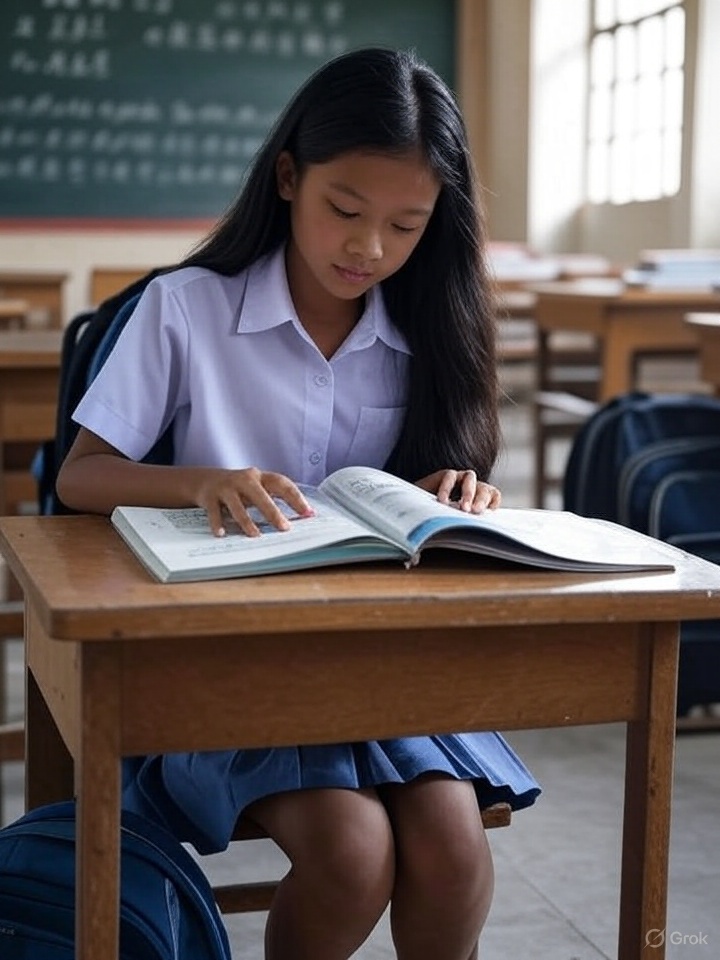
Anna wakes up at seven o’clock. She wears her warm school uniform, coat, scarf, and gloves. She eats bread and tea for breakfast and walks to school. School starts at eight o’clock with English, math, and science. At midday, she eats lunch in the school canteen. In the afternoon, she has history and art, which she enjoys. School finishes at three o’clock. At home, Anna does her homework. In the evening, she eats dinner with her parents and sometimes watches TV. She goes to bed at nine o’clock.
#################
#################
#################
Anna’s Winter School Day
Anna is a student. In winter, her school day starts early. She wakes up at seven o’clock. It is cold outside, so she puts on her warm school uniform: a white shirt, a blue sweater, and a dark skirt. She also wears a coat, scarf, and gloves.
At half past seven, Anna eats breakfast with her family. She usually has bread and tea. Then she walks to school. The streets are sometimes snowy, and Anna likes the white trees.
School starts at eight o’clock. In the morning, Anna has English, math, and science. At midday, she eats lunch in the school canteen. In the afternoon, she has history and art. Anna enjoys drawing in art class.
At three o’clock, school finishes. Anna goes home and does her homework. She writes in her notebook and reads a book for English.
In the evening, Anna has dinner with her parents. They often eat soup, rice, and vegetables. After dinner, she sometimes watches TV or talks with her mother.
At nine o’clock, Anna goes to bed. She feels tired after her school day. Outside, the winter night is cold, but Anna is warm in her bed.
English is important because it is used in many countries. People use English to talk, travel, and work. Learning English helps you meet new friends from other countries. You can watch movies, listen to songs, and read books in English. English is also useful for the internet, schools, and jobs. Many companies want people who can speak English. If you know English, you can understand more and communicate better. It opens new chances for learning and work. English is easy to start, and with practice, you can speak and understand it better every day. ________________________ Vocabulary:
to be cool – to be nice, fun, or popular
to be important – to matter, to be needed
a country – a place with its own people, land, and rules
to talk – to use words to speak with someone
to travel – to go to different places
to work – to do a job
to meet friends – to see and talk with friends
to watch a movie – to see a story on a screen
to listen to a song – to hear music and words
to read a book – to look at words in a book and understand them
to be useful – to help you, to be good for something
a company – a business where people work
people (in a company) – the workers in a company
to understand – to know the meaning of something
to communicate – to share ideas or talk with someone
to open a chance – to make a new opportunity possible
with practice – by doing something many times to get better
#################
Multiple-choice test, one answer correct:
1. What does “to be cool” mean? a) to be nice, fun, or popular b) to be tired c) to be old
2. What does “to be important” mean? a) to be small b) to matter, to be needed c) to be fast
3. What is “a country”? a) a place with its own people, land, and rules b) a type of food c) a small toy
4. What does “to talk” mean? a) to run fast b) to use words to speak with someone c) to sleep
5. What does “to travel” mean? a) to stay at home b) to go to different places c) to eat a lot
6. What does “to work” mean? a) to sleep b) to play c) to do a job
7. What does “to meet friends” mean? a) to eat food alone b) to see and talk with friends c) to read a book
8. What does “to watch a movie” mean? a) to see a story on a screen b) to listen to music c) to draw
9. What does “to listen to a song” mean? a) to sleep b) to hear music and words c) to write
10. What does “to read a book” mean? a) to talk b) to look at words in a book and understand them c) to listen to a song
11. What does “to be useful” mean? a) to help you, to be good for something b) to be boring c) to be expensive
12. What is “a company”? a) a place to sleep b) a school c) a business where people work
13. Who are people (in a company)? a) children at school b) animals c) the workers in a company
14. What does “to understand” mean? a) to forget b) to run c) to know the meaning of something
15. What does “to communicate” mean? a) to eat b) to sleep c) to share ideas or talk with someone
16. What does “to open a chance” mean? a) to close a door b) to watch TV c) to make a new opportunity possible
She wants to travel to different countries next summer.
Tom is very cool. Everyone likes him.
We can watch a movie on TV tonight.
John wants to read a new book in English.
Learning English is important for school and jobs.
A company is a place where many people work.
I like to listen to music when I am happy.
We can meet new friends at school.
If you practice every day, you can understand English better.
Speaking English helps you communicate with people in other countries.
Learning a language can open new chances for learning and work.
#####################
Match the words with the correct meaning:
Words
to travel
to work
to meet friends
to watch a movie
to listen to a song
to read a book
to be important
a country
a company
to understand
Definitions: a) to see and talk with friends b) to go to different places c) a place with its own people, land, and rules d) to do a job e) to look at words in a book and know the meaning f) to know the meaning of something g) a business where people work h) to be needed, to matter i) to hear music and words j) to see a story on a screen
Find the words in the text – which phrase are we looking for?
________________________________ Correct words: important meet friends better know internet songs watch schools countries ________________________________
Cloze story
Fill in the blanks with the correct words from the box:
My name is Veera. I have a big dream for my future job. I want to work with numbers. But I want to do this in a beautiful, luxury hotel. This kind of job is in the hospitality business. I know this will be a difficult path. But I also believe it will make me very happy and proud.
First, I need to learn a lot. I will go to university to study accounting. This is how you learn to work with money and numbers for a company. After I finish school, I will try to get a special professional certificate. One important certificate is called a CPA *. This certificate is proof that I am very good with accounting rules. This knowledge will be my most important tool for my career.
However, I know I need more than just school. I need to understand how a hotel works every day. I plan to start with an internship job at a hotel. This will let me learn about the front desk, the rooms, and the things the hotel buys. I also need to learn computer programs that hotels use for their money. I want to understand how my number job helps guests have a perfect stay. Good money management helps the hotel give great service.
I am ready for this work. It is a mix of being very careful with details and also thinking about the big picture. I am excited to join a team. This team makes sure the hotel is successful and has a famous, good name. I know my journey will have many challenges. But I am a hard worker, and I will not quit. I am committed to achieving my goal.
__________________________ *CPA: Certified Public Accountant. A CPA in Cambodia is a certified accountant. They check company accounts, make financial reports, and help businesses follow laws. They pass special exams to work professionally.
__________________________
Vocabulary – part 1:
Precision: Being very, very careful. Doing something with no mistakes.
Passion: A very strong feeling of liking something a lot. Loving what you do.
Hospitality business: The business of making people feel welcome. It includes hotels and restaurants.
Accounting: The job of watching and managing money for a company.
To work with numbers: To do a job that uses math, like adding and subtracting.
A difficult path: A way to your goal that is not easy. It has many problems.
To believe: To think that something is true or good.
To be proud: To feel happy and good about something you did.
A professional certificate: A special paper that says you are an expert in something.
To be proof: To show that something is true.
Accounting rules: The special instructions for how to manage money correctly.
Knowledge: The things that you know and have learned.
A tool: A thing that helps you do a job. A hammer is a tool for building. Knowledge is a tool for your mind.
An internship: A temporary job for a student to learn and get experience.
Front desk (in a hotel): The place in a hotel where guests go when they arrive. They get their room key there.
Money management: The job of deciding how to use money wisely.
To give great service: To help people very well and make them happy.
A mix: When two or more different things are put together.
A big picture: The idea of the whole plan, not just the small details.
To be excited: To feel very happy and eager about something that will happen.
To join a team: To become part of a group that works together.
To be successful: To do well and reach your goals.
Famous: Known by many people.
A journey: A trip from one place to another. It can be a real trip or the path to a goal in life.
A challenge: Something that is difficult to do.
To quit: To stop doing something.
To be committed: To promise yourself that you will not quit. You will keep trying.
To achieve a goal: To successfully do what you wanted to do. ###############
Multiple choice, one answer correct, part 1:
1. Precision a) to work very fast b) to be very careful with no mistakes c) to be very strong
2. Passion a) a very strong feeling of love for something b) a very difficult job c) a special paper for your job
3. Hospitality business a) the business of building houses b) the business of selling cars c) the business of hotels and restaurants
4. Accounting a) the job of cooking food b) the job of managing money for a company c) the job of cleaning a hotel
5. To work with numbers a) to paint pictures b) to use math in your job c) to write stories
6. A difficult path a) a very wide road b) a way to a goal that has many problems c) a short walk to school
7. To believe a) to think something is true or good b) to eat something quickly c) to run very fast
8. To be proud a) to feel sad about something b) to feel happy about something you did c) to feel very tired
9. A professional certificate a) a special key for a door b) a special paper that says you are an expert c) a new computer
10. To be proof a) to show that something is true b) to hide something c) to make a mistake
11. Accounting rules a) instructions for how to play a game b) instructions for how to manage money correctly c) instructions for how to cook
12. Knowledge a) the things you have learned and know b) the food you eat c) the money you have
13. A tool a) something that helps you do a job b) a type of shoe c) a song you sing
14. An internship a) a long vacation b) a permanent job for experts c) a temporary job for students to learn
__________________
Correct Answers:
Precision: to be very careful with no mistakes (b)
Passion: a very strong feeling of love for something (a)
Hospitality business: the business of hotels and restaurants (c)
Accounting: the job of managing money for a company (b)
To work with numbers: to use math in your job (b)
A difficult path: a way to a goal that has many problems (b)
To believe: to think something is true or good (a)
To be proud: to feel happy about something you did (b)
A professional certificate: a special paper that says you are an expert (b)
To be proof: to show that something is true (a)
Accounting rules: instructions for how to manage money correctly (b)
Knowledge: the things you have learned and know (a)
A tool: something that helps you do a job (a)
An internship: a temporary job for students to learn (c)
############################
Multiple choice, one answer correct, part 2:
Front desk (in a hotel) a) the kitchen where food is made b) the place where guests go when they arrive c) the room where people sleep
Money management a) the job of spending money quickly b) the job of deciding how to use money wisely c) the job of finding money on the street
To give great service a) to help people very well and make them happy b) to sell things to people c) to tell people what to do
A mix a) when one thing is alone b) when two or more different things are put together c) when something is very old
A big picture a) a very large painting b) a photograph of a big family c) the idea of the whole plan, not just the small details
To be excited a) to feel very tired and sleepy b) to feel very happy and eager about something that will happen c) to feel angry about something
To join a team a) to watch a group play a game b) to become part of a group that works together c) to leave a group because you are tired
To be successful a) to do well and reach your goals b) to try something new c) to lose a game or competition
Famous a) known by very few people b) known by many people c) very expensive to buy
A journey a) a short walk to the store b) a trip from one place to another; it can be a real trip or the path to a goal in life c) a meal you eat in the morning
A challenge a) something that is very easy to do b) something that is difficult to do c) a type of game with cards
To quit a) to start doing something new b) to stop doing something c) to try very hard
To be committed a) to promise yourself that you will not quit; you will keep trying b) to forget to do something important c) to be late for an appointment
To achieve a goal a) to forget what you wanted to do b) to make a new plan for the future c) to successfully do what you wanted to do
_______________
Correct answers:
15. Front desk (in a hotel): the place where guests go when they arrive (b) 16. Money management: the job of deciding how to use money wisely (b) 17. To give great service: to help people very well and make them happy (a) 18. A mix: when two or more different things are put together (b) 19. A big picture: the idea of the whole plan, not just the small details (c) 20. To be excited: to feel very happy and eager about something that will happen (b) 21. To join a team: to become part of a group that works together (b) 22. To be successful: to do well and reach your goals (a) 23. Famous: known by many people (b) 24. A journey: a trip from one place to another; it can be a real trip or the path to a goal in life (b) 25. A challenge: something that is difficult to do (b) 26. To quit: to stop doing something (b) 27. To be committed: to promise yourself that you will not quit; you will keep trying (a) 28. To achieve a goal: to successfully do what you wanted to do (c) #####################
Fill in, one answer correct:
Veera wants to work in the hospitality ________. a) business b) rules c) goal
2. She wants to give great ________ at a luxury hotel. a) accounting b) service c) management
3. She knows it will be a difficult ________. a) path b) picture c) team
4. First, she will study ________ at university. a) numbers b) accounting c) software
5. Then, she will get a professional ________. a) certificate b) proof c) goal
6. Her life will be an interesting ________. a) knowledge b) service c) journey
7. She needs to learn more than just ________. a) numbers b) pictures c) tools
8. She feels ________ about her new career. a) internship b) accounting c) excitement
9. She will ________ her best effort to the job. a) work b) give c) manage
10. She will learn about the ________ where guests arrive. a) management b) front desk c) accounting
11. She has a ________ for her work. a) precision b) passion c) challenge
12. She is ________ about her future team. a) excited b) committed c) proud
13. She will help protect the hotel’s ________. a) health b) rules c) reputation
14. She will not ________ when it gets difficult. a) achieve b) believe c) quit
15. Veera is ________ to her plan. a) committed b) successful c) famous
16. She wants to ________ her dreams. a) quit b) achieve c) believe
17. She ________ in her future success. a) achieves b) believes c) quits
18. She remains ________ to her studies. a) excited b) proud c) committed
19. She will learn money ________ skills. a) management b) certificate c) picture
20. Her work will be ________ of her ability. a) service b) tool c) proof ____________________
Correct version:
Veera wants to work in the hospitality business. (a)
She wants to give great service at a luxury hotel. (b)
She knows it will be a difficult path. (a)
First, she will study accounting at university. (b)
Then, she will get a professional certificate. (a)
Her life will be an interesting journey. (c)
She needs to learn more than just numbers. (a)
She feels excitement about her new career. (c)
She will give her best effort to the job. (b)
She will learn about the front desk where guests arrive. (b)
She has a passion for her work. (b)
She is excited about her future team. (a)
She will help protect the hotel’s reputation. (c)
She will not quit when it gets difficult. (c)
Veera is committed to her plan. (a)
She wants to achieve her dreams. (b)
She believes in her future success. (b)
She remains committed to her studies. (c)
She will learn money management skills. (a)
Her work will be proof of her ability. (c)
#####################
Match the word with its definition:
Words
business
service
path
accounting
certificate
journey
numbers
excitement
give
front desk
passion
excited
reputation
quit
committed
Meanings
A. a strong feeling of happiness and eagerness B. to stop doing something C. the way to a goal D. the work of helping people well E. a trip through life F. the job of managing money G. a place in a hotel where guests go first H. a strong feeling of love for something I. to provide or offer something to others J. a company or type of work K. feeling very happy about something future L. promised to not give up M. math symbols like 1, 2, 3 N. a paper that says you are an expert O. what people think about someone or something
Answers:
business: a company or type of work
service: the work of helping people well
path: the way to a goal
accounting: the job of managing money
certificate: a paper that says you are an expert
journey: a trip through life
numbers: math symbols like 1, 2, 3
excitement: a strong feeling of happiness and eagerness
gives: to provide or offer something to others
front desk: a place in a hotel where guests go first
passion: a strong feeling of love for something
excited: feeling very happy about something future
reputation: what people think about someone or something
quit: to stop doing something
committed: promised to not give up _____________________________
committed / is / She / her goal / to _____________________ Answers:
Veera wants to work in a hotel.
She will get an accounting degree.
She needs to learn more than numbers.
She will be an intern.
She is committed to her goal. ###############
Yes, she does? No, she doesn’t? If negative answer, give correct information.
Does she want to work in a hotel?
Does she want to be a teacher?
Does she need to get a degree?
Does she think her path is easy?
Does she want to get a professional certificate?
Does she only learn about numbers?
Does she want to join a team?
Answers:
Yes, she does.
No, she doesn’t. She wants to be an accountant.
Yes, she does.
No, she doesn’t. She thinks it is difficult.
Yes, she does.
No, she doesn’t. She learns more than numbers.
Yes, she does. ____________________________
Does she want to work in a hotel? Yes, she does.
Does she want to be a teacher? No, she doesn’t. She wants to be an accountant.
Does she need to get a degree? Yes, she does.
Does she think her path is easy? No, she doesn’t. She thinks it is difficult.
Does she want to get a professional certificate? Yes, she does.
Does she only learn about numbers? No, she doesn’t. She learns more than numbers.
Does she want to join a team? Yes, she does.
################### Fill in, words below:
hard – accounting – numbers – committed – internship – dream – career
___________________
My name is Veera. My __________ is to be an accountant in a beautiful, luxury hotel. I will study __________ at university and get a CPA certificate. I also plan to do an __________ to learn how a hotel works every day. I want to understand how my job with __________ helps guests have a perfect stay. I am a __________worker and ready for this challenge. I will not quit. I am __________ to achieving my goal for a happy _________. __________________
Correct version:
My name is Veera. My dream is to be an accountant in a beautiful, luxury hotel. I will study accounting at university and get a CPA certificate. I also plan to do an internship to learn how a hotel works every day. I want to understand how my job with numbers helps guests have a perfect stay. I am a hard worker and ready for this challenge. I will not quit. I am committed to achieving my goal for a happy career. #################
Now rewrite the exact story, starting with
Her name is Veera. Her dream is……..
make all changes necessary.
________________________
Correct version:
Her name is Veera. Her dream is to be an accountant in a beautiful, luxury hotel. She will study accounting at university and get a CPA certificate. She also plans to do an internship to learn how a hotel works every day. She wants to understand how her job with numbers helps guests have a perfect stay. She is a hard worker and ready for this challenge. She will not quit. She is committed to achieving her goal for a happy career.
My name is Veata. I am 14 years old. I live in Cambodia. I have a dream for the future. I want to work in tourism. I want to work in a hotel. I think a hotel is a very good place. Many people come from other countries. They come for holidays. I want to help them and make them happy
I know some things I need for this dream. I must speak English well. English is important because many tourists speak English. I also want to learn another language, maybe Chinese. I must be friendly and polite. I must smile every day. I must be on time and work hard. I must like people and talk to them.
How can I reach my dream? I go to school and study. I read books. I watch English films. I can talk with tourists in my town. This helps me learn. Later, I want to study at a hotel school. I can learn how to welcome guests, how to show rooms, how to work in a restaurant, how to answer the phone, how to give information about the city, how to help with bags, and how to smile when people need help. I also want to learn about accounting because money is important in a hotel. I want to learn about advertising because a hotel must tell people about its rooms and services.
Sometimes it is not easy. But I believe I can do it. I will try every day. My dream is strong. One day I will work in a hotel as a manager.
_________________ Vocabularies:
to try: to attempt to do something.
to have a dream: to want to do something very much in the future.
a country (plural: countries): a place like Cambodia, Thailand, or England.
to come for a holiday: to travel to a place for vacation and fun.
to make somebody happy: to do something that makes another person feel good.
important: something you must do or have. You need it.
maybe: it is possible, but you are not sure. Perhaps.
to be friendly: to be kind and nice to other people.
to be polite: to have good manners; to say „please“ and „thank you“.
to smile: to make a happy face with your mouth.
to be on time: to not be late; to arrive at the correct time.
to work hard: to use a lot of energy and try your best to do something.
to talk to people: to speak with other people.
to reach a dream: to get what you want for your future; to make your dream real.
to study at school: to learn things in a classroom.
to watch a film: to look at a movie for fun.
to answer the phone: to say „hello“ when the telephone rings.
a bag: a thing you use to carry your things, like clothes.
accounting (hotel): the work of watching and counting the hotel’s money.
advertising: telling many people about a thing to make them want to buy it.
a service (in a hotel): help that the hotel gives you, like clean rooms or food.
sometimes: not always and not never; on some occasions.
to believe: to feel sure that something is true or possible. #################
Match the word with the meaning
a dream
a country
to be friendly
to be polite
to smile
important
to be on time
to work hard
to answer the phone
a bag
accounting
advertising
a service
to believe
to try
a) to use a lot of energy to do something well b) to feel sure something is true or possible c) to say „hello“ when the telephone rings d) a place like Cambodia or Vietnam e) to have good manners f) to make a happy face with your mouth g) something you need to do or have h) to be kind and nice to people i) to not be late j) a thing you use to carry your clothes k) telling people about something to make them buy it l) help that a hotel gives you m) to want to do something very much in the future n) to attempt to do something o) the work of watching and counting money
1. She wants to work in a shop. Answer: No, she doesn’t. She wants to work in a hotel. 2. She wants to be a hotel manager. Answer: Yes, she does. 3. She likes to meet people from other countries. Answer: Yes, she does. 4. She thinks English is not important. Answer: No, she doesn’t. She thinks English is important. 5. She goes to school. Answer: Yes, she does. 6. She hates studying. Answer: No, she doesn’t. She studies hard. 7. She watches English films. Answer: Yes, she does. 8. She talks to tourists in her town. Answer: Yes, she does. 9. She wants to learn Spanish. Answer: No, she doesn’t. She wants to learn Chinese, as well 10. She believes she can succeed. Answer: Yes, she does. #################### Interview with Veata – fill in, words below:
hotel – watch – dream – work – fourteen – talk – help – polite – hard – manage
————————— 1. What is your name? My name is Veata. 2. How old are you? I am __________ years old. 3. Where do you live? I live in Cambodia. 4. What is your dream job? My dream job is to __________ in a hotel. 5. Why do you like hotels? I like hotels because many tourists come and I can __________ them. 6. What languages do you want to speak? I want to speak English and Chinese. 7. How do you learn English? I read books, __________ films, and __________ to tourists. 8. What is important for a hotel job? It is important to be friendly, __________, and smile. 9. Do you work hard? Yes, I work very __________ for my dream. 10. Where do you want to study? I want to study at a __________school. 11. What do you want to learn there? I want to learn how to help guests and _________ a hotel. 12. Do you believe in your __________? Yes, I believe I can do it!
Listen => link ################## A1+ Interview: talking with Sreyroth (Veata’s Friend) – fill in, words below:
school – fourteen – welcome – meets – smart – town – smile – speak – dream – hotel – reads – talks – welcome __________________
Interviewer: Hello, Sreyroth. Can you tell me about your best friend? Sreyroth: Yes, of course. .
What is your friend’s name? Her name is Veata.
How old is she? She is __________ years old.
Where does she live? She lives in Cambodia, in my _________.
What is her dream job? She wants to work in a __________.
Why does she like hotels? She likes hotels because she _________ tourists and helps them.
What languages does she want to speak? She wants to __________ English and Chinese.
How does she learn English? She __________ books, watches films, and __________ to tourists.
What is important for her future job? It is important to be friendly, polite, and to __________.
Does she work hard? Yes, she works very hard for her __________.
Where does she want to study? She wants to study at a hotel __________.
What does she want to learn there? She wants to learn how to __________ guests and manage a hotel.
Do you think she can succeed? Yes, I believe she can do it because she is __________ and kind.
Interviewer: Thank you, Sreyroth. Sreyroth: You are __________.
Interviewer: Hello, Sreyroth. Can you tell me about your best friend? Sreyroth: Yes, of course.
What is your friend’s name? Her name is Veata.
How old is she? She is fourteen years old.
Where does she live? She lives in Cambodia, in my town.
What is her dream job? She wants to work in a hotel.
Why does she like hotels? She likes hotels because she meets tourists and helps them.
What languages does she want to speak? She wants to speak English and Chinese.
How does she learn English? She reads books, watches films, and talks to tourists.
What is important for her future job? It is important to be friendly, polite, and to smile.
Does she work hard? Yes, she works very hard for her dream.
Where does she want to study? She wants to study at a hotel school.
What does she want to learn there? She wants to learn how to welcome guests and manage a hotel.
Do you think she can succeed? Yes, I believe she can do it because she is smart and kind.
Interviewer: Thank you, Sreyroth. Sreyroth: You are welcome. #################
Read:
My name is Veata. I am fourteen years old. I live in Cambodia. My dream is to work in a hotel. I want to help tourists and make them happy. I study English very hard. I read books and watch films. I also talk to tourists in my town. I want to be friendly and polite. I must smile and work hard. Later, I want to study at a hotel school. I want to learn how to welcome guests and manage a hotel. I believe in my dream. I will try until I succeed (=to get what you want).
Her name is Veata. She is fourteen years old. She lives……….
and make all changes necessary. _____________
Correct version:
Her name is Veata. She is fourteen years old. She lives in Cambodia. Her dream is to work in a hotel. She wants to help tourists and make them happy. She studies English very hard. She reads books and watches films. She also talks to tourists in her town. She wants to be friendly and polite. She must smile and work hard. Later, she wants to study at a hotel school. She wants to learn how to welcome guests and manage a hotel. She believes in her dream. She will try until she succeeds.
My name is Ben. I am seventeen years old now, but I remember my daily routine when I was ten.
I woke up at seven o’clock every morning. I ate breakfast, usually cereal with milk. Then, I brushed my teeth and got dressed for school. School started at half past eight. I had lessons like maths, English, and science. My favourite subject was art.
At twelve o’clock, I ate lunch at school with my friends. After lunch, we had more lessons. School finished at three o’clock. I went home and did my homework first. Then, I had free time. I often played football in the park or played video games.
I had dinner with my family at six o’clock. After dinner, I sometimes watched television or read a book. I took a shower and put on my pyjamas. I went to bed at nine o’clock. I read in bed for a short time before I slept.
___________________
Vocabulary – with past tense form in (_____):
childhood The time when you are a child.
to remember (remembered) To think about something from the past.
daily routine The normal things you do every day.
to wake up (woke up) To stop sleeping.
to eat breakfast (ate breakfast) To have your first meal in the morning.
usually What happens most of the time.
cereal A breakfast food made from grain, often eaten with milk.
to brush teeth (brushed teeth) To clean your teeth with a brush.
to get dressed (got dressed) To put on your clothes.
a lesson A time in school when a teacher helps you learn.
science Learning about the world, like plants, animals, and experiments.
the favourite subject The school lesson you like the most.
lunch A meal you eat in the middle of the day.
to finish (finished) To end.
free time Time when you can do what you want, with no work or school.
to play a game (played a game) To do something for fun, like football or video games.
to have dinner (had dinner) To eat your evening meal.
sometimes Not always and not never, but some of the time.
to watch TV (watched TV) To look at a television for entertainment.
to take a shower (took a shower) To wash your body with water that falls on you.
to put on pyjamas (put on pyjamas) To put on the clothes you wear for sleeping.
for a short time For a small amount of time, not for long.
to sleep (slept) To rest with your eyes closed.
#################
Vocabulary Multiple Choice Test
Choose the best word or phrase to complete each sentence.
The time when you are young is called your _. a) daily routine b) free time c) childhood
I _ my old school friends last week. a) played a game b) remembered c) had dinner
After I _, I ate breakfast. a) woke up b) brushed teeth c) got dressed
For breakfast, I _ cereal with milk. a) sometimes b) ate c) usually
After breakfast, I _ and got ready for school. a) brushed teeth b) took a shower c) put on pyjamas
At school, we had a _ about animals. a) science b) lesson c) lunch
My _ was art because I liked drawing. a) favourite subject b) free time c) daily routine
At twelve o’clock, I ate _ in the cafeteria. a) breakfast b) cereal c) lunch
School _ at three o’clock in the afternoon. a) started b) finished c) woke up
After homework, I had _ to play. a) a lesson b) free time c) a shower
I _ of football with my friends. a) watched TV b) played a game c) had dinner
At six o’clock, our family _ together. a) ate breakfast b) had dinner c) brushed teeth
_ after dinner, I read a book. a) UsuallySometimes b) Usually c) For a short time
Before bed, I _ to get clean. a) put on pyjamas b) took a shower c) got dressed
Then I _ before getting into bed. a) played a game b) ate cereal c) put on pyjamas
I read _ before I _. a) for a short time / slept b) usually / finished c) sometimes / woke up ____________________
Hello! My name is Ben, and I am ten years old. This is my daily routine.
I wake up at seven o’clock. I eat breakfast, usually cereal with milk. Then, I brush my teeth and get dressed for school. School starts at half past eight. I have lessons like maths, English, and science. My favourite subject is art.
At twelve o’clock, I eat lunch at school with my friends. After lunch, we have more lessons. School finishes at three o’clock. I go home and do my homework first. Then, I have free time. I often play football in the park or play video games.
I have dinner with my family at six o’clock. After dinner, I sometimes watch television or read a book. I take a shower and put on my pyjamas. I go to bed at nine o’clock. I read in bed for a short time before I sleep. ____________________
A bit faster audio-version:
____________________
Vocabulary:
daily / (=slash) a routine: things you do every day. your normal plan for a day.
to wake up: to open your eyes and stop sleeping.
to eat breakfast: to have your first meal in the morning.
cereal: a dry breakfast food made from grain. you eat it with milk.
to brush teeth: to clean your teeth with a brush and toothpaste.
to get dressed: to put on your clothes.
a lesson (school): a time in school when you learn one subject, like english or history.
maths: a school subject with numbers, adding, and subtracting.
science: a school subject about the world, like plants, animals, and experiments.
a favourite lesson: the school subject you like the most.
art: a school subject where you draw, paint, and make things.
lunch: the meal you eat in the middle of the day.
to finish: to end or to stop. when something is done.
to do first: to do something before you do anything else.
free time: time when you can choose what to do. you do not have to work or study.
to have dinner: to eat your main meal in the evening.
sometimes: not always and not never. it happens on some days.
to watch tv: to look at a television for entertainment or news.
to take a shower: to wash your body with water that falls from above.
to put on pyjamas: to put on soft clothes you wear for sleeping.
to go to bed: to get into your bed to sleep.
a short time: a small amount of time, like 5 or 10 minutes.
15 statements based on the text, some true, some false, answer accordingly:
Example 1: Statement: Does he read a book in bed? Answer: Yes, he does.
Example 2: Statement: Does Ben wake up at six o’clock? Answer: No, he doesn’t. He wakes up at seven o’clock. – – – – – – – – – – – – – – – – – – – – – – – –
Statement: Does he eat cereal for breakfast? Answer: __________________________
Statement: Does he brush his teeth before breakfast? Answer: __________________________
Statement: Do his lessons start at half past eight? Answer: __________________________
Statement: Does he like art the most? Answer: __________________________
Statement: Does he eat lunch at home? Answer: __________________________
Statement: Do his friends eat lunch with him? Answer: __________________________
Statement: Does school finish at four o’clock? Answer: __________________________
Statement: __________________________
Statement: Does he play football in the park? Answer: __________________________
Statement: Do he and his family eat dinner at six o’clock? Answer: __________________________
Statement: Does he always watch TV after dinner? Answer: __________________________
Statement: Does he take a shower in the morning? Answer: __________________________
Statement: Does he go to bed at nine o’clock? Answer: __________________________
– – – – – – – – – – – – – – – – – – – – – – – –
Correct answers:
Statement: Does he eat cereal for breakfast? Answer: Yes, he does.
Statement: Does he brush his teeth before breakfast? Answer: No, he doesn’t. He brushes his teeth after breakfast.
Statement: Do his lessons start at half past eight? Answer: Yes, they do.
Statement: Does he like art the most? Answer: Yes, he does.
Statement: Does he eat lunch at home? Answer: No, he doesn’t. He eats lunch at school.
Statement: Do his friends eat lunch with him? Answer: Yes, they do.
Statement: Does school finish at four o’clock? Answer: No, it doesn’t. It finishes at three o’clock.
Statement: Does he play video games before doing his homework? Answer: No, he doesn’t. He does his homework first.
Statement: Does he play football in the park? Answer: Yes, he does.
Statement: Do he and his family eat dinner at six o’clock? Answer: Yes, they do.
Statement: Does he always watch TV after dinner? Answer: No, he doesn’t. He only sometimes watches TV.
Statement: Does he take a shower in the morning? Answer: No, he doesn’t. He takes a shower before bed.
Statement: Does he go to bed at nine o’clock? Answer: Yes, he does. #################
Put the sentences in order
[ 1] After dinner, I sometimes read a book.
[2 ] I go to school at half past eight.
[ 3] I have dinner with my family at six o’clock.
[ 4] I eat breakfast, usually cereal with milk.
[ 5] I go to bed at nine o’clock.
[ 6] After school, I do my homework first.
[ 7] Then, I brush my teeth and get dressed.
[ 8] I wake up at seven o’clock.
Correct order: 8,4,7,2,6,3,1,5
##############
What time does Ben do these things?
He wakes up at _____.
School starts at _____.
He eats lunch at _____.
School finishes at _____.
He has dinner at _____.
He goes to bed at _____.
__________________
Answers: seven o’clock – half past eight – twelve o’clock – three o’clock – six o’clock – nine o’clock
###########
Use the original story above, and rewrite it, starting with
His name is Ben, and he is ten years old……… Make all changes necessary. ________________________
Correct version:
His name is Ben, and he is ten years old. This is his daily routine.
He wakes up at seven o’clock. He eats breakfast, usually cereal with milk. Then, he brushes his teeth and gets dressed for school. School starts at half past eight. He has lessons like maths, English, and science. His favourite subject is art.
At twelve o’clock, he eats lunch at school with his friends. After lunch, they have more lessons. School finishes at three o’clock. He goes home and does his homework first. Then, he has free time. He often plays football in the park or plays video games.
He has dinner with his family at six o’clock. After dinner, he sometimes watches television or reads a book. He takes a shower and puts on his pyjamas. He goes to bed at nine o’clock. He reads in bed for a short time before he sleeps.
##############
Interview with Ben, complete
Interviewer: Hello Ben. What is your name? Ben: My name is Ben.
Interviewer:What time do you wake up? Ben: I wake up at ________________.
Interviewer:What do you eat for breakfast? Ben: I usually eat _____________with milk.
Interviewer:Where do you go after breakfast? Ben: I go to _________________.
Interviewer:What is your favourite subject? Ben: My favourite subject is ___________.
Interviewer:Who do you eat lunch with? Ben: I eat lunch with my ___________.
Interviewer:When does school finish? Ben: School finishes at _______________.
Interviewer:What do you do first after school? Ben: I do my _______________ first.
Interviewer:Where do you play football? Ben: I play in the _____________.
Interviewer:What time do you eat dinner? Ben: I have dinner at _____________.
Interviewer:Who is with you at dinner? Ben: My ______________ is with me.
Interviewer:What do you do after dinner? Ben: I sometimes watch television or ___________ a book.
Interviewer:When do you go to bed? Ben: I go to bed at ____________.
Interviewer: Thank you, Ben! Ben: You’re welcome!
###################
Full version:
Interviewer: Hello Ben. What is your name? Ben: My name is Ben.
Interviewer:What time do you wake up? Ben: I wake up at seven o’clock.
Interviewer:What do you eat for breakfast? Ben: I usually eat cereal with milk.
Interviewer:Where do you go after breakfast? Ben: I go to school.
Interviewer:What is your favourite subject? Ben: My favourite subject is art.
Interviewer:Who do you eat lunch with? Ben: I eat lunch with my friends.
Interviewer:When does school finish? Ben: School finishes at three o’clock.
Interviewer:What do you do first after school? Ben: I do my homework first.
Interviewer:Where do you play football? Ben: I play in the park.
Interviewer:What time do you eat dinner? Ben: I have dinner at six o’clock.
Interviewer:Who is with you at dinner? Ben: My family is with me.
Interviewer:What do you do after dinner? Ben: I sometimes watch television or read a book.
Interviewer:When do you go to bed? Ben: I go to bed at nine o’clock.
Interviewer: Thank you, Ben! Ben: You’re welcome!
################
An Interview With Ben’s Friend, Emma
Interviewer: Hello Emma. You know Ben well, right? Emma: Yes, we are good friends.
Interviewer:Who is Ben’s favourite teacher? Emma: His favourite teacher is his __________teacher.
Interviewer:Where does he go after school? Emma: He goes to the __________ to play.
Interviewer:How does he do his homework? Emma: He does his __________ quickly and carefully.
Interviewer:When does he watch television? Emma: He sometimes watches television after __________.
Interviewer:Which sport does he like best? Emma: He likes __________ best.
Interviewer:Who does he play with? Emma: He plays with his _________ from school.
Interviewer:What time does he go to bed? Emma: He goes to bed at _________.
Interviewer:How often does he read before sleep? Emma: He reads a book _________ night.
Interviewer:Why does he like his routine? Emma: He says it makes him happy and ready for _________.
Tom: “Hi! Have you got a pet?” Anna: “Yes! I have got a cat. And you?” Tom: “No, I haven’t got a pet. But I have got a bike.” Anna: “Have you got a bike?” Tom: “Yes! I have got a red bike.”
Then they meet Sam. Tom: “Hi Sam! Have you got a dog?” Sam: “No, I haven’t got a dog. But I have got a hamster.”
In the playground, they meet Lily. Tom: “Hi Lily! Have you got a ball?” Lily: “Yes, I have got a blue ball. Have you got a ball?” Tom: “No, I haven’t got a ball.” Anna: “Have you got a doll?” Lily: “Yes, I have got a doll. Have you got a doll, Sam?” Sam: “No, I haven’t got a doll.”
Then Tom sees his teacher. Tom: “Have you got a dog, Mr. Brown?” Mr. Brown: “Yes, I have got a dog. And I have got a cat too!”
####################
Exercise 1 – Fill in the blanks
Complete the sentences with have got / haven’t got / Have you got:
Tom: “___ a pet?”
Anna: “Yes, ___ a cat.”
Tom: “No, ___ a pet. But ___ a bike.”
Anna: “___ a bike?”
Tom: “Yes! ___ a red bike.”
Tom: “Hi Sam! ___ a dog?”
Sam: “No, ___ a dog. But ___ a hamster.”
Tom: “Hi Lily! ___ a ball?”
Lily: “Yes, ___ a blue ball. ___ you got a doll?”
Sam: “No, ___ a doll.”
Answers :
Have you got
I have got
I haven’t got / I have got
Have you got
I have got
Have you got
I haven’t got / I have got
Have you got
I have got / Have
I haven’t got
################
Exercise 2 – Matching
Match the person to what they have got:
Tom → a ___
Anna → a ___
Sam → a ___
Lily → a ___
Options: a) blue ball b) hamster c) cat d) red bike ____________________
Answers – Exercise 2: 1 → d (red bike) 2 → c (cat) 3 → b (hamster) 4 → a (blue ball)
###############
Exercise 3 – Make your own story
Complete 10 dialogues using Have you got / I have got / I haven’t got:
A: “___ a pet?” B: “Yes, ___ a cat.”
A: “___ a bike?” B: “No, ___ a bike.”
A: “___ a ball?” B: “Yes, ___ a ball.”
A: “___ a doll?” B: “No, ___ a doll.”
A: “___ a hamster?” B: “Yes, ___ a hamster.”
A: “___ a kite?” B: “No, ___ a kite.”
A: “___ a pencil?” B: “Yes, ___ a pencil.”
A: “___ a notebook?” B: “No, ___ a notebook.”
A: “___ a dog?” B: “Yes, ___ a dog.”
A: “___ a toy car?” B: “No, ___ a toy car.”
Answers – Exercise 3:
Have you got / I have got
Have you got / I haven’t got
Have you got / I have got
Have you got / I haven’t got
Have you got / I have got
Have you got / I haven’t got
Have you got / I have got
Have you got / I haven’t got
Have you got / I have got
Have you got / I haven’t got
A: “Have you got a pet?” B: “Yes, I have got a cat.”
A: “Have you got a bike?” B: “No, I haven’t got a bike.”
A: “Have you got a ball?” B: “Yes, I have got a ball.”
A: “Have you got a doll?” B: “No, I haven’t got a doll.”
A: “Have you got a hamster?” B: “Yes, I have got a hamster.”
A: “Have you got a kite?” B: “No, I haven’t got a kite.”
A: “Have you got a pencil?” B: “Yes, I have got a pencil.”
A: “Have you got a notebook?” B: “No, I haven’t got a notebook.”
A: “Have you got a dog?” B: “Yes, I have got a dog.”
A: “Have you got a toy car?” B: “No, I haven’t got a toy car.”
######################
Have or has?
Here is the updated version with pet instead of ruler:
_______ Tom and Susan got a dog? No, they _______n’t got a dog. _______ Susan got a dog? No, she _______n’t got a dog. _______ Tom got a dog? Yes, he _______ got a dog. But his neighbours _______n’t got a dog.
_______ Tom and Susan got a pet? No, they _______n’t got a pet. _______ Susan got a pet? No, she _______n’t got a pet. _______ Tom got a pet? Yes, he _______ got a pet. But his neighbours _______n’t got a pet.
_______Tom and Susan got a notebook? No, they _______n’t got a notebook. _______ Susan got a notebook? No, she _______n’t got a notebook. _______ Tom got a notebook? Yes, he _______ got a notebook. But his neighbours _______n’t got a notebook.
_______Tom and Susan got a toy car? No, they _______n’t got a toy car. _______ Susan got a toy car? No, she _______n’t got a toy car. ________Tom got a toy car? Yes, he _______ got a toy car. But his neighbours _______n’t got a toy car.
_______ Tom and Susan got a ball? No, they _______ n’t got a ball. _______ Susan got a ball? No, she _______ n’t got a ball. _______ Tom got a ball? Yes, he _______ got a ball. But his neighbours _______ n’t got a ball.
——————————-
Full version:
Have Tom and Susan got a dog? No, they haven’t got a dog. Has Susan got a dog? No, she hasn’t got a dog. Has Tom got a dog? Yes, he has got a dog. But his neighbours haven’t got a dog.
Have Tom and Susan got a pet? No, they haven’t got a pet. Has Susan got a pet? No, she hasn’t got a pet. Has Tom got a pet? Yes, he has got a pet. But his neighbours haven’t got a pet.
Have Tom and Susan got a notebook? No, they haven’t got a notebook. Has Susan got a notebook? No, she hasn’t got a notebook. Has Tom got a notebook? Yes, he has got a notebook. But his neighbours haven’t got a notebook.
Have Tom and Susan got a toy car? No, they haven’t got a toy car. Has Susan got a toy car? No, she hasn’t got a toy car. Has Tom got a toy car? Yes, he has got a toy car. But his neighbours haven’t got a toy car.
Have Tom and Susan got a ball? No, they haven’t got a ball. Has Susan got a ball? No, she hasn’t got a ball. Has Tom got a ball? Yes, he has got a ball. But his neighbours haven’t got a ball.
Does your elbow connect your leg to your foot? No, it doesn’t!
Does your nose help you smell? ____________
Does your thumb help you breathe? ____________
Do your eyes help you see? ____________
Do your fingers help you hear? ____________
Does your mouth help you talk and eat? ____________
Does your hair help you see better? ____________
Does your back help you smell? ____________
Do your legs help you walk and run? ____________
Do your feet help you chew food? ____________
Does your chest protect your heart and lungs? ____________
Does your neck connect your head to your body? ____________
Does your stomach help you talk? ____________
Do your ears help you hear sounds? ____________
Does your mouth protect your heart? ____________
Do your toes help you balance when you stand? ____________
Does your shoulder help you taste? ____________
Do your teeth help you chew food? ____________
Does your neck help you pick up things? ____________
_________________
Answers:
Do your knees help your legs bend? Yes, they do.
Does your elbow connect your leg to your foot? No, it doesn’t.
Does your nose help you smell? Yes, it does.
Does your thumb help you breathe? No, it doesn’t.
Do your eyes help you see? Yes, they do.
Do your fingers help you hear? No, they don’t.
Does your mouth help you talk and eat? Yes, it does.
Does your hair help you see better? No, it doesn’t.
Does your back help you smell? No, it doesn’t.
Do your legs help you walk and run? Yes, they do.
Do your feet help you chew food? No, they don’t.
Does your chest protect your heart and lungs? Yes, it does.
Does your neck connect your head to your body? Yes, it does.
Does your stomach help you talk? No, it doesn’t.
Do your ears help you hear sounds? Yes, they do.
Does your mouth protect your heart? No, it doesn’t.
Do your toes help you balance when you stand? Yes, they do.
Does your shoulder help you taste? No, it doesn’t.
Do your teeth help you chew food? Yes, they do.
Does your neck help you pick up things? No, it doesn’t.
##################
Match each body part to the correct function:
Body parts:
eyes
ears
nose
mouth
teeth
neck
shoulders
arms
elbows
hands
fingers
chest
stomach
legs
Functions:
a. help you hear b. help you chew c. help you see d. connects your head to your body e. help you walk and run f. help you hold things g. helps you smell h. help you bend your arm i. help you eat and talk j. protect your heart and lungs k. help you pick up small things l. connect your arms to your body m. between your shoulder and hand n. helps you digest food _________________ Answers: 1c, 2a, 3g, 4i, 5b, 6d, 7l, 8m, 9h, 10f, 11k, 12j, 13n, 14e ###############
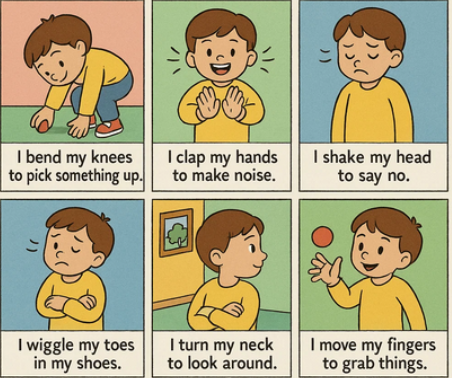
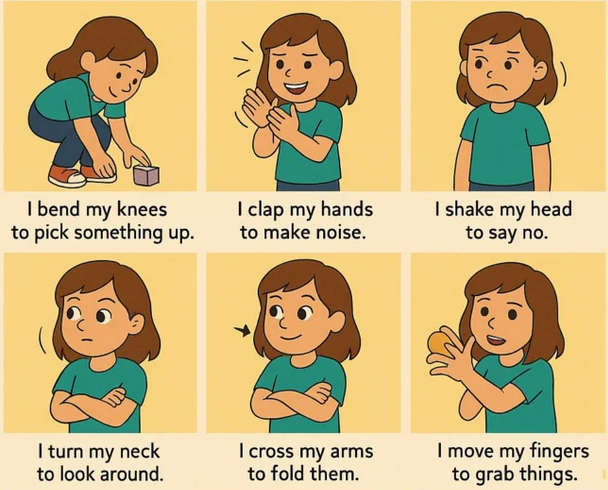
Action commands:
Touch your nose.
Show your ears.
Move your fingers.
Bend your knees.
Raise your hand.
Shake your head.
Wiggle your toes.
Turn your neck.
Clap your hands.
Touch your shoulders.
Point with your thumb.
Cross your arms.
###############
My Day with Tommy
Tommy is my little brother. Today, we play together.
“Tommy, touch your nose!” I say. Tommy touches his nose and laughs.
“Show your ears!” I say. Tommy shows his ears.
“Move your fingers!” I say. Tommy moves his fingers fast.
“Bend your knees!” I say. Tommy bends his knees and jumps.
“Raise your hand!” I say. Tommy raises his hand high.
“Shake your head!” I say. Tommy shakes his head left and right.
“Wiggle your toes!” I say. Tommy wiggles his toes in his shoes.
“Turn your neck!” I say. Tommy turns his neck slowly.
“Clap your hands!” I say. Tommy claps his hands loud.
“Touch your shoulders!” I say. Tommy touches his shoulders.
“Point with your thumb!” I say. Tommy points with his thumb to the sun.
“Cross your arms!” I say. Tommy crosses his arms and smiles.
We have fun! Tommy learns all the body parts today.
###################
Gap-fill exercise:
I ______ my knees to pick something up.. a) bend b) clap c) wiggle
I ______ my hands to make noise. a) wiggle b) clap c) turn
I ______ my head to say no. a) shake b) point c) cross
I ______ my toes in my shoes. a) raise b) wiggle c) bend
I ______ my neck to look around. a) touch b) turn c) move
I ______ my fingers to grab things. a) clap b) bend c) move
I ______ my arms to fold them. a) cross b) bend c) wiggle
I ______ my hand to ask a question. a) raise b) wiggle c) shake
I ______ my thumb to point. a) move b) point c) wiggle
I ______ my knees to sit down. a) bend b) clap c) shake
I ______ my head to say yes. a) shake b) nod c) cross
I ______ my fingers to write. a) move b) raise c) bend
wave – walks – mouth – teeth – knees – arms – fingers – hears __________________ One sunny morning, Anna wakes up and opens her eyes. She stretches her __________ and legs. She gets out of bed and __________ to the window. She looks outside with her eyes and _________ birds with her ears. She smiles with her __________ and brushes her __________. Then she puts on her shoes and wiggles her toes.
Outside, Anna meets her friend Tom. They __________ their hands and say hello. They walk to the park. In the park, they kick a ball with their feet, throw it with their hands, and catch it with their __________. They sit on the grass, bend their __________, and rest their backs. The sun is warm on their faces, and they feel happy.
____________________-
Full version:
One sunny morning, Anna wakes up and opens her eyes. She stretches her arms and legs. She gets out of bed and walks to the window. She looks outside with her eyes and hears birds with her ears. She smiles with her mouth and brushes her teeth. Then she puts on her shoes and wiggles her toes.
Outside, Anna meets her friend Tom. They wave their hands and say hello. They walk to the park. In the park, they kick a ball with their feet, throw it with their hands, and catch it with their fingers. They sit on the grass, bend their knees, and rest their backs. The sun is warm on their faces, and they feel happy.
############ Another body-story:
I have a body. My body is strong, healthy, and active. I have a head. On my head, I have bright eyes, a small nose, a smiling mouth, and ears. I use my eyes to see, my ears to hear, my nose to smell, and my mouth to talk and eat.
I have a neck and broad shoulders. I have two arms. At the end of my arms, I have hands and fingers. I use my hands to write, draw, touch, and hold things.
I have a chest and a stomach. My legs are long and strong. At the end of my legs, I have feet and toes. I use my legs and feet to walk, run, jump, and explore.
All my body parts are important. They help me move, play, feel, and enjoy life every day!
Vocabulary:
head – the top part of your body
eyes – i use them to see
nose – i use it to smell
mouth – i use it to eat and talk
ears – i use them to hear
neck – connects the head and the body
shoulders – the top part of the arms
arms – i use them to lift and carry
hands – i use them to write, draw, and touch
fingers – at the end of hands
chest – front part of the body, above the stomach
stomach – i use it to digest food
legs – i use them to walk, run, and jump
feet – at the end of legs, i use them to stand and walk
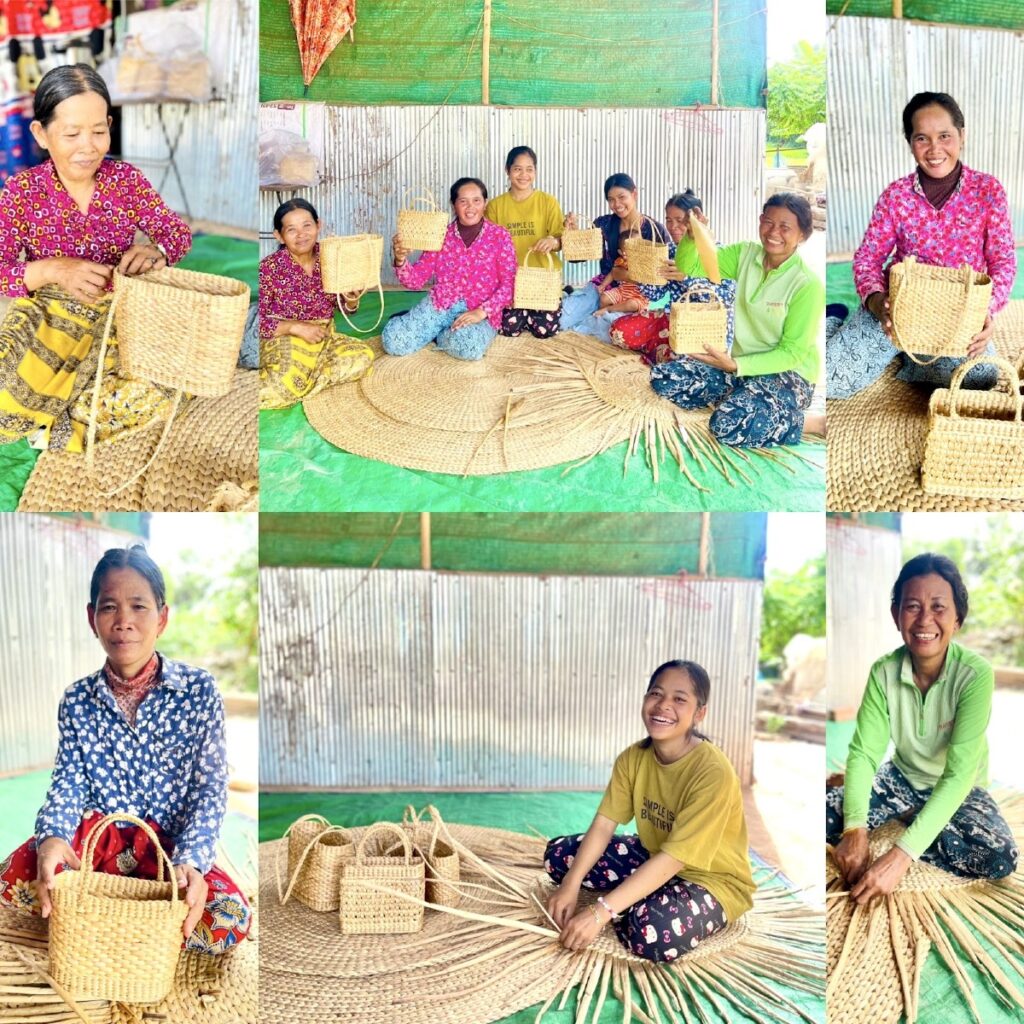
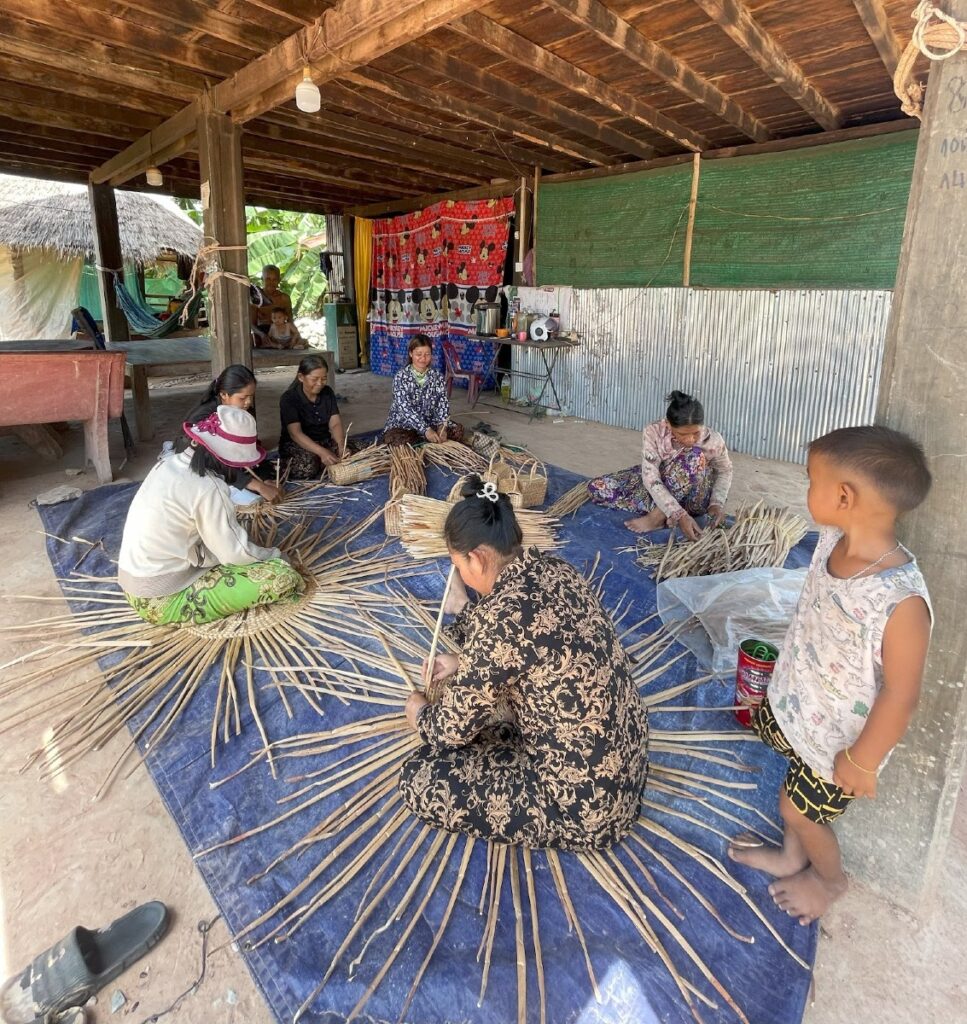
The Shinta Mani Foundation helps women in a small village. These women want a better life for their families. The Foundation gave them a loan with no interest. This means they can borrow money and pay it back later without extra cost.
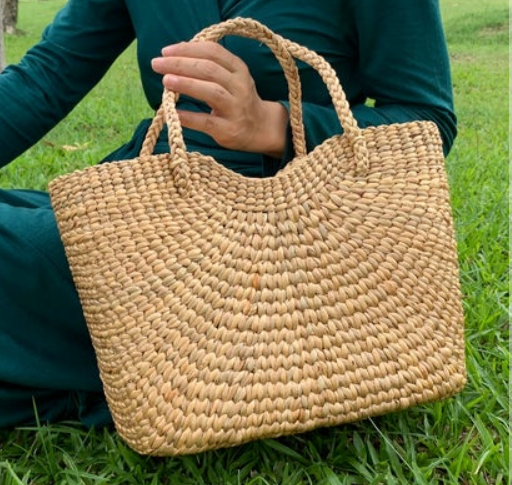
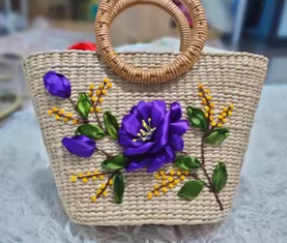
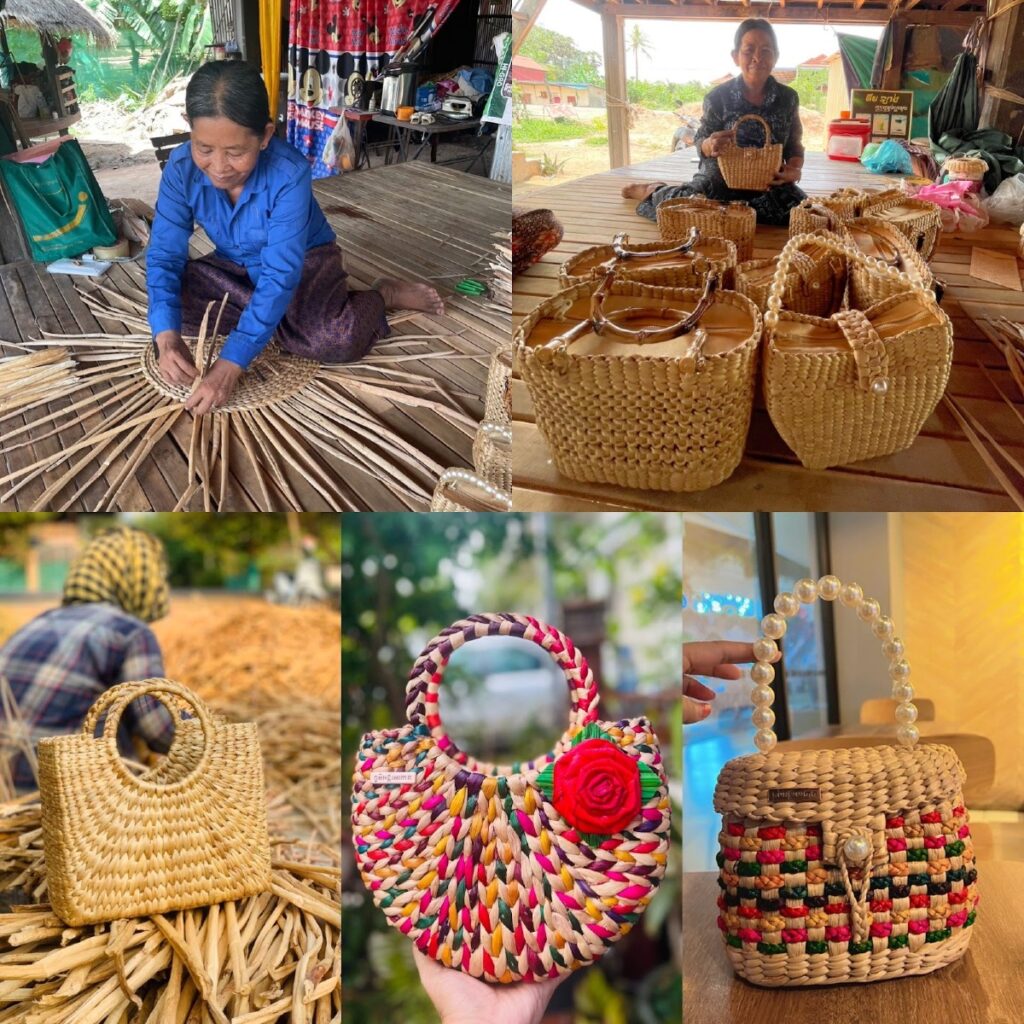
The women use water hyacinth, a plant that grows too much and blocks rivers. They turn this plant into beautiful, eco-friendly bags. This helps the environment by using a plant that would be a problem.
Making and selling the bags gives the women money. They use the money to send their children to school, buy food, go to the doctor, and fix their homes. The work also helps the women stay close and support each other.
The women use traditional weaving skills. These skills come from their families and culture. The bags are strong and pretty. Many people who care about nature want to buy them.
This project helps the women and the environment. It gives the women confidence and independence. Buying these bags helps both the planet and the people.
__________________________
Vocabulary:
weeds: plants that grow where people do not want them.
a bag: something to carry things in.
to weave: to make something by crossing threads or plants.
a village: a small group of houses where people live.
crafts: things made by hand, like art or useful items.
a foundation: a group that helps people or does good work.
a loan with no interest: money you borrow and give back without extra money.
to borrow money: to take money and give it back later.
extra cost: more money you have to pay.
a water hyacinth: a plant that grows in water.
to block rivers: to stop rivers from flowing.
eco-friendly: good for the earth and nature.
environment: the world around us – plants, animals, air, and water.
to sell: to give something to someone for money.
to fix a home: to make a house better or repair it.
to support: to help or take care of someone.
skills: things you can do well because you learned them.
to care about nature: to want to protect animals, plants, and the earth.
to give confidence: to help someone feel sure and brave.
independence: being able to do things by yourself.
a planet: a big round place in space, like earth where we live.
#################
Test your vocabulary, one correct:
part 1: 1-16
part 2: 17-21
1. What does “weeds” mean? a) plants that grow where people do not want them b) flowers in a garden c) trees that grow very tall
2. What is “a bag”? a) a kind of shoe b) something to carry things in c) a piece of furniture
3. What does “to weave” mean? a) to cut paper b) to paint a picture c) to make something by crossing threads or plants
4. What is “a village”? a) a kind of food b) a small group of houses where people live c) a very big city
5. What are “crafts”? a) things made by hand, like art or useful items b) machines that fly c) types of music
6. What is “a foundation”? a) a group that helps people or does good work b) a kind of animal c) a type of plant
7. What is “a loan with no interest”? a) money you find on the street b) money you borrow and give back without extra money c) money you get as a gift
8. What does “to borrow money” mean? a) to lose money b) to steal money c) to take money and give it back later
9. What is “extra cost”? a) more money you have to pay b) free money c) a discount on prices
10. What is “a water hyacinth”? a) a kind of fish b) a small bird c) a plant that grows in water
11. What does “to block rivers” mean? a) to stop rivers from flowing b) to make rivers bigger c) to clean rivers
12. What does “eco-friendly” mean? a) bad for plants b) good for the earth and nature c) something made of plastic
13. What is “environment”? a) a machine b) the world around us – plants, animals, air, and water c) a type of building
14. What does “to sell” mean? a) to buy something b) to give something to someone for money c) to borrow something
15. What does “to fix a home” mean? a) to make a house better or repair it b) to clean a house c) to paint a picture
16. What does “to support” mean? a) to hurt someone b) to help or take care of someone c) to run very fast
17. What are “skills”? a) foods you eat b) things you can do well because you learned them c) toys you play with
18. What does “to care about nature” mean? a) to break trees b) to want to protect animals, plants, and the earth c) to ignore plants and animals
19. What does “to give confidence” mean? a) to tell someone a secret b) to help someone feel sure and brave c) to make someone sad
20. What is “independence”? a) being able to do things by yourself b) needing help all the time c) working with others
21. What is “a planet”? a) a type of cloud b) a big round place in space, like earth where we live c) a kind of star _______________________
Answer key: 1 a, 2 b, 3 c, 4 b, 5 a, 6 a, 7 b, 8 c, 9 a, 10 c, 11 a, 12 b, 13 b, 14 b, 15 a, 16 b, 17 b, 18 b, 19 b, 20 a, 21 b #################
Match the definitions to their respective words:
Definitions
plants that grow where people do not want them:___e___
something to carry things in:______
to make something by crossing threads or plants:______
a small group of houses where people live:______
things made by hand, like art or useful items:______
a group that helps people or does good work:______
money you borrow and give back without extra money:______
to take money and give it back later:______
more money you have to pay:______
a plant that grows in water:______
to stop rivers from flowing:______
good for the earth and nature:______
the world around us – plants, animals, air, and water:______
to give something to someone for money:______
to make a house better or repair it:______
to help or take care of someone:______
things you can do well because you learned them:______
to want to protect animals, plants, and the earth:______
to help someone feel sure and brave:______
being able to do things by yourself:______
a big round place in space, like earth where we live:______
Words
a. independence b. to care about nature c. a loan with no interest d. to give confidence e. weeds f. a bag g. to weave h. to borrow money i. to support j. a village k. to sell l. eco-friendly m. to fix a home n. crafts o. environment p. a foundation q. skills r. to block rivers s. a planet t. a water hyacinth u. extra cost
________________________
Answers: 1 e, 2 f, 3 g, 4 j, 5 n, 6 p, 7 c, 8 h, 9 u, 10 t, 11 r, 12 l, 13 o, 14 k, 15 m, 16 i, 17 q, 18 b, 19 d, 20 a, 21 s
################
True or False?
The Shinta Mani Foundation works with women in a small village.
The women get a loan with high interest.
They use water hyacinth to make eco-friendly bags.
Water hyacinths grow in the mountains.
Selling bags helps the women send their children to school.
The project is bad for the environment.
The women use traditional weaving skills.
The bags are weak and break easily.
Many people who care about nature want to buy the bags.
The women use the money to fix their homes.
The project gives the women confidence and independence.
The bags are made from plastic.
The women learned weaving skills from their families.
Buying a bag helps both the women and the planet. ______________
True: 1, 3, 5, 7, 9, 10, 11, 13, 14
#################
Short answers:
Does the Shinta Mani Foundation help women in a small village? Yes, it does.
Do the women get a loan with no interest? _____________
Do the women make bags from plastic bottles? _____________
Does water hyacinth grow in the river? _____________
Do the women sell the bags to earn money? _____________
Do the women use the money to travel to other countries? _____________
Does the project help the women send their children to school? _____________
Do the bags hurt the environment? _____________
Do the women fix their homes with the money? _____________
Does the project give the women more confidence? _____________
Do the women get less food because of the project? _____________
Do the women stay as a strong group? _____________
Does the project make the women work alone? _____________
The Shinta Mani Foundation supports women in a small __________.
The women started a business with a no-interest __________.
They turn water hyacinth into __________ bags.
Water hyacinth are __________ that grow in rivers.
The income helps the women send their __________ to school.
They can also buy more clothes for their __________.
The women use traditional weaving __________ to make the bags.
Selling bags allows the women to _________ and improve their homes.
The project helps the women gain confidence and ________.
The group of women stays strong and __________each other.
__________ bags are bad for the environment.
The project also helps protect the __________.
____________________________
Full version:
The Shinta Mani Foundation supports women in a small village.
The women started a business with a no-interest loan.
They turn water hyacinth into eco-friendly bags.
Water hyacinths are plants that grow in rivers.
The income helps the women send their children to school.
They can also buy more clothes for their families.
The women use traditional weaving skills to make the bags.
Selling bags allows the women to fix and improve their homes.
The project helps the women gain confidence and independence.
The group of women stays strong and supports each other.
Plastic bags are bad for the environment.
The project also helps protect the planet.
#####################
Complete the story, words below:
weaving – borrow – confidence – eco-friendly – village.- blocks – women – life – sell – loan ________________________
The Shinta Mani Foundation helps women in a small __________. They want a better __________ for their families. The Foundation gives them a__________ with no interest. They __________ money and pay it back later without extra cost. The women use water hyacinth, a plant that grows too much and __________ rivers. They make __________ bags from the plant. They __________ the bags and get money for school, food, doctors, and fixing homes. They keep their __________ skills from their culture. The bags are strong and beautiful. The project helps the __________ and the planet. It gives them __________ and independenc
___________________
Full version:
The Shinta Mani Foundation helps women in a small village. They want a better life for their families. The Foundation gives them a loan with no interest. They borrow money and pay it back later without extra cost. The women use water hyacinth, a plant that grows too much and blocks rivers. They make eco-friendly bags from the plant. They sell the bags and get money for school, food, doctors, and fixing homes. They keep their weaving skills from their culture. The bags are strong and beautiful. The project helps the women and the planet. It gives them confidence and independence.