Hotels use a lot of water for showers, laundry, cleaning, and gardens.
What businesses can do:
Put signs to ask guests to reuse towels
Use low-water toilets and showers
Fix water leaks quickly
Use plants that need less water
Reuse water for gardens if possible
This is very important in places where water is limited.
##############
Hotels use a lot of water every day. Guests need water for showers. Hotels also use water to wash clothes, clean rooms, and water gardens. In many places water is not enough so hotels should save water.
There are many simple ways hotels can save water. They can put signs in bathrooms and ask guests to use towels again. This helps use less water for washing. Hotels can use toilets and showers that use less water.
They should check water pipes and fix leaks fast. Even small leaks can waste a lot of water. Hotels can also use plants that need little water in gardens. They can reuse water for gardens when it is safe.
Saving water is important for hotels and for the future. Guests can also help by taking shorter showers and telling staff about problems. These small actions make a big difference in saving water every day.
Hotels and guests should work together to protect water for everyone. It is good for nature and helps people in the future. Water saving is very important all the time.
##############
True or false:
Leaks waste a lot of water.
Hotels use water for showers.
Water saving is important in dry places.
Reusing towels reduces water use.
Plants that need less water help save water.
Fixing leaks saves water.
Hotels use water for cleaning rooms.
Guests should use more towels every day to save water.
Water saving is not important in dry places. True is: Water saving is important in dry places.
Reusing towels reduces water use.
Plants that need less water help save water.
Fixing leaks saves water.
Hotels use water for cleaning the streets. True is: Hotels do not use water for cleaning the streets.
Guests should use new towels every day to save water. True is: Guests should use fewer towels every day to save water.
Low-water toilets use less water.
Water is unlimited everywhere. True is: Water is not unlimited everywhere.
Reusing water for gardens can save water.
Hotels use water for laundry.
Showers always use no water. True is: Showers use water.
Plants that need more water help save water. True is: Plants that need less water help save water.
Hotels should always keep taps [a place where water comes out] running. True is: Hotels should not always keep taps running.
##################
Match the words with the correct definitions:
Words
waste
environment
reduce
refillable
guests
straws
reusable
recycling
landfills
pollution
packaging
businesses
stations
correctly
single-use
Definitions
A. Things that are thrown away after use. B. Places where people can get or refill something. C. Able to be filled again and used many times. D. Harmful dirty substances in air, water, or land. E. Companies or organizations that sell goods or services. F. Used for only one time and then thrown away. G. People staying in a hotel. H. To make something smaller or less. I. The natural world around us. J. Tubes used for drinking liquids. K. Materials used to cover or contain products. L. The process of collecting and using materials again. M. In the right or proper way. N. Able to be used again many times. O. Places where waste is buried in the ground.
Hotels can replace small shampoo bottles with larger containers.
Tourists often create plastic waste through everyday items.
Water refill stations can help reduce plastic bottle use.
Plastic straws are mentioned as a source of waste.
Hotels can choose paper products instead of plastic ones.
Some plastic items are used only once.
Recycling can help reduce the amount of waste in landfills.
Hotels should recycle different materials.
Plastic waste is harmful to nature.
Accor is trying to reduce plastic use in hotels.
Guests may not need to buy new bottles when refill stations are available.
Refillable bottles can reduce plastic waste every day.
Tourism can cause pollution.
Hotels and businesses should take action to reduce waste.
More hotels following these ideas could improve the situation.
Evidence from the text
A. “This company is working to reduce single-use plastic in many hotels.” B. “Hotels should also stop using plastic straws, cups, and forks.” C. “They can use paper or reusable materials instead.” D. “Guests can refill their bottles and do not need to buy new plastic bottles.” E. “Hotels and other businesses should try to reduce plastic waste in simple ways.” F. “Another important step is recycling.” G. “This reduces a lot of plastic every day.” H. “If more hotels do these actions, tourism will create less plastic waste and less pollution.” I. “This is bad for the environment.” J. “They can use big refillable bottles instead.” K. “This helps reduce waste.” L. “Hotels should recycle paper, glass, and plastic correctly.” M. “This helps keep waste out of landfills.” N. “Tourism creates a lot of plastic waste, like bottles, bags, and food packaging.” O. “These items create a lot of waste because they are used only one time.”
Tourism creates a lot of plastic waste, like bottles and packaging.
What businesses can do:
Stop using small plastic shampoo bottles
Use refillable soap and shampoo containers
Give guests water refill stations
Avoid plastic straws and cutlery
Recycle paper, glass, and plastic
Example: Accor works to remove single-use plastic in many of its hotels. Guests often see refill bottles instead of small plastic ones.
############
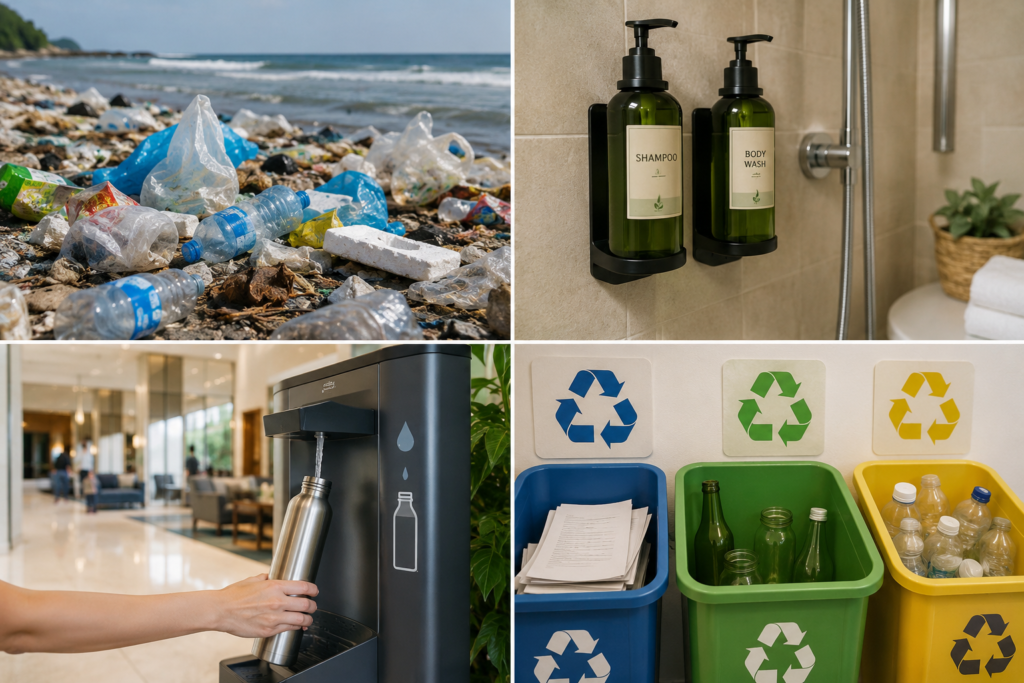
Tourism creates a lot of plastic waste, like bottles, bags, and food packaging. This is bad for the environment. Hotels and other businesses should try to reduce plastic waste in simple ways.
First, hotels should stop using small plastic bottles for shampoo and soap. They can use big refillable bottles instead. This reduces a lot of plastic every day.
Second, hotels can give guests water refill stations. Guests can refill their bottles and do not need to buy new plastic bottles. This helps reduce waste.
Hotels should also stop using plastic straws, cups, and forks. They can use paper or reusable materials instead. These items create a lot of waste because they are used only one time.
Another important step is recycling. Hotels should recycle paper, glass, and plastic correctly. This helps keep waste out of landfills.
An example is Accor. This company is working to reduce single-use plastic in many hotels. Guests often see refillable bottles instead of small plastic ones.
If more hotels do these actions, tourism will create less plastic waste and less pollution.
###################
True or false:
Tourism creates plastic waste like bottles and bags.
Hotels should use many small plastic bottles for shampoo.
Refillable bottles can help reduce plastic waste.
Water refill stations help guests reuse bottles.
Plastic straws and forks should be kept in hotels.
Recycling paper, glass, and plastic is important.
Accor is trying to reduce single-use plastic.
Tourism does not create plastic waste.
Guests can refill their water bottles in hotels.
Hotels should only use plastic items to save money.
Using big refillable shampoo bottles reduces waste.
Plastic cups and straws are used only one time.
Recycling helps reduce waste in landfills.
Hotels do not need to care about plastic waste.
More hotels can help reduce pollution by using less plastic.
Tourism creates plastic waste like bottles and bags.
Hotels should use many small plastic bottles for shampoo. True is: Hotels should not use small plastic bottles for shampoo. They should use big refillable bottles instead.
Refillable bottles can help reduce plastic waste.
Water refill stations help guests reuse bottles.
Plastic straws and forks should be kept in hotels. True is: Hotels should not use plastic straws and forks. They should use reusable or paper ones instead.
Recycling paper, glass, and plastic is important.
Accor is trying to reduce single-use plastic.
Tourism does not create plastic waste. True is: Tourism creates a lot of plastic waste like bottles, bags, and packaging.
Guests can refill their water bottles in hotels.
Hotels should only use plastic items to save money. True is: Hotels should avoid plastic items and try to use reusable or recyclable materials.
Using big refillable shampoo bottles reduces waste.
Plastic cups and straws are used only one time.
Recycling helps reduce waste in landfills.
Hotels do not need to care about plastic waste. True is: Hotels should care about plastic waste and try to reduce it.
More hotels can help reduce pollution by using less plastic.
#################
Match the words with the correct definitions:
Words:
Tourism
Plastic
Waste
Bottle
Bag
Packaging
Hotel
Guest
Refillable
Reuse
Recycle
Reduce
Pollution
Environment
Station
Definitions:
A. A place where people stay when they travel B. To use something again C. The natural world around us D. Things that are thrown away E. A place where people can get water or other services F. Travel for holidays or business G. To make something smaller or less H. A person who stays in a hotel I. Dirty air, water, or land J. A container for carrying things K. Something that can be filled again L. A material used to make many products M. A container for liquids N. Material used to wrap products O. To change waste into new materials
A. “Hotels use a lot of electricity every day.” B. “Hotels should recycle paper, glass, and plastic correctly.” C. “Tourism creates a lot of plastic waste, like bottles, bags, and food packaging.” D. “Hotels should stop using small plastic bottles for shampoo and soap.” E. “Guests can refill their bottles and do not need to buy new plastic bottles.” F. “Hotels should also stop using plastic straws, cups, and forks.” G. “This can create pollution and harm the environment.” H. “They can use big refillable containers instead.” I. “Hotels can give guests water refill stations.” J. “If many hotels follow these steps, they can help protect the environment and save natural resources for the future.” K. “Hotels can also install solar panels on roofs.” L. “Big hotel groups like Accor are working to remove single-use plastic in many of their hotels.” M. “Hotels and other businesses should try to reduce plastic waste in simple ways.” N. “Hotels should try to reduce energy use.” O. “Solar panels provide clean energy from the sun.”
Hotels use electricity for lights, air conditioning, kitchens, and laundry.
What businesses can do:
Use LED lights instead of old bulbs
Turn off lights in empty rooms
Use air conditioning only when needed
Install solar panels if possible
Buy electricity from clean energy sources
Example: Big hotel groups like Hilton Worldwide try to reduce energy use in rooms and public areas. They also set goals to cut carbon emissions over time.
####################
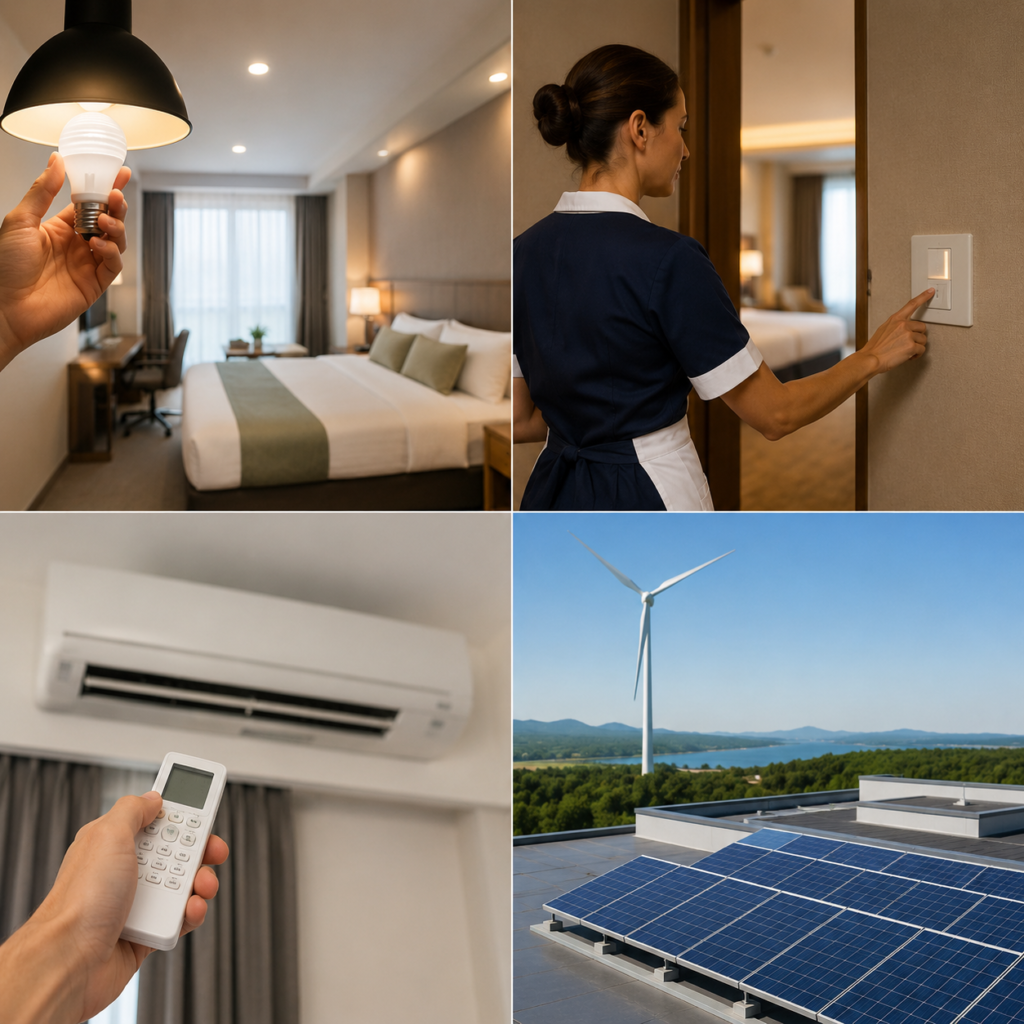
Hotels use a lot of electricity every day. They need power for lights, air conditioning, kitchens, and laundry. This can create pollution and harm the environment. Because of this, hotels should try to use less energy and choose cleaner energy.
There are many simple ways hotels can save energy. First, they can use LED lights instead of old bulbs. LED lights use less electricity and last longer. Second, hotels can turn off lights in rooms when they are empty. This is an easy way to avoid waste. Third, air conditioning should be used only when it is needed. Guests and staff can also set it to a normal temperature instead of very cold settings.
Hotels can also install solar panels on roofs. Solar panels use energy from the sun, which is clean and free. Another good step is to buy electricity from clean energy sources like wind or water power. This helps reduce pollution from fossil fuels.
Big hotel groups like Hilton Worldwide already try to save energy in many of their hotels. They use energy-saving systems and set goals to reduce carbon emissions each year. This shows that even large companies can make positive changes.
If many hotels follow these steps, they can help protect the environment and save natural resources for the future.
################# True or false:
Hotels use electricity for lighting, kitchens, and laundry.
LED lights use more electricity than old bulbs.
Air conditioning should be used only when needed.
Solar panels produce energy from the sun.
Fossil fuels are clean energy sources.
Turning off empty-room lights helps save energy.
Wind and water power are examples of clean energy.
Hotels should try to reduce energy use.
Solar energy is described as harmful and expensive.
Large hotel companies can reduce carbon emissions.
Air conditioning should always be set to very cold.
Hotels use electricity for lighting, kitchens, and laundry.
LED lights use more electricity than old bulbs. True is: LED lights use less electricity than old bulbs.
Air conditioning should be used only when needed.
Solar panels produce energy from the sun.
Fossil fuels are clean energy sources. True is: Fossil fuels are not clean energy sources.
Turning off empty-room lights helps save energy.
Wind and water power are examples of clean energy.
Hotels should try to reduce energy use.
Solar energy is described as harmful and expensive. True is: Solar energy is described as clean and free.
Large hotel companies can reduce carbon emissions.
Air conditioning should always be set to very cold. True is: Air conditioning should be used at a normal temperature and only when needed.
Saving energy can help protect the environment.
Hotels only use electricity for lighting. True is: Hotels use electricity for lighting, air conditioning, kitchens, and laundry.
Solar panels can be installed on hotel roofs.
Energy waste can be reduced by simple actions.
#################
Match word and meaning:
Words
Pollution
Resource
Solar energy
Emissions
Fossil fuels
Electricity
Environment
Renewable
Carbon
System
Energy
Reduce
Install
Temperature
Maintain
Meanings
A. Energy from the sun B. Something useful that people need C. Power used to operate machines and lights D. Damage to air, water, or land E. Coal, oil, and natural gas F. Gases released into the atmosphere G. The natural world around us H. Able to be replaced naturally over time I. A chemical element found in fuels and air J. A group of connected parts working together K. The ability to do work or produce power L. To make something smaller or less M. To put equipment into use or place N. A measurement of how hot or cold something is O. To keep something in good condition or working order
Solar energy is clean and comes from a natural source.
Air conditioning should only be used when necessary.
Hotels use electricity for many different daily operations.
Large companies can take action to reduce environmental damage.
Turning off lights is a simple way to reduce energy use.
LED lights are more efficient than old bulbs.
Hotels should try to use less energy whenever possible.
Wind and water power are examples of clean energy.
Empty hotel rooms should not waste electricity.
Hotels can help protect natural resources for the future.
Solar panels can help hotels produce their own electricity.
Hilton Worldwide uses systems that save energy in hotels.
High energy use can harm the environment.
Hotels use a lot of electricity every day.
Companies can set yearly goals to reduce carbon emissions.
Evidence (A–O)
A. “Hotels use a lot of electricity every day.” B. “This can create pollution and harm the environment.” C. “Even large companies can make positive changes.” D. “LED lights use less electricity and last longer.” E. “They can turn off lights in rooms when they are empty.” F. “They use energy-saving systems and set goals to reduce carbon emissions each year.” G. “Clean energy sources like wind or water power.” H. “Hotels can help protect the environment and save natural resources for the future.” I. “Solar panels use energy from the sun, which is clean and free.” J. “They need power for lights, air conditioning, kitchens, and laundry.” K. “Air conditioning should be used only when it is needed.” L. “Hotels should try to use less energy and choose cleaner energy.” M. “Hotels can install solar panels on roofs.” N. “Turning off lights in rooms when they are empty.” O. “Set goals to reduce carbon emissions each year.”
Solar energy is clean and comes from a natural source Evidence: “Solar panels use energy from the sun, which is clean and free.”
Air conditioning should only be used when necessary Evidence: “Air conditioning should be used only when it is needed.”
Hotels use electricity for many different daily operations Evidence: “They need power for lights, air conditioning, kitchens, and laundry.”
Large companies can take action to reduce environmental damage Evidence: “Even large companies can make positive changes.”
Turning off lights is a simple way to reduce energy use Evidence: “They can turn off lights in rooms when they are empty.”
LED lights are more efficient than old bulbs Evidence: “LED lights use less electricity and last longer.”
Hotels should try to use less energy whenever possible Evidence: “Hotels should try to use less energy and choose cleaner energy.”
Wind and water power are examples of clean energy Evidence: “Clean energy sources like wind or water power.”
Empty hotel rooms should not waste electricity Evidence: “They can turn off lights in rooms when they are empty.”
Hotels can help protect natural resources for the future Evidence: “They can help protect the environment and save natural resources for the future.”
Solar panels can help hotels produce their own electricity Evidence: “Hotels can install solar panels on roofs.”
Hilton Worldwide uses systems that save energy in hotels Evidence: “They use energy-saving systems and set goals to reduce carbon emissions each year.”
High energy use can harm the environment Evidence: “This can create pollution and harm the environment.”
Hotels use a lot of electricity every day Evidence: “Hotels use a lot of electricity every day.”
Companies can set yearly goals to reduce carbon emissions Evidence: “Set goals to reduce carbon emissions each year.”
#################
Multiple choice, one answer is correct:
1. Why do hotels use a lot of electricity?
A. To build new facilities, parking areas, and gardens B. To power lights, cooling systems, kitchens, and laundry C. To transport visitors, employees, and hotel supplies
2. What problem can high energy use create?
A. It can increase pollution and harm the environment B. It can reduce room sizes and guest satisfaction C. It can limit food choices and hotel services
3. What does the text suggest hotels should do?
A. Use more electricity during busy travel periods B. Replace workers with automated energy systems C. Choose cleaner energy and reduce energy waste
4. Why are LED lights recommended?
A. They provide colorful lighting for special events B. They require daily replacement by hotel staff C. They use less electricity and last much longer
5. What should happen to lights in empty rooms?
A. They should remain on to welcome new guests B. They should be turned off to save electricity C. They should be checked daily by maintenance teams
6. How should air conditioning be used?
A. It should remain active throughout every season B. It should operate only when it is necessary C. It should always run at the lowest temperature
7. What temperature setting is recommended?
A. A very cold temperature throughout the entire day B. A different temperature in every hotel room C. A normal temperature rather than a very cold one
8. Where can hotels install solar panels?
A. Inside hotel kitchens near cooking equipment B. On hotel roofs where they can receive sunlight C. Under hotel floors where they stay protected
9. What is an advantage of solar energy?
A. It is generated from imported fuel supplies B. It is produced mainly by large power stations C. It is clean, renewable, and available from sunlight
10. Which clean energy sources are mentioned?
A. Oil power and diesel power are mentioned B. Wind power and water power are mentioned C. Coal power and gas power are mentioned
11. Why is clean energy important?
A. It helps increase demand for fossil fuels B. It helps reduce pollution from fossil fuels C. It helps create larger hotel buildings worldwide
12. What hotel company is used as an example?
A. Hyatt Hotels is mentioned as an example B. Hilton Worldwide is mentioned as an example C. Marriott International is mentioned as an example
13. What does Hilton Worldwide do to save energy?
A. It limits guest access to electrical equipment B. It uses energy-saving systems in many hotels C. It closes hotel facilities during busy seasons
14. What goal does Hilton Worldwide set each year?
A. To expand hotel operations into new countries B. To increase room prices across all locations C. To reduce carbon emissions through planned actions
15. What could happen if many hotels follow these ideas?
A. They could eliminate the need for all electricity B. They could help protect resources for the future C. They could replace all traditional energy sources
World Environment Day (June 5) is a good moment for tourism and hospitality businesses to help the planet. Hotels, travel companies, and restaurants use a lot of energy, water, and materials. Small changes can make a big difference when many guests are involved.
1. Save energy and reduce pollution
Hotels use electricity for lights, air conditioning, kitchens, and laundry.
What businesses can do:
Use LED lights instead of old bulbs
Turn off lights in empty rooms
Use air conditioning only when needed
Install solar panels if possible
Buy electricity from clean energy sources
Example: Big hotel groups like Hilton Worldwide try to reduce energy use in rooms and public areas. They also set goals to cut carbon emissions over time.
2. Use less plastic and create less waste
Tourism creates a lot of plastic waste, like bottles and packaging.
What businesses can do:
Stop using small plastic shampoo bottles
Use refillable soap and shampoo containers
Give guests water refill stations
Avoid plastic straws and cutlery
Recycle paper, glass, and plastic
Example: Accor works to remove single-use plastic in many of its hotels. Guests often see refill bottles instead of small plastic ones.
3. Save water
Hotels use a lot of water for showers, laundry, cleaning, and gardens.
What businesses can do:
Put signs to ask guests to reuse towels
Use low-water toilets and showers
Fix water leaks quickly
Use plants that need less water
Reuse water for gardens if possible
This is very important in places where water is limited.
4. Buy local food and products
Transporting food from far away creates pollution.
What businesses can do:
Buy food from local farms
Use seasonal fruits and vegetables
Offer more plant-based meals
Reduce food waste in kitchens
Example: Many hotels working with Marriott International try to buy more local food. This helps farmers nearby and reduces transport pollution.
5. Protect nature and animals
Tourism can harm nature if it is not controlled. But it can also help protect it.
What businesses can do:
Do not disturb animals in natural areas
Limit the number of visitors in sensitive places
Support beach cleaning or forest projects
Teach tourists how to behave in nature
Example: Some travel programs work with UNEP to protect oceans, forests, and animals.
6. Help guests behave in a green way
Guests can also help protect the environment.
What businesses can do:
Ask guests to reuse towels and bed sheets
Give rewards for eco-friendly choices
Offer bike rentals or public transport tips
Show simple signs about saving energy and water
When guests understand what to do, they often help.
7. Measure and improve
Businesses should check their impact on the environment.
What they can do:
Track energy and water use
Count waste and recycling levels
Set simple yearly goals
Write reports about improvements
Groups like UN Tourism encourage tourism companies to measure and reduce their impact.
8. Use World Environment Day in a real way
June 5 should not only be marketing. It should lead to real action.
Ideas:
Start a recycling program on that day
Plant trees with staff and guests
Stop single-use plastics from that date
Teach staff simple eco rules
Launch a “green stay” option for guests
Short summary
Tourism and hospitality can help the environment by:
using less energy
saving water
reducing plastic waste
buying local food
protecting nature
teaching guests good habits
Even small steps help a lot when many hotels and travel companies do them together.
preserve tradition, protect the sky, protect the city
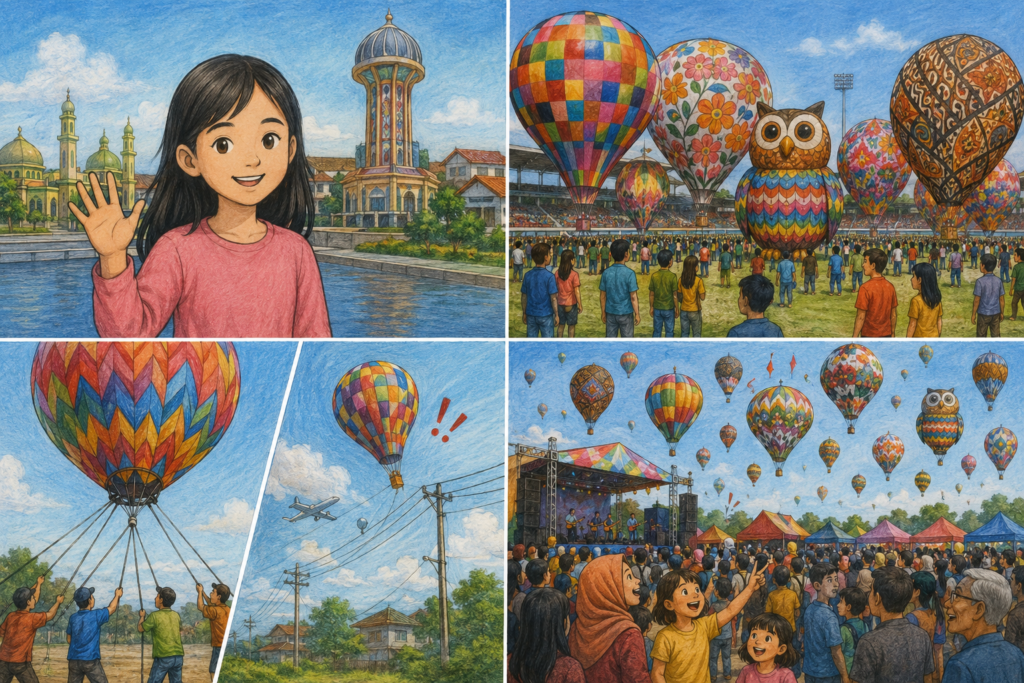
Hello, my name is Wulandari. I am a young girl from Pekalongan, Central Java. In 2026, after Idul Fitri (Idul Fitri is a special day for Muslims) on 21 March, I went to a big and beautiful event called the Pekalongan (city in central Java) Balloon Festival. The festival happened during Syawalan (Syawalan is a celebration one week after Idul Fitri), about one week after Lebaran (Muslim holiday). People made big hot air balloons from paper and plastic. The balloons had many bright colours. Some looked like animals, flowers, or batik patterns. Around 79 teams joined the event. They flew the balloons at Stadion Hoegeng. In the past, people released the balloons freely without ropes. This was dangerous because the balloons could hit planes or power lines. But in 2026, the government made a safe festival. They tied all the balloons with strong ropes. This is called “balon tambat (a balloon tied with ropes so it cannot fly away)”. Everyone enjoyed the show safely. On the festival day, I went to the stadium with my family. Many people came. Families, children, and old people watched together. The sky became full of colourful balloons. It looked very beautiful. There was music, food, and many places to take photos. People felt happy and proud of our culture. The festival was very important for us. It kept our old tradition alive in a safe way. Young people like me learned how to make balloons from our parents. Many visitors came from other cities. I liked this festival very much. When I saw the balloons go up into the sky, I felt excited and happy. It showed our creativity and togetherness. The theme this year was “Jaga Tradisi, Jaga Langit, Jaga Kota” (Preserve Tradition, Protect the Sky, Protect the City).
It was one of the best events in my city.
Vocabulary:
an event: a special occasion when people meet or do something together
a balloon: a light rubber object you fill with air or gas so it floats or becomes round
a bright colour: a strong, clear colour that is easy to see (like red, yellow, or blue)
a batik pattern: a traditional cloth design made with wax and dye
to join an event: to take part in an event with other people
to fly a balloon: to make a balloon go up into the air
to release: to let something go free
a rope: a long, thick string used to tie or pull things
to hit a plane: to touch or crash into an airplane (usually dangerous)
a power line: wires that carry electricity
to be safe: to be free from danger
to tie something: to use a string or rope to hold something together
to enjoy the show: to have fun watching a performance or event
to be proud of one’s culture: to feel happy and positive about your traditions and way of life
to keep a tradition alive: to continue doing customs from the past
to feel excited: to feel very happy and energetic about something
to show creativity: to make or do something in a new and imaginative way
togetherness: the feeling of being close and united with others
to preserve: to keep something safe so it does not change or get lost
to protect: to keep someone or something safe from harm
#################
Verbs and their past tense forms (regular, irregular):
Infinitive
Past Simple
A1 Definition
be
was / were
exist; be in a state
go
went
move from one place to another
happen
happened
take place
make
made
create or produce
have
had
own or possess something
look
looked
seem or appear
join
joined
become part of a group
fly
flew
move through the air
release
released
let something go
hit
hit
strike with force
can
could
be able to
tie
tied
fasten with a rope
call
called
give a name to something
enjoy
enjoyed
get pleasure from something
come
came
move to a place
watch
watched
look at something for a time
become
became
change into something
feel
felt
experience an emotion
keep
kept
continue to have or maintain
learn
learned
get knowledge or skill
like
liked
enjoy something
see
saw
use your eyes
show
showed
make something visible
preserve
preserved
keep something safe or unchanged
protect
protected
keep safe from harm
################
Match the words with the correct definitions
Words
an event
a balloon
a bright colour
a batik pattern
to join an event
to fly a balloon
to release
a rope
to hit a plane
a power line
to be safe
to tie something
to enjoy the show
to be proud of one’s culture
to keep a tradition alive
to feel excited
to show creativity
togetherness
to preserve
to protect
Definitions
A. to feel very happy and energetic about something B. a long, thick string used to tie or pull things C. a traditional cloth design made with wax and dye D. to take part in an event with other people E. to keep something safe so it does not change or get lost F. a special occasion when people meet or do something together G. to have fun watching a performance or event H. to let something go free I. to feel happy and positive about your traditions and way of life J. to keep someone or something safe from harm K. wires that carry electricity L. a light rubber object you fill with air or gas M. to make or do something in a new and imaginative way N. to make a balloon go up into the air O. to be free from danger P. to continue doing customs from the past Q. to use a string or rope to hold something together R. to touch or crash into an airplane (usually dangerous) S. a strong, clear colour that is easy to see T. the feeling of being close and united with others
to make or do something in a new and imaginative way
to be free from danger
to make a balloon go up into the air
a special occasion when people meet or do something together
wires that carry electricity
to touch or crash into an airplane (usually dangerous)
to have fun watching a performance or event
to continue doing customs from the past
to feel happy and positive about your traditions and way of life
the feeling of being close and united with others
to use a string or rope to hold something together
to keep something safe so it does not change or get lost
Words
A. to fly a balloon B. togetherness C. a rope D. to preserve E. to enjoy the show F. to be safe G. to protect H. to join an event I. a balloon J. to show creativity K. an event L. to keep a tradition alive M. to feel excited N. to release O. to hit a plane P. a batik pattern Q. a power line R. to tie something S. to be proud of one’s culture T. a bright colour
A rope is a digital tool used to control music during cultural shows.
A balloon is a light thing filled with air or gas.
To join an event means to watch the festival from home without going outside.
A batik pattern is a traditional design on cloth.
To release means to collect all festival items and lock them in storage.
A power line carries electricity to houses.
Togetherness means people stay alone and do activities without others.
An event is a time when people meet and do activities.
To preserve means to keep something safe for the future.
A power line is a type of cloth used to decorate batik clothes at festivals.
A balloon is a heavy metal object used to build festival stages in cities.
To be safe means to not be in danger.
A rope is a long string used to tie things.
To release means to let something go free.
A batik pattern is a machine used to clean the stadium after events.
An event is a small private room used only for storing festival food supplies.
To join an event means to take part in it.
Togetherness means people are happy and united.
To be safe means to increase danger during balloon flights at the stadium.
To preserve means to change traditions quickly into new modern sports.
_____________________
True: 2,4,6,8,9,12,13,14,16,17
_____________________
Correct version:
A rope is a digital tool used to control music during cultural shows. True is: A rope is a long string used to tie things.
A balloon is a light thing filled with air or gas.
To join an event means to watch the festival from home without going outside. True is: To join an event means to take part in it.
A batik pattern is a traditional design on cloth.
To release means to collect all festival items and lock them in storage. True is: To release means to let something go free.
A power line carries electricity to houses.
Togetherness means people stay alone and do activities without others. True is: Togetherness means people are happy and united.
An event is a time when people meet and do activities.
To preserve means to keep something safe for the future.
A power line is a type of cloth used to decorate batik clothes at festivals. True is: A power line carries electricity to houses.
A balloon is a heavy metal object used to build festival stages in cities. True is: A balloon is a light thing filled with air or gas.
To be safe means to not be in danger.
A rope is a long string used to tie things.
To release means to let something go free.
A batik pattern is a machine used to clean the stadium after events. True is: A batik pattern is a traditional design on cloth.
An event is a small private room used only for storing festival food supplies. True is: An event is a time when people meet and do activities.
To join an event means to take part in it.
Togetherness means people are happy and united.
To be safe means to increase danger during balloon flights at the stadium. True is: To be safe means to not be in danger.
To preserve means to change traditions quickly into new modern sports. True is: To preserve means to keep something safe for the future.
###############
Short answers, past simple, basics:
Example Sentence
Yes
No
I learned letters.
Yes, I did.
No, I didn’t.
You read signs.
Yes, you did.
No, you didn’t.
He spoke English.
Yes, he did.
No, he didn’t.
She watched TV.
Yes, she did.
No, she didn’t.
It helped me.
Yes, it did.
No, it didn’t.
We used an app.
Yes, we did.
No, we didn’t.
You read words.
Yes, you did.
No, you didn’t.
They made mistakes.
Yes, they did.
No, they didn’t.
Questions (Past Simple)
Question
Yes
No
Did I learn letters?
Yes, I did.
No, I didn’t.
Did you read signs?
Yes, you did.
No, you didn’t.
Did he speak English?
Yes, he did.
No, he didn’t.
Did she watch TV?
Yes, she did.
No, she didn’t.
Did it help me?
Yes, it did.
No, it didn’t.
Did we use an app?
Yes, we did.
No, we didn’t.
Did you read words?
Yes, you did.
No, you didn’t.
Did they make mistakes?
Yes, they did.
No, they didn’t.
Was / Were
Question
Yes
No
Was I happy?
Yes, I was.
No, I wasn’t.
Were you happy?
Yes, you were.
No, you weren’t.
Was he happy?
Yes, he was.
No, he wasn’t.
Was she happy?
Yes, she was.
No, she wasn’t.
Was it good?
Yes, it was.
No, it wasn’t.
Were we happy?
Yes, we were.
No, we weren’t.
Were you happy?
Yes, you were.
No, you weren’t.
Were they happy?
Yes, they were.
No, they weren’t.
#################
Short answers wanted:
Did Wulandari go to the balloon festival?
YOU WRITE: Yes, she did.
Was the festival in Jakarta?
Did people use ropes to hold the balloons?
Were the balloons made only from metal?
Did the festival happen after Idul Fitri?
Did the government make the festival safer in 2026?
Was the sky empty during the festival?
Were there about 79 teams in the event?
Did families watch the festival together?
Did the festival have music and food?
Did the balloons fly freely without ropes in 2026?
Was the stadium called Jakarta Stadium?
Did visitors come from other cities?
Were there only 10 teams in the festival?
Did young people learn to make balloons?
Was the festival not important for culture?
Did people feel happy at the festival?
Was the theme about ignoring traditions?
Did the balloons look like animals and flowers?
Was the festival dangerous in 2026?
______________________
Answers:
Did Wulandari go to the balloon festival? — Yes, she did.
Was the festival in Jakarta? — No, it wasn’t.
Did people use ropes to hold the balloons? — Yes, they did.
Were the balloons made only from metal? — No, they weren’t.
Did the festival happen after Idul Fitri? — Yes, it did.
Did the government make the festival safer in 2026? — Yes, it did.
Was the sky empty during the festival? — No, it wasn’t.
Were there about 79 teams in the event? — Yes, there were.
Did families watch the festival together? — Yes, they did.
Did the festival have music and food? — Yes, it did.
Did the balloons fly freely without ropes in 2026? — No, they didn’t.
Was the stadium called Jakarta Stadium? — No, it wasn’t.
Did visitors come from other cities? — Yes, they did.
Were there only 10 teams in the festival? — No, there weren’t.
Did young people learn to make balloons? — Yes, they did.
Was the festival not important for culture? — No, it wasn’t.
Did people feel happy at the festival? — Yes, they did.
Was the theme about ignoring traditions? — No, it wasn’t.
Did the balloons look like animals and flowers? — Yes, they did.
Was the festival dangerous in 2026? — No, it wasn’t.
##############
Basics in past simple:
Personal Pronoun
Verb (Past)
Object
I
ate
apples
You
ate
apples
He
ate
apples
She
ate
apples
It
ate
apples
We
ate
apples
You (plural)
ate
apples
They
ate
apples
I
played
football
You
played
football
He
played
football
She
played
football
It
played
football
We
played
football
You (plural)
played
football
They
played
football
Personal Pronoun
Verb (Past Negative)
Object
I
did not eat
apples
You
did not eat
apples
He
did not eat
apples
She
did not eat
apples
It
did not eat
apples
We
did not eat
apples
You (plural)
did not eat
apples
They
did not eat
apples
I
did not play
football
You
did not play
football
He
did not play
football
She
did not play
football
It
did not play
football
We
did not play
football
You (plural)
did not play
football
They
did not play
football
Did + Pronoun
Verb
Object
Did I
eat
apples?
Did you
eat
apples?
Did he
eat
apples?
Did she
eat
apples?
Did it
eat
apples?
Did we
eat
apples?
Did you
eat
apples?
Did they
eat
apples?
Did I
play
football?
Did you
play
football?
Did he
play
football?
Did she
play
football?
Did it
play
football?
Did we
play
football?
Did you
play
football?
Did they
play
football?
Didn’t + Pronoun
Verb
Object
Didn’t I
eat
apples?
Didn’t you
eat
apples?
Didn’t he
eat
apples?
Didn’t she
eat
apples?
Didn’t it
eat
apples?
Didn’t we
eat
apples?
Didn’t you
eat
apples?
Didn’t they
eat
apples?
Didn’t I
play
football?
Didn’t you
play
football?
Didn’t he
play
football?
Didn’t she
play
football?
Didn’t it
play
football?
Didn’t we
play
football?
Didn’t you
play
football?
Didn’t they
play
football?
##################
Past simple forms of ‚to be‘:
Person
Past
I
was
You
were
He/She/It
was
We
were
You (pl)
were
They
were
Person
Question
I
Was I …?
You
Were you …?
He/She/It
Was he/she/it …?
We
Were we …?
You (pl)
Were you …?
They
Were they …?
Person
Negative
I
I was not (I wasn’t)
You
You were not (You weren’t)
He/She/It
He/She/It was not (He/She/It wasn’t)
We
We were not (We weren’t)
You (pl)
You were not (You weren’t)
They
They were not (They weren’t)
Person
Negative Question
I
Wasn’t I …?
You
Weren’t you …?
He/She/It
Wasn’t he/she/it …?
We
Weren’t we …?
You (pl)
Weren’t you …?
They
Weren’t they …?
####################
Answers as shown: a) negation b) question c) negative question
Wulandari went to the balloon festival.
YOU WRITE: a) Wulandari did not go to the balloon festilva. b) Did Wulanari go to the balloon festival? c) Didn’t Wulanari go to the balloon festival?
The festival was in Jakarta.
People used ropes to hold the balloons.
The balloons were made only from metal.
The festival happened after Idul Fitri.
The government made the festival safer in 2026.
The sky was empty during the festival.
There were about 79 teams in the event.
Families watched the festival together.
The festival had music and food.
The balloons flew freely without ropes in 2026.
The stadium was called Jakarta Stadium.
Visitors came from other cities.
There were only 10 teams in the festival.
Young people learned to make balloons.
The festival was important for culture.
The festival showed creativity and togetherness.
People felt happy at the festival.
The balloons looked like animals and flowers.
The festival was dangerous in 2026.
___________________________
Correct version:
Wulandari went to the balloon festival. a) Wulandari did not go to the balloon festival. b) Did Wulandari go to the balloon festival? c) Didn’t Wulandari go to the balloon festival?
The festival was in Jakarta. a) The festival was not in Jakarta. b) Was the festival in Jakarta? c) Wasn’t the festival in Jakarta?
People used ropes to hold the balloons. a) People did not use ropes to hold the balloons. b) Did people use ropes to hold the balloons? c) Didn’t people use ropes to hold the balloons?
The balloons were made only from metal. a) The balloons were not made only from metal. b) Were the balloons made only from metal? c) Weren’t the balloons made only from metal?
The festival happened after Idul Fitri. a) The festival did not happen after Idul Fitri. b) Did the festival happen after Idul Fitri? c) Didn’t the festival happen after Idul Fitri?
The government made the festival safer in 2026. a) The government did not make the festival safer in 2026. b) Did the government make the festival safer in 2026? c) Didn’t the government make the festival safer in 2026?
The sky was empty during the festival. a) The sky was not empty during the festival. b) Was the sky empty during the festival? c) Wasn’t the sky empty during the festival?
There were about 79 teams in the event. a) There were not about 79 teams in the event. b) Were there about 79 teams in the event? c) Weren’t there about 79 teams in the event?
Families watched the festival together. a) Families did not watch the festival together. b) Did families watch the festival together? c) Didn’t families watch the festival together?
The festival had music and food. a) The festival did not have music and food. b) Did the festival have music and food? c) Didn’t the festival have music and food?
The balloons flew freely without ropes in 2026. a) The balloons did not fly freely without ropes in 2026. b) Did the balloons fly freely without ropes in 2026? c) Didn’t the balloons fly freely without ropes in 2026?
The stadium was called Jakarta Stadium. a) The stadium was not called Jakarta Stadium. b) Was the stadium called Jakarta Stadium? c) Wasn’t the stadium called Jakarta Stadium?
Visitors came from other cities. a) Visitors did not come from other cities. b) Did visitors come from other cities? c) Didn’t visitors come from other cities?
There were only 10 teams in the festival. a) There were not only 10 teams in the festival. b) Were there only 10 teams in the festival? c) Weren’t there only 10 teams in the festival?
Young people learned to make balloons. a) Young people did not learn to make balloons. b) Did young people learn to make balloons? c) Didn’t young people learn to make balloons?
The festival was important for culture. a) The festival was not important for culture. b) Was the festival important for culture? c) Wasn’t the festival important for culture?
The festival showed creativity and togetherness.(REPLACED) a) The festival did not show creativity and togetherness. b) Did the festival show creativity and togetherness? c) Didn’t the festival show creativity and togetherness?
People felt happy at the festival. a) People did not feel happy at the festival. b) Did people feel happy at the festival? c) Didn’t people feel happy at the festival?
The balloons looked like animals and flowers. a) The balloons did not look like animals and flowers. b) Did the balloons look like animals and flowers? c) Didn’t the balloons look like animals and flowers?
The festival was dangerous in 2026. a) The festival was not dangerous in 2026. b) Was the festival dangerous in 2026? c) Wasn’t the festival dangerous in 2026?
##################
Complete in past simple:
Wulandari ________ (go) to a balloon festival in Pekalongan after Idul Fitri. The festival ________ (happen) in 2026 at Hoegeng Stadium. She ________ (see) many people who ________ (come) with their families. About 79 teams ________ (make) colourful balloons from paper and plastic. People ________ (tie) the balloons with ropes for safety. In the past, balloons ________ (fly) freely, but now the government ________ (make) the event safer. There ________ (be) music, food, and many visitors. People ________ (see) the balloons in the sky and ________ (feel) happy. Wulandari ________ (go) around the stadium and ________ (meet) many friends. She ________ (take) photos and ________ (show) them to her parents. Young people ________ (learn) how to make balloons from older people. The festival ________ (keep) old traditions alive in a safe way. Wulandari ________ (feel) very excited and ________ (think) the event was beautiful. She ________ (know) it was one of the best moments she ________ (have) in her life.
________________________
Correct version:
Wulandari went to a balloon festival in Pekalongan after Idul Fitri. The festival happened in 2026 at Hoegeng Stadium. She saw many people who came with their families. About 79 teams made colourful balloons from paper and plastic. People tied the balloons with ropes for safety. In the past, balloons flew freely, but now the government made the event safer. There was music, food, and many visitors. People saw the balloons in the sky and felt happy. Wulandari went around the stadium and met many friends. She took photos and showed them to her parents. Young people learned how to make balloons from older people. The festival kept old traditions alive in a safe way. Wulandari felt very excited and thought the event was beautiful. She knew it was one of the best moments she had in her life.
##################
Match question and answer:
Where did you go?
2.When did the festival happen?
3.Who did you see there?
4.What did people make?
5.How did they keep the balloons safe?
6.What did you see in the sky?
7.How did you feel?
8.Where did you go during the festival?
9.Who did you meet?
10.What did you do with photos?
11.Who learned about balloons?
12.What did the festival keep?
13.How did you think about the event?
14.What did the festival show?
Answers:
a. I felt very happy and excited. b. It displayed creativity and togetherness. c. I moved around the stadium. d. I attended a balloon festival in Pekalongan. e. I greeted many friends. f. I noticed many colourful balloons. g. It took place in 2026 after Idul Fitri. h. I met many people with their families. i. I found it beautiful. j. They created colourful balloons from paper and plastic. k. Young people gained skills [to learn how to do something better] from older people. l. I captured [take ] pictures and gave them to my parents. m. They controlled them with ropes. n. It maintained [keep] old traditions alive.
The Secret Garden is a story by Frances Hodgson Burnett. It is about a girl named Mary Lennox.
Mary is a young girl. At the start, she is not happy. She lives in India with her rich parents, but they are always busy. They do not take care of her. Mary feels lonely and often behaves rudely.
One day, a sickness spreads in India. Many people get sick. Mary’s parents die. Mary becomes an orphan. She has no family in India.
Mary goes to England to live with her uncle, Mr. Craven. He lives in a big house called Misselthwaite Manor. The house is old and quiet. Mary feels lonely again.
At the house, she meets Mrs. Medlock, the housekeeper. She is strict. Mary learns that her uncle is often away because he is sad about his wife’s death.
Mary spends time outside. She enjoys the garden. She hears about a secret garden that is locked and not used.
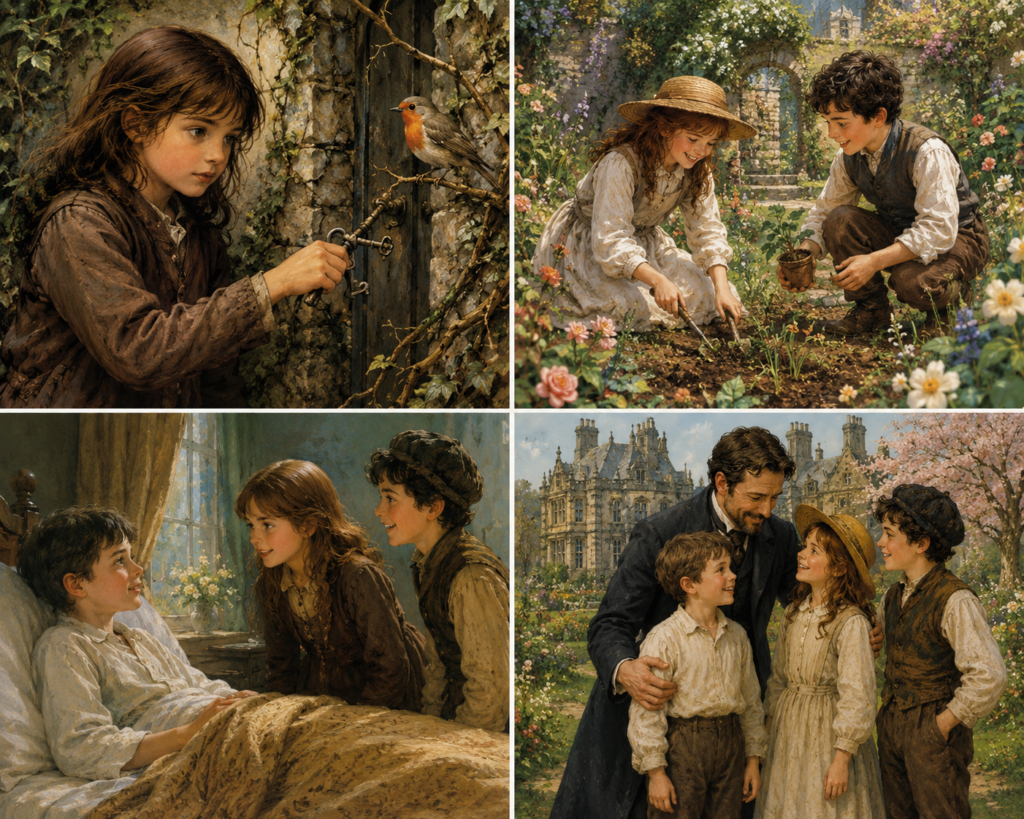
Mary becomes curious. She looks for the garden. A robin bird helps her find a key and a hidden door. Mary opens the door and finds the secret garden.
The garden is empty and wild. Mary decides to care for it. She cleans it and plants seeds. She goes there every day.
Slowly, Mary becomes happier and kinder. The garden also becomes beautiful again. Flowers grow.
Mary meets a boy named Dickon. He loves animals and plants. He helps Mary in the garden. They become friends.
Mary also finds her cousin Colin. He is sick and stays in bed. He thinks he cannot walk.
Mary tells Colin about the garden. Colin wants to see it. Mary and Dickon take him outside.
Colin feels happy in the garden. He comes many times. He becomes stronger and starts to walk again.
At the end, Mr. Craven comes home. He is surprised to see Colin walking and happy. He also sees the beautiful garden.
The secret garden changes many lives. Mary, Colin, and the garden all become healthy and happy.
______________________
Vocabulary
a secret garden: a garden that is hidden and not easy to find
to be busy: to have a lot of work or things to do
to take care of somebody: to help and look after someone
to feel lonely: to feel sad because you are alone
to behave in a rude way: to act impolitely or badly to others
sickness: illness; when you are not healthy
an orphan: a child whose parents are dead
a manor: a big old house, usually in the countryside
a housekeeper: a person who cleans and organizes a house
to be strict: to make people follow rules very carefully
to be curious: to want to learn or know new things
big grounds: a large area of land around a house
a robin (bird): a small bird with a red chest
to be hidden: to be not easy to see or find
to clean: to make something not dirty
to pull out weeds: to remove unwanted plants from the ground
to plant seeds: to put seeds in soil so plants can grow
all the time: always; very often
to believe: to think something is true
to be afraid: to feel scared
to be healthy: to be well and not sick
to be confident: to feel sure about yourself
to be surprised: to feel shocked because something unexpected happens
A. to act impolitely or badly to others B. a child whose parents are dead C. to feel sure about yourself D. a big old house, usually in the countryside E. to remove unwanted plants from the ground F. to have a lot of work or things to do G. a small bird with a red chest H. to feel sad because you are alone I. a garden that is hidden and not easy to find J. to help and look after someone K. to feel scared L. to think something is true M. a person who cleans and organizes a house N. to be not easy to see or find O. to make people follow rules very carefully P. to put seeds in soil so plants can grow Q. a large area of land around a house R. always; very often S. illness; when you are not healthy T. to feel shocked because something unexpected happens
to feel shocked because something unexpected happens
to help and look after someone
a large area of land around a house
to be not easy to see or find
to think something is true
illness; when you are not healthy
to feel or want to learn new things
Words:
A. to take care of somebody B. to be strict C. a robin (bird) D. to behave in a rude way E. a manor F. to be afraid G. to plant seeds H. an orphan I. to feel lonely J. a housekeeper K. to pull out weeds L. to be confident M. a secret garden N. to be curious O. sickness P. big grounds Q. to be busy R. to be surprised S. to be hidden T. to believe
Use: The past simple is used to talk about finished actions in the past.
#################
Verbs in text, regular and irregular past tense:
Infinitive
Past Simple
to be
was / were
to live
lived
to walk
walked
to feel
felt
to see
saw
to wave
waved
to smile
smiled
to ask
asked
to talk
talked
to laugh
laughed
to go
went
to throw
threw
to watch
watched
to have
had
to try
tried
to skip
skipped
to fall
fell
to start
started
to rain
rained
to run
ran
to get
got
to find
found
to drink
drank
################
Match the words to the definitions
Words:
to feel excited
to throw stones
to change everything
to smile
to wave
to laugh
to be calm (river)
a bike
to feel bored
to get wet
to watch
to walk with somebody
to skip a big stone
a splash
a little bit
to jump
Definitions:
A. to move your hand to say hello or goodbye B. to feel very happy and full of energy C. to look at something carefully D. to be quiet and not moving fast E. to show happiness with your mouth F. to make everything different G. a bicycle you ride H. to go on foot together with someone I. to make a happy sound because something is funny J. to have water on your body or clothes K. to throw a stone so it bounces on water L. the sound or drops of water when something hits water M. to feel like nothing is interesting N. to move quickly up into the air O. to send stones through the air with your hand P. a small amount
the sound or drops of water when something hits water
to send stones through the air with your hand
to throw a stone so it bounces on water
a small amount
Words : A. to feel bored B. to smile C. a bike D. to wave E. to feel excited F. to get wet G. to jump H. to change everything I. to watch J. to laugh K. to walk with somebody L. to be calm (river) M. a splash N. to throw stones O. to skip a big stone P. a little bit
Did Mia’s life feel the same or different after meeting Leo?
_____________________
Short answers:
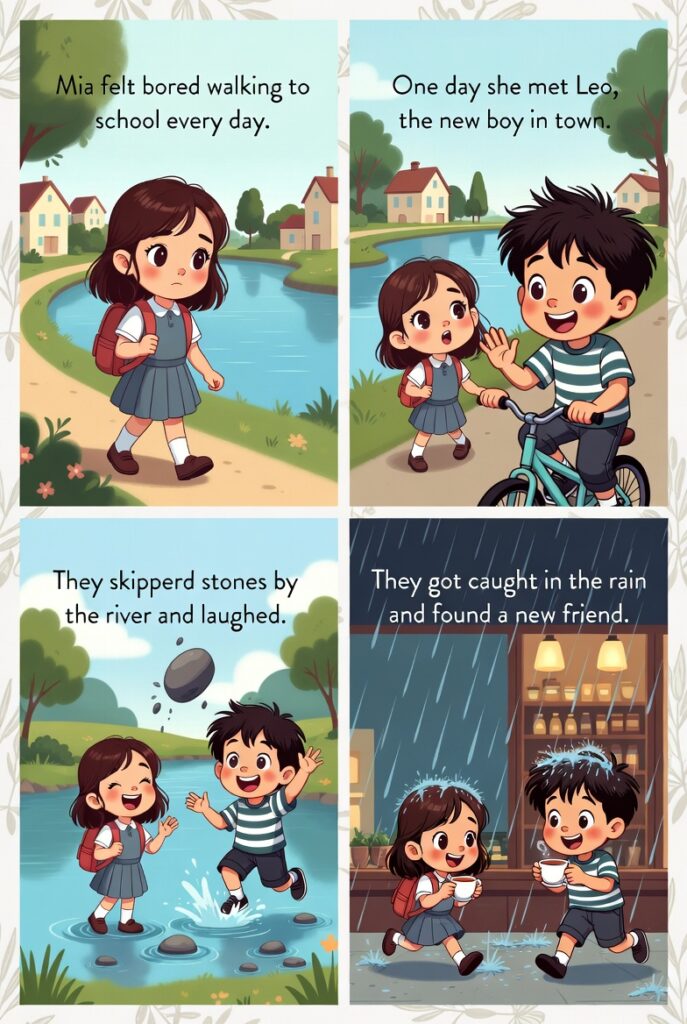
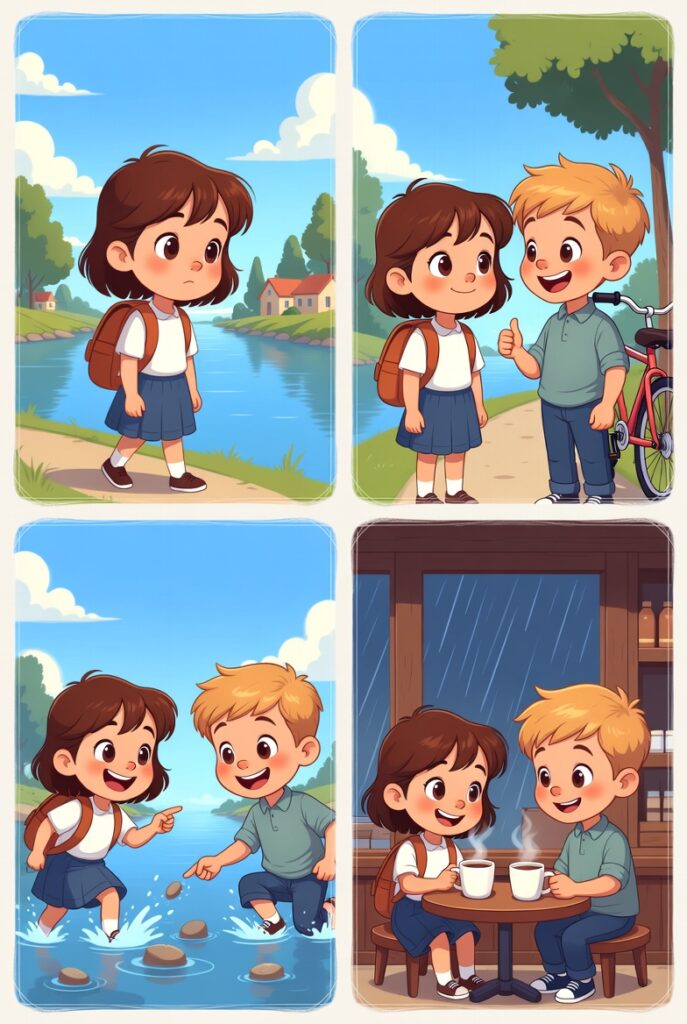
Where did Mia live? – small town, near river
How did Mia feel at the beginning of the story? – bored
Who did Mia meet on the way to school? – Leo
What was Leo riding when Mia saw him? – bike
What did Leo do when he saw Mia for the first time? – waved, smiled
What did Leo ask Mia to do after school? – walk together
When did Mia and Leo walk together? – after school
Where did Mia and Leo go after school? – river
What did they do at the river? – talked, laughed, threw stones
What did they throw into the river? – stones
Why did Leo’s stone fall into the water? – big stone, splash
What happened when Leo tried to skip a big stone? – fell, splash
When did it start to rain? – while outside, later
Where did Mia and Leo go when it started to rain? – shop
What did Mia and Leo drink in the shop? – hot tea
How did Mia feel while she was in the shop? – warm, happy
How did Mia feel at the end of the day? – happy, excited
What changed in Mia’s life after meeting Leo? – new friend, not bored, different days
#################
Short answers, past simple, basics:
Example Sentence
Yes
No
I learned letters.
Yes, I did.
No, I didn’t.
You read signs.
Yes, you did.
No, you didn’t.
He spoke English.
Yes, he did.
No, he didn’t.
She watched TV.
Yes, she did.
No, she didn’t.
It helped me.
Yes, it did.
No, it didn’t.
We used an app.
Yes, we did.
No, we didn’t.
You read words.
Yes, you did.
No, you didn’t.
They made mistakes.
Yes, they did.
No, they didn’t.
Questions (Past Simple)
Question
Yes
No
Did I learn letters?
Yes, I did.
No, I didn’t.
Did you read signs?
Yes, you did.
No, you didn’t.
Did he speak English?
Yes, he did.
No, he didn’t.
Did she watch TV?
Yes, she did.
No, she didn’t.
Did it help me?
Yes, it did.
No, it didn’t.
Did we use an app?
Yes, we did.
No, we didn’t.
Did you read words?
Yes, you did.
No, you didn’t.
Did they make mistakes?
Yes, they did.
No, they didn’t.
Was / Were
Question
Yes
No
Was I happy?
Yes, I was.
No, I wasn’t.
Were you happy?
Yes, you were.
No, you weren’t.
Was he happy?
Yes, he was.
No, he wasn’t.
Was she happy?
Yes, she was.
No, she wasn’t.
Was it good?
Yes, it was.
No, it wasn’t.
Were we happy?
Yes, we were.
No, we weren’t.
Were you happy?
Yes, you were.
No, you weren’t.
Were they happy?
Yes, they were.
No, they weren’t.
#################
Short answers:
Leo rode a bike when Mia saw him.
YOU WRITE: Yes, he did.
Mia went home feeling sad and bored again.
Mia and Leo walked together after school.
They played football in a big stadium.
Mia lived in a small town near a river.
They went to a cinema to watch a movie.
It was sunny all day and nothing changed.
The river was blue and calm.
Mia met Leo on her way to school.
Leo was Mia’s brother.
They stayed inside all day and never went outside.
Mia felt bored at the beginning of the story.
Leo fell into the river and got very angry.
They drank hot tea in a small shop.
Mia and Leo did not talk to each other.
They went to the river and threw stones.
Leo was new in town.
The river water was dirty and dangerous.
________________________
Answers:
Leo rode a bike when Mia saw him. – Yes, he did.
Mia went home feeling sad and bored again. – No, she didn’t.
Mia and Leo walked together after school. – Yes, they did.
They played football in a big stadium. – No, they didn’t.
Mia lived in a small town near a river. – Yes, she did.
They went to a cinema to watch a movie. – No, they didn’t.
It was sunny all day and nothing changed. – No, it wasn’t.
The river was blue and calm. – Yes, it was.
Mia met Leo on her way to school. – Yes, she did.
Leo was Mia’s brother. – No, he wasn’t.
They stayed inside all day and never went outside. – No, they didn’t.
Mia felt bored at the beginning of the story. – Yes, she did.
Leo fell into the river and got very angry. – No, he didn’t.
They drank hot tea in a small shop. – Yes, they did.
Mia and Leo did not talk to each other. – No, they didn’t.
They went to the river and threw stones. – Yes, they did.
Leo was new in town. – Yes, he was.
The river water was dirty and dangerous. – No, it wasn’t.
#################
Basics in past simple:
Personal Pronoun
Verb (Past)
Object
I
ate
apples
You
ate
apples
He
ate
apples
She
ate
apples
It
ate
apples
We
ate
apples
You (plural)
ate
apples
They
ate
apples
I
played
football
You
played
football
He
played
football
She
played
football
It
played
football
We
played
football
You (plural)
played
football
They
played
football
Personal Pronoun
Verb (Past Negative)
Object
I
did not eat
apples
You
did not eat
apples
He
did not eat
apples
She
did not eat
apples
It
did not eat
apples
We
did not eat
apples
You (plural)
did not eat
apples
They
did not eat
apples
I
did not play
football
You
did not play
football
He
did not play
football
She
did not play
football
It
did not play
football
We
did not play
football
You (plural)
did not play
football
They
did not play
football
Did + Pronoun
Verb
Object
Did I
eat
apples?
Did you
eat
apples?
Did he
eat
apples?
Did she
eat
apples?
Did it
eat
apples?
Did we
eat
apples?
Did you
eat
apples?
Did they
eat
apples?
Did I
play
football?
Did you
play
football?
Did he
play
football?
Did she
play
football?
Did it
play
football?
Did we
play
football?
Did you
play
football?
Did they
play
football?
Didn’t + Pronoun
Verb
Object
Didn’t I
eat
apples?
Didn’t you
eat
apples?
Didn’t he
eat
apples?
Didn’t she
eat
apples?
Didn’t it
eat
apples?
Didn’t we
eat
apples?
Didn’t you
eat
apples?
Didn’t they
eat
apples?
Didn’t I
play
football?
Didn’t you
play
football?
Didn’t he
play
football?
Didn’t she
play
football?
Didn’t it
play
football?
Didn’t we
play
football?
Didn’t you
play
football?
Didn’t they
play
football?
##################
Past simple forms of ‚to be‘:
Person
Past
I
was
You
were
He/She/It
was
We
were
You (pl)
were
They
were
Person
Question
I
Was I …?
You
Were you …?
He/She/It
Was he/she/it …?
We
Were we …?
You (pl)
Were you …?
They
Were they …?
Person
Negative
I
I was not (I wasn’t)
You
You were not (You weren’t)
He/She/It
He/She/It was not (He/She/It wasn’t)
We
We were not (We weren’t)
You (pl)
You were not (You weren’t)
They
They were not (They weren’t)
Person
Negative Question
I
Wasn’t I …?
You
Weren’t you …?
He/She/It
Wasn’t he/she/it …?
We
Weren’t we …?
You (pl)
Weren’t you …?
They
Weren’t they …?
##################
Answer as shown:
Mia lived in a big city far away from any river.
YOU WRITE: No, she didn’t. She lived in a city near the river
Leo was Mia’s brother.
Mia felt excited and happy at the beginning of the story.
Mia and Leo went to school together every morning.
The river water was dirty and dangerous.
Mia and Leo never talked to each other.
They went to a cinema to watch a movie.
It was sunny all day and never rained.
Leo fell into the river and got very angry.
Mia went home feeling sad and bored again.
Mia and Leo did not meet each other at all.
Leo stayed in town for only one hour.
They rode horses to school together.
The river was red and full of fire.
Mia threw a big stone into the sky like a ball.
They ate pizza inside the river.
Leo could not ride a bike.
Mia stayed home all day and never went outside.
They did not laugh together at all.
The shop where they went was cold and dark, and they left immediately.
_________________________
Answers:
Mia lived in a big city far away from any river. – No, she didn’t. She lived in a small town near the river.
Leo was Mia’s brother. – No, he wasn’t. He was a new boy in town.
Mia felt excited and happy at the beginning of the story. – No, she didn’t. She felt bored.
Mia and Leo went to school together every morning. – No, they didn’t. They met on the way to school.
The river water was dirty and dangerous. – No, it wasn’t. It was blue and calm.
Mia and Leo never talked to each other. – No, they didn’t. They talked and laughed together.
They went to a cinema to watch a movie. – No, they didn’t. They went to the river.
It was sunny all day and never rained. – No, it wasn’t. It started to rain.
Leo fell into the river and got very angry. – No, he didn’t. He dropped a stone into the water.
Mia went home feeling sad and bored again. – No, she didn’t. She went home happy and excited.
Mia and Leo did not meet each other at all. – No, they didn’t. They met and became friends.
Leo stayed in town for only one hour. – No, he didn’t. He lived there as a new student.
They rode horses to school together. – No, they didn’t. Leo rode a bike.
The river was red and full of fire. – No, it wasn’t. It was blue and calm.
Mia threw a big stone into the sky like a ball. – No, she didn’t. She threw stones into the river.
They ate pizza inside the river. – No, they didn’t. They drank hot tea in a shop.
Leo could not ride a bike. – No, he couldn’t. He rode a bike.
Mia stayed home all day and never went outside. – No, she didn’t. She went to school and met Leo.
They did not laugh together at all. – No, they didn’t. They laughed together.
The shop where they went was cold and dark, and they left immediately. – No, it wasn’t. It was warm, and they stayed and drank tea.
##################
Form questions to which the words given are the answer:
Mia’s town was near a river. a) Mia’s town: b) Mia’s: c) near a river:
Leo’s bike was from Germany. a) Leo’s bike: b) Leo’s: c) Germany
Mia walked to school every day. a) Mia: b) walked to school every day: c) school: d) every day:
Leo rode a bike in the afternoon. a) Leo: b) rode a bike in the afternoon: c) a bike: d) in the afternoon:
Mia and Leo went to the river after school. a) Mia and Leo: b) went to the river after school: c) the river: d) after school:
They threw stones into the river. a) They: b) threw stones at the river: c) stones: d) the river:
Mia’s day was a good one. a) Mia’s day: b) Mia’s: c) a good one:
_______________________
Correct version:
Mia’s town was near a river. a) Mia’s town: What was near a river? b) Mia’s: Whose town was near a river? c) near a river: Where was Mia’s town?
Leo’s bike was from Germany. a) Leo’s bike: What was from Germany? b) Leo’s: Whose bike was from Germany? c) Germany: Where was Leo’s bike from?
Mia walked to school every day. a) Mia: Who walked to school every day? b) walked to school every day: What did Mia do every day? c) school: Where did Mia walk to? d) every day: How often/When did Mia walk to school?
Leo rode a bike in the afternoon. a) Leo: Who rode a bike in the afternoon? b) rode a bike in the afternoon: What did Leo do in the afternoon? c) a bike: What did Leo ride? d) in the afternoon: When did Leo ride a bike?
Mia and Leo went to the river after school. a) Mia and Leo: Who went to the river? b) went to the river after school: What did Mia and Leo do after school? c) the river: Where did Mia and Leo go? d) after school: When did they go to the river?
They threw stones into the river. a) They: Who threw stones into the river? b) threw stones at the river: What did they do? c) stones: What did they throw into the river? d) the river: Where did they throw the stones into?
Mia’s day was a good one. a) Mia’s day: What was a good one? b) Mia’s: Whose day was a good one? c) a good one: What kind of day was Mia’s day?
###############
Fill in – past simple:
Mia ______________ (live) in a small town near a river. She ______________ (feel) bored every day when she ______________ (walk) to school. One day, she ______________ (meet) a boy named Leo who ______________ (ride) a bike and ______________ (be) new in town. He ______________ (wave) and ______________ (smile) at her. After school, Leo ______________ (ask) Mia to walk with him, and they ______________ (go) to the river together. They ______________ (talk), ______________ (laugh), and ______________ (throw) stones into the calm blue water. Leo ______________ (try) to skip a big stone, but it ______________ (fall) with a splash. Suddenly, it ______________ (start) to rain, and they ______________ (run) to a small shop. They ______________ (drink) hot tea and ______________ (stay) warm inside. Later, Mia ______________ (go) home feeling happy and excited. She ______________ (have) a new friend, and her life ______________ (change). Every day ______________ (become) more interesting because she ______________ (spend) time with Leo and ______________ (enjoy) their small adventures together by the river.
———————————– Correct version:
Mia lived in a small town near a river. She felt bored every day when she walked to school. One day, she met a boy named Leo who rode a bike and was new in town. He waved and smiled at her. After school, Leo asked Mia to walk with him, and they went to the river together. They talked, laughed, and threw stones into the calm blue water. Leo tried to skip a big stone, but it fell with a splash. Suddenly, it started to rain, and they ran to a small shop. They drank hot tea and stayed warm inside. Later, Mia went home feeling happy and excited. She had a new friend, and her life changed. Every day became more interesting because she spent time with Leo and enjoyed their small adventures together by the river.