Kategorie: Beginners

  • 🏖️Why English is important in tourism – Mira’s thoughts🏖️ (A1, intermediate to advanced beginners, present simple)

    • English is fun?

    Basics:

    Personal Pronounam / is / are
    Iam8 years old
    Youare8 years old
    Heis8 years old
    Sheis8 years old
    Itis8 years old
    Weare8 years old
    You (plural)are8 years old
    Theyare8 years old

    Negation:

    Personal Pronounam not / is not / are not
    Iam not8 years old
    Youare not8 years old
    Heis not8 years old
    Sheis not8 years old
    Itis not8 years old
    Weare not8 years old
    You (plural)are not8 years old
    Theyare not8 years old

    Questions:

    Question WordPersonal Pronoun
    AmI8 years old?
    Areyou8 years old?
    Ishe8 years old?
    Isshe8 years old?
    Isit8 years old?
    Arewe8 years old?
    Areyou (plural)8 years old?
    Arethey8 years old?

    Statement:

    Personal PronounVerb
    Ilikeice cream
    Youlikeice cream
    Helikesice cream
    Shelikesice cream
    Itlikesice cream
    Welikeice cream
    You (plural)likeice cream
    Theylikeice cream

    Negation:

    Personal PronounVerb (negative)
    Ido not likeice cream
    Youdo not likeice cream
    Hedoes not likeice cream
    Shedoes not likeice cream
    Itdoes not likeice cream
    Wedo not likeice cream
    You (plural)do not likeice cream
    Theydo not likeice cream

    Questions:

    Do / DoesPersonal PronounVerbSugar?
    DoIlikesugar?
    Doyoulikesugar?
    Doeshelikesugar?
    Doesshelikesugar?
    Doesitlikesugar?
    Dowelikesugar?
    Doyou (plural)likesugar?
    Dotheylikesugar?

    #################

    Some thoughts:

    I think English is a very important language. Many people in the world speak English.
    When we work in tourism, we meet many tourists. Many tourists speak English. When we speak English, we can talk with them. We can help them find a room. We can help them take a car or a bus.
    Tourists feel happy when they understand us. When we speak English, we can get a better job. We can work in hotels, restaurants, and travel places. We can also work in other countries. We can get more money.
    English helps us every day at work. English is good for us and for the tourists. This is why I want to learn English.
    And so does her friend, Rina.
    _________________________
    Vocabulary:

    a friend – a person you like and spend time with.

    important – very good to know or do.

    a thought – something you have in your head.

    an advanced beginner – someone who knows a little more than a beginner.

    to meet somebody – to see and talk to a person for the first time.

    to talk with tourists – to speak to people who visit your country.

    to find a room – to look for and get a room to stay in.

    to take a car – to go somewhere in a car.

    to understand – to know what someone says or means.

    a better job – a job that gives more money or is nicer.

    a travel place – a place for tourists to visit.

    a country (countries) – a big part of the world, like Cambodia or Indonesia.

    to get money – to receive money.

    #################

    Multiple choice, one answer correct:


    1. Mira works in a…
      a) travel place  b) car  c) friend
    2. Her job is…
      a) friend  b) important  c) country
    3. Every morning she…
      a) meets somebody  b) talks with tourists  c) countries
    4. She talks with…
      a) money  b) a better job  c) tourists
    5. Tourists feel good when they…
      a) understand  b) car  c) find a room
    6. She is…
      a) a friend  b) an advanced beginner  c) a thought
    7. She wants…
      a) a better job  b) to take a car  c) a travel place
    8. She wants to get…
      a) a friend  b) a room  c) money
    9. She wants to make…
      a) a friend  b) a thought  c) a car
    10. She has…
      a) a car  b) a thought  c) a friend

    ——————————–
    Answers:
    1 a, 2 b, 3 b, 4 c, 5 a,
    6 b, 7 a, 8 c, 9 a, 10 c

    ——————————–
    Correct version:

    Mira works in a travel place.

    Her job is important.

    Every morning she meets somebody.

    She talks with tourists.

    Tourists feel good when they understand.

    She is an advanced beginner.

    She wants a better job.

    She wants to get money.

    She wants to make a friend.

    She has a friend.

    ###############

    Negate the following sentences:

    1. Mira lives in a big country.

      YOU WRITE:

      Mira does not live in a big country.
    2. She works in a travel place.
      ________________________
    3. Her job is very important to her.
      ________________________
    4. Every morning, she meets somebody new.
      ________________________
    5. She talks with tourists from many countries.
      ________________________
    6. She helps them find a room and take a car.
      ________________________
    7. Tourists are happy when they understand her English.
      ________________________
    8. She is an advanced beginner.
      ________________________
    9. She has a thought: “If I speak English well, I can get a better job.”
      ________________________
    10. Mira wants to travel to other countries and make a friend in each one.
      ________________________

      ———————————
      Correct answers:
    1. Mira does not live in a big country.
    2. She does not work in a travel place.
    3. Her job is not very important to her.
    4. Every morning, she does not meet somebody new.
    5. She does not talk with tourists from many countries.
    6. She does not help them find a room and take a car.
    7. Tourists are not happy when they understand her English.
    8. She is not an advanced beginner.
    9. She does not have a thought: “If I speak English well, I can get a better job.”
    10. Mira does not want to travel to other countries and does not want to make a friend in each one.

    ######################

    Rewrite as questions:

    Mira lives in a big country.

    >>>>>YOU WRITE:

    >>>>>Mia does not live in a big country.

    Mira works in a travel place.
    __________________________

    Her job is important.
    __________________________

    Every morning she meets somebody.
    __________________________

    She talks with tourists.
    __________________________

    Tourists feel good when they understand.
    __________________________

    She is an advanced beginner.
    __________________________

    She wants a better job.
    __________________________

    She wants to get money.
    __________________________

    She wants to make a friend.
    __________________________

    She has a friend.
    __________________________

    ———————————–
    Correct answers:

    Does Mira work in a travel place?
    Is her job important?
    Does she meet somebody every morning?
    Does she talk with tourists?
    Do tourists feel good when they understand?
    Is she an advanced beginner?
    Does she want a better job?
    Does she want to get money?
    Does she want to make a friend?
    Does she have a friend?

    #####################

    Form questions to which word/s given is/are the answer:

    1. She works in a travel place.

      a) She: Who works in a travel place?
      b) works in a travel place: What does she do?
      c) ain a travel place: Where does she work?

    2. She likes her job a lot.

    a) She:
    b) likes her job a lot:
    c) her job:
    d) a lot:

    3. Every morning, she meets somebody new.

    a) Every morning:
    b) she:
    c) meets somebody new:
    d) somebody new

    4. She talks with tourists every day.

    a) She
    b) talks witk tourists:
    c) every day

    5. She helps them every Saturday.

    a) She:
    b) helps them:
    c) them:
    d) every Saturday

    ————————
    Correct answers:

    She likes her job a lot.
    a) Who likes her job a lot?
    b) What does she do?
    c) What does she like?
    d) How much does she like her job?

    Every morning, she meets somebody new.
    a) When does she meet somebody new?
    b) Who meets somebody new every morning?
    c) What does she do every morning?
    d) Who does she meet?

    She talks with tourists every day.
    a) Who talks with tourists every day?
    b) What does she do?
    c) How often does she talk with tourists?

    She helps them every Saturday.
    a) Who helps them every Saturday?
    b) What does she do every Saturday?
    c) Who does she help?
    d) When does she help them?

    ###################

    Fill in:

    likes, travel place, every morning,
    tourists, help, friend, country,
    money, important, meets

    1. Mira lives in a big __________.
    2. She works in a __________.
    3. She __________ her job a lot.
    4. __________, she meets somebody new.
    5. She talks with __________.
    6. She wants to __________ people.
    7. She wants to get __________.
    8. Her job is very __________.
    9. She wants to make a __________.
    10. She __________ somebody new every morning.

    ———————-
    Correct answers:

    Mira lives in a big country.
    She works in a travel place.
    She likes her job a lot.
    Every morning, she meets somebody new.
    She talks with tourists.
    She wants to help people.
    She wants to get money.
    Her job is very important.
    She wants to make a friend.
    She meets somebody new every morning.

    ################

    Matching exercise – answer in a complete sentences:


    1. Who lives in a big country?
    2. Where does Mira work?
    3. What does she like a lot?
    4. When does she meet somebody new?
    5. Who does she talk with every day?
    6. What does she want to do for people?
    7. What does she want to get?
    8. How is her job?
    9. What does she want to make?
    10. Who does she meet every morning?


    Answers :

    a) Money
    b) Somebody new
    c) Help
    d) Important
    e) Her job
    f) Tourists
    g) Friend
    h) Travel place
    i) Mira
    j) Every morning


    _______________
    Answers: 1 i, 2 h, 3 e, 4 j, 5 f, 6 c, 7 a, 8 d, 9 g, 10 b

    _______________

    Correct answers:

    1. Who lives in a big country? → Mira lives in a big country.
    2. Where does Mira work? → She works in a travel place.
    3. What does she like a lot? → She likes her job a lot.
    4. When does she meet somebody new? → She meets somebody new every morning.
    5. Who does she talk with every day? → She talks with tourists every day.
    6. What does she want to do for people? → She wants to help people.
    7. What does she want to get? → She wants to get money.
    8. How is her job? → Her job is important.
    9. What does she want to make? → She wants to make a friend.
    10. Who does she meet every morning? → She meets somebody new every morning.

    #############

    Unscramble the sentences:

    1. lives / country / Mira / in / a / big
    2. works / travel place / in / a / She
    3. job / her / likes / She / a lot
    4. meets / morning / somebody / Every / new / she
    5. talks / with / day /tourists / She / every
    6. wants / She / friend / to / make / a /
    7. get / wants / She / to / money

    _______________
    Correct sentences:

    1. Mira lives in a big country.
    2. She works in a travel place.
    3. She likes her job a lot.
    4. Every morning she meets somebody new.
    5. She talks with tourists every day.
    6. She wants to make a friend.
    7. She wants to get money.

    #############

    Interview, fill in, words below:

    better – world – friend – tourists – happy –
    money. – tourism – find –
    travel places –
    every day

    ———————————


    1. Why does Mira think English is important?
      Because many people in the __________ speak English.
    2. Who does Mira meet when she works in __________?
      She meets many tourists.
    3. Do many tourists speak English?
      Yes, many tourists speak English.
    4. What can Mira do when she speaks English?
      She can talk with __________.
    5. How can Mira help tourists?
      She can help them _________ a room and take a car or a bus.
    6. How do tourists feel when they understand Mira?
      They feel __________.
    7. What can Mira get when she speaks English?
      She can get a __________ job.
    8. Where can she work if she speaks English?
      She can work in hotels, restaurants, and __________.
    9. Can she work in other countries?
      Yes, she can work in other countries.
    10. What can she get by working in other countries?
      She can get more __________
    11. How does English help Mira?
      It helps her __________ at work.
    12. Who else wants to learn English?
      Her __________ Rina, also wants to learn English.

    —————————————

    Correct version:


    1. Why does Mira think English is important?
      Because many people in the world speak English.
    2. Who does Mira meet when she works in tourism?
      She meets many tourists.
    3. Do many tourists speak English?
      Yes, many tourists speak English.
    4. What can Mira do when she speaks English?
      She can talk with tourists.
    5. How can Mira help tourists?
      She can help them find a room and take a car or a bus.
    6. How do tourists feel when they understand Mira?
      They feel happy.
    7. What can Mira get when she speaks English?
      She can get a better job.
    8. Where can she work if she speaks English?
      She can work in hotels, restaurants, and travel places.
    9. Can she work in other countries?
      Yes, she can work in other countries.
    10. What can she get by working in other countries?
      She can get more money.
    11. How does English help Mira?
      It helps her every day at work.
    12. Who else wants to learn English?
      Her friend, Rina, also wants to learn English.

    ##################

    Read the following story:

    I think English is a very important language. Many people in the world speak English. When I work in tourism, I meet many tourists. Many tourists speak English. When I speak English, I can talk with them. I can help them find a room. I can help them take a car or a bus. Tourists feel happy when they understand me. When I speak English, I can get a better job. I can work in hotels, restaurants, and travel places. I can also work in other countries. I can get more money. English helps me every day at work, and it is good for me and for the tourists. This is why I want to learn English. My friend Rina wants to learn English too.
    ————
    Rewrite the story starting with

    >>>>>>>>>Mira thinks English is a very important………
    >>>>>>>>>…………………………………..When she works……..

    and make all changes necessary.

    _______________________

    Correct version:

    Mira thinks English is a very important language. Many people in the world speak English. When she works in tourism, she meets many tourists. Many tourists speak English. When she speaks English, she can talk with them. She can help them find a room. She can help them take a car or a bus. Tourists feel happy when they understand her. When she speaks English, she can get a better job. She can work in hotels, restaurants, and travel places. She can also work in other countries. She can get more money. English helps her every day at work. English is good for her and for the tourists. This is why she wants to learn English. And so does her friend, Rina.


    ###############

    Words got srambled – find the words. Which phrase are we looking for?

  • 🤩Meet your first English sentences – Maya, a little girl (A1 beginners, part 9)

    • a typical weekend at home


    Basics:

    Personal Pronounam / is / are
    Iam8 years old
    Youare8 years old
    Heis8 years old
    Sheis8 years old
    Itis8 years old
    Weare8 years old
    You (plural)are8 years old
    Theyare8 years old

    Negation:

    Personal Pronounam not / is not / are not
    Iam not8 years old
    Youare not8 years old
    Heis not8 years old
    Sheis not8 years old
    Itis not8 years old
    Weare not8 years old
    You (plural)are not8 years old
    Theyare not8 years old

    Questions:

    Question WordPersonal Pronoun
    AmI8 years old?
    Areyou8 years old?
    Ishe8 years old?
    Isshe8 years old?
    Isit8 years old?
    Arewe8 years old?
    Areyou (plural)8 years old?
    Arethey8 years old?

    Statement:

    Personal PronounVerb
    Ilikeice cream
    Youlikeice cream
    Helikesice cream
    Shelikesice cream
    Itlikesice cream
    Welikeice cream
    You (plural)likeice cream
    Theylikeice cream

    Negation:

    Personal PronounVerb (negative)
    Ido not likeice cream
    Youdo not likeice cream
    Hedoes not likeice cream
    Shedoes not likeice cream
    Itdoes not likeice cream
    Wedo not likeice cream
    You (plural)do not likeice cream
    Theydo not likeice cream

    Questions:

    Do / DoesPersonal PronounVerbSugar?
    DoIlikesugar?
    Doyoulikesugar?
    Doeshelikesugar?
    Doesshelikesugar?
    Doesitlikesugar?
    Dowelikesugar?
    Doyou (plural)likesugar?
    Dotheylikesugar?

    ################

    Maya and life on a weekend

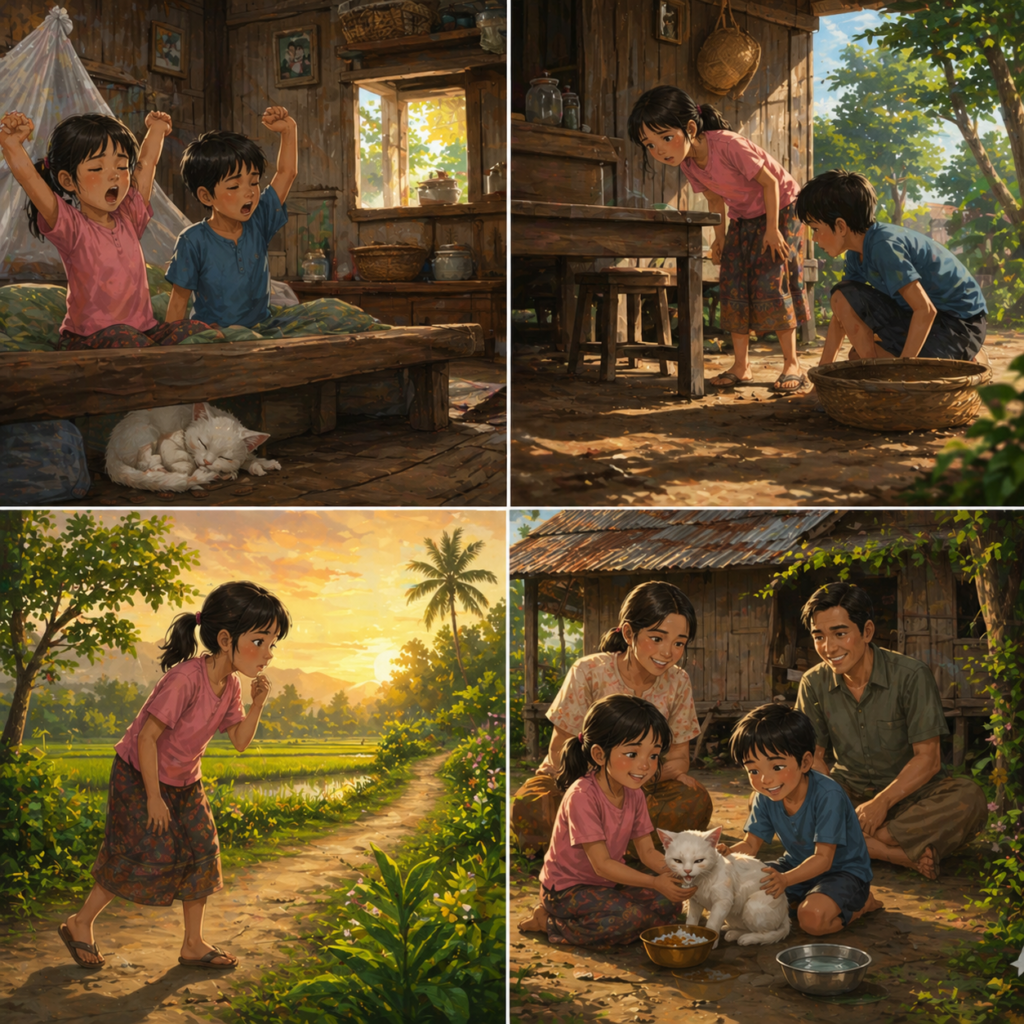
    Maya is a young girl. She lives with her parents in the countryside. The air is fresh, and the nature around her house is green and quiet.

    On weekends, Maya sleeps a little longer in the morning. She does not need to go to school. After breakfast, she helps her father and mother. Sometimes she helps in the garden. She waters the flowers and feeds the chickens.

    Later, she plays with her friends near the house. They run, laugh, and play games together. Maya likes this time very much.

    In the afternoon, she does her homework. She learns new words and writes sentences. Maya also learns for school. She wants to speak good English. She reads easy English books. She also listens to English texts.

    Maya knows that listening is very important. The ear and brain must get used to the sounds. She listens again and again. Step by step, she understands more.

    In the evening, she sits with her parents. They talk about the day. Maya feels happy and safe. She loves her weekends in the countryside. She works, plays, and learns — and every week, she becomes better at English.

    _______________________

    Vocabulary:

    • parents – your mother and father.
    • countryside – land outside the city, with fields, trees, and farms.
    • fresh air – clean air outside.
    • to be quiet – to make no sound, not loud.
    • a weekend – Saturday and Sunday.
    • need to do something – must do something.
    • breakfast – the first meal in the morning.
    • to water flowers – to give flowers water.
    • to feed the chickens – to give chickens food.
    • to laugh – to make a happy sound, like “ha ha ha.”
    • afternoon – the time after 12:00 and before evening.
    • to write a sentence – to write words that make one idea.
    • to listen to a text – to hear words or a story.
    • to be important – to have a big meaning or value.
    • an ear – the part of your body you use to hear.
    • brain – the part of your head that thinks.
    • to get used to a sound – to hear a sound many times so it feels easy.
    • step by step – slowly, one small step after another.
    • to understand – to know the meaning.
    • to feel safe – to feel no danger.
    • to become better in English – to learn more English and speak well.

    ####################

    Match the word with the definition:


    Words:

    1. parents
    2. countryside
    3. fresh air
    4. to be quiet
    5. a weekend
    6. need to do something
    7. breakfast
    8. to water flowers
    9. to feed the chickens
    10. to laugh
    11. afternoon
    12. to write a sentence
    13. to listen to a text
    14. to be important
    15. an ear
    16. brain
    17. to get used to a sound
    18. step by step
    19. to understand
    20. to feel safe
    21. to become better in English


    Definitions:

    A. to feel no danger
    B. clean air outside
    C. slowly, one small step after another
    D. the time after 12:00 and before evening
    E. to give chickens food
    F. to make no sound, not loud
    G. the part of your body you use to hear
    H. land outside the city, with fields, trees, and farms
    I. to have a big meaning or value
    J. Saturday and Sunday
    K. to hear a sound many times so it feels easy
    L. to give flowers water
    M. the first meal in the morning
    N. to hear words or a story
    O. your mother and father
    P. must do something
    Q. to make a happy sound, like “ha ha ha”
    R. to know the meaning
    S. the part of your head that thinks
    T. to learn more English and speak well
    U. to write words that make one idea


    ___________________
    Answers:

    1 O, 2 H, 3 B, 4 F, 5 J, 6 P, 7 M,
    8 L, 9 E, 10 Q, 11 D, 12 U, 13 N, 14 I,
    15 G, 16 S, 17 K, 18 C, 19 R, 20 A, 21 T
    ___________________

    Correct version:

    parents – your mother and father
    countryside – land outside the city, with fields, trees, and farms
    fresh air – clean air outside
    to be quiet – to make no sound, not loud
    a weekend – Saturday and Sunday
    need to do something – must do something
    breakfast – the first meal in the morning
    to water flowers – to give flowers water
    to feed the chickens – to give chickens food
    to laugh – to make a happy sound, like “ha ha ha”
    afternoon – the time after 12:00 and before evening
    to write a sentence – to write words that make one idea
    to listen to a text – to hear words or a story
    to be important – to have a big meaning or value
    an ear – the part of your body you use to hear
    brain – the part of your head that thinks
    to get used to a sound – to hear a sound many times so it feels easy
    step by step – slowly, one small step after another
    to understand – to know the meaning
    to feel safe – to feel no danger
    to become better in English – to learn more English and speak well

    ##################
    Correct the statements:

    1. Maya lives in a big city with tall buildings.

      YOU WRITE:

      No, she does not live in a big city with tall buuildings. She lives in a house in the countryside.
    2. Maya wakes up very early on weekends.
      __________________________________
    3. Maya eats lunch first in the morning.
      __________________________________
    4. Maya helps her parents clean the car every weekend.
      __________________________________
    5. Maya plays computer games all day.
      __________________________________
    6. Maya does her homework at night.
      __________________________________
    7. Maya reads books in German.
      __________________________________
    8. Maya listens to music in Spanish.
      __________________________________
    9. Maya learns math when she listens to English texts.
      __________________________________
    10. Maya spends her weekends at the beach.
      __________________________________

    ————————–
    Correct version:

    She lives in a big city with tall buildings. No, she does not live in a big city with tall buildings. She lives in a house in the countryside.

    She wakes up very early on weekends. No, she does not wake up very early on weekends. She sleeps a little longer on weekends.

    She eats lunch first in the morning. No, she does not eat lunch first in the morning. She eats breakfast in the morning.

    She helps her parents clean the car every weekend. No, she does not help her parents clean the car every weekend. She helps her parents in the garden and with the animals.

    She plays computer games all day. No, she does not play computer games all day. She plays outside with her friends.

    She does her homework at night. No, she does not do her homework at night. She does her homework in the afternoon.

    She reads books in German. No, she does not read books in German. She reads books in English.

    She listens to music in Spanish. No, she does not listen to music in Spanish. She listens to English texts.

    She learns math when she listens to English texts. No, she does not learn math when she listens to English texts. She learns English when she listens to texts.

    She spends her weekends at the beach. No, she does not spend her weekends at the beach. She spends her weekends at home in the countryside.
    ####################

    Answer as follows:


    1. Does Maya live in a big city with tall buildings?

      YOU WRITE:

      Maya does not live in a big city. She lives in the countryside.

    2. Does Maya wake up very early on weekends?
    ____________________________________

    3. Does Maya eat lunch first in the morning?
    ____________________________________

    4. Does Maya play all day and never help her parents?
    ____________________________________

    5. Does Maya never play with her friends?
    ____________________________________

    6. Does Maya do her homework at night?
    ____________________________________

    7. Does Maya read books in another language than English?____________________________________

    8. Does Maya listen to music instead of English texts?
    ____________________________________

    9. Does Maya think listening is not important?
    ____________________________________

    10. Does Maya never learn for school?
    ____________________________________


    ———————————
    Correct version:


    Does Maya live in a big city with tall buildings?
    Maya does not live in a big city. She lives in the countryside.

    Does Maya wake up very early on weekends?
    Maya does not wake up very early. She sleeps longer on weekends.

    Does Maya eat lunch first in the morning?
    Maya does not eat lunch first. She eats breakfast in the morning.

    Does Maya play all day and never help her parents?
    Maya does not play all day. She helps her father and mother.

    Does Maya never play with her friends?
    Maya does not stay alone. She plays with her friends.

    Does Maya do her homework at night?
    Maya does not do her homework at night. She does homework on weekends.

    Does Maya read books in another language than English?
    Maya does not read other language books. She reads English books.

    Does Maya listen to music instead of English texts?
    Maya does not listen to music. She listens to English texts.

    Does Maya think listening is not important?
    Maya does not think listening is not important. She knows listening is very important.

    Does Maya never learn for school?
    Maya does not skip learning. She learns for school.


    ####################

    Gap-fill exercise, complete by using the correct form of the verb in brackets ()


    1. Maya _______ in the countryside. (live)
    2. She _______ longer on weekends. (sleep)
    3. Maya _______ her father and mother. (help)
    4. They _______ with their friends near the house. (play)
    5. She _______ her homework in the afternoon. (do)
    6. Maya _______ for school. (learn)
    7. He _______ English books. (read)
    8. She _______ English texts. (listen to)
    9. We _______ that listening is very important. (know)
    10. The ear and brain _______ to the sounds. (get used)

    Answer Key:

    1. lives
    2. sleeps
    3. helps
    4. play
    5. does
    6. learns
    7. reads
    8. listens to
    9. know
    10. get used

      —————————————–

    Full version:

    1. Maya lives in the countryside.
    2. She sleeps longer on weekends.
    3. Maya helps her father and mother.
    4. They play with their friends near the house.
    5. She does her homework in the afternoon.
    6. Maya learns for school.
    7. He reads English books.
    8. She listens to English texts.
    9. We know that listening is very important.
    10. The ear and brain get used to the sounds.

    #################

    Answer:

    1. Does Maya live in a big city?

      YOU WRITE:

      No, she does not live in a big city. She lives in a house in the countryside
    2. Does she wake up very early on weekends?
      ________________________________
    3. Does Maya eat lunch first in the morning?
      ________________________________
    4. Does she never help her parents?
      ________________________________
    5. Do Maya and her friends stay at home all day?
      ________________________________
    6. Does she do her homework at night?
      ________________________________
    7. Does Maya read books in German?
      ________________________________
    8. Does she listen to music instead of English texts?
      ________________________________
    9. Do Maya and her parents talk about the news?
      ________________________________
    10. Does she spend her weekends at the beach?
      ________________________________

    ——————————-
    Correct version:

    Does Maya live in a big city?
    No, she does not live in a big city. She lives in the countryside.

    Does Maya wake up very early on weekends?
    No, she does not wake up very early. She sleeps longer on weekends.

    Does Maya eat lunch first in the morning?
    No, she does not eat lunch first. She eats breakfast in the morning.

    Does Maya never help her parents?
    No, she does not never help her parents. She helps her father and mother.

    Do Maya and her friends stay at home all day?
    No, they do not stay at home all day. They play with their friends.

    Does Maya do her homework at night?
    No, she does not do her homework at night. She does her homework on weekends.

    Does Maya read books in German?
    No, she does not read books in German. She reads English books.

    Does she listen to music instead of English texts?
    No, she does not listen to music. She listens to English texts.

    Do Maya and her parents talk about the news?
    No, they do not talk about the news They talk about the day together.

    Does Maya spend her weekends at the beach?
    No, she does not spend her weekends at the beach. She spends her weekends in the countryside.

    ######################


    Multiple-choice, one answer correct:

    1. Where does Maya live?
      a) In the countryside
      b) In a big city
      c) At the beach
    2. What does Maya do on weekends in the morning?
      a) Sleeps longer
      b) Goes to school
      c) Cleans her room
    3. Who does Maya help on weekends?
      a) Her friends
      b) Her father and mother
      c) Her teacher
    4. What does Maya do with her friends?
      a) Plays
      b) Reads books
      c) Listens to English texts
    5. When does Maya do her homework?
      a) At night
      b) On weekends
      c) At school
    6. What language books does Maya read?
      a) German
      b) English
      c) Spanish
    7. What does Maya listen to?
      a) Music
      b) Stories in German
      c) English texts
    8. What does Maya know is very important?
      a) Listening
      b) Reading
      c) Writing
    9. What do the ear and brain do?
      a) Sleep
      b) Talk
      c) Get used to the sounds
    10. What does Maya learn for?
      a) Games
      b) Sports
      c) School

    _________________
    Answers:

    1-a, 2-a, 3-b, 4-a, 5-b,
    6-b, 7-c, 8-a, 9-c, 10-c

    #################

    Interview with Maya:


    1. Where do you live, Maya?
    I live in the countryside.

    2. Who do you live with?
    I live with my father and mother.

    3. What do you do on weekends in the morning?
    I sleep longer.

    4. Do you help your parents?
    Yes, I help my father and mother.

    5. What do you help them with?
    I help them at home and in the garden.

    6. Do you play with friends?
    Yes, I play with my friends.

    7. When do you do your homework?
    I do my homework on weekends.

    8. Do you learn for school?
    Yes, I learn for school.

    9. What books do you read?
    I read English books.

    10. What do you listen to?
    I listen to English texts.

    11. Is listening important?
    Yes, listening is very important.

    12. Why is listening important?
    The ear and brain must get used to the sounds.


    ###################

    Fill in, words below:

    reading – sleep -play – house –
    step by step – help -brain –
    homework – countryside –
    listening

    ——————————–


    Hello, my name is Maya.
    I live in the __________ with my father and mother.
    On weekends, I __________ a little longer in the morning.
    I __________ my parents at home and in the garden.
    I play with my friends near our __________.
    I also do my __________ and learn for school.
    I like __________ English books and listening to English texts.
    I know__________ is very important because my ear and _________ must get used to the sounds.
    __________, I understand more.
    I am happy when I learn and __________


    ___________________

    Correct version:

    Hello, my name is Maya.
    I live in the countryside with my father and mother.
    On weekends, I sleep a little longer in the morning.
    I help my parents at home and in the garden.
    I play with my friends near our house.
    I also do my homework and learn for school.
    I like reading English books and listening to English texts.
    I know listening is very important because my ear and brain must get used to the sounds.
    Step by step, I understand more.
    I am happy when I learn and play.

    ################

    Rewrite the Maya story starting with

    >>>>>>>>>>>>Her name is Maya.
    >>>>>>>>>>>>She lives in the countryside………..

    Make all changes necessary.

    _______________________________

    Correct version:


    Her name is Maya.
    She lives in the countryside with her father and mother.
    On weekends, she sleeps a little longer in the morning.
    She helps her parents at home and in the garden.
    She plays with her friends near their house.
    She also does her homework and learns for school.
    She likes reading English books and listening to English texts.
    She knows listening is very important because her ear and brain must get used to the sounds.
    Step by step, she understands more.
    She is happy when she learns and plays.


  • 🤩Meet your first English sentences – Maya, a little girl (A1 beginners, part 8)

    -a typical morning, going to school


    Basics:

    Personal Pronounam / is / are
    Iam8 years old
    Youare8 years old
    Heis8 years old
    Sheis8 years old
    Itis8 years old
    Weare8 years old
    You (plural)are8 years old
    Theyare8 years old

    Negation:

    Personal Pronounam not / is not / are not
    Iam not8 years old
    Youare not8 years old
    Heis not8 years old
    Sheis not8 years old
    Itis not8 years old
    Weare not8 years old
    You (plural)are not8 years old
    Theyare not8 years old

    Questions:

    Question WordPersonal Pronoun
    AmI8 years old?
    Areyou8 years old?
    Ishe8 years old?
    Isshe8 years old?
    Isit8 years old?
    Arewe8 years old?
    Areyou (plural)8 years old?
    Arethey8 years old?

    Statement:

    Personal PronounVerb
    Ilikeice cream
    Youlikeice cream
    Helikesice cream
    Shelikesice cream
    Itlikesice cream
    Welikeice cream
    You (plural)likeice cream
    Theylikeice cream

    Negation:

    Personal PronounVerb (negative)
    Ido not likeice cream
    Youdo not likeice cream
    Hedoes not likeice cream
    Shedoes not likeice cream
    Itdoes not likeice cream
    Wedo not likeice cream
    You (plural)do not likeice cream
    Theydo not likeice cream

    Questions:

    Do / DoesPersonal PronounVerbSugar?
    DoIlikesugar?
    Doyoulikesugar?
    Doeshelikesugar?
    Doesshelikesugar?
    Doesitlikesugar?
    Dowelikesugar?
    Doyou (plural)likesugar?
    Dotheylikesugar?


    Maya and a typical morning


    Maya wakes up at 6 o’clock.
    She gets out of bed and goes to the bathroom.
    She washes her face and brushes her teeth.
    Then she puts on her clothes.

    At 6:30, Maya goes to the kitchen.
    She eats breakfast. She eats bread and drinks water.
    Her mother drinks coffee.

    At 7 o’clock, Maya goes to school.
    She walks to school.
    She sees many children on the way.

    At 7:30, school starts.
    Maya goes to her class and sits down.
    The teacher says, “Good morning.”
    They learn English and math.

    The morning is quiet and nice.


    ___________________________

    Vocabulary:

    • to wake up – to stop sleeping
    • to get out of bed – to leave your bed
    • a bathroom – a room for washing and using the toilet
    • to wash one’s face – to clean your face with water
    • to brush one’s teeth – to clean your teeth with a toothbrush
    • to put on clothes – to wear clothes
    • breakfast – the first meal of the day
    • on the way to school – when you go to school
    • a class (school) – a room or group where students learn
    • to sit down – to go from standing to sitting
    • math (school) – the subject about numbers
    • quiet – no or little noise
    • nice – good or pleasant

    ##############


    Match the word with the definition:

    Words:

    1. to wake up
    2. to get out of bed
    3. a bathroom
    4. to wash one’s face
    5. to brush one’s teeth
    6. to put on clothes
    7. breakfast
    8. on the way to school
    9. a class (school)
    10. to sit down
    11. math (school)
    12. quiet
    13. nice


    Definitions:

    a. the first meal of the day
    b. a room for washing and using the toilet
    c. good or pleasant
    d. to clean your teeth with a toothbrush
    e. to leave your bed
    f. when you go to school
    g. no or little noise
    h. a room or group where students learn
    i. to stop sleeping
    j. to clean your face with water
    k. the subject about numbers
    l. to go from standing to sitting
    m. to wear clothes


    __________________
    Answers:
    1-i, 2-e, 3-b, 4-j, 5-d, 6-m,
    7-a, 8-f, 9-h, 10-l, 11-k, 12-g, 13-c

    __________________

    Correct answers:

    1. to wake up – to stop sleeping
    2. to get out of bed – to leave your bed
    3. a bathroom – a room for washing and using the toilet
    4. to wash one’s face – to clean your face with water
    5. to brush one’s teeth – to clean your teeth with a toothbrush
    6. to put on clothes – to wear clothes
    7. breakfast – the first meal of the day
    8. on the way to school – when you go to school
    9. a class (school) – a room or group where students learn
    10. to sit down – to go from standing to sitting
    11. math (school) – the subject about numbers
    12. quiet – no or little noise
    13. nice – good or pleasant

    ###################

    Correct the statements:

    1. Maya wakes up at 7 o’clock.

      YOU WRITE:

      No, she does not wake up at 7 o’clock. She wakes up at 6 o’clock.

    2. She goes to the kitchen before she gets out of bed.
      __________________________________
    3. Maya drinks coffee for breakfast.
      __________________________________
    4. She walks to school at 6 o’clock.
      __________________________________
    5. Maya sees many animals on the way to school.
      __________________________________
    6. School starts at 8 o’clock.
      __________________________________
    7. Maya sits down in the bathroom.
      __________________________________
    8. They learn history and music in class.
      __________________________________
    9. The morning is loud and noisy.
      __________________________________
    10. Maya puts on a T-shirt in the morning.
      __________________________________

    ——————————-
    Correct answers:


    Maya wakes up at 7 o’clock.
    No, she does not wake up at 7 o’clock. She wakes up at 6 o’clock.

    She goes to the kitchen before she gets out of bed.
    No, she does not go to the kitchen before she gets out of bed. She gets out of bed first.

    Maya drinks coffee for breakfast.
    No, she does not drink coffee for breakfast. She drinks water.

    She walks to school at 6 o’clock.
    No, she does not walk to school at 6 o’clock. She walks to school at 7 o’clock.

    Maya sees many animals on the way to school.
    No, she does not see animals on the way to school. She sees many children.

    School starts at 8 o’clock.
    No, school does not start at 8 o’clock. It starts at 7:30.

    Maya sits down in the bathroom.
    No, she does not sit down in the bathroom. She sits down in the class.

    They learn history and music in class.
    No, they do not learn history and music. They learn English and math.

    The morning is loud and noisy.
    No, the morning is not loud and noisy. The morning is quiet and nice.

    Maya puts on a T-shirt in the morning.
    No, she does not put on a T-shirt. She puts on her school clothes.

    ################

    Answer as follows:

    1. Does Maya wake up at 6 or 7 o’clock?

      YOU WRITE:

      Maya does not get up at 7 o’clock. She gets up at 6 o’clock.
    2. Does she get out of bed before or after going to the bathroom?
      ____________________________________
    3. Does Maya wash her face with water or with juice?
      ____________________________________
    4. Does she brush her teeth in the morning or at night?
      ____________________________________
    5. Does Maya put on her school clothes or pajamas?
      ____________________________________
    6. Does she eat breakfast in the kitchen or in the bathroom?
      ____________________________________
    7. Does Maya drink water or coffee for breakfast?
      ____________________________________
    8. Does she walk to school or take a car?
      ____________________________________
    9. Does Maya sit down in the class or in the bathroom?
      ____________________________________
    10. Is the morning quiet and nice or loud and noisy?
      ____________________________________

    ——————————
    Correct answers:

    Maya does not wake up at 7 o’clock. She wakes up at 6 o’clock.

    She does not go to the bathroom before getting out of bed. She gets out of bed first.

    Maya does not wash her face with juice. She washes her face with water.

    She does not brush her teeth at night. She brushes her teeth in the morning.

    Maya does not put on pajamas. She puts on her school clothes.

    She does not eat breakfast in the bathroom. She eats breakfast in the kitchen.

    Maya does not drink coffee for breakfast. She drinks water.

    She does not take a car to school. She walks to school.

    Maya does not sit down in the bathroom. She sits down in her class.

    The morning is not loud and noisy. It is quiet and nice.

    #################


    Fill in the blanks with the correct verb in its correct form, words (infinitives (!) below):

    to walk, to brush, to eat, to get out,
    to put on, to sit, to wash,
    to wake up, to go,
    to drink

    1. Maya ______ up at 6 o’clock.
    2. She ______ out of bed and goes to the bathroom.
    3. She ______ to the kitchen at 6:30.
    4. She ______ her face in the bathroom.
    5. She ______ her teeth every morning.
    6. She ______ on her school clothes.
    7. She ______ breakfast in the kitchen.
    8. She ______ water for breakfast.
    9. She ______ to school.
    10. She ______ down in her class.

    ——————————-

    Correct answers:

    1. Maya likes to wake up at 6 o’clock.
    2. She wants to get out of bed and go to the bathroom.
    3. She needs to go to the kitchen at 6:30.
    4. She likes to wash her face in the bathroom.
    5. She needs to brush her teeth every morning.
    6. She wants to put on her school clothes.
    7. She likes to eat breakfast in the kitchen.
    8. She wants to drink water for breakfast.
    9. She needs to walk to school.
    10. She likes to sit down in her class.

      #########################

    Answer the question:

    1. Does Maya not wake up at 7 o’clock?

      YOU WRITE:

      No, she does not wake up at 7 o’clock. She wakes up at 6 o’clock.

    2. Does she not go to the kitchen before she gets out of bed?
      ___________________________
    3. Does Maya not drink coffee for breakfast?
      ___________________________
    4. Does she not eat breakfast in the bathroom?
      ___________________________
    5. Does Maya not walk to school at 6 o’clock?
      ___________________________
    6. Does she not see children on the way to school?
      ___________________________
    7. Does school not start at 8 o’clock?
      ___________________________
    8. Does Maya not sit down in the bathroom?
      ___________________________
    9. Do they not learn history and music in class?
      ___________________________
    10. Is the morning not loud and noisy?
      ___________________________

      ——————————-

    Answers:

    1. Does Maya not wake up at 7 o’clock?
      No, she does not wake up at 7 o’clock. She wakes up at 6 o’clock.
    2. Does she not go to the kitchen before she gets out of bed?
      No, she does not go to the kitchen before she gets out of bed. She gets out of bed first.
    3. Does Maya not drink coffee for breakfast?
      No, she does not drink coffee for breakfast. She drinks water.
    4. Does she not eat breakfast in the bathroom?
      No, she does not eat breakfast in the bathroom. She eats breakfast in the kitchen.
    5. Does Maya not walk to school at 6 o’clock?
      No, she does not walk to school at 6 o’clock. She walks to school at 7 o’clock.
    6. Does she not see children on the way to school?
      No, she does not see no children. She sees many children on the way to school.
    7. Does school not start at 8 o’clock?
      No, school does not start at 8 o’clock. It starts at 7:30.
    8. Does Maya not sit down in the bathroom?
      No, she does not sit down in the bathroom. She sits down in her class.
    9. Do they not learn history and music in class?
      No, they do not learn history and music. They learn English and math.
    10. Is the morning not loud and noisy?
      No, the morning is not loud and noisy. It is quiet and nice.

    #####################


    Multiple choice, one answer correct:

    1. What does Maya drink for breakfast?
    a) Water
    b) Juice
    c) Coffee

    2. Where does Maya eat breakfast?
    a) In the classroom
    b) In the kitchen
    c) In the bathroom

    3. What does Maya wash in the morning?
    a) Hair
    b) Hands
    c) Face

    4. What does Maya brush in the morning?
    a) Teeth
    b) Hair
    c) Shoes

    5. Where does Maya go after getting out of bed?
    a) Kitchen
    b) Classroom
    c) Bathroom

    6. How does Maya go to school?
    a) Car
    b) Walk
    c) Bicycle

    7. What time does Maya wake up?
    a) 6 o’clock
    b) 5 o’clock
    c) 7 o’clock

    8. Where does Maya sit at school?
    a) Bathroom
    b) Kitchen
    c) Classroom

    9. What does Maya put on after washing?
    a) Pajamas
    b) Coat
    c) School clothes

    10. How is the morning?
    a) Loud and noisy
    b) Quiet and nice
    c) Dark and cold


    ____________________
    Answers:
    1-a, 2-b, 3-c, 4-a, 5-c, 6-b, 7-a, 8-c, 9-c, 10-b

    ###############u

    Interviw with Maya:


    1. What time do you wake up?
    Maya: I wake up at 6 o’clock.

    2. What do you do after waking up?
    Maya: I wash my face and brush my teeth.

    3. Where do you go after you get out of bed?
    Maya: I go to the bathroom.

    4. When do you eat breakfast?
    Maya: I eat breakfast at 6:30.

    5. Why do you brush your teeth?
    Maya: I brush my teeth to be clean.

    6. How do you go to school?
    Maya: I walk to school.

    7. Which clothes do you put on in the morning?
    Maya: I put on my school clothes.

    8. How many children do you see on the way to school?
    Maya: I see many children.

    9. What do you eat for breakfast?
    Maya: I eat bread.

    10. What do you drink for breakfast?
    Maya: I drink water.

    11. Who do you sit with in class?
    Maya: I sit with my classmates.

    12. How is the morning?
    Maya: The morning is quiet and nice.


    ###################

    Fill in, words below:

    bathroom – drinks – quiet – kitchen –
    brush -sit down – breakfast –
    on the way – learn –
    put on – wake up

    I ________ at 6 o’clock.
    I get out of bed and go to the __________.
    I wash my face and __________ my teeth.
    Then I __________ my school clothes.
    At 6:30, I go to the __________.
    I eat __________.
    I eat bread and drink water.
    My mother __________ coffee.
    At 7 o’clock, I walk to school.
    I see many children __________.
    At 7:30, school starts.
    I go to my class and _________.
    We __________ English and math.
    The morning is __________ and nice.
    ——————————–

    Correct version:

    I wake up at 6 o’clock.
    I get out of bed and go to the bathroom.
    I wash my face and brush my teeth.
    Then I put on my school clothes.
    At 6:30, I go to the kitchen.
    I eat breakfast.
    I eat bread and drink water.
    My mother drinks coffee.
    At 7 o’clock, I walk to school.
    I see many children on the way.
    At 7:30, school starts.
    I go to my class and sit down.
    We learn English and math.
    The morning is quiet and nice.
    _____________________

    Use the ‚Correct version‘ and rewrite it in the 3rd person singular.

    YOU WRITE:

    >>>>>>>>>>>>>Maya wakes up at 6 o’clock. She gets out……………

    make all changes necessary.

    _____________________

    Correct version:


    Maya wakes up at 6 o’clock.
    She gets out of bed and goes to the bathroom.
    She washes her face and brushes her teeth.
    Then she puts on her school clothes.

    At 6:30, Maya goes to the kitchen.
    She eats breakfast. She eats bread and drinks water.
    Her mother drinks coffee.

    At 7 o’clock, Maya walks to school.
    She sees many children on the way.

    At 7:30, school starts.
    Maya goes to her class and sits down.
    The teacher says, “Good morning.”
    They learn English and math.

    The morning is quiet and nice.


    ################

  • 🤩Meet your first English sentences – Oum, a girl from Siem Reap (A1 beginners, part 7)

    • a day in her life.

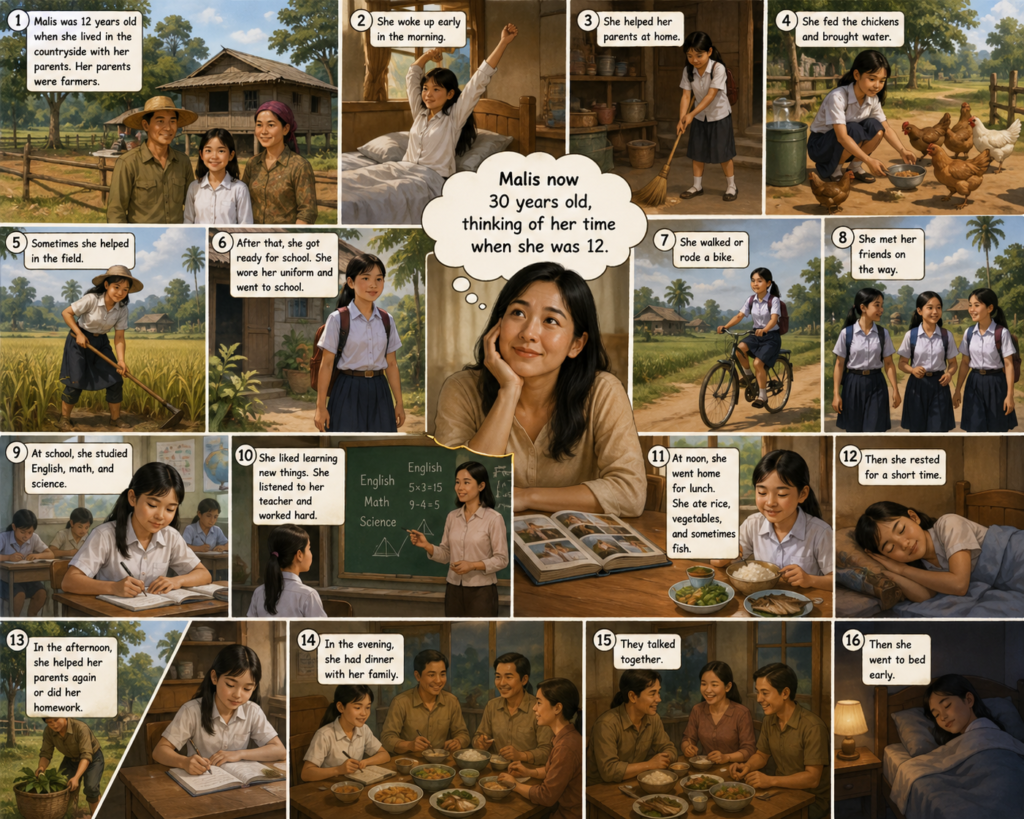
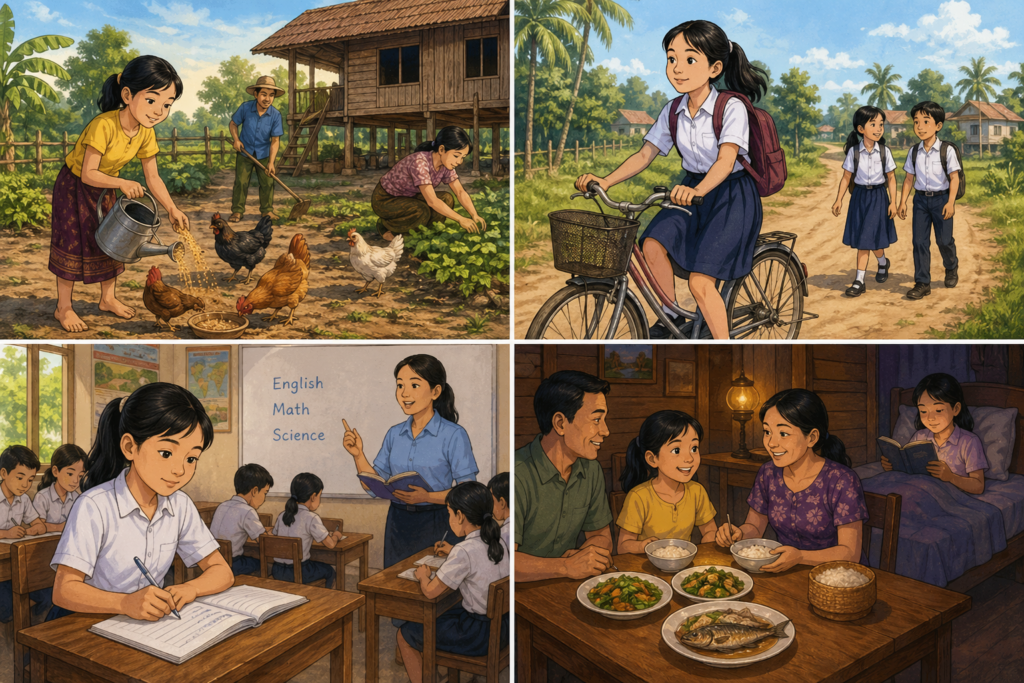
    Oum is a young girl.
    She wakes up early.
    She eats breakfast.
    She puts on her school uniform.
    She takes her bag.
    She walks to school.
    She sees her friends.
    She goes to class.
    She reads and writes.
    She counts numbers.
    She draws pictures.
    She plays at break time.
    She laughs with friends.
    She learns many things.
    The bell rings.
    School is finished.
    She walks home.
    She eats dinner.
    She does homework.
    She goes to sleep.
    ———————————-

    Vocabulary:

    • young – not old
    • to wake up – to open your eyes in the morning
    • to eat breakfast – to eat food in the morning
    • to put on a uniform – to wear school clothes
    • to take a bag – to pick up your school bag
    • to walk – to go with your feet
    • to see friends – to look at and meet friends
    • to go to class – to enter the classroom
    • to read – to look at words and understand
    • to write – to make words with a pen or pencil
    • to count numbers – to say 1, 2, 3, 4…
    • to draw pictures – to make a picture with a pencil or pen
    • to play – to have fun
    • break time – time to rest and play at school
    • to laugh – to make a happy sound “ha ha”
    • the bell rings – the school bell makes a sound “ding ding”
    • finished – done, no more
    • homework – school work at home
    • to sleep – to close your eyes and rest at night

    #################
    Basics:

    Personal Pronounam / is / are
    Iam8 years old
    Youare8 years old
    Heis8 years old
    Sheis8 years old
    Itis8 years old
    Weare8 years old
    You (plural)are8 years old
    Theyare8 years old

    Negation:

    Personal Pronounam not / is not / are not
    Iam not8 years old
    Youare not8 years old
    Heis not8 years old
    Sheis not8 years old
    Itis not8 years old
    Weare not8 years old
    You (plural)are not8 years old
    Theyare not8 years old

    Questions:

    Question WordPersonal Pronoun
    AmI8 years old?
    Areyou8 years old?
    Ishe8 years old?
    Isshe8 years old?
    Isit8 years old?
    Arewe8 years old?
    Areyou (plural)8 years old?
    Arethey8 years old?

    Statement:

    Personal PronounVerb
    Ilikeice cream
    Youlikeice cream
    Helikesice cream
    Shelikesice cream
    Itlikesice cream
    Welikeice cream
    You (plural)likeice cream
    Theylikeice cream

    Negation:

    Personal PronounVerb (negative)
    Ido not likeice cream
    Youdo not likeice cream
    Hedoes not likeice cream
    Shedoes not likeice cream
    Itdoes not likeice cream
    Wedo not likeice cream
    You (plural)do not likeice cream
    Theydo not likeice cream

    Questions:

    Do / DoesPersonal PronounVerbSugar?
    DoIlikesugar?
    Doyoulikesugar?
    Doeshelikesugar?
    Doesshelikesugar?
    Doesitlikesugar?
    Dowelikesugar?
    Doyou (plural)likesugar?
    Dotheylikesugar?

    ####################

    Negations, questions:

    1. Oum is a young girl.

      YOU WRITE:

    a) Oum is not a young girl.
    b) Is Oum a young girl?

    2. She wakes up early.

    YOU WRITE:

    a) She does not eat breakfast.
    b) Does she eat breakfast?

    ——————————

    3. Oum eats breakfast.
    a) ______________________
    b) ______________________

    4. Oum puts on her school uniform.
    a) ______________________
    b) ______________________

    5. Oum takes her bag.
    a) ______________________
    b) ______________________

    6. Oum walks to school.
    a) ______________________
    b) ______________________

    7. Oum sees her friends.
    a) ______________________
    b) ______________________

    8. Oum goes to class.
    a) ______________________
    b) ______________________

    9. Oum reads and writes.
    a) ______________________
    b) ______________________

    10. Oum counts numbers.
    a) ______________________
    b) ______________________

    11. Oum draws pictures.
    a) ______________________
    b) ______________________

    —————————

    Correct version:

    1. Oum is young.
    a) Oum is not young.
    b) Is Oum young?

    2. Oum wakes up early.
    a) Oum does not wake up early.
    b) Does Oum wake up early?

    3. Oum eats breakfast.
    a) Oum does not eat breakfast.
    b) Does Oum eat breakfast?

    4. Oum puts on her uniform.
    a) Oum does not put on her uniform.
    b) Does Oum put on her uniform?

    5. Oum takes her bag.
    a) Oum does not take her bag.
    b) Does Oum take her bag?

    6. Oum walks to school.
    a) Oum does not walk to school.
    b) Does Oum walk to school?

    7. Oum sees her friends.
    a) Oum does not see her friends.
    b) Does Oum see her friends?

    8. Oum goes to class.
    a) Oum does not go to class.
    b) Does Oum go to class?

    9. Oum reads and writes.
    a) Oum does not read and write
    b) Does Oum readand write?

    11. Oum counts numbers.
    a) Oum does not count numbers.
    b) Does Oum count numbers?

    12. Oum draws pictures.
    a) Oum does not draw pictures.
    b) Does Oum draw pictures?

    ##################

    Answer:

    1. Is Oum a young girl?

      YOU WRITE:

      Yes, she is a young girl.
    2. Does Oum wake up early?
      _______________________
    3. Does Oum eat breakfast?
      _______________________
    4. Does Oum put on her school uniform?
      _______________________
    5. Does Oum walk to school?
      _______________________
    6. Does Oum see her friends?
      _______________________
    7. Does Oum go to class?
      _______________________
    8. Does Oum read and write?
      _______________________
    9. Does Oum play at break time?
      _______________________
    10. Does Oum do homework?
      _______________________

      ——————————–

    Correct answers:

    Yes, Oum is a young girl.

    Yes, Oum wakes up early.

    Yes, Oum eats breakfast.

    Yes, Oum puts on her school uniform.

    Yes, Oum walks to school.

    Yes, Oum sees her friends.

    Yes, Oum goes to class.

    Yes, Oum reads and writes.

    Yes, Oum plays at break time.

    Yes, Oum does homework.
    ##################

    True?

    1. Oum is an old woman.

      YOU WRITE:

      No, she is not an old woman. She is a young girl.
    2. Oum sleeps all day.

      YOU WRITE:

      No, she does not sleep all day. She wakes up early.
    3. Oum eats lunch in the morning.
      ______________________________
    4. Oum wears a red dress to school.
      ______________________________
    5. Oum drives a car to school.
      ______________________________
    6. Oum sees a cat on the way to school.
      ______________________________
    7. Oum sleeps in class.
      ______________________________
    8. Oum sleeps at break time.
      ______________________________
    9. Oum goes to school at night.
      ______________________________

    ———————————-
    Correct version:

    1. No, she is not an old woman. She is a young girl.
    2. No, she does not sleep all day. She wakes up early.
    3. No, she does not eat lunch in the morning. She eats breakfast.
    4. No, she does not wear a red dress at school. She puts on her school uniform.
    5. No, she does not drive a car to school. She walks to school.
    6. No, she does not see a cat on the way to school. She sees her friends.
    7. No, she does not sleep at break time. She plays at break time.
    8. No, she does not go to school at night. She sleeps at night.

    #######################

    True or false?

    1. Is Oum a girl or a boy?

      YOU WRITE:

      Oum is not a boy. Oum is a girl
    2. Does she get up at 10 in the morning?
      ______________________________
    3. Does she eat breakfast at school?
      ______________________________
    4. Does she wear a red dress?
      ______________________________
    5. Does she walk or drive to school?
      ______________________________
    6. Does she see a cat on the way to school?
      ______________________________
    7. Does she sleep at break time?
      ______________________________
    8. Does she go to school at night?
      ______________________________
    9. Does she read and write in class?
      ______________________________
    10. Does she do homework at school?
      ______________________________

    ————————-

    Correct version:

    No, she is not a boy. She is a girl.

    No, she does not get up at 10 in the morning. She gets up early.

    No, she does not eat breakfast at school. She eats breakfast at home.

    No, she does not wear a red dress. She puts on her school uniform.

    No, she does not drive to school. She walks to school.

    No, she does not see a cat on the way to school. She sees her friends.

    No, she does not sleep at break time. She plays at break time.

    No, she does not go to school at night. She goes to school in the morning.

    No, she does not skip [to not do something you usually do.] reading and writing. She reads and writes in class.

    No, she does not do homework at school. She does homework at home.

    ################

    Interview:


    Interviewer: Is Oum an old woman?
    Person: No, she is not an old woman. She is a young girl.

    Interviewer: Does Oum wake up early?
    Person: Yes, she wakes up early.

    Interviewer: Does Oum eat breakfast?
    Person: Yes, she eats breakfast.

    Interviewer: Does Oum wear a red dress?
    Person: No, she does not wear a red dress. She wears her school uniform.

    Interviewer: Does Oum take her bag?
    Person: Yes, she takes her bag.

    Interviewer: Does Oum walk to school?
    Person: Yes, she walks to school.

    Interviewer: Does Oum see a cat on the way?
    Person: No, she does not see a cat. She sees her friends.

    Interviewer: Does Oum go to class?
    Person: Yes, she goes to class.

    Interviewer: Does Oum play at break time?
    Person: Yes, she plays at break time.

    Interviewer: Does Oum do homework at school?
    Person: No, she does not do homework at school. She does homework at home.


    ##################

    Complete, fill in, words below:

    bag – breakfast – at home – wakes up –
    walks – school uniform –
    goes – friends –
    break time

    ————————————–


    Interviewer: Who is Oum?
    Person: She is a young girl.

    Interviewer: What does Oum do in the morning?
    Person: She __________ early.

    Interviewer: What does Oum eat in the morning?
    Person: She eats __________.

    Interviewer: What does Oum wear to school?
    Person: She wears her __________.

    Interviewer: What does Oum take to school?
    Person: She takes her __________.

    Interviewer: How does Oum go to school?
    Person: She __________ to school.

    Interviewer: Who does Oum see on the way to school?
    Person: She sees her___________.

    Interviewer: Where does Oum go after she arrives at school?
    Person: She __________ to class.

    Interviewer: What does Oum do at __________?
    Person: She plays with her friends.

    Interviewer: Where does Oum do her homework?
    Person: No, she does not do homework at school. She does homework __________

    .
    ————————————–

    Correct version:


    Interviewer: Who is Oum?
    Person: She is a young girl.

    Interviewer: What does Oum do in the morning?
    Person: She wakes up early.

    Interviewer: What does Oum eat in the morning?
    Person: She eats breakfast.

    Interviewer: What does Oum wear to school?
    Person: She wears her school uniform.

    Interviewer: What does Oum take to school?
    Person: She takes her bag.

    Interviewer: How does Oum go to school?
    Person: She walks to school.

    Interviewer: Who does Oum see on the way to school?
    Person: She sees her friends.

    Interviewer: Where does Oum go after she arrives at school?
    Person: She goes to class.

    Interviewer: What does Oum do at break time?
    Person: She plays with her friends.

    Interviewer: Where does Oum do her homework?
    Person: No, she does not do homework at school. She does homework at home.


    #######################
    A story:

    I am a young girl. I wake up early and eat breakfast.
    I put on my school uniform and take my bag.
    I walk to school and see my friends on the way.
    I go to class, and I read and write.
    I count numbers and draw pictures.
    At break time, I play with my friends and laugh.
    The bell rings and school is finished.
    I walk home, do my homework, and go to sleep.
    ________________________

    Rewrite the story, start with

    Oum is a young girl. She wakes up……….

    and make all changes necessary.
    ________________________

    Correct version:


    Oum is a young girl. She wakes up early and eats breakfast. She puts on her school uniform and takes her bag. She walks to school and sees her friends on the way. She goes to class, and she reads and writes. She counts numbers and draws pictures. At break time, she plays with her friends and laughs. The bell rings and school is finished. She walks home, does her homework, and goes to sleep.
    ###################

  • 🍽 A tribute to a great lady:meet Sarea, a role model (A1, present simple)

    • living her dream

    Meet CHHORB Sarea, a 19-year-old from Angkor Thom District, Siem Reap. Her family is very poor. Her father works as a farmer and a construction worker. He earns only 10 USD a day. Her mother makes baskets to help the family. They live in a small house made of leaves and zinc. It is not strong, and they often do not have enough food.

    Sarea has a hard life, but she does not give up. She studies every day and becomes the first person in her family to finish high school. She wants to go to university, but she has no money. She feels sad and thinks her dream is over. Then she learns about the Shinta Mani Foundation.

    She joins the Culinary Arts Program and finds her love for cooking. The Foundation gives her help and hope. Today, she works as a casual staff for three months at Shinta Mani Hotel. She is very happy and thankful to the Foundation and the kind donors who support her.

    ___________________________

    Vocabulary:

    • a role model – a person who is a good example for others.
    • to meet somebody – to see and talk to someone for the first time or again.
    • a construction worker – a person who builds houses, roads, or buildings.
    • to earn money – to get money by working.
    • 10 USD a day – ten US dollars for one day of work.
    • a basket – a container made of bamboo or plastic to carry things.
    • a house made of leaves – a house built using leaves for the roof or walls.
    • zinc – a metal used for the roof of a simple house.
    • food – things we eat to live.
    • a hard life – a life that is not easy.
    • to give up – to stop trying.
    • to study hard – to learn a lot and try your best in school.
    • to finish high school – to complete the last year of school.
    • to have no money – to not have any money.
    • to feel sad – to not feel happy.
    • a dream is over – the hope or wish is finished.
    • to learn about something – to get new information.
    • to join a program – to become part of a course or group.
    • culinary arts – learning how to cook.
    • to find one’s love for cooking – to see that you really like to cook.
    • a foundation – an organization that helps people.
    • hope – a good feeling about the future.
    • a casual staff – a person who works for a short time.
    • to be thankful – to feel happy and say thank you.
    • kind donors – good people who give money to help others.
    • to support somebody – to help a person.
    • to discover = to find out – to learn something new.

    ####################

    Multiple-choice, one answer correct


    1. A role model is …
      a) a good example for others b) a kind of food c) a type of house
    2. A construction worker …
      a) cooks food b) builds houses c) sells clothes
    3. To earn money means …
      a) to sleep at home b) to play a game c) to get money by working
    4. A basket is …
      a) a kind of roof b) a container to carry things c) a type of car
    5. Zinc is …
      a) a fruit from a tree b) a kind of animal c) a metal for roofs
    6. To give up means …
      a) to eat food b) to walk fast c) to stop trying
    7. To study hard means …
      a) to learn a lot b) to travel far c) to sleep late
    8. To finish high school means …
      a) to go on holiday b) to complete school c) to start a job
    9. To have no money means …
      a) to not have any money b) to work in a hotel c) to buy food
    10. To feel sad means …
      a) to draw a picture b) to not feel happy c) to run fast
    11. A dream is over means …
      a) the hope is finished b) the sun comes up c) the school starts
    12. To learn about something means …
      a) to eat with friends b) to get new information c) to go to sleep
    13. To join a program means …
      a) to become part of it b) to buy a house c) to leave a job
    14. Culinary arts is …
      a) learning to cook b) building a road c) making clothes
    15. A foundation is …
      a) an organization that helps b) a kind of animal c) a place to eat
    16. Hope is …
      a) a long road b) a kind of food c) a good feeling about the future
    17. A casual staff is …
      a) a rich person b) a big boss c) a short-time worker
    18. To be thankful means …
      a) to run fast b) to feel happy and say thank you c) to paint a wall
    19. Kind donors are …
      a) people who play football b) people who sell clothes c) people who give money to help
    20. To support somebody means …
      a) to cook rice b) to read a book c) to help a person

    ________________________
    Answers:
    1a, 2b, 3c, 4b, 5c, 6c, 7a, 8b,
    9a, 10b, 11a, 12b, 13a, 14a,
    15a, 16c, 17c, 18b, 19c, 20c

    ________________________

    Correct version:

    A role model is a good example for others.

    A construction worker builds houses.

    To earn money means to get money by working.

    A basket is a container to carry things.

    Zinc is a metal for roofs.

    To give up means to stop trying.

    To study hard means to learn a lot.

    To finish high school means to complete school.

    To have no money means to not have any money.

    To feel sad means to not feel happy.

    A dream is over means the hope is finished.

    To learn about something means to get new information.

    To join a program means to become part of it.

    Culinary arts is learning to cook.

    A foundation is an organization that helps.

    Hope is a good feeling about the future.

    A casual staff is a short-time worker.

    To be thankful means to feel happy and say thank you.

    Kind donors are people who give money to help.

    To support somebody means to help a person.

    #################


    Gap-Fill Exercise (A1)

    1. Sarea is a ________ for other children.
      a) role model b) basket c) zinc
    2. Her father works as a ________.
      a) construction worker b) casual staff c) foundation
    3. She wants to ________ money to help her family.
      a) cook b) earn c) join
    4. Her mother makes a ________ to sell.
      a) basket b) house c) hope
    5. Their roof is made of ________.
      a) food b) dream c) zinc
    6. Sarea never wants to ________ even if life is hard.
      a) give up b) study c) feel sad
    7. She likes to ________ hard every day.
      a) study b) support c) help
    8. She finishes ________ school first in her family.
      a) casual b) high c) culinary
    9. Sarea has no ________ for university.
      a) basket b) money c) donor
    10. Sometimes she feels ________ when she has no money.
      a) hope b) sad c) zinc
    11. Sarea keeps her ________ even when things are hard.
      a) role model b) dream c) hope
    12. She wants to ________ more about cooking.
      a) learn b) eat c) paint
    13. She decides to ________ a program at the foundation.
      a) build b) give up c) join
    14. Culinary arts is learning to ________.
      a) cook b) study c) build
    15. A ________ helps children like Sarea.
      a) food b) basket c) foundation
    16. She feels ________ for all the help she gets.
      a) casual b) thankful c) zinc
    17. Some kind ________ give money to help the foundation.
      a) donors b) food c) baskets
    18. The foundation helps Sarea to ________ her dream.
      a) eat b) support c) give up
    19. She works as a ________ staff at the hotel for three months.
      a) role model b) zinc c) casual
    20. She wants to ________ other children in her village.
      a) learn b) cook c) help

    —————————–
    Answers:

    1a, 2a, 3b, 4a, 5c, 6a, 7a,
    8b, 9b, 10b, 11c, 12a, 13c,
    14a, 15c, 16b, 17a, 18b, 19c, 20c
    —————————

    Correct answers:

    1. Sarea is a role model for other children.
    2. Her father works as a construction worker.
    3. She wants to earn money to help her family.
    4. Her mother makes a basket to sell.
    5. Their roof is made of zinc.
    6. Sarea never wants to give up even if life is hard.
    7. She likes to study hard every day.
    8. She finishes high school first in her family.
    9. Sarea has no money for university.
    10. Sometimes she feels sad when she has no money.
    11. Sarea keeps her hope even when things are hard.
    12. She wants to learn more about cooking.
    13. She decides to join a program at the foundation.
    14. Culinary arts is learning to cook.
    15. A foundation helps children like Sarea.
    16. She feels thankful for all the help she gets.
    17. Some kind donors give money to help the foundation.
    18. The foundation helps Sarea to support her dream.
    19. She works as a casual staff at the hotel for three months.
    20. She wants to help other children in her village.

    #####################


    Match the words with their correct definitions:

    Words:

    1. role model
    2. construction worker
    3. earn money
    4. basket
    5. zinc
    6. give up
    7. study hard
    8. finish high school
    9. money
    10. learn about something
    11. join a program
    12. culinary arts
    13. foundation
    14. help


    Definitions:

    A. to become part of a course or group
    B. a container to carry things
    C. a person who is a good example for others
    D. a metal used for the roof of a house
    E. to stop trying
    F. to get new information
    G. to work to get money
    H. to complete the last year of school
    I. a person who builds houses or roads
    J. a good organization that helps people
    K. to study a lot and try your best
    L. a unit used to buy things
    M. learning how to cook
    N. to help someone


    _________________________
    Answers:
    1C, 2I, 3G, 4B, 5D, 6E, 7K, 8H,
    9L, 10F, 11A, 12M, 13J, 14N

    _________________________

    Correct version:

    help – to help someone

    role model – a person who is a good example for others

    construction worker – a person who builds houses or roads

    earn money – to work to get money

    basket – a container to carry things

    zinc – a metal used for the roof of a house

    give up – to stop trying

    study hard – to study a lot and try your best

    finish high school – to complete the last year of school

    money – a unit used to buy things

    learn about something – to get new information

    join a program – to become part of a course or group

    culinary arts – learning how to cook

    foundation – a good organization that helps people

    ##################

    True or false:

    1. Sarea is 19 years old.
    2. Her father earns 50 USD a day.
    3. Her mother weaves baskets to help the family.
    4. Sarea was the first in her family to finish high school.
    5. She had enough money to go to university.
    6. She discovered the Shinta Mani Foundation.
    7. Sarea hates cooking.
    8. She joined the Culinary Arts program.
    9. She works as a casual staff at Shinta Mani Hotel for three months.
    10. Sarea lives in a big apartment in the city.
    11. Her family lives in a house made of leaves and zinc.
    12. The foundation does not help children.
    13. Sarea wants to give up her dreams.
    14. She is thankful to the foundation and donors.
    15. Her father works only as a teacher.


    ——————————-

    True: 1,3,4,6,8,9,11,14

    ——————————-

    Correct version:

    Sarea is 19 years old.

    Her father earns 50 USD a day. True is: He earns 10 USD a day.

    Her mother weaves baskets to help the family.

    Sarea was the first in her family to finish high school.

    She had enough money to go to university. True is: She had no money for university.

    She discovered the Shinta Mani Foundation.

    Sarea hates [does not like at all] cooking. True is: She loves cooking.

    She joined the Culinary Arts program.

    She works as a casual staff at Shinta Mani Hotel for three months.

    Sarea lives in a big apartment in the city. True is: She lives in a small house made of leaves and zinc.

    Her family lives in a house made of leaves and zinc.

    The foundation does not help children. True is: The foundation helps children.

    Sarea wants to give up her dreams. True is: She never gives up her dreams.

    She is thankful to the foundation and donors.

    Her father works only as a teacher. True is: He works as a farmer and construction worker.

    ##################

    Basics:

    Personal Pronounam / is / are
    Iam8 years old
    Youare8 years old
    Heis8 years old
    Sheis8 years old
    Itis8 years old
    Weare8 years old
    You (plural)are8 years old
    Theyare8 years old

    Negation:

    Personal Pronounam not / is not / are not
    Iam not8 years old
    Youare not8 years old
    Heis not8 years old
    Sheis not8 years old
    Itis not8 years old
    Weare not8 years old
    You (plural)are not8 years old
    Theyare not8 years old

    Questions:

    Question WordPersonal Pronoun
    AmI8 years old?
    Areyou8 years old?
    Ishe8 years old?
    Isshe8 years old?
    Isit8 years old?
    Arewe8 years old?
    Areyou (plural)8 years old?
    Arethey8 years old?

    Statement:

    Personal PronounVerb
    Ilikeice cream
    Youlikeice cream
    Helikesice cream
    Shelikesice cream
    Itlikesice cream
    Welikeice cream
    You (plural)likeice cream
    Theylikeice cream

    Negation:

    Personal PronounVerb (negative)
    Ido not likeice cream
    Youdo not likeice cream
    Hedoes not likeice cream
    Shedoes not likeice cream
    Itdoes not likeice cream
    Wedo not likeice cream
    You (plural)do not likeice cream
    Theydo not likeice cream

    Questions:

    Do / DoesPersonal PronounVerbSugar?
    DoIlikesugar?
    Doyoulikesugar?
    Doeshelikesugar?
    Doesshelikesugar?
    Doesitlikesugar?
    Dowelikesugar?
    Doyou (plural)likesugar?
    Dotheylikesugar?

    ##################

    Correct the staments:

    1. Sarea is 25 years old.

      EXAMPLE:

      Sarea is not 25 years old. She is 19 years old.

    2. Her father earns 50 USD a day.
      _____________________________
    3. Her mother works in a restaurant.
      _____________________________
    4. Sarea already went to university.
      _____________________________
    5. She hates cooking.
      _____________________________
    6. She never finished high school.
      _____________________________
    7. Her family lives in a large concrete house.
      _____________________________
    8. The foundation does not help children.
      _____________________________
    9. Sarea works as a full-time manager at the hotel.
      _____________________________
    10. Her father works only as a teacher.
      _____________________________


    —————————–
    Correct version:

    1. Sarea is 25 years old → Sarea is not 25 years old → Sarea is 19 years old
    2. Her father earns 50 USD a day → Her father does not earn 50 USD a day → Her father earns 10 USD a day
    3. Her mother works in a restaurant → Her mother does not work in a restaurant → Her mother weaves baskets to help the family
    4. Sarea already went to university → Sarea has not gone to university → She had no money for university
    5. She hates cooking → She does not hate cooking → She loves cooking
    6. She never finished high school → She did finish high school → She was the first in her family to finish high school
    7. Her family lives in a large concrete house → Her family does not live in a large concrete house → Her family lives in a house made of leaves and zinc
    8. The foundation does not help children → The foundation helps children → The foundation helps children like Sarea
    9. Sarea works as a full-time manager at the hotel → Sarea does not work as a full-time manager at the hotel → She works as a casual staff at Shinta Mani Hotel for three months
    10. Her father works only as a teacher → Her father does not work only as a teacher → He works as a farmer and construction worker

    #########################

    Correct the following statements:

    1. Does Sarea live in a big apartment in the city?

      YOU WRITE:

      No, Sarea does not live in a big apartment in the city. She lives in a small house in the countryside.

    2. Do her parents have a lot of money?
      __________________________
    3. Does her father earn 50 USD a day?
      __________________________
    4. Do her siblings [brothers or sisters] go to university?
      __________________________
    5. Does her mother work in a restaurant?
      __________________________
    6. Does Sarea hate cooking?
      __________________________
    7. Do her parents work in offices?
      __________________________
    8. Does she never finish high school?
      __________________________
    9. Does Sarea work as a full-time manager at the hotel?
      __________________________
    10. Do her grandparents live with them?
      __________________________
    11. Does she go to university every day?
      __________________________
    12. Do her friends work at the hotel?
      __________________________
    13. Does her family have a shop?
      __________________________
    14. Does her father only teach at school?
      __________________________

    ———————————–
    Correct answers:

    1. Does Sarea live in a big apartment in the city? → No, she does not live in a big apartment in the city. She lives in a small house made of leaves and zinc.
    2. Do her parents have a lot of money? → No, they do not have a lot of money. They have very little money; her father earns 10 USD a day.
    3. Does her father earn 50 USD a day? → No, he does not earn 50 USD a day. He earns 10 USD a day.
    4. Do her siblings go to university? → No, they do not go to university. Only Sarea finished high school.
    5. Does her mother work in a restaurant? → No, she does not work in a restaurant. She works by weaving baskets to help the family.
    6. Does Sarea hate cooking? → No, she does not hate cooking. She loves cooking.
    7. Do her parents work in offices? → No, they do not work in offices. Her father works as a farmer and construction worker.
    8. Does she finish high school? → No, she does not fail to finish high school. She finishes high school and is the first in her family to do so.
    9. Does Sarea work as a full-time manager at the hotel? → No, she does not work as a full-time manager. She works as a casual staff for three months.
    10. Do her grandparents live with them? → No, they do not live with them. She only lives with her parents.
    11. Does she go to university every day? → No, she does not go to university every day. She cannot go because she has no money.
    12. Do her friends work at the hotel? → No, they do not work at the hotel. Only Sarea works there.
    13. Does her family have a shop? → No, they do not have a shop. They have a small farm.
    14. Does her father teach at school? → No, he does not teach at school. He works as a farmer and construction worker.

    ####################

    Interview with Sarea:


    Interviewer: Hello! What is your name?
    Sarea: My name is Sarea.

    Interviewer: How old are you?
    Sarea: I am 19 years old.

    Interviewer: Where do you live?
    Sarea: I live in Angkor Thom, Siem Reap.

    Interviewer: Who do you live with?
    Sarea: I live with my parents.

    Interviewer: What does your father do?
    Sarea: My father works as a farmer and construction worker.

    Interviewer: What does your mother do?
    Sarea: My mother weaves baskets.

    Interviewer: Do you have brothers or sisters?
    Sarea: No, I do not have siblings.

    Interviewer: Do you go to school?
    Sarea: Yes, I finish high school.

    Interviewer: What do you like to do in your free time?
    Sarea: I like cooking.

    Interviewer: Do you have a job?
    Sarea: Yes, I work as a casual staff at Shinta Mani Hotel.

    Interviewer: How long do you work at the hotel?
    Sarea: I work there for three months.

    Interviewer: Do you like your job?
    Sarea: Yes, I like my job very much.

    Interviewer: Are you happy with your life?
    Sarea: Yes, I am happy and thankful.

    Interviewer: Who helps you in your life?
    Sarea: The foundation and kind donors help me.


    ################

    Rewrite the following story starting with…

    Her name is Sarea. She is 19 years old………………….

    and make all changes necessary:


    My name is Sarea. I am 19 years old. I live in Angkor Thom, Siem Reap with my parents. My father works as a farmer and construction worker. My mother weaves baskets to help our family. We have a small house made of leaves and zinc.

    I am the first in my family to finish high school. I have no money for university, but I never give up. I discover the Shinta Mani Foundation and join the Culinary Arts program. I love cooking and learn many new things.

    Now, I work as a casual staff at Shinta Mani Hotel for three months. I am happy and thankful to the foundation and kind donors for helping me and giving me hope for the future.


    _________________________

    Correct version:


    Her name is Sarea. She is 19 years old and lives in Angkor Thom, Siem Reap, with her parents. Her father works as a farmer and construction worker, earning only 10 USD a day. Her mother weaves baskets to help the family. They live in a small house made of leaves and zinc, and sometimes they do not have enough food.

    Sarea never gives up on school. She is the first in her family to finish high school. She has no money for university, but she discovers the Shinta Mani Foundation and joins the Culinary Arts program. She loves cooking and learns many new skills.

    Today, Sarea works as a casual staff at Shinta Mani Hotel for three months. She is happy and thankful to the foundation and kind donors for helping her and giving her hope for the future.


    #############

    Final vocabulary test, a challenge, yes, you can:

    1. a person who is a good example for others :______________
    2. to see and talk to someone for the first time or after a long time :______________
    3. a person who builds houses, roads, or buildings :______________
    4. to get money by working :______________
    5. the amount of money someone gets each day (10 dollars) :______________
    6. a container to carry or hold things :______________
    7. a house with walls or roof made from leaves :______________
    8. a metal used for roofs or other building parts :______________
    9. something that people eat :______________
    10. a life with many problems or difficulties :______________
    11. to stop trying :______________
    12. to try your best at learning :______________
    13. to complete all years of school before university :______________
    14. not to have money :______________
    15. to be unhappy :______________
    16. when a hope or plan cannot happen :______________
    17. to get information or knowledge about something :______________
    18. to become part of a course or group :______________
    19. learning to cook :______________
    20. to discover that you enjoy cooking :______________
    21. a group or organization that helps people :______________
    22. a feeling that good things can happen :______________
    23. a worker who works for a short time or part-time :______________
    24. to feel happy because someone helps you :______________
    25. people who give money or help to others :______________
    26. to help someone :______________
    27. to find out something new :______________

    —————————-
    Correct version:

    1. a person who is a good example for others : role model
    2. to see and talk to someone for the first time or after a long time : to meet somebody
    3. a person who builds houses, roads, or buildings : construction worker
    4. to get money by working : to earn money
    5. the amount of money someone gets each day (10 dollars) : 10 USD a day
    6. a container to carry or hold things : basket
    7. a house with walls or roof made from leaves : house made of leaves
    8. a metal used for roofs or other building parts : zinc
    9. something that people eat : food
    10. a life with many problems or difficulties : hard life
    11. to stop trying : to give up
    12. to try your best at learning : to study hard
    13. to complete all years of school before university : to finish high school
    14. not to have money : to have no money
    15. to be unhappy : to feel sad
    16. when a hope or plan cannot happen : a dream is over
    17. to get information or knowledge about something : to learn about something
    18. to become part of a course or group : to join a program
    19. learning to cook : culinary arts
    20. to discover that you enjoy cooking : to find one’s love for cooking
    21. a group or organization that helps people : foundation
    22. a feeling that good things can happen : hope
    23. a worker who works for a short time or part-time : casual staff
    24. to feel happy because someone helps you : to be thankful
    25. people who give money or help to others : kind donors
    26. to help someone : to support somebody
    27. to find out something new : to discover

    #######################

    APPENDIX – a mentor

    if she had a mentor, he/she would write:

    If she had a mentor, he/she probably would send her that message:

    Dear Sarea,

    You are an inspiration, blazing a trail as the first in your family to graduate high school and pursue your dreams through the Shinta Mani Foundation’s culinary arts program.
    Your hard work and determination shine brightly, and I want you to know how incredible you are for pushing forward despite the challenges.
    Stay focused on your goals, because every step you take is building a future filled with possibility.
    Your passion for culinary arts is your spark—let it guide you, even when the path feels tough.
    You have the strength to overcome anything, and the Shinta Mani Foundation believes in you, just as I do.
    Keep dreaming big, because your dreams are valid, and they’re worth every ounce of effort. You’re not just creating a career; you’re creating a legacy for yourself and those who will follow in your footsteps.
    Believe in yourself, stay true to your heart, and know that you’re capable of achieving greatness.
    You’ve already come so far—keep going, and let your dreams carry you to places you never imagined.With admiration and encouragement,

    you mentor

  • 🥰Anika, a little girl (A1, beginners, present tense, to be, statements, questions, negations, how to…………)

    • a day in her life

    Basics:

    Personal Pronounam / is / are
    Iam8 years old
    Youare8 years old
    Heis8 years old
    Sheis8 years old
    Itis8 years old
    Weare8 years old
    You (plural)are8 years old
    Theyare8 years old

    Negation:

    Personal Pronounam not / is not / are not
    Iam not8 years old
    Youare not8 years old
    Heis not8 years old
    Sheis not8 years old
    Itis not8 years old
    Weare not8 years old
    You (plural)are not8 years old
    Theyare not8 years old

    Questions:

    Question WordPersonal Pronoun
    AmI8 years old?
    Areyou8 years old?
    Ishe8 years old?
    Isshe8 years old?
    Isit8 years old?
    Arewe8 years old?
    Areyou (plural)8 years old?
    Arethey8 years old?

    Statement:

    Personal PronounVerb
    Ilikeice cream
    Youlikeice cream
    Helikesice cream
    Shelikesice cream
    Itlikesice cream
    Welikeice cream
    You (plural)likeice cream
    Theylikeice cream

    Negation:

    Personal PronounVerb (negative)
    Ido not likeice cream
    Youdo not likeice cream
    Hedoes not likeice cream
    Shedoes not likeice cream
    Itdoes not likeice cream
    Wedo not likeice cream
    You (plural)do not likeice cream
    Theydo not likeice cream

    Questions:

    Do / DoesPersonal PronounVerbSugar?
    DoIlikesugar?
    Doyoulikesugar?
    Doeshelikesugar?
    Doesshelikesugar?
    Doesitlikesugar?
    Dowelikesugar?
    Doyou (plural)likesugar?
    Dotheylikesugar?


    Anika is eight.
    She lives in a village with her mother and father.
    Every morning, she eats breakfast and goes to school.
    She likes to read and draw.
    After school, she helps her mother.
    She feeds the chickens and waters the flowers.
    In the evening, she plays with her friends.
    Anika is happy and loves her home.

    ______________________

    Vocabulary:

    a village – a small place where people live, not a city

    mother – a woman who has children

    father – a man who has children

    morning – the time after night, before afternoon

    to eat – to put food in your mouth

    breakfast – the first meal in the morning

    to like to read – to enjoy looking at books or stories

    to draw – to make a picture with a pencil or pen

    after school – the time when school is finished

    to help – to do something for another person

    to feed the chickens – to give food to the chickens

    to water the flowers – to give water to the flowers

    the evening – the time after afternoon, before night

    to play with friends – to have fun with friends

    to be happy – to feel good and smile

    to love home – to feel good and safe at home

    ################


    Answer:


    EXAMPLE:

    Is Anika eight or ten years old?

    YOU WRITE:

    She is eight years old.

    1. Does she live in a village or in a city?
    2. Does she live with her grandmother or with he mother and father?
    3. Does she have breakfast in the morning or does she not have breakfast in the morning?
    4. Does she go to school or to the park after breakfast?
    5. does she like to reand and draw or to play in the park?
    6. Doe she play with freinds after school or help her mother?
    7. Does she feed the birds or the chickens?
    8. Does she water she flowers or the trees in the garden?
    9. Does she watch TV in the evening or play with her friends?

    ——————————-

    Answers:

    1. She lives in a village.
    2. She lives with her mother and father.
    3. She has breakfast in the morning.
    4. She goes to school after breakfast.
    5. She likes to read and draw.
    6. She helps her mother after school.
    7. She feeds the chickens.
    8. She waters the flowers in the garden.
    9. She plays with her friends in the evening.

    #################

    Correct the statements (see grammar above):

    1. Anika is ten years old.

      YOU WRITE:

      Anika is not ten years old. She is eight years old.
    2. Anika lives in a big city.
      __________________
    3. She lives with her grandmother.
      __________________
    4. She does not go to school.
      __________________
    5. She does not like to read.
      __________________
    6. She plays in the park after school.
      __________________
    7. She feeds the dogs.
      __________________
    8. She waters the trees.
      __________________
    9. She watches TV in the evening.
      __________________
    10. Anika is sad.
      __________________

      —————————–

      ################

    Correct answers:

    1. Anika is not ten years old. She is eight years old.

    2. Anika does not live in a big city. She lives in a village.

    3. She does not live with her grandmother. She lives with her mother and father.

    4. She does not skip school. She goes to school.

    5. She does not dislike reading. She likes to read.

    6. She does not play in the park after school. She helps her mother.

    7. She does not feed the dogs. She feeds the chickens.

    8. She does not water the trees. She waters the flowers.

    9. She does not watch TV in the evening. She plays with her friends.

    10. Anika is not sad. She is happy.

    ##################

    Correct the follwoing questions:

    1. Is Anika ten years old?

      YOU WRITE:

      No, she is not ten years old. She is eight years old.
    2. Does Anika live in a big city?
      ________________________
    3. Does she live with her grandmother?
      ________________________
    4. Does she skip school?
      ________________________
    5. Does she dislike reading?
      ________________________
    6. Does she play in the park after school?
      ________________________
    7. Does she feed the dogs?
      ________________________
    8. Does she water the trees?
      ________________________
    9. Does she watch TV in the evening?
      ________________________
    10. Is Anika sad?
      ________________________

    ——————————–
    Correct answers:

    1. No, Anika is not ten years old. She is eight years old.
    2. No, Anika does not live in a big city. She lives in a village.
    3. No, she does not live with her grandmother. She lives with her mother and father.
    4. No, she does not skip school. She goes to school.
    5. No, she does not dislike reading. She likes to read.
    6. No, she does not play in the park after school. She helps her mother.
    7. No, she does not feed the dogs. She feeds the chickens.
    8. No, she does not water the trees. She waters the flowers.
    9. No, she does not watch TV in the evening. She plays with her friends.
    10. No, Anika is not sad. She is happy.

    ####################

    Fill in, words below:

    home – waters – father – morning – garden –
    eight – chickens – happy – read –
    school – after school –
    city – village –
    flowers

    1. Anika is ______ years old.
    2. She lives in a ______.
    3. She lives with her mother and ______.
    4. Every ______ she eats breakfast.
    5. She goes to ______ after breakfast.
    6. She likes to ______ and draw.
    7. After ______, she helps her mother.
    8. She gives food to the ______.
    9. She ______ the flowers in the garden.
    10. In the ______, she plays with her friends.
    11. Anika is ______ and smiles a lot.
    12. She loves her ______.
    13. She does not live in a ______.
    14. She helps her family in the ______.

    Correct answers:

    Anika is eight years old.

    She lives in a village.

    She lives with her mother and father.

    Every morning she eats breakfast.

    She goes to school after breakfast.

    She likes to read and draw.

    After school, she helps her mother.

    She gives food to the chickens.

    She waters the flowers in the garden.

    In the evening, she plays with her friends.

    Anika is happy and smiles a lot.

    She loves her home.

    She does not live in a city.

    She helps her family in the garden.

    ###############

    Fill in, words below:

    mother – breakfast – flowers – chickens –
    eight – morning – village –

    draw -love –
    play


    Interviewer: Hello, Anika! How old are you?
    Anika: I am __________ years old.

    Interviewer: Where do you live?
    Anika: I live in a __________.

    Interviewer: Who do you live with?
    Anika: I live with my __________ and father.

    Interviewer: Do you go to school?
    Anika: Yes, I go to school.

    Interviewer: What time do you wake up?
    Anika: I wake up in the __________.

    Interviewer: What do you eat in the morning?
    Anika: I eat __________.

    Interviewer: What do you like to do?
    Anika: I like to read and __________.

    Interviewer: Do you help your brother?
    Anika: No, I help my mother.

    Interviewer: What do you feed?
    Anika: I feed the __________.

    Interviewer: Do you water the trees?
    Anika: No, I water the __________.

    Interviewer: What do you do in the evening?
    Anika: I __________with my friends.

    Interviewer: Are you happy?
    Anika: Yes, I am happy.

    Interviewer: Do you like your home?
    Anika: Yes, I __________ my home.

    Interviewer: Do you live in a city?
    Anika: No, I do not live in a city.


    —————————–
    Correct version:


    Interviewer: Hello, Anika! How old are you?
    Anika: I am eight years old.

    Interviewer: Where do you live?
    Anika: I live in a village.

    Interviewer: Who do you live with?
    Anika: I live with my mother and father.

    Interviewer: Do you go to school?
    Anika: Yes, I go to school.

    Interviewer: What time do you wake up?
    Anika: I wake up in the morning.

    Interviewer: What do you eat in the morning?
    Anika: I eat breakfast.

    Interviewer: What do you like to do?
    Anika: I like to read and draw.

    Interviewer: Do you help your brother?
    Anika: No, I help my mother.

    Interviewer: What do you feed?
    Anika: I feed the chickens.

    Interviewer: Do you water the trees?
    Anika: No, I water the flowers.

    Interviewer: What do you do in the evening?
    Anika: I play with my friends.

    Interviewer: Are you happy?
    Anika: Yes, I am happy.

    Interviewer: Do you like your home?
    Anika: Yes, I love my home.

    Interviewer: Do you live in a city?
    Anika: No, I do not live in a city.


  • Irregular plurals (A1 intermediate)

    SingularPlural
    childchildren
    manmen
    womanwomen
    toothteeth
    footfeet
    mousemice
    personpeople
    goosegeese
    sheepsheep
    fishfish
    deerdeer
    knifeknives
    wifewives
    leafleaves
    loafloaves
    calfcalves
    thiefthieves
    potatopotatoes
    tomatotomatoes
    diedice

    ###############

    What is the plural of…………….

    fish: ________________________________

    knife: ________________________________

    mouse: ________________________________

    child: ________________________________

    loaf: ________________________________

    man: ________________________________

    tooth: ________________________________

    sheep: ________________________________

    woman: ________________________________

    foot: ________________________________

    potato: ________________________________

    leaf: ________________________________

    goose: ________________________________

    wife: ________________________________

    die: ________________________________

    calf: ________________________________

    thief: ________________________________

    tomato: ________________________________

    person: ________________________________

    deer: ________________________________

    fish: _______________________________


    #################

    Answers:

    knife – knives
    mouse – mice
    child – children
    loaf – loaves
    man – men
    tooth – teeth
    sheep – sheep
    woman – women
    foot – feet
    potato – potatoes
    leaf – leaves
    goose – geese
    wife – wives
    die – dice
    calf – calves
    thief – thieves
    tomato – tomatoes
    person – people
    deer – deer
    fish – fish
    ##################
    Vocabulary:

    • knife – a tool [a thing that you use with your hands to do a job.] to cut things
    • mouse – a small animal with a long tail [long part at the back of an animal’s body.]
    • child – a young boy or girl
    • loaf – a whole bread
    • man – an adult male person
    • tooth – a hard part in your mouth for chewing [to use your teeth to break food into small pieces]
    • sheep – an animal with wool
    • woman – an adult female person
    • foot – the part of the body at the end of your leg
    • potato – a round vegetable that grows in the ground
    • leaf – the green part of a tree or plant
    • goose – a large bird that lives near water
    • wife – a married woman
    • die [pl. dice] – a small cube [shape with 6 equal square sides] with numbers for games
    • calf – a young cow
    • thief – a person who takes things that are not theirs
    • tomato – a red vegetable or fruit
    • person – a human being
    • deer – a wild animal with antlers [horns]
    • fish – an animal that lives in water and swims

    ################

    Match-the-word-with-definition:


    Words:

    1. child
    2. goose
    3. tomato
    4. mouse
    5. knife
    6. woman
    7. thief
    8. loaf
    9. deer
    10. foot
    11. potato
    12. calf
    13. tooth
    14. person


    Definitions:

    a. a human being
    b. a young cow
    c. a small animal with a long tail
    d. a tool to cut things
    e. a young boy or girl
    f. an adult female person
    g. a wild animal with antlers
    h. a red vegetable or fruit
    i. a part of the body at the end of the leg
    j. a person who takes things that are not theirs
    k. a large bird that lives near water
    l. a whole bread
    m. a round vegetable that grows in the ground
    n. a hard part in your mouth for chewing


    ______________________

    Answers: 1-e, 2-k, 3-h, 4-c, 5-d, 6-f,
    7-j, 8-l, 9-g, 10-i, 11-m, 12-b, 13-n, 14-a

    ______________________

    Correct version:


    child – a young boy or girl
    goose – a large bird that lives near water
    tomato – a red vegetable or fruit
    mouse – a small animal with a long tail
    knife – a tool to cut things
    woman – an adult female person
    thief – a person who takes things that are not theirs
    loaf – a whole bread
    deer – a wild animal with antlers
    foot – a part of the body at the end of the leg
    potato – a round vegetable that grows in the ground
    calf – a young cow
    tooth – a hard part in your mouth for chewing
    person – a human being

    ##############


    Fill in:

    1. The ______ play in the garden. (child)
    2. The ______ swim on the lake. (goose)
    3. I eat ______ every day. (tomato)
    4. The ______ run after the cheese. (mouse)
    5. They cut the bread with ______. (knife)
    6. The ______ work in the garden. (woman)
    7. The ______ steal things quietly. (thief)
    8. I buy ______ from the bakery. (loaf)
    9. The ______ run in the forest. (deer)
    10. We wash our ______ every morning. (foot)
    11. We cook ______ for dinner. (potato)
    12. The farmer has young ______ in the field. (calf)
    13. I brush my ______ twice a day. (tooth)
    14. The ______ walk to school. (person)
    15. The ______ laugh and play outside. (child)
    16. The ______ eat grass in the field. (sheep)
    17. The ______ help each other. (man)
    18. The ______ sing in the forest. (goose)
    19. Many ______ grow on the trees. (leaf)
    20. The ______ bake bread in the oven. (woman)

    ———————————-

    Correct answers:

    1. The children play in the garden.
    2. The geese swim on the lake.
    3. I eat tomatoes every day.
    4. The mice run after the cheese.
    5. They cut the bread with knives.
    6. The women work in the garden.
    7. The thieves steal things quietly.
    8. I buy loaves from the bakery.
    9. The deer run in the forest.
    10. We wash our feet every morning.
    11. We cook potatoes for dinner.
    12. The farmer has young calves in the field.
    13. I brush my teeth twice a day.
    14. The people walk to school.
    15. The children laugh and play outside.
    16. The sheep eat grass in the field.
    17. The men help each other.
    18. The geese sing in the forest.
    19. Many leaves grow on the trees.
    20. The women bake bread in the oven.
  • Personal pronouns, possessive pronouns, possessive adjectives (A1, beginner, revised version)

    Example Pattern

    • I have a house.
    • It is my house.
    • It is mine.
    • It belongs to me.

    Practice Sentences

    You

    • You have a bike.
    • It is your bike.
    • It is yours.
    • It belongs to you.

    He

    • He has a car.
    • It is his car.
    • It is his.
    • It belongs to him.

    She

    • She has a book.
    • It is her book.
    • It is hers.
    • It belongs to her.

    It

    • It has a tail.
    • It is its tail.
    • The tail is its.
    • It belongs to it.

    We

    • We have a garden.
    • It is our garden.
    • It is ours.
    • It belongs to us.

    They

    • They have a dog.
    • It is their dog.
    • It is theirs.
    • It belongs to them.

    ###################

    • cat – a small animal that people often keep as a pet
    • bag – something you use to carry things
    • shoes – things you wear on your feet
    • room – a part of a house or building with walls and a door
    • ball – a round object used for playing games
    • pen – something you use to write
    • car – a vehicle that people drive
    • hat – something you wear on your head
    • books – objects with pages that you read
    • wallet – a small case for money and cards
    • house – a building where people live
    • dog – an animal often kept as a pet
    • kitchen – a room where people cook food
    • dress – clothes that women or girls wear
    • newspaper – pages with news that people read
    • chair – something you sit on
    • phone – a device for calling or texting people
    • table – furniture with a flat top used for working or eating
    • book – an object with pages that you read


    ###################


    ✏️ Fill in the blanks:

    1. This is _her_ cat. (she)
    2. That is _____ bag. (I)
    3. He is wearing _____ shoes. (he)
    4. We are cleaning _____ room. (we)
    5. They are playing with _____ ball. (they)
    6. This is _____ pen. (you)
    7. That is _____ car. (I)
    8. She loves _____ hat. (she)
    9. They forgot _____ books. (they)
    10. He found _____ wallet. (he)
    11. This is _____ house. (we)
    12. That is _____ dog. (you)
    13. We are cooking in _____ kitchen. (we)
    14. She can’t find _____ dress. (she)
    15. He is reading _____ newspaper. (he)
    16. This is _____ chair. (I)
    17. They are cleaning _____ room. (they)
    18. That is _____ phone. (you)
    19. This is _____ table. (we)
    20. She is holding _____ book. (she)

    _______________
    ✅ Answers:

    1. This is her cat. (she)
    2. That is my bag. (I)
    3. He is wearing his shoes. (he)
    4. We are cleaning our room. (we)
    5. They are playing with their ball. (they)
    6. This is your pen. (you)
    7. That is my car. (I)
    8. She loves her hat. (she)
    9. They forgot their books. (they)
    10. He found his wallet. (he)
    11. This is our house. (we)
    12. That is your dog. (you)
    13. We are cooking in our kitchen. (we)
    14. She can’t find her dress. (she)
    15. He is reading his newspaper. (he)
    16. This is my chair. (I)
    17. They are cleaning their room. (they)
    18. That is your phone. (you)
    19. This is our table. (we)
    20. She is holding her book. (she)

    ###################


    ✏️ Fill in the blanks:

    1. This bag is _hers_ (she).
    2. That pen is ___________ (I).
    3. These shoes are ___________ (he).
    4. This hat is ___________ (you).
    5. That house is ___________ (we).
    6. These books are ___________ (they).
    7. This cat is ___________ (she).
    8. That dog is ___________ (he).
    9. This table is ___________ (I).
    10. Those chairs are ___________ (we).
    11. This phone is ___________ (you).
    12. These keys are ___________ (they).
    13. This dress is ___________ (she).
    14. That wallet is ___________ (he).
    15. This car is ___________ (we).
    16. These cups are ___________ (I).
    17. This bag is ___________ (you).
    18. That ball is ___________ (they).
    19. This book is ___________ (he).
    20. These shoes are ___________ (she).

    —————————–

    Answers:

    1. This bag is hers. (she)
    2. That pen is mine. (I)
    3. These shoes are his. (he)
    4. This hat is yours. (you)
    5. That house is ours. (we)
    6. These books are theirs. (they)
    7. This cat is hers. (she)
    8. That dog is his. (he)
    9. This table is mine. (I)
    10. Those chairs are ours. (we)
    11. This phone is yours. (you)
    12. These keys are theirs. (they)
    13. This dress is hers. (she)
    14. That wallet is his. (he)
    15. This car is ours. (we)
    16. These cups are mine. (I)
    17. This bag is yours. (you)
    18. That ball is theirs. (they)
    19. This book is his. (he)
    20. These shoes are hers. (she)

    ###################


    ✏️ Fill in the blanks;

    1. This is my bag and that is __your__ (you) bag.
    2. This is my pen and that is ________ (he) pen.
    3. This is my book and that is ________ (she) book.
    4. This is my chair and that is ________ (we) chair.
    5. This is my ball and that is ________ (they) ball.
    6. This is your house and that is ________ (I) house.
    7. This is your phone and that is ________ (she) phone.
    8. This is your dog and that is ________ (he) dog.
    9. This is your car and that is ________ (we) car.
    10. This is your table and that is ________ (they) table.
    11. This is his bike and that is ________ (I) bike.
    12. This is his hat and that is ________ (you) hat.
    13. This is his bed and that is ________ (she) bed.
    14. This is her dress and that is ________ (he) dress.
    15. This is her cup and that is ________ (we) cup.
    16. This is her bag and that is ________ (they) bag.
    17. This is our room and that is ________ (you) room.
    18. This is our garden and that is ________ (she) garden.
    19. This is our cat and that is ________ (he) cat.
    20. This is their toy and that is ________ (I) toy.


    Answers:

    1. This is my bag and that is your (you) bag.
    2. This is my pen and that is his (he) pen.
    3. This is my book and that is her (she) book.
    4. This is my chair and that is our (we) chair.
    5. This is my ball and that is their (they) ball.
    6. This is your house and that is my (I) house.
    7. This is your phone and that is her (she) phone.
    8. This is your dog and that is his (he) dog.
    9. This is your car and that is our (we) car.
    10. This is your table and that is their (they) table.
    11. This is his bike and that is my (I) bike.
    12. This is his hat and that is your (you) hat.
    13. This is his bed and that is her (she) bed.
    14. This is her dress and that is his (he) dress.
    15. This is her cup and that is our (we) cup.
    16. This is her bag and that is their (they) bag.
    17. This is our room and that is your (you) room.
    18. This is our garden and that is her (she) garden.
    19. This is our cat and that is his (he) cat.
    20. This is their toy and that is my (I) toy.

    ###############


    ✏️ Fill in the blanks with the correct possessive pronoun

    1. This is my bag, it is _mine_ (I).
    2. This is your pen, it is __________ (you).
    3. This is his book, it is __________ (he).
    4. This is her chair, it is __________ (she).
    5. This is our ball, it is __________ (we).
    6. This is their house, it is __________ (they).
    7. This is my phone, it is __________ (I).
    8. This is your dog, it is __________ (you).
    9. This is his car, it is __________ (he).
    10. This is her cup, it is __________ (she).
    11. This is our table, it is __________ (we).
    12. This is their bike, it is __________ (they).
    13. This is my hat, it is __________ (I).
    14. This is your bag, it is __________ (you).
    15. This is his bed, it is __________ (he).
    16. This is her dress, it is __________ (she).
    17. This is our room, it is __________ (we).
    18. This is their cat, it is __________ (they).
    19. This is my shoes, it is __________ (I).
    20. This is your toy, it is __________ (you).

    ———————–


    Answers :

    1. This is my bag, it is mine (I).
    2. This is your pen, it is yours (you).
    3. This is his book, it is his (he).
    4. This is her chair, it is hers (she).
    5. This is our ball, it is ours (we).
    6. This is their house, it is theirs (they).
    7. This is my phone, it is mine (I).
    8. This is your dog, it is yours (you).
    9. This is his car, it is his (he).
    10. This is her cup, it is hers (she).
    11. This is our table, it is ours (we).
    12. This is their bike, it is theirs (they).
    13. This is my hat, it is mine (I).
    14. This is your bag, it is yours (you).
    15. This is his bed, it is his (he).
    16. This is her dress, it is hers (she).
    17. This is our room, it is ours (we).
    18. This is their cat, it is theirs (they).
    19. This is my shoes, it is mine (I).
    20. This is your toy, it is yours (you).

    ####################


    ✏️ Fill in the blanks

    1. This is _my_ (I) bag. It belongs to _me_ (I). It is not _theirs_ (they).
    2. This is _______ (you) pen. It belongs to _______ (you). It is not _______ (he).
    3. This is _______ (he) book. It belongs to _______ (he). It is not _______ (she).
    4. This is _______ (she) chair. It belongs to _______ (she). It is not _______ (we).
    5. This is _______ (we) ball. It belongs to _______ (we). It is not _______ (they).
    6. This is _______ (they) house. It belongs to _______ (they). It is not _______ (I).
    7. This is _______ (I) phone. It belongs to _______ (I). It is not _______ (you).
    8. This is _______ (you) dog. It belongs to _______ (you). It is not _______ (he).
    9. This is _______ (he) car. It belongs to _______ (he). It is not _______ (she).
    10. This is _______ (she) cup. It belongs to _______ (she). It is not _______ (we).
    11. This is _______ (we) table. It belongs to _______ (we). It is not _______ (they).
    12. This is _______ (they) bike. It belongs to _______ (they). It is not _______ (I).
    13. This is _______ (I) hat. It belongs to _______ (I). It is not _______ (you).
    14. This is _______ (you) bag. It belongs to _______ (you). It is not _______ (he).
    15. This is _______ (he) bed. It belongs to _______ (he). It is not _______ (she).
    16. This is _______ (she) dress. It belongs to _______ (she). It is not _______ (we).
    17. This is _______ (we) room. It belongs to _______ (we). It is not _______ (they).
    18. This is _______ (they) cat. It belongs to _______ (they). It is not _______ (I).
    19. These are _______ (I) shoes. They belong to _______ (I). They are not _______ (you).
    20. This is _______ (you) toy. It belongs to _______ (you). It is not _______ (he).

    ————————


    ✅ Answers:

    This is my bag. It belongs to me. It is not theirs.

    This is your pen. It belongs to you. It is not his.

    This is his book. It belongs to him. It is not hers.

    This is her chair. It belongs to her. It is not ours.

    This is our ball. It belongs to us. It is not theirs.

    This is their house. It belongs to them. It is not mine.

    This is my phone. It belongs to me. It is not yours.

    This is your dog. It belongs to you. It is not his.

    This is his car. It belongs to him. It is not hers.

    This is her cup. It belongs to her. It is not ours.

    This is our table. It belongs to us. It is not theirs.

    This is their bike. It belongs to them. It is not mine.

    This is my hat. It belongs to me. It is not yours.

    This is your bag. It belongs to you. It is not his.

    This is his bed. It belongs to him. It is not hers.

    This is her dress. It belongs to her. It is not ours.

    This is our room. It belongs to us. It is not theirs.

    This is their cat. It belongs to them. It is not mine.

    These are my shoes. They belong to me. They are not yours.

    This is your toy. It belongs to you. It is not his.

    ##################


    ✏️ Fill in the blanks

    1. This is not _my_ (I) bag. It belongs to _them_ (they). It is not _mine_ (I), but _theirs_ (they).
    2. This is not ______ (you) pen. It belongs to ______ (he). It is not ______ (you), but ______ (he).
    3. This is not ______ (he) book. It belongs to ______ (she). It is not ______ (he), but ______ (she).
    4. This is not ______ (she) chair. It belongs to ______ (we). It is not ______ (she), but ______ (we).
    5. This is not ______ (we) ball. It belongs to ______ (they). It is not ______ (we), but ______ (they).
    6. This is not ______ (they) house. It belongs to ______ (I). It is not ______ (they), but ______ (I).
    7. This is not ______ (I) phone. It belongs to ______ (you). It is not ______ (I), but ______ (you).
    8. This is not ______ (you) dog. It belongs to ______ (he). It is not ______ (you), but ______ (he).
    9. This is not ______ (he) car. It belongs to ______ (she). It is not ______ (he), but ______ (she).
    10. This is not ______ (she) cup. It belongs to ______ (we). It is not ______ (she), but ______ (we).
    11. This is not ______ (we) table. It belongs to ______ (they). It is not ______ (we), but ______ (they).
    12. This is not ______ (they) bike. It belongs to ______ (I). It is not ______ (they), but ______ (I).
    13. This is not ______ (I) hat. It belongs to ______ (you). It is not ______ (I), but ______ (you).
    14. This is not ______ (you) bag. It belongs to ______ (he). It is not ______ (you), but ______ (he).
    15. This is not ______ (he) bed. It belongs to ______ (she). It is not ______ (he), but ______ (she).
    16. This is not ______ (she) dress. It belongs to ______ (we). It is not ______ (she), but ______ (we).
    17. This is not ______ (we) room. It belongs to ______ (they). It is not ______ (we), but ______ (they).
    18. This is not ______ (they) cat. It belongs to ______ (I). It is not ______ (they), but ______ (I).
    19. This is not ______ (I) phone. It belongs to ______ (you). It is not ______ (I), but ______ (you).
    20. This is not ______ (you) toy. It belongs to ______ (he). It is not ______ (you), but ______ (he).


    —————————–
    Answers:


    1. This is not my bag. It belongs to them. It is not mine, but theirs.
    2. This is not your pen. It belongs to him. It is not yours, but his.
    3. This is not his book. It belongs to her. It is not his, but hers.
    4. This is not her chair. It belongs to us. It is not hers, but ours.
    5. This is not our ball. It belongs to them. It is not ours, but theirs.
    6. This is not their house. It belongs to me. It is not theirs, but mine.
    7. This is not my phone. It belongs to you. It is not mine, but yours.
    8. This is not your dog. It belongs to him. It is not yours, but his.
    9. This is not his car. It belongs to her. It is not his, but hers.
    10. This is not her cup. It belongs to us. It is not hers, but ours.
    11. This is not our table. It belongs to them. It is not ours, but theirs.
    12. This is not their bike. It belongs to me. It is not theirs, but mine.
    13. This is not my hat. It belongs to you. It is not mine, but yours.
    14. This is not your bag. It belongs to him. It is not yours, but his.
    15. This is not his bed. It belongs to her. It is not his, but hers.
    16. This is not her dress. It belongs to us. It is not hers, but ours.
    17. This is not our room. It belongs to them. It is not ours, but theirs.
    18. This is not their cat. It belongs to me. It is not theirs, but mine.
    19. This is not my phone. It belongs to you. It is not mine, but yours.
    20. This is not your toy. It belongs to him. It is not yours, but his.

    #################

  • Meet your first English sentences – Oum, a girl from Siem Reap (A1 beginners, part 6)

    Hello! My name is Oum.
    I am twelve years old.
    I am from Siem Reap.

    I like football and pizza.
    I don’t like spiders.
    I don’t like homework.

    My dream is to be a teacher.
    I want to travel to Paris one day.

    ______________


    ##########


    Exercise 1: true or false

    1. Oum is twelve years old.
    2. She is from Paris.
    3. She likes football.
    4. She likes spiders.
    5. She does not like homework.
    6. She wants to be a teacher.

    Exercise 2: answer

    1. What is her name?
    2. How old is she?
    3. Where is she from?
    4. What does she like? (2 things)
    5. What does she not like? (2 things)
    6. What is her dream?

    Exercise 3 – fill in


    football, twelve, homework, teacher, Siem Reap, Paris

    1. Oum is ______ years old.
    2. She is from ______.
    3. She likes ______.
    4. She doesn’t like ______.
    5. Her dream is to be a ______.
    6. She wants to go to ______.

    Exercise 4 – one answer correct

    1. Oum is … (ten / twelve / fifteen)
    2. She is from … (London / Siem Reap / New York)
    3. She likes … (spiders / pizza / homework)
    4. She does not like … (football / pizza / spiders)
    5. Her dream is to be … (a teacher / a doctor / a singer)
    6. She wants to travel to … (Bangkok / Paris / Rome)

    Exercise 5 – and you?

    1. My name is …
    2. I am … years old.
    3. I am from …
    4. I like …
    5. I don’t like …
    6. My dream is …

    _______________________


    ✅ Exercise 1

    1. True
    2. False
    3. True
    4. False
    5. True
    6. True

    ✅ Exercise 2

    1. Her name is Oum.
    2. She is twelve years old.
    3. She is from Siem Reap.
    4. She likes football and pizza.
    5. She does not like spiders and homework.
    6. Her dream is to be a teacher.

    ✅ Exercise 3

    1. twelve
    2. Siem Reap
    3. football
    4. homework
    5. teacher
    6. Paris

    ✅ Exercise 4

    1. twelve
    2. Siem Reap
    3. pizza
    4. spiders
    5. a teacher
    6. Paris

    ##################

    ✅ How to make sentences negative:


    Singular

    • I like pizza. / I do not like pizza.
    • You like pizza. / You do not like pizza.
    • He likes pizza. / He does not like pizza.
    • She likes pizza. / She does not like pizza.
    • It likes pizza. / It does not like pizza.

    Plural

    • We like pizza. / We do not like pizza.
    • You like pizza. / You do not like pizza.
    • They like pizza. / They do not like pizza.

    ______________________


    Like oder likes?

    1. They ______ pizza.
    2. He ______ pizza.
    3. We ______ pizza.
    4. She ______ pizza.
    5. I ______ pizza.
    6. It ______ pizza.

    Do not/ does not?

    1. She ______ like pizza.
    2. I ______ like pizza.
    3. They ______ like pizza.
    4. He ______ like pizza.
    5. You ______ like pizza.
    6. We ______ like pizza.

    ________________________


    ✅ Like oder likes?

    1. They like pizza.
    2. He likes pizza.
    3. We like pizza.
    4. She likes pizza.
    5. I like pizza.
    6. It likes pizza.

    ✅ Do not/does not

    1. She does not like pizza.
    2. I do not like pizza.
    3. They do not like pizza.
    4. He does not like pizza.
    5. You do not like pizza.
    6. We do not like pizza.
      ################


    Listen again => LINK


    [My name is Oum.
    I am twelve years old.
    I am from Siem Reap.
    I like football and pizza.
    I don’t like spiders.
    I don’t like homework.
    My dream is to be a teacher.
    I want to travel to Paris one day.]

    ____________________

    Now you talk to Oum:

    Your name is Oum.
    You are twelve years old.
    You are from Siem Reap.

    You like football and pizza.
    You don’t like spiders.
    You don’t like homework.

    Your dream is to be a teacher.
    You want to travel to Paris one day.

    ##################

    Now you talk about Oum:


    Her name is Oum.
    She is twelve years old.
    She is from Siem Reap.

    She likes football and pizza.
    She doesn’t like spiders.
    She doesn’t like homework.

    Her dream is to be a teacher.
    She wants to travel to Paris one day.
    ###############

    Simple statements:


    Singular

    • I am a teacher.
    • You are a teacher.
    • He is a teacher
    • She is a teacher.
    • It is a teacher.

    Plural

    • We are teachers.
    • You are teachers.
    • They are teachers.

    ###############


    Am, is oder are?

    1. They ______ teachers.
    2. I ______ a teacher.
    3. She ______ a teacher.
    4. You ______ teachers (plural!).
    5. He ______ a teacher.
    6. We ______ teachers.
    7. You ______ a teacher.
    8. It ______ a teacher.

    __________________


    ✅ Am, is oder are

    1. They are teachers.
    2. I am a teacher.
    3. She is a teacher.
    4. You are teachers (plural!)
    5. He is a teacher.
    6. We are teachers.
    7. You are a teacher.
    8. It is a teacher.

  • Meet your first English sentences – Ben’s morning (A1 beginners, part 5)

    EfB#5


    📘 Ben’s Morning


    I am Ben.
    I wake up at 7 o’clock.
    I wash my face and hands.
    I brush my teeth.
    I eat bread and milk for breakfast.
    I put on my clothes.
    I go to school.
    I am happy.


    Word List – simple explanations

    • to wake up = open your eyes in the morning
    • to wash = make your hands or face clean
    • face = the front part of your head
    • hands = what you use to touch things
    • to brush = clean with a brush
    • teeth = in your mouth, you brush them (singular: tooth)
    • breakfast = the first meal in the morning
    • clothes = what you wear
    • happy = not sad, you smile

    Exercises

    Exercise 1: Fill in the blanks

    1. I ______ at 7 o’clock.
    2. I wash my ______ and ______.
    3. I brush my ______.
    4. I eat ______ and milk.
    5. I put on my ______.

    Exercise 2: Answer the questions

    1. What time does Ben wake up?
    2. What does Ben wash in the morning?
    3. What does Ben brush?
    4. What does Ben eat for breakfast?
    5. Is Ben happy?

    Exercise 3: True or False

    1. Ben wakes up at 8 o’clock.
    2. Ben washes his face and hands.
    3. Ben brushes his teeth.
    4. Ben eats pizza for breakfast.
    5. Ben is happy.

    Exercise 4: Put the sentences in the correct order (1–5).

    • I eat bread and milk.
    • I put on my clothes.
    • I wake up at 7 o’clock.
    • I brush my teeth.
    • I go to school.

    Exercise 5: Match the words with definitions

    Words (numbers):

    1. brush
    2. breakfast
    3. clothes
    4. wash
    5. teeth

    Definitions (letters):

    a) what you wear
    b) the first meal in the morning
    c) clean with a brush
    d) make your hands or face clean
    e) in your mouth, you brush them


    Exercise 6: Write about YOUR morning
    Write 5 sentences.

    1. I wake up at ______.
    2. I wash my ______.
    3. I brush my ______.
    4. I eat ______ for breakfast.
    5. I put on my ______.

    Answers

    Exercise 1:
    1 → wake up
    2 → face, hands
    3 → teeth
    4 → bread
    5 → clothes

    Exercise 2:
    1 → 7 o’clock
    2 → face and hands
    3 → teeth
    4 → bread and milk
    5 → Yes, Ben is happy

    Exercise 3:
    1 → False
    2 → True
    3 → True
    4 → False
    5 → True

    Exercise 4 (order):
    1 → I wake up at 7 o’clock
    2 → I wash my face and hands
    3 → I brush my teeth
    4 → I eat bread and milk
    5 → I put on my clothes
    6 → I go to school

    Exercise 5:
    1 → c
    2 → b
    3 → a
    4 → d
    5 → e

    Exercise 6:
    (open)


    ###################
    I am Ben.
    I wake up at 7 o’clock.
    I wash my face and hands.
    I brush my teeth.
    I eat bread and milk for breakfast.
    I put on my clothes.
    I go to school.
    I am happy.
    ____________________
    Forms of the verb ‚to be‘:

    singular:
    I am
    a teacher.
    You are a teacher.
    He is a teacher.
    She is a teacher.
    It is a teacher.

    plural:
    We are teachers.
    You are teachers.
    They are teachers
    #################

    You:
    Your name is Ben.
    You wake up at 7 o’clock.
    You wash your face and hands.
    You brush your teeth.
    You eat bread and milk for breakfast.
    You put on your clothes.
    You go to school.
    You are happy.
    _______________

    He:
    His
    name is Ben.
    He wakes up at 7 o’clock.
    He washes his face and hands.
    He brushes his teeth.
    He eats bread and milk for breakfast.
    He puts on his clothes.
    He goes to school.
    He is happy
    _______________

    She:
    Her
    name is Ann.
    She wakes up at 7 o’clock.
    She washes her face and hands.
    She brushes her teeth.
    She eats bread and milk for breakfast.
    She puts on her clothes.
    She goes to school.
    She is happy.

    _______________

    We:
    Our
    names are Ben and Ann.
    We wake up at 7 o’clock.
    We wash our faces and hands.
    We brush our teeth.
    We eat bread and milk for breakfast.
    We put on our clothes.
    We go to school.
    We are happy.
    ________________

    You (plural):
    Your
    names are Ben and Ann.
    You wake up at 7 o’clock.
    You wash your faces and hands.
    You brush your teeth.
    You eat bread and milk for breakfast.
    You put on your clothes.
    You go to school.
    You are happy.

    _________________


    They:
    Their
    names are Ben and Ann.
    They wake up at 7 o’clock.
    They wash their faces and hands.
    They brush their teeth.
    They eat bread and milk for breakfast.
    They put on their clothes.
    They go to school.
    They are happy.
    #############


    Additional information:


    # How to form plurals => LINK

    ##Forms of ‚to be‘: am, is are => LINK

    ### Forms of ‚to have‘: have or has => LINK
    ____________________________

    ###Personal pronouns: my, your…… => LINK


    Examples:


    Singular

    • You have a house. It is yours. It is your house.
    • He has a house. It is his. It is his house.
    • She has a house. It is hers. It is her house.

    Plural

    • We have a house. It is ours. It is our house.
    • You have a house. It is yours. It is your house.
    • They have a house. It is theirs. It is their house.

    ___________________

    Fill in, thge first one is given:


    1. This is (we) OUR burger. No, it is not. This is (she) HER burger, and that one is (they) THEIR burger.
    2. This is (he) ________ ice cream. No, it is not. This is (I) ________ ice cream, and that one is (you) ________ ice cream.
    3. This is (they) ________ salad. No, it is not. This is (we) ________ salad, and that one is (she) ________ salad.
    4. This is (you) ________ sandwich. No, it is not. This is (he) ________ sandwich, and that one is (I) ________ sandwich.
    5. This is (I) ________ cake. No, it is not. This is (they) ________ cake, and that one is (we) ________ cake.
    6. This is (she) ________ soup. No, it is not. This is (you) ________ soup, and that one is (he) ________ soup.
    7. This is (we) ________ bread. No, it is not. This is (I) ________ bread, and that one is (they) ________ bread.
    8. This is (he) ________ pizza. No, it is not. This is (she) ________ pizza, and that one is (you) ________ pizza.
    9. This is (they) ________ coffee. No, it is not. This is (he) ________ coffee, and that one is (we) ________ coffee.
    10. This is (you) ________ milk. No, it is not. This is (they) ________ milk, and that one is (she) ________ milk.

    _________________
    Answers:

    British English


    1. This is (we) our burger. No, it is not. This is (she) her burger, and that one is (they) their burger.
    2. This is (he) his ice cream. No, it is not. This is (I) my ice cream, and that one is (you) your ice cream.
    3. This is (they) their salad. No, it is not. This is (we) our salad, and that one is (she) her salad.
    4. This is (you) your sandwich. No, it is not. This is (he) his sandwich, and that one is (I) my sandwich.
    5. This is (I) my cake. No, it is not. This is (they) their cake, and that one is (we) our cake.
    6. This is (she) her soup. No, it is not. This is (you) your soup, and that one is (he) his soup.
    7. This is (we) our bread. No, it is not. This is (I) my bread, and that one is (they) their bread.
    8. This is (he) his pizza. No, it is not. This is (she) her pizza, and that one is (you) your pizza.
    9. This is (they) their coffee. No, it is not. This is (he) his coffee, and that one is (we) our coffee.
    10. This is (you) your milk. No, it is not. This is (they) their milk, and that one is (she) her milk.

    American English:


    #####################


    more at =>LINK
    _______________________

    Have / has + possessive pronouns)

    1. She ______ a house. It is ______. It is ______ house.
    2. I ______ a house. It is ______. It is ______ house.
    3. They ______ a house. It is ______. It is ______ house.
    4. He ______ a house. It is ______. It is ______ house.
    5. We ______ a house. It is ______. It is ______ house.
    6. You ______ a house. It is ______. It is ______ house.
    7. He ______ a house. It is ______. It is ______ house.
    8. She ______ a house. It is ______. It is ______ house.
    9. You ______ a house. It is ______. It is ______ house.
    10. We ______ a house. It is ______. It is ______ house.

    ___________________


    Answers:

    1. She has a house. It is hers. It is her house.
    2. I have a house. It is mine. It is my house.
    3. They have a house. It is theirs. It is their house.
    4. He has a house. It is his. It is his house.
    5. We have a house. It is ours. It is our house.
    6. You have a house. It is yours. It is your house.
    7. He has a house. It is his. It is his house.
    8. She has a house. It is hers. It is her house.
    9. You have a house. It is yours. It is your house.
    10. We have a house. It is ours. It is our house.
      ______________________


      Negative sentences: fill in:

      She _doesn’t _have_ a house. It is not _hers_. It is not _her_ house.
      I ______ ______ a house. It is not ______. It is not ______ house.
      They ______ ______ a house. It is not ______. It is not ______ house.
      He ______ ______ a house. It is not ______. It is not ______ house.
      We ______ ______ a house. It is not ______. It is not ______ house.
      You ______ ______ a house. It is not ______. It is not ______ house.
      He ______ ______ a house. It is not ______. It is not ______ house.
      She ______ ______ a house. It is not ______. It is not ______ house.
      You ______ ______ a house. It is not ______. It is not ______ house.
      We ______ ______ a house. It is not ______. It is not ______ house.
      ____________________-

    Answers:

    She does not have a house. It is not hers. It is not her house.

    I do not have a house. It is not mine. It is not my house.

    They do not have a house. It is not theirs. It is not their house.

    He does not have a house. It is not his. It is not his house.

    We do not have a house. It is not ours. It is not our house.

    You do not have a house. It is not yours. It is not your house.

    He does not have a house. It is not his. It is not his house.

    She does not have a house. It is not hers. It is not her house.

    You do not have a house. It is not yours. It is not your house.

    We do not have a house. It is not ours. It is not our house.