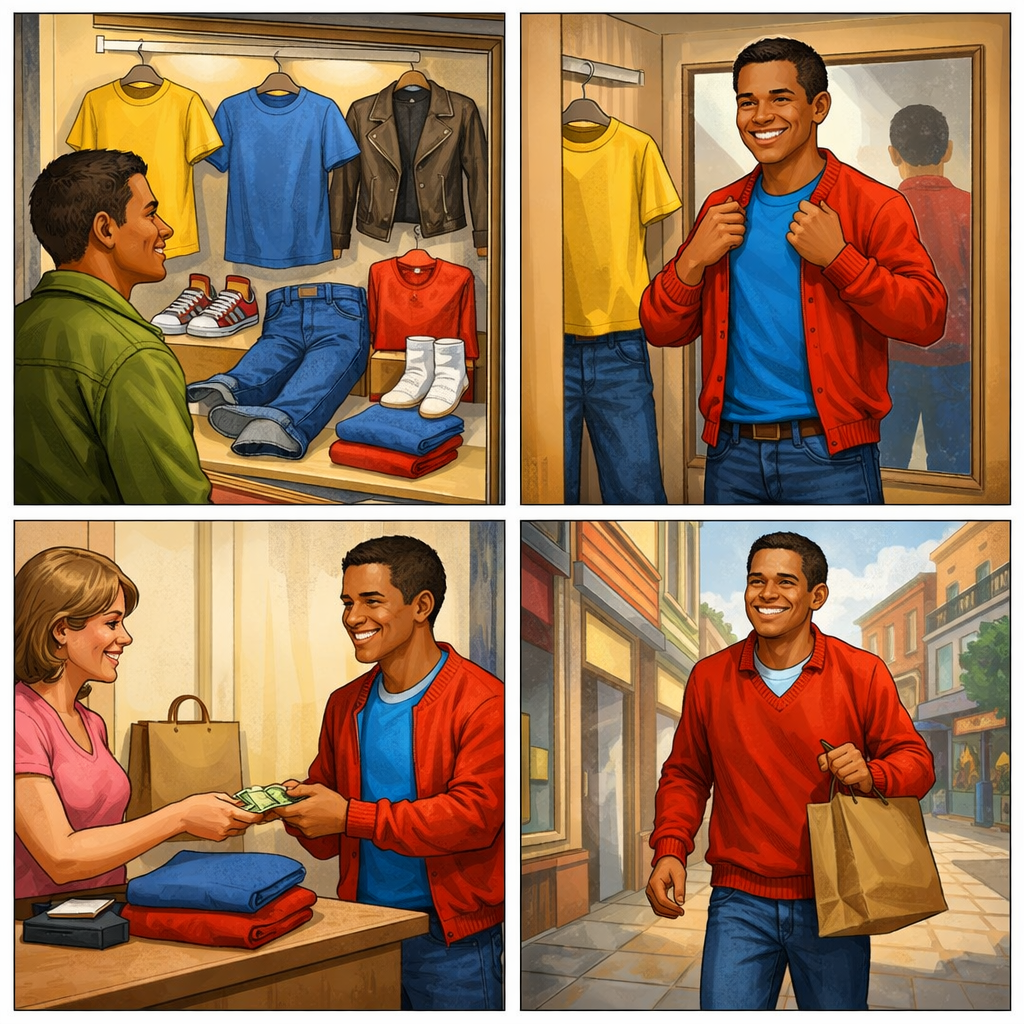
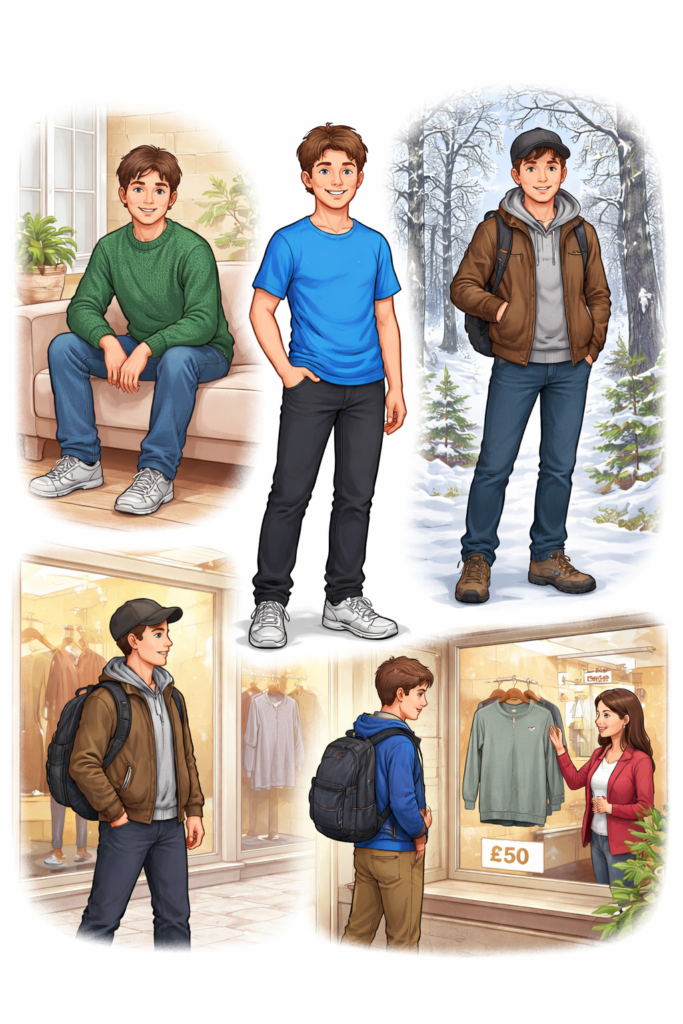
Salas is a customer in a town. Salas goes to a shop window. There is a T-shirt, jeans, a dress, a leather jacket, trainers, a sweater and socks. Salas likes clothes. Salas looks at everything.
Salas likes jeans. Jeans are blue trousers. Salas likes blue jeans. Salas does not like the yellow T-shirt. Salas chooses a blue T-shirt and a red sweater.
Salas goes to a changing room. Just a minute. The size is alright. Salas really likes the sweater and the jeans. Salas does not buy the yellow T-shirt.
Salas chooses the clothes and buys them. Everything is alright. Salas walks away. Salas is really happy.
_________________________
Vocabulary:
a customer – a person who buys something
a town – a place where people live
a shop window – a window that shows things in a shop
A sweater is for your feet. ❌ True is: A sweater is for your body.
Socks are clothes for your feet. ✅
Trainers are for walking. ❌ True is: Trainers are shoes for sport.
A changing room is outside the shop. ❌ True is: A changing room is a room to change clothes.
A customer buys clothes. ✅
A key ring is for your feet. ❌ True is: A key ring holds your keys.
A shop window is a window to show things. ✅
Salas chooses a mobile phone. ❌ True is: Salas chooses a T-shirt.
################
Answer:
Is Salas in a town or in a village [a small place where people live]?
Does Salas go to a shop window or a restaurant?
Does he choose a T-shirt or a magazine?
Are jeans blue or yellow?
Does he go to a changing room or a park?
Does he like a sweater or a key ring?
Are socks for your feet or for your hands?
Does a customer buy clothes or sleep in the shop?
Are trainers for sport or for sleeping?
Does Salas walk away happy or sad?
______________________
Correct answers:
Salas is in a town.
Salas goes to a shop window.
Salas chooses a T-shirt.
Jeans are blue.
Salas goes to a changing room.
Salas likes a sweater.
Socks are for your feet.
A customer buys clothes.
Trainers are for sport.
Salas walks away happy.
################
################
Story 2:
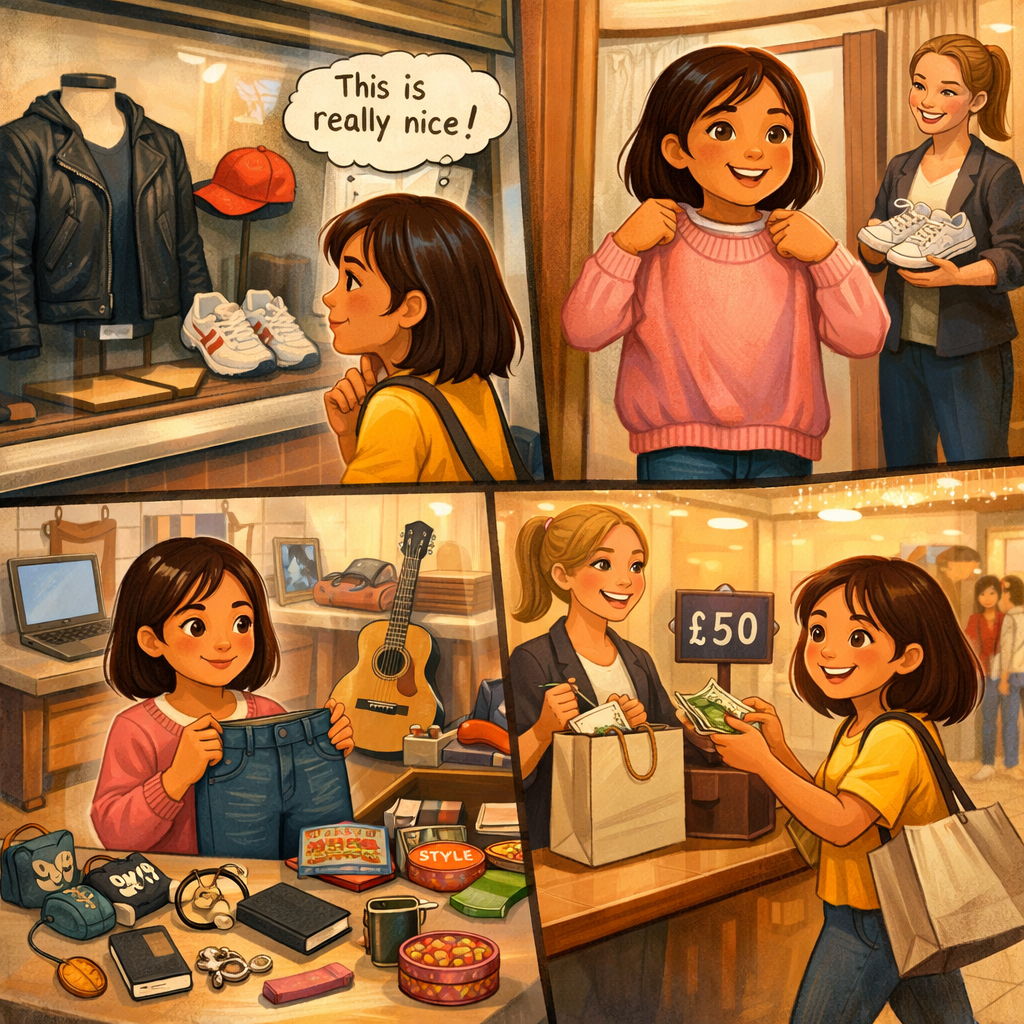
Tak is a girl. She likes clothes very much. Today, she goes shopping in the city. She wants a new T-shirt, a dress, and a sweater. First, she looks at the shop window. There is a leather jacket, a cap, and running shoes. She thinks, “This is really nice!”
Tak goes into the shop. A shop assistant helps her. She wants a sweater, socks, and trainers. She tries the sweater in the changing room. It is warm and in order.
Next, she looks at jeans, a laptop, and a guitar. She is interested in the jeans. Suddenly, she sees a key ring, a pencil case, and a magazine. She also likes a mobile phone and sweets in a tin.
Tak asks the price. The sweater is fifty pounds. She smiles. It is not expensive. Tak pays and walks away happily. She has everything she wants.
_________________________
Vocabulary:
Key ring – a small thing to hold your keys.
Pencil case – a bag for pens and pencils.
To smile – to move your mouth like happy.
Expensive – costs a lot of money.
#################
True or false:
Tak wants a new T-shirt, a dress, and a sweater.
Tak tries the jeans in the changing room.
The sweater costs fifty pounds.
Tak sees a key ring, a pencil case, and a magazine.
Tak pays and goes home happily.
Tak sees a leather jacket in the shop.
Tak smiles because the sweater is expensive.
Tak walks into the shop and asks for a mobile phone first.
Tak tries the jeans in the changing room. True is: Tak tries the sweater in the changing room.
The sweater costs fifty pounds.
Tak sees a key ring, a pencil case, and a magazine.
Tak pays and goes home happily.
Tak sees a leather jacket in the shop.
Tak smiles because the sweater is expensive. True is: Tak smiles because the sweater is not expensive.
Tak walks into the shop and asks for a mobile phone first. True is: Tak asks for clothes first.
A shop assistant helps Tak in the shop.
Tak finds sweets in a tin and likes them.
###############
Answer in complete sentences:
Does Tak want a T-shirt or jeans?
Does Tak try the sweater or the jeans in the changing room?
Does the sweater cost fifty pounds or one hundred pounds?
Does Tak see a key ring or a laptop in the shop?
Does Tak go home happily or sadly?
Does Tak see a leather jacket or a cap in the shop?
Does Tak smile because the sweater is expensive or not expensive?
Does Tak ask for clothes or a mobile phone first?
Does a shop assistant help Tak or ignore her?
Does Tak like sweets in a tin or a pencil case more?
_________________
Answers:
Tak wants a T-shirt.
Tak tries the sweater in the changing room.
The sweater costs fifty pounds.
Tak sees a key ring in the shop.
Tak goes home happily.
Tak sees a leather jacket in the shop.
Tak smiles because the sweater is not expensive.
Tak asks for clothes first.
A shop assistant helps Tak.
Tak likes sweets in a tin.
################
################
Story 3:
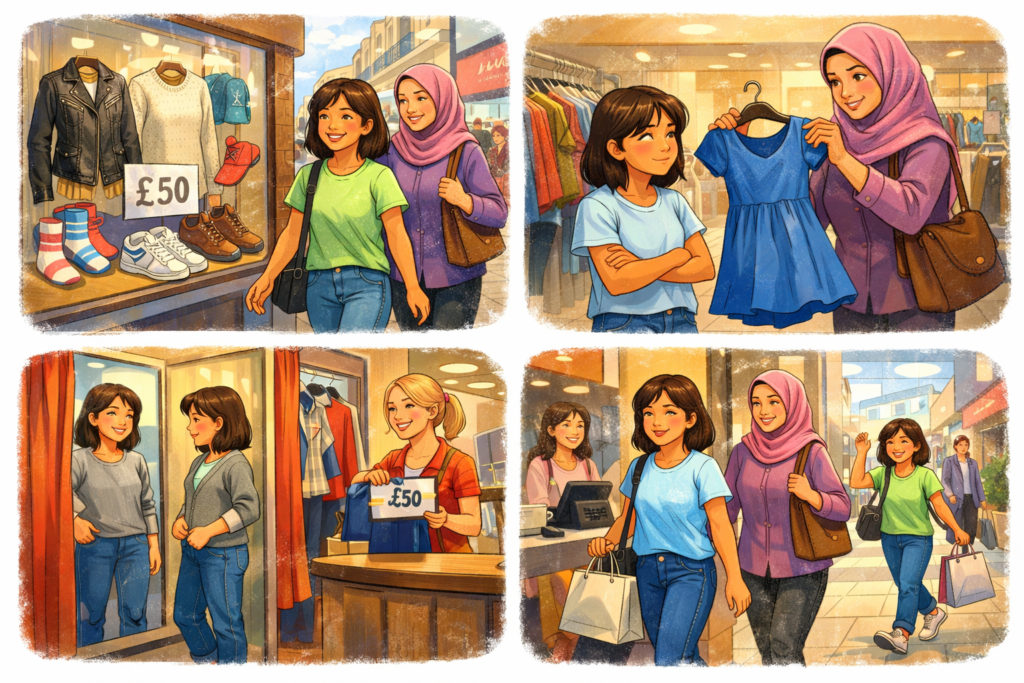
Oum goes shopping in the city with her mother. She wants a new T-shirt and jeans. The T-shirt is light and nice. The jeans are strong and blue. The price is fifty pounds. A shop assistant helps them.
Oum’s mother wants her to buy a blue dress. She thinks the dress is nice, but Oum does not like it at all. She looks at the shop window and sees many clothes: a leather jacket, a sweater, socks, a cap, trainers, and walking shoes. Oum tries on the jeans, the T-shirt, and the sweater in the changing room. She does not try the dress.
Finally, Oum buys the jeans, the T-shirt, and trainers. Her mother is a little sad, but Oum is happy. She thinks the clothes are really nice. They leave the shop. Oum is very satisfied with her new clothes.
_______________________
Vocabulary:
to be nice – good, friendly, or pleasant
to try on jeans – to put jeans on to see if they fit
finally – at the end, after everything else
to be sad – to feel unhappy
to leave a shop – to go out of a shop
to be satisfied – to feel happy with something you have or bought
################
True or false:
Oum buys a blue dress in the shop.
Oum tries on a sweater in the changing room.
Her mother wants Oum to buy a dress.
Oum leaves the shop unhappy.
The T-shirt Oum likes is light.
Oum buys trainers.
Oum tries on jeans to see if they fit.
The shop assistant helps Oum.
Oum buys only socks.
Oum sees many clothes in the shop window.
________________
True: 2, 3, 5, 6, 7, 8, 10
________________
Correct version:
Oum buys a blue dress in the shop. True is: Oum does not buy a blue dress.
Oum tries on a sweater in the changing room.
Her mother wants Oum to buy a dress.
Oum leaves the shop unhappy. True is: Oum leaves the shop happy.
The T-shirt Oum likes is light.
Oum buys trainers.
Oum tries on jeans to see if they fit.
The shop assistant helps Oum.
Oum buys only socks. True is: Oum buys jeans, a T-shirt, and trainers.
Oum sees many clothes in the shop window.
#################
Answer in complete sentneces:
Does Oum go shopping with her father or her mother?
Does Oum want a T-shirt or a dress?
Does Oum buy jeans or a skirt?
Does Oum like the blue dress or the sweater?
Does her mother want her to buy a dress or trainers?
Does Oum try on a T-shirt or a hat?
Does Oum buy trainers or only socks?
Does Oum leave the shop happy or sad?
Does a shop assistant help Oum or ignore her?
Does Oum see many clothes in the shop window or only one?
Assistant: Hello. Can I help you? Tom: Hello. Yes, please. I want to buy shoes.
Assistant: Sure. What kind of shoes do you want? Tom: I want sports shoes.
Assistant: OK. We have many types. These are football shoes. Those are tennis shoes.
Tom: I want tennis shoes. Can I try those, please?
Assistant: Yes, of course. What size do you need?
Tom: Size 42.
Assistant: Here you are. This pair is very comfortable.
Tom: Thank you. I like this pair.
Assistant: Do you want to try them on? Tom: Yes, please.
Assistant: How do they feel? Tom: They feel good.
Assistant: Good. What color do you like? Tom: I like blue.
Assistant: We have blue and black. That one is black.
Tom: I like blue more.
Assistant: OK. Please walk a little. Tom: Yes. They are nice.
Assistant: How much do you want to pay? Tom: Not too much.
Assistant: These shoes are 80 euros.
Tom: Oh, that is too expensive. Do you have a cheaper pair?
Assistant: Yes. These are 50 euros and very good.
Tom: Let me try them.
Assistant: How are they? Tom: They are good and comfortable.
Assistant: Do you like them? Tom: Yes. I like them.
Assistant: Great. Do you want to buy them? Tom: Yes, I will take them.
Assistant: Perfect. Please go to the counter.
Tom: Thank you very much. Assistant: You’re welcome. Goodbye!
###############
In a shop:
Shopkeeper: Hello. Can I help you? Sue: Hello. Yes, please.
Shopkeeper: What do you want to buy? Sue: I want to buy a cap.
Shopkeeper: OK. Please look over there. These caps are nice, which color? Sue: I like the blue cap.
Shopkeeper: Good choice. This cap looks nice on you. Sue: Yes, I like it.
Shopkeeper: Do you want anything else? Sue: Yes. I want a shirt.
Shopkeeper: We have shirts here and shirts over there. Those shirts over there look nice. Sue: I want to see the shirts.
Shopkeeper: OK. This shirt is blue. Sue: Blue is nice. But I want a white shirt.
Shopkeeper:That shirt on the wall is white. Sue: I like the white shirt.
Shopkeeper: Do you want long sleeves or short sleeves? Sue: I want short sleeves.
Shopkeeper:These shirts over there are short sleeves. Sue: I like the short sleeves.
Shopkeeper: What material do you like? Sue: I like cotton.
Shopkeeper:Look! This shirt is cotton. Sue: The shirt feels good.
Shopkeeper: The price is 60 Euros. Sue: Oh, that is too expensive.
Shopkeeper: Look over there. That shirt is cheaper and green. Sue: The green color is OK.
Shopkeeper: The cap and the shirt are 45 Euros. Sue: Great. I will take them.
################
Mr. Black and Mrs. Black go shopping. Mrs. Black likes shopping. Mr. Black does not. He is bored.
Mrs. Black goes into a shop. Mr. Black sits outside. He reads a newspaper. He waits.
Mrs. Black is still in the shop. It starts to rain. Mr. Black goes into the shop. He helps Mrs. Black. They choose a nice dress. Mrs. Black is happy.
They pay for the dress. Then they go home. Mr. Black is a little tired. But he is happy because Mrs. Black is happy.
_____________________
True or false:
Mr. Black sits outside and reads a newspaper.
Mrs. Black does not like shopping.
It starts to rain while Mrs. Black is in the shop.
Mr. Black chooses a dress by himself.
They go home together after shopping.
Mr. Black is happy because his wife is happy.
Mrs. Black leaves the shop before it rains.
Mrs. Black goes into a shop to look at clothes.
____________________
Answers: 1-T, 2-F, 3-T, 4-F, 5-T, 6-T, 7-F, 8-T
##############
Speedy, the super dog
After shopping, Mr. Green goes for a walk with his dog. They go to the park. The park is big and green. There are many trees, flowers, and a small lake. Mr. Green sits on a bench. He enjoys watching the playground. He sees children playing and people walking. Some people run and some ride bikes.
After some time, Mr. Green starts going home. His dog, Speedy, runs back to the bench. Mr. Green does not know why. Then Speedy comes back. He carries the bag with the food. Mr. Green has forgotten the bag on the bench. He is happy and thanks Speedy.
___________________
Fill in, words below:
bag, playground, walk, bench, park, green, thanks, lake, walking, bench
After shopping, Mr. Green goes for a _______ with his dog.
They go to the _______.
The park is big and _______.
There are many trees, flowers, and a small _______.
Mr. Green sits on a _______.
He enjoys watching the _______.
He sees children playing and people _______.
Speedy runs back to the _______.
Speedy carries the _______ with the food.
Mr. Green is happy and _______ Speedy.
———————————– Correct version:
After shopping, Mr. Green goes for a walk with his dog.
They go to the park.
The park is big and green.
There are many trees, flowers, and a small lake.
Mr. Green sits on a bench.
He enjoys watching the playground.
He sees children playing and people walking.
Speedy runs back to the bench.
Speedy carries the bag with the food.
Mr. Green is happy and thanks Speedy.
################
Put the story in order
Speedy runs back to the bench.
Mr. Green sits on the bench and watches the playground.
They go home together.
Mr. Green forgets the bag on the bench.
Mr. Green and Speedy go to the park.
Speedy brings the bag to Mr. Green.
Mr. Green enjoys watching the people in the park.
They walk near the small lake.
_______________________
Correct order:
Mr. Green goes for a walk with his dog.
They go to the park.
Mr. Green sits on the bench.
He enjoys watching the playground.
Mr. Green starts going home.
Speedy runs back to the bench.
Speedy comes back carrying the bag.
They go home together.
#################
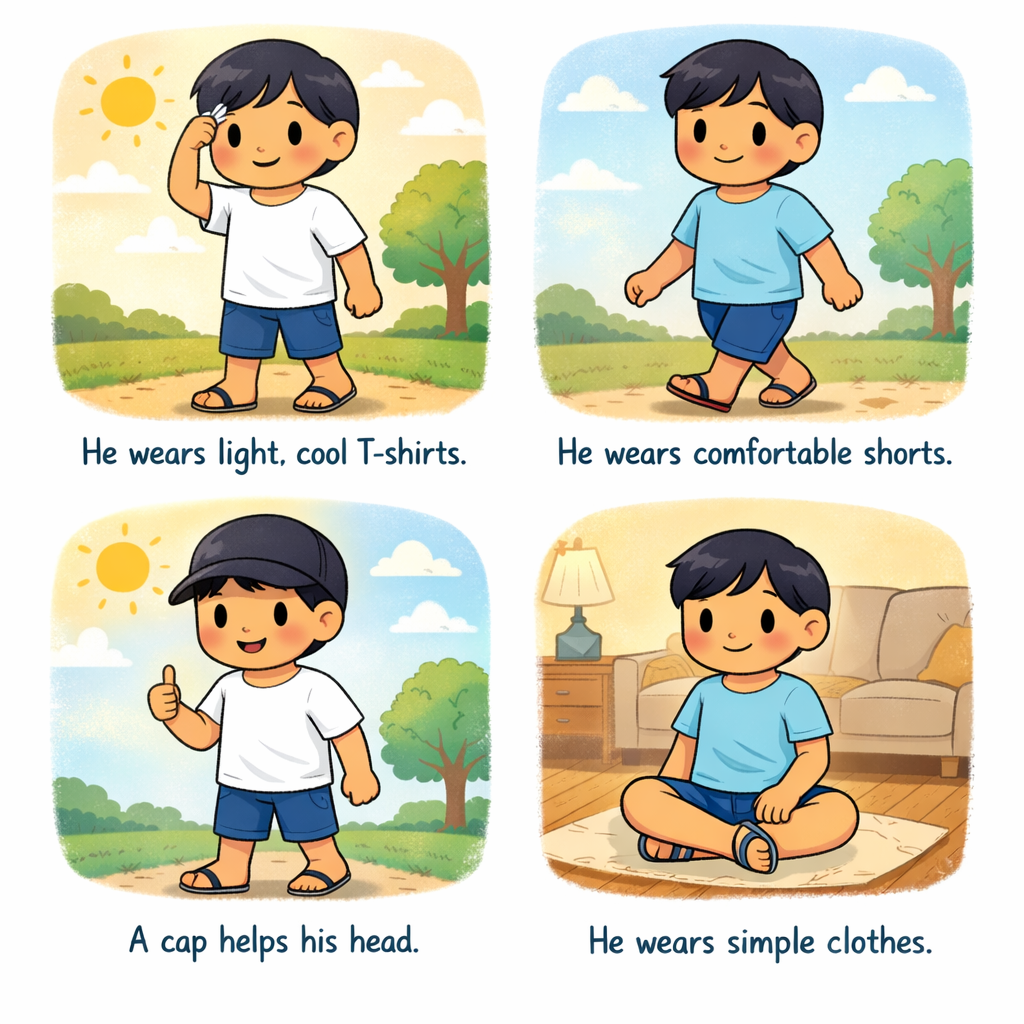
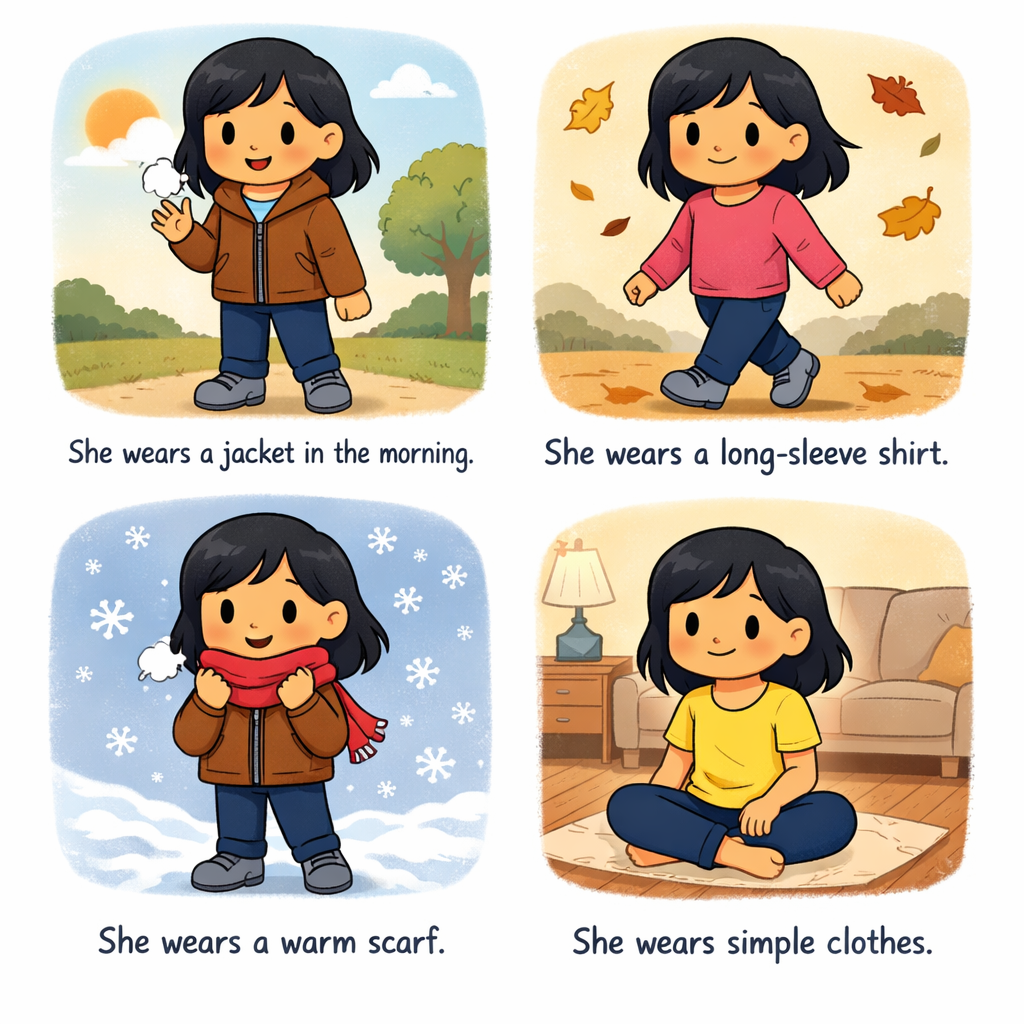
Toby and his likes
Toby likes clothes very much. His favorite clothes are simple and comfortable. He likes a blue T-shirt and black jeans. The jeans are strong and comfortable. At home, Toby often wears a sweater. The sweater is warm, and he feels alright in it.
In winter, Toby wears a leather jacket. On his feet, he wears trainers every day. When he goes to the woods, he wears walking shoes. He also wears socks and a cap.
On Saturday, Toby goes to a shop. He looks at the shop window. A shop assistant helps him. The price for the pullover is fifty pounds. This is a surprise. Toby walks away. He does not buy the pullover. __________________
Vocabulary:
Word
Simple definition
clothes
things you wear
to be comfortable
to feel good, not bad
at home
in your house
to wear
to have clothes on your body
to feel alright
to feel OK
to go to the woods
to go to a place with many trees
to wear socks
to have socks on your feet
a shop window
a window that shows things in a shop
a shop assistant
a person who helps in a shop
a price
how much something costs
(a prize
something you win)
a surprise
something you do not expect
to walk away
to go from a place
to buy
to get something for money
###############
Match the words (1–10) with the definitions (A–J)
Words
pullover
sweater
trainers
leather jacket
shop assistant
price
comfortable
woods
cap
walking shoes
Definitions
A. Shoes made for long walks, often used in nature B. A person who helps customers in a shop C. A warm piece of clothing worn on the upper body D. Shoes people wear for sport or every day E. A place with many trees F. A jacket made from animal skin G. Something that feels good and easy to wear H. The amount of money something costs I. A hat worn on the head J. A warm top you pull on over your head
_______________________
Answers: 1J, 2C, 3D, 4F, 5B, 6H, 7G, 8E, 9I, 10A
################
True or false
Toby likes simple and comfortable clothes.
Toby often wears a pullover at home.
Toby wears trainers when he goes to the woods.
The leather jacket Toby wears is warm.
Toby bought a pullover for fifty pounds.
Toby’s favorite T-shirt is blue.
He wears a sweater in winter instead of a leather jacket.
Toby wears socks and a cap sometimes.
Toby feels uncomfortable in his sweater.
Toby looks at the shop window on Saturday.
____________________
Answers: 1T, 2F, 3F, 4T, 5F, 6T, 7F, 8T, 9F, 10T
##############
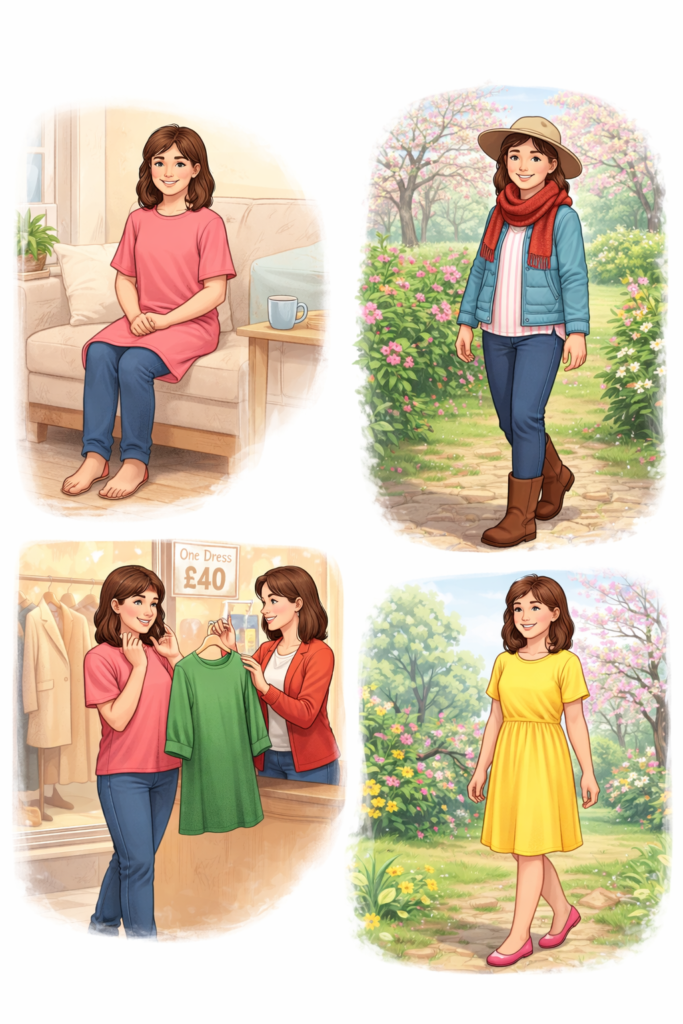
Emma and her likes:
Emma loves dresses. She likes bright and pretty clothes. Her favorite dress is yellow. It is soft and easy to wear. At home, she often wears a long T-shirt. It is comfortable and warm. In spring, Emma wears a light jacket. She likes to wear flats every day. When she goes to the garden, she wears boots. She also wears a hat and a scarf. On Monday, Emma goes to a clothes shop. She looks at the new dresses. A shop assistant shows her a green dress. The price is forty pounds. Emma is surprised. She leaves the shop. She does not buy the dress.
__________________
Vocabulary:
a dress – a piece of clothes for girls or women, it covers the body and goes down to the legs
bright – full of strong light or strong color
pretty – nice to look at, beautiful
a soft dress – a dress that is comfortable and not hard
to wear – to have clothes, shoes, or something on your body
spring (season) – the season after winter and before summer; the weather is warm and flowers grow
flats (shoes) – shoes with no high heel, flat on the bottom
boots – shoes that cover the feet and go above the ankle
a scarf – a long piece of cloth you wear around your neck to keep warm
a shop assistant – a person who works in a shop and helps people
to be surprised – to feel something is new or unexpected
################
Match the word to the correct definition:
a dress 2. bright 3. pretty 4. a soft dress 5. to wear 6. spring 7. flats 8. boots 9. a scarf 10. a shop assistant 11. to be surprised
Definitions: a. shoes with no high heel b. to feel something is new or unexpected c. a piece of clothes for girls or women d. the season after winter, before summer, flowers grow e. a long piece of cloth around the neck to keep warm f. nice to look at, beautiful g. a person who works in a shop and helps people h. shoes that cover the feet and go above the ankle i. full of strong light or color j. a dress that is comfortable and not hard k. to have clothes, shoes, or something on your body
Yesterday (Past Simple – Signalwörter: yesterday, last night, ago)
Yesterday, Anna woke up at 7 am.
She ate breakfast at 8am yesterday.
She walked to school last Friday.
She played football with her friends two weeks ago.
Last night, she watched a movie.
Now / Today (Present Progressive – Signalwörter: now, at the moment, today, currently)
Now, Anna is sitting in her room.
She is reading a book.
Her brother is playing outside.
She is learning English at the moment.
Tomorrow / Next Week (Present Progressive for future with a plan – Signalwörter: tomorrow, next week, on Monday)
Tomorrow, Anna is visiting her grandmother.
She is going to the park with her friends in two hours.
This coming Monday, she is meeting her teacher.
Everyday / Regular actions (Present Simple – Signalwörter: every day, usually, always, often, never, on Mondays)
Anna wakes up at 7 am every day.
She goes to school from Monday to Friday.
She always eats breakfast before school.
She usually plays football after school.
###################
# Present Simple (everyday habits / routines) Anna wakes up at 7 am every day. She goes to school from Monday to Friday. She always eats breakfast before class.
# Past Simple (yesterday / last night) Yesterday, Anna woke up at 8 am. She ate toast for breakfast. She went to the park with her friends. Last night, she watched a movie.
# Present Progressive now (at the moment / today) Now, Anna is sitting at her desk. She is doing her homework. Her dog is sleeping on the floor. Today, she is learning new English words.
# Present Progressive for future (tomorrow / next week / this coming Monday) Tomorrow, Anna is visiting her grandmother. Next week, she is starting a new English course. This coming Monday, she is meeting her friends at the park.
#################
# Present Simple (everyday habits / routines) Tom wakes up at 6:30 every day. He drinks coffee and reads the news. He goes to work by bus.
# Past Simple (yesterday / last night) Yesterday, Tom woke up late. He missed the bus and walked to work. After work, he cooked dinner and watched a football match on TV.
# Present Progressive now (at the moment / today) Now, Tom is sitting in the living room. He is writing an email to his friend. His cat is playing with a ball of yarn. Today, he is practicing his English.
# Present Progressive for future (tomorrow / next week / this coming Monday) Tomorrow, Tom is meeting his colleague for lunch. Next week, he is going on a short trip to the mountains. This coming Monday, he is starting a new project at work.
##################
Complete:
Sam usually _________ (wake up) at 7 o’clock. He _________ (eat) bread and _________ (drink) milk. He _________ (go) to school every day.
Yesterday, Sam _________ (play) football with his friends. Then he _________ (watch) a cartoon and _________ (eat) pizza for dinner.
Now, Sam _________ (sit) at his desk. He_________ (do) his homework. His cat _________ (sleep) on the bed.
Tomorrow, Sam _________ (go) to the park. He _________ (meet) his friend Mia. They _________ (go) to play games together.
_______________________
Correct version:
Sam usually wakes up at 7 o’clock. He eats bread and drinks milk. He goes to school every day.
Yesterday, Sam played football with his friends. He watched a cartoon and ate pizza for dinner.
Now, Sam is sitting at his desk. He is doing his homework. His cat is sleeping on the bed.
Tomorrow, Sam is going to the park. He is meeting his friend Mia. They are going to play games together.
#################
Emma often __________ (wake) up at 6:30. She __________ (brush) her teeth and __________ (drink) water. She usually __________ (eat) eggs for breakfast.
Yesterday, Emma __________ (go) to the market. She __________ (buy) apples and bread. She __________ (meet) her friend Lily and they __________ (talk) for a while.
Now, Emma __________ (clean) her room. She__________ (listen) to music. Her dog __________ (run) around the garden.
Tomorrow, Emma __________ (visit) her aunt. She__________ (take) some flowers for her. They __________ (have) lunch together.
———————————- Correct version:
Emma often wakes up at 6:30. She brushes her teeth and drinks water. She usually eats eggs for breakfast.
Yesterday, Emma went to the market. She bought apples and bread. She met her friend Lily and they talked for a while.
Now, Emma is cleaning her room. She is listening to music. Her dog is running around the garden.
Tomorrow, Emma is visiting her aunt. She is taking some flowers for her. They are having lunch together.
#################
Mia usually __________ (wake up) at 8 o’clock. She __________ (drink) milk and eats bread. She usually __________ (go) to the park in the afternoon.
Yesterday, Mia __________ (walk) to the shop. She __________ (buy) apples and bread. She __________ (meet)her friend Tom and they __________ (talk) for a while.
Now, Mia __________ (sit) at her desk. She __________ (write) a letter. Her cat __________ (sleep) on the sofa.
Tomorrow, Mia __________ (visit) her grandmother. She __________ (take) some flowers. They __________ (have) lunch together.
———————————-
Correct version:
Mia wakes up at 8 o’clock every day. She drinks milk and eats bread. She usually goes to the park in the afternoon.
Yesterday, Mia walked to the shop. She bought apples and bread. She met her friend Tom and they talked for a while.
Now, Mia is sitting at her desk. She is writing a letter. Her cat is sleeping on the sofa.
Tomorrow, Mia is visiting her grandmother. She is taking some flowers. They are going to have lunch together.
Actions happening right now, at the moment from speaking Example: I am studying English.
Near future plans (already decided) Example: We are visiting my uncle tomorrow.
3. Signal Words
now, right now, at the moment, today, tonight
tomorrow, next week (for future plans)
###################
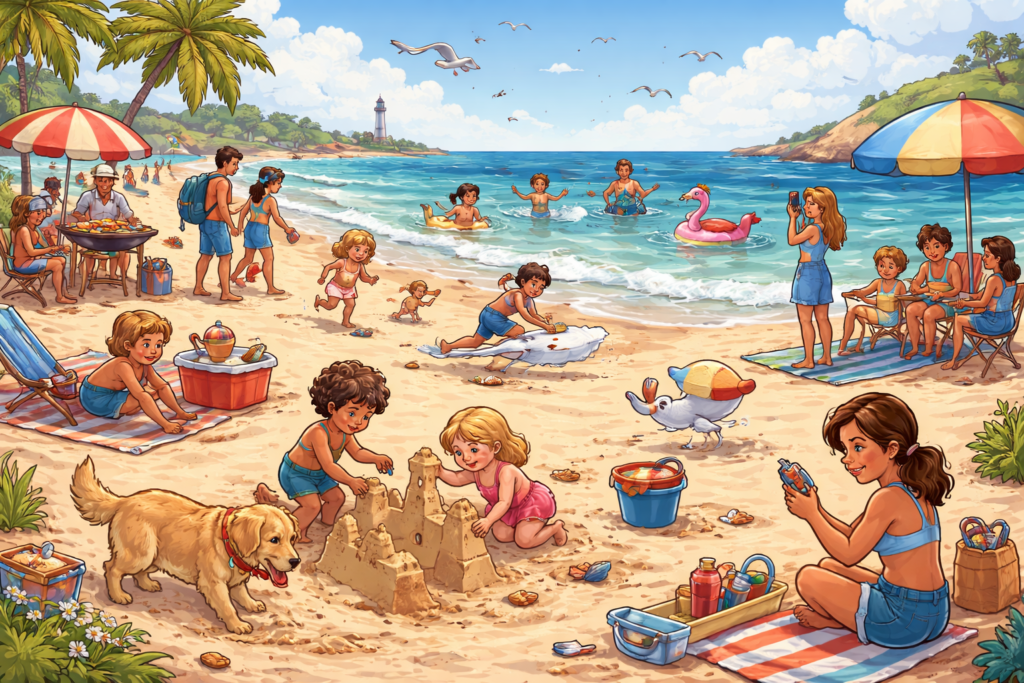
Describing the picture – happening NOW:
The sun is shining in the park.
Many people are enjoying the day.
Families are sitting on the grass.
Parents are eating food with their children.
A man is cooking food on a grill.
Children are running and playing.
A boy is kicking a ball.
A girl is riding a small bike.
Children are playing on the slide.
A father is carrying a child.
People are walking in the park.
A woman is doing yoga on the grass.
Friends are talking and smiling.
A kite is flying in the sky.
People are sitting near the lake.
A boat is moving on the water.
A dog is lying on the grass.
Another dog is walking with its owner.
Children are blowing bubbles.
A family is having a picnic.
People are resting under trees.
Children are eating ice cream.
Birds are flying above the park.
People are watching the children.
Everyone is having a happy day. 😊
################
Summary:
a) Statements (Affirmative)
Personal Pronoun
Form of to be
Verb + -ing
I
am
playing
You
are
eating
He / She / It
is
reading
We
are
working
You (plural)
are
singing
They
are
dancing
Structure: >>>>Subject + am/are/is + verb + -ing >>>>Example: She is reading.
b) Negative Statements
Personal Pronoun
Form of to be
Verb + -ing
I
am not
playing
You
are not
eating
He / She / It
is not
reading
We
are not
working
You (plural)
are not
singing
They
are not
dancing
Structure: >>>>Subject + am/are/is + not + verb + -ing >>>>Example: He is not reading.
c) Questions
Form of to be
Personal Pronoun
Verb + -ing
Am
I
playing?
Are
you
eating?
Is
he / she / it
reading?
Are
we
working?
Are
you (plural)
singing?
Are
they
dancing?
Structure: >>>>Am / Are / Is + subject + verb + -ing? >>>>Example: Are you studying English?
d1) Negative Questions
Form of to be
Personal Pronoun
Verb + -ing
Aren’t / Am not*
I
playing?
Aren’t
you
eating?
Isn’t
he / she / it
reading?
Aren’t
we
working?
Aren’t
you (plural)
singing?
Aren’t
they
dancing?
*Note: >>For I, “Aren’t I …?” is common in speech; >>“Am I not …?” is formal.
Structure: >>>>Am / Is / Are + subject + not + verb + -ing? >>>>Example: Isn’t she reading now?
d2) Negative Questions
Form of to be + pronoun+ not
Verb + -ing
Am I not
reading?
Are you not
eating?
Is he not
reading?
Is she not
reading?
Is it not
raining?
Are we not
working?
Are you not (plural)
singing?
Are they not
dancing?
Structure: Am / Is / Are + subject + not + verb + -ing?
Example:
Am I not reading the book correctly?
Are you not eating lunch?
################ Some pictures:
A family is sitting on a blanket [A soft thing you put on the ground or on a bed to sit or lie on.].
The mother is eating food.
The father is eating food.
The parents are smiling.
A boy is sitting with his parents.
The boy is looking at the food.
The family is having a picnic.
A dog is lying on the blanket.
The dog is looking at the family.
The dog is resting.
Plates are on the blanket.
Food is on the plates.
The sun is shining.
People are walking in the park.
Children are playing behind them.
####################
The man is cooking.
The girl is eating.
The boy is playing football.
The woman is running.
The boy is flying a kite [A toy you fly in the sky on a string.].
The man is rowing a boat.
The woman is sitting.
The children are playing on the slide [A thing children go down for fun, usually in a playground.].
The girl is blowing bubbles [To make small round balls of air in water or soap].
The boy is riding a bike.
People are walking in the park.
The man and woman are smiling.
The kids are running.
People are enjoying the sun.
Birds are flying in the sky.
###################
A man is carrying a child on his shoulders. A girl is eating an ice cream. A boy is riding a bike. A woman is sitting on a blanket. A dog is standing near the woman. People are playing in the park. Children are sliding on the slide. A family is having a picnic. Trees are growing in the background. A boy is wearing a hat. The sun is shining in the sky. People are sitting on benches [A long seat for people to sit on, usually outside.]. A child is pointing at something. The grass is covering the ground. A basket is holding food.
Who is …? → asks who the person is → Who is the teacher?
What is …? → asks about a thing or person → What is this?
What does … do? → asks about actions or jobs → What does she do?
Where …? → place → Where does he live?
When …? → time → When do they play football?
Why …? → reason → Why does she eat fast?
How …? → way / manner → How do you go to work?
Structure:
Question word + do/does + subject + verb (for actions)
Question word + is/are (for identity or things)
3. Difference Examples
Who is …? → identity → Who is the teacher? (NO __do__ or __does__!)
Who does … help? → action → Who does he help?
What is …? → thing / person → What is this?
What does … do? → action / job → What does she do?
Remember:
“Who is / What is …” → identity / thing
“Who does / What does … do” → action / work
###################
I work on Sunday.
YOU WRITE: I: Who works on Sunday? work: What do I do on Sunday? on Sunday: When do I work?
He lives here. He: __________ lives here: __________ here: __________
They like coffee. They: __________ coffee: __________
She works in an office. She: __________ works: __________ in an office: __________
We play music. We: __________ play music: __________ music. __________
You like green tea. Youo: __________ tea: __________ green: __________
He plays football in the garden. He: __________ plays football: __________ football: __________ in the garden: __________
She likes big apples. She: __________ big apples: __________ big: __________
I work in the morning. I: __________ work: __________ in the morning: __________
They live in town. They: __________ live: __________ in town: __________
———————————-
Correct answers:
I work on Sunday. I: Who works on Sunday? work: What do I do on Sunday? on Sunday: When do I work?
He lives here. He: Who lives here? lives here: What does he do? here: Where does he live?
They like coffee. They: Who likes coffee? coffee: What do they like?
She works in an office. She: Who works in an office? works: What does she do? in an office: Where does she work?
We play music. We: Who plays music? play music: What do we do? music: What do we play?
You like tea. You: Who likes tea? tea: What do you like? green: Which tea do you like?
He plays football in the garden. He: Who plays football in the garden? plays football: What does he do? football: What does he play? in the garden: Where does he play?
She likes big apples. She: Who likes big apples? big apples: What does she like? big: Which apples does she like?
I work in the morning. I: Who works in the morning? work: What do I do? in the morning: When do I work?
They live in town. They: Who lives in town? live: What do they do? in town: Where do they live?
#################
1. I eat breakfast at 7 o’clock. I: __________ eat: __________ breakfast: __________ at 7 o’clock: __________
2. He plays football on Sunday. He: __________ plays football: __________ football: __________ on Sunday: __________
3. She likes chocolate. She: __________ likes: __________ chocolate: __________
4. We go to school by bus. We: __________ go: __________ to school: __________ by bus: __________
5. They watch TV in the evening. They: __________ watch: __________ TV: __________ in the evening: __________
6. You drink water every day. You: __________ drink: __________ water: __________ every day: __________
7. The cat sleeps on the sofa. The cat: __________ sleeps: __________ on the sofa: __________
8. I read a book in the morning. I: __________ read: __________ a book: __________ in the morning: __________
9. He works in a shop. He: __________ works: __________ in a shop: __________
10. She drinks tea in the afternoon. She: __________ drinks: __________ tea: __________ in the afternoon: __________
———————————-
Correct version:
1. I eat breakfast at 7 o’clock. I: Who eats breakfast at 7 o’clock? eat: What do I do? breakfast: What do I eat? at 7 o’clock: When do I eat breakfast?
2. He plays football on Sunday. He: Who plays football on Sunday? plays football: What does he do? football: What does he play? on Sunday: When does he play football?
3. She likes chocolate. She: Who likes chocolate? likes: What does she do? chocolate: What does she like?
4. We go to school by bus. We: Who goes to school by bus? go: What do we do? to school: Where do we go? by bus: How do we go to school?
5. They watch TV in the evening. They: Who watches TV in the evening? watch: What do they do? TV: What do they watch? in the evening: When do they watch TV?
6. You drink water every day. You: Who drinks water every day? drink: What do you do? water: What do you drink? every day: How often do you drink water?
7. The cat sleeps on the sofa. The cat: What sleeps on the sofa? sleeps: What does the cat do? on the sofa: Where does the cat sleep?
8. I read a book in the morning. I: Who reads a book in the morning? read: What do I do? a book: What do I read? in the morning: When do I read a book?
9. He works in a shop. He: Who works in a shop? works: What does he do? in a shop: Where does he work?
10. She drinks tea in the afternoon. She: Who drinks tea in the afternoon? drinks: What does she do? tea: What does she drink? in the afternoon: When does she drink tea?
#############
Match the question to the answer
Questions:
What do you eat for breakfast?
Where does he live?
Who plays football on Sunday?
When do they watch TV?
How do you go to school?
What does she drink in the morning?
Where do we go on Saturday?
Who reads a book every night?
When does he wake up?
How does she go to work?
What do they like to eat?
Where does the cat sleep?
Who plays the piano?
When do you play football?
Answers:
a. By bus b. At 7 o’clock c. I eat eggs d. He plays football e. In London f. She drinks milk g. We go to the park h. I read a book i. He wakes up at 6 j. She goes by car k. They like pizza l. The cat sleeps on the sofa m. She plays the piano n. On Sunday
This is Sophea. He is from Yangoon. He is 20 years old. He is a student. He goes to school every day. He likes rice and noodles. He drinks water. He has a friend. His friend’s name is Vannak. Sophea likes football. He likes music. On Sunday, he visits his family. He has a dog. The dog is small. Sophea is happy. He wants to learn English.
_________________________
Match question to answer:
Questions about Sophea
Who is your friend?
Where is he from?
How old is he?
What does he do?
When does he go to school?
Why does he like football?
Which food does he like?
Who is his best friend?
How does he go to school?
What pet does he have?
Answers
a. He goes to school every day. b. I am his best friend. c. He is a student. d. He is 20 years old. e. He has a dog. f. He goes by bus. g. My friend is Sophea. h. He likes rice and noodles. i. He likes football because it is fun. j. He is from Yangoon.
_________________________
Correct version:
Interviewer: Who is your friend? Friend: My friend is Sophea.
Interviewer: Where is he from? Friend: He is from Yangoon.
Interviewer: How old is he? Friend: He is 20 years old.
Interviewer: What does he do? Friend: He is a student.
Interviewer: When does he go to school? Friend: He goes to school every day.
Interviewer: Why does he like football? Friend: He likes football because it is fun.
Interviewer: Which food does he like? Friend: He likes rice and noodles.
Interviewer: Who is his best friend? Friend: I am his best friend.
Interviewer: How does he go to school? Friend: He goes by bus.
Interviewer: What pet does he have? Friend: He has a dog.
##################
Read:
This is Aye Thandar. She is from Yangon. She is 18 years old. She is a student. She goes to school every day. She likes to eat rice and curry. She drinks water. She has a friend. Her friend’s name is Soe. Aye Thandar likes to play badminton. She also likes to listen to music. On Sunday, she visits her family. She has a cat. The cat is small and white. Aye Thandar is happy.
_________________________
What is the question?
__________?
This girl is Aye Thandar.
YOU WRITE: Who is this girl?
_________?
She is from Yangon.
_________?
She is 18 years old.
_________?
She is a student.
_________?
She goes to school every day.
_________?
She likes to eat rice and curry.
_________?
Her friend’s name is Soe.
_________?
She likes to play badminton and listen to music.
_________?
She visits her family on Sunday.
_________ (pet)?
She has a small white cat.
_____________________ Correct version:
Who is this girl?
This girl is Aye Thandar.
Where is she from?
She is from Yangon.
How old is she?
She is 18 years old.
What does she do?
She is a student.
When does she go to school?
She goes to school every day.
What food does she like?
She likes rice and curry.
Who is her friend?
Her friend’s name is Soe.
What does she like to do?
She likes to play badminton and listen to music.
When does she visit her family?
On Sunday.
What pet does she have?
She has a small white cat.
##################
Short answers, basics:
Example Sentence
Yes
No
I learn the alphabet.
Yes, I do.
No, I don’t.
You read signs.
Yes, you do.
No, you don’t.
He practices speaking.
Yes, he does.
No, he doesn’t.
She watches cartoons.
Yes, she does.
No, she doesn’t.
It helps us learn English.
Yes, it does.
No, it doesn’t.
We use apps like Duolingo.
Yes, we do.
No, we don’t.
You read labels.
Yes, you do.
No, you don’t.
They make mistakes sometimes.
Yes, they do.
No, they don’t.
Question
Yes
No
Do I learn the alphabet?
Yes, I do.
No, I don’t.
Do you read signs?
Yes, you do.
No, you don’t.
Does he practice speaking?
Yes, he does.
No, he doesn’t.
Does she watch cartoons?
Yes, she does.
No, she doesn’t.
Does it help us learn English?
Yes, it does.
No, it doesn’t.
Do we use apps like Duolingo?
Yes, we do.
No, we don’t.
Do you read labels?
Yes, you do.
No, you don’t.
Do they make mistakes sometimes?
Yes, they do.
No, they don’t.
Question
Yes
No
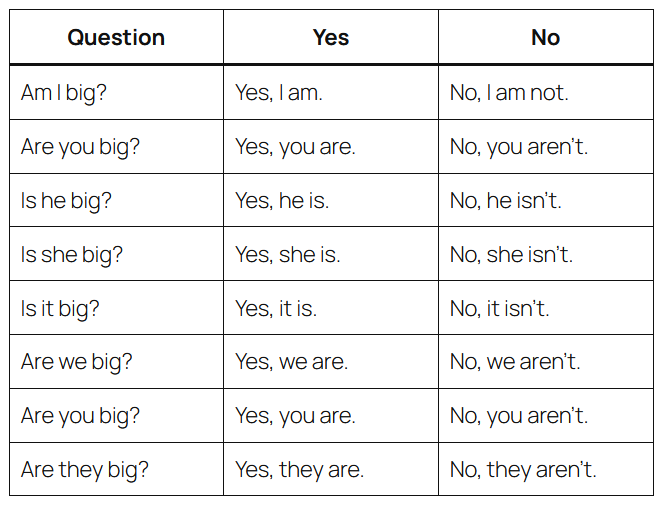
Am I big?
Yes, I am.
No, I am not.
Are you big?
Yes, you are.
No, you aren’t.
Is he big?
Yes, he is.
No, he isn’t.
Is she big?
Yes, she is.
No, she isn’t.
Is it big?
Yes, it is.
No, it isn’t.
Are we big?
Yes, we are.
No, we aren’t.
Are you big?
Yes, you are.
No, you aren’t.
Are they big?
Yes, they are.
No, they aren’t.
#####################
False statements, give a short answer, followed by the correct statement:
Aye Thandar is from Mandalay.
YOU WRITE: No, she isn’t. She is from Yangoon.
She is 20 years old. ___________________________
She is a teacher. ___________________________
She goes to school on Sunday. ___________________________
She likes to eat bread and eggs. ___________________________
She drinks juice. ___________________________
She has no friends. ___________________________
Her friend’s name is Min. ___________________________
She likes to play football. ___________________________
She likes to read books. ___________________________
She visits the school on Sunday. ___________________________
She has a dog. ___________________________
The cat is big and black. ___________________________
Aye Thandar is sad. ___________________________
————————————-
Correct version:
No, she isn’t. She is from Yangon.
No, she isn’t. She is 18 years old.
No, she isn’t. She is a student.
No, she doesn’t. She goes to school every day.
No, she doesn’t. She likes to eat rice and curry.
No, she doesn’t. She drinks water.
No, she doesn’t. She has a friend.
No, her friend isn’t. Her friend’s name is Soe.
No, she doesn’t. She likes to play badminton.
No, she doesn’t. She likes to listen to music.
No, she doesn’t. She visits her family on Sunday.
No, she doesn’t. She has a cat.
No, it isn’t. The cat is small and white.
No, she isn’t. Aye Thandar is happy.
#################
Which is true? Answer in a complete sentence:
Is she from Yangon or Mandalay?
YOU WRITE: She is from Yangoon.
Is she 18 or 20 years old? ____________________________
Is she a student or a teacher? ____________________________
Does she go to school every day or only on Sunday? ____________________________
Does she like rice and curry or bread and eggs? ____________________________
Does she drink water or juice? ____________________________
Does she have a friend or no friends? ____________________________
Is her friend’s name Soe or Min? ____________________________
Does she like to play badminton or football? ____________________________
Does she like to listen to music or read books? ____________________________
Does she visit her family or school on Sunday? ____________________________
Does she have a cat or a dog? ____________________________
Is her cat small and white or big and black? ____________________________
Is Aye Thandar happy or sad? ____________________________
She works in an office. → She doesn’t work in an office.
We play music. → We don’t play music.
You like tea. → You don’t like tea.
He plays football. → He doesn’t play football.
She likes apples. → She doesn’t like apples.
I work in the morning. → I don’t work in the morning.
They live in town. → They don’t live in town.
#################
Do / Does?
___ opens the door?
___ you like coffee?
___ works in an office?
___ she live here?
___ likes pizza?
___ eats breakfast at 7 o’clock?
___ they play football?
___ likes music?
___ live near school?
___ he go to work every day?
___ answers the phone?
___ you work on Sunday?
___ cleans the house?
___ she like tea?
___ play tennis on Saturday?
___ watches TV in the evening?
________________________
Corrrect version:
Who opens the door?
Do you like coffee?
Who works in an office?
Does she live here?
Who likes pizza?
Who eats breakfast at 7 o’clock?
Do they play football?
Who likes music?
Who lives near school?
Does he go to work every day?
Who answers the phone?
Do you work on Sunday?
Who cleans the house?
Does she like tea?
Do they play tennis on Saturday?
Who watches TV in the evening?
#################
Question, negation:
She likes apples.
YOU WRITE: >>>>Does she like apples? >>>>She doesn’t like apples.
We live here. _____________________ _____________________
He works at home. _____________________ _____________________
They like music. _____________________ _____________________
It works well. _____________________ _____________________
I like tea. _____________________ _____________________
You work here. _____________________ _____________________
She lives near school. _____________________ _____________________
We like pizza. _____________________ _____________________
He plays football. _____________________ _____________________
They live in town. _____________________ _____________________
I work today. _____________________ _____________________
It opens the door. _____________________ _____________________
You like milk. _____________________ _____________________
——————————–
Correct version:
She likes apples. Does she like apples? She doesn’t like apples.
We live here. Do we live here? We don’t live here.
He works at home. Does he work at home? He doesn’t work at home.
They like music. Do they like music? They don’t like music.
It works well. Does it work well? It doesn’t work well.
I like tea. Do I like tea? I don’t like tea.
You work here. Do you work here? You don’t work here.
She lives near school. Does she live near school? She doesn’t live near school.
We like pizza. Do we like pizza? We don’t like pizza.
He plays football. Does he play football? He doesn’t play football.
They live in town. Do they live in town? They don’t live in town.
I work today. Do I work today? I don’t work today.
It opens the door. Does it open the door? It doesn’t open the door.
You like milk. Do you like milk? You don’t like milk.
##################
Short answers, basics:
Example Sentence
Yes
No
I learn the alphabet.
Yes, I do.
No, I don’t.
You read signs.
Yes, you do.
No, you don’t.
He practices speaking.
Yes, he does.
No, he doesn’t.
She watches cartoons.
Yes, she does.
No, she doesn’t.
It helps us learn English.
Yes, it does.
No, it doesn’t.
We use apps like Duolingo.
Yes, we do.
No, we don’t.
You read labels.
Yes, you do.
No, you don’t.
They make mistakes sometimes.
Yes, they do.
No, they don’t.
Question
Yes
No
Do I learn the alphabet?
Yes, I do.
No, I don’t.
Do you read signs?
Yes, you do.
No, you don’t.
Does he practice speaking?
Yes, he does.
No, he doesn’t.
Does she watch cartoons?
Yes, she does.
No, she doesn’t.
Does it help us learn English?
Yes, it does.
No, it doesn’t.
Do we use apps like Duolingo?
Yes, we do.
No, we don’t.
Do you read labels?
Yes, you do.
No, you don’t.
Do they make mistakes sometimes?
Yes, they do.
No, they don’t.
Question
Yes
No
Am I big?
Yes, I am.
No, I am not.
Are you big?
Yes, you are.
No, you aren’t.
Is he big?
Yes, he is.
No, he isn’t.
Is she big?
Yes, she is.
No, she isn’t.
Is it big?
Yes, it is.
No, it isn’t.
Are we big?
Yes, we are.
No, we aren’t.
Are you big?
Yes, you are.
No, you aren’t.
Are they big?
Yes, they are.
No, they aren’t.
#####################
Questions, short answers, correct statement:
She likes apples (bananas).
YOU WRITE: >>>>Does she like apples? >>>>No, she doesn’t. >>>>She likes bananas.
We live here (four miles away).
He works in his home (garden) .
They like music (reading).
It works well (badly).
I like tea (coffee).
You work here ( in an office).
She lives near the school (the hospital).
We like pizza (lasagne).
He plays football (tennis).
They live in town (in the countryside).
I work in the morning (afternoon) .
It opens the door (window).
You like milk (orange juice).
_________________________
Correct answers:
She likes apples (bananas). Does she like apples? No, she doesn’t. She likes bananas.
We live here (four miles away). Do we live here? No, we don’t. We live four miles away.
He works in his home (garden). Does he work in his home? No, he doesn’t. He works in the garden.
They like music (reading). Do they like music? No, they don’t. They like reading.
It works well (badly). Does it work well? No, it doesn’t. It works badly.
I like tea (coffee). Do I like tea? No, I don’t. I like coffee.
You work here (in an office). Do you work here? No, you don’t. You work in an office.
She lives near the school (the hospital). Does she live near the school? No, she doesn’t. She lives near the hospital.
We like pizza (lasagne). Do we like pizza? No, we don’t. We like lasagne.
He plays football (tennis). Does he play football? No, he doesn’t. He plays tennis.
They live in town (in the countryside). Do they live in town? No, they don’t. They live in the countryside.
I work in the morning (afternoon). Do I work in the morning? No, I don’t. I work in the afternoon.
It opens the door (window). Does it open the door? No, it doesn’t. It opens the window.
You like milk (orange juice). Do you like milk? No, you don’t. You like orange juice.
##################
Read:
My name is Anna. I am ten years old. I live in a small house. I have a dog. His name is Max. He is brown and small. I like Max.
Every morning, I eat breakfast. I eat bread and milk. I go to school. I like my school. I have a teacher. Her name is Mrs. Lee. I have friends. We play in the garden.
After school, I go home. I read a book. I play with Max. I eat dinner. I go to bed. I am happy.
_______________________
Rewrite story, start with
>>>>>>>>Her name is Anna. She is…………
make all changes necessary.
_______________________
Correct version
Her name is Anna. She is ten years old. She lives in a small house. She has a dog. His name is Max. He is brown and small. She likes Max.
Every morning, she eats breakfast. She eats bread and milk. She goes to school. She likes her school. She has a teacher. Her name is Mrs. Lee. She has friends. They play in the garden.
After school, she goes home. She reads a book. She plays with Max. She eats dinner. She goes to bed. She is happy.
Sokheng works at Bensley’s bar every day. He starts in the morning by cleaning the bar and preparing tools. He checks the drinks and makes sure everything is ready.
When guests come, Sokheng greets them with a friendly smile and talks to them. He asks what they like and remembers their favorite drinks. He makes drinks carefully. He mixes juices, alcohol, and flavors. Some drinks taste sweet. Some drinks taste sour. He tries fun new ideas to make drinks special and tasty.
Sokheng gives drinks to guests with a smile. He tells a small story about the drink or the ingredients. He listens to guests and talks with them. Guests feel happy because Sokheng makes them feel welcome. They enjoy the drinks and the stories.
After the bar closes, Sokheng cleans the tools and checks the stock. He thinks about new drinks for the next day. Sokheng works hard, shares joy, and helps people smile every day.
__________________________
Vocabulary:
a mixologist – a person who makes special drinks for people.
to clean – to make a place or thing free from dirt.
to prepare – to get something ready before using it.
a tool (bar) – something you use to help make drinks.
to check drinks – to look at drinks and make sure they are okay.
to make sure – to be certain that something is correct or ready.
to greet guests – to say hello to people when they arrive.
a smile – when your mouth turns up to show you are happy.
to remember – to keep information in your mind.
a favorite drink – the drink a person likes the most.
sweet – when food or a drink has sugar or tastes nice.
sour – when food or a drink tastes like lemon or vinegar.
fun ideas – new or interesting thoughts that make work enjoyable.
to make a drink tasty – to make a drink good to eat or drink.
an ingredient – something used to make a drink or food.
to make guests feel welcome – to help people feel happy and comfortable.
to enjoy – to feel happy and like something.
to check the stock (bar) – to see how many drinks and ingredients are ready.
to share joy – to make other people feel happy.
#################
Match the words to the correct definition:
Words:
a mixologist
to clean
to prepare
a tool (bar)
to check drinks
to make sure
to greet guests
a smile
to remember
a favorite drink
sweet
sour
fun ideas
to make a drink tasty
an ingredient
to make guests feel welcome
to enjoy
to check the stock (bar)
to share joy
—————– Definitions:
a. to look at drinks and make sure they are okay b. a person who makes special drinks for people c. new or interesting thoughts that make work enjoyable d. when food or a drink tastes like lemon or vinegar e. to say hello to people when they arrive f. to help people feel happy and comfortable g. something used to make a drink or food h. when your mouth turns up to show you are happy i. to make a drink good to eat or drink j. to make a place or thing free from dirt k. to get something ready before using it l. to feel happy and like something m. the drink a person likes the most n. to be certain that something is correct or ready o. to make other people feel happy p. to see how many drinks and ingredients are ready q. a person who works at a bar (not needed here, skip) r. when food or a drink has sugar or tastes nice s. to keep information in your mind
He starts his day by cooking food for guests. True is: He starts his day by cleaning the bar and preparing tools.
He cleans the bar and prepares tools in the morning.
Sokheng forgets to greet guests when they arrive. True is: Sokheng greets guests with a friendly smile when they arrive.
He remembers what drinks guests like.
Some drinks taste sweet.
Some drinks taste sour. True is: Some drinks taste different, but not sour.
He ignores fun ideas and never tries new drinks. True is: He tries fun ideas to make drinks special.
Sokheng makes guests feel welcome when they arrive.
Guests enjoy the drinks and small stories.
He does not work hard at the bar. True is: He works hard at the bar every day.
He never cleans the tools at the end of the day. True is: He cleans the tools at the end of the day.
He checks the drinks to make sure everything is ready.
He does not talk to guests while working. True is: He talks to guests while working.
###################
Which correct?
Does Sokheng work at Bensley’s bar or Bensley’s restaurant?
Does he start his day by cleaning the bar or cooking food?
Does Sokheng prepare tools or food in the morning?
Does he greet guests or ignore guests when they arrive?
Does he remember drinks that guests like or forget them?
Does he make drinks carefully or carelessly?
Do some drinks taste sweet or bitter?
Do some drinks taste sour or salty?
Does Sokheng try fun ideas or always make the same drinks?
Does he make guests feel welcome or unhappy?
Do guests enjoy the drinks and stories or dislike them?
Does Sokheng work hard or rest all day?
Does he check the drinks to make sure everything is ready or ignore them?
Does he clean the tools at the end of the day or leave them dirty?
________________________
Answers:
Sokheng works at Bensley’s bar.
He starts his day by cleaning the bar.
Sokheng prepares tools in the morning.
He greets guests when they arrive.
He remembers drinks that guests like.
He makes drinks carefully.
Some drinks taste sweet.
Some drinks taste sour.
Sokheng tries fun ideas.
He makes guests feel welcome.
Guests enjoy the drinks and stories.
Sokheng works hard.
He checks the drinks to make sure everything is ready.
He cleans the tools at the end of the day.
#################
Short answers, basics:
Example Sentence
Yes
No
I learn the alphabet.
Yes, I do.
No, I don’t.
You read signs.
Yes, you do.
No, you don’t.
He practices speaking.
Yes, he does.
No, he doesn’t.
She watches cartoons.
Yes, she does.
No, she doesn’t.
It helps us learn English.
Yes, it does.
No, it doesn’t.
We use apps like Duolingo.
Yes, we do.
No, we don’t.
You read labels.
Yes, you do.
No, you don’t.
They make mistakes sometimes.
Yes, they do.
No, they don’t.
Question
Yes
No
Do I learn the alphabet?
Yes, I do.
No, I don’t.
Do you read signs?
Yes, you do.
No, you don’t.
Does he practice speaking?
Yes, he does.
No, he doesn’t.
Does she watch cartoons?
Yes, she does.
No, she doesn’t.
Does it help us learn English?
Yes, it does.
No, it doesn’t.
Do we use apps like Duolingo?
Yes, we do.
No, we don’t.
Do you read labels?
Yes, you do.
No, you don’t.
Do they make mistakes sometimes?
Yes, they do.
No, they don’t.
Question
Yes
No
Am I big?
Yes, I am.
No, I am not.
Are you big?
Yes, you are.
No, you aren’t.
Is he big?
Yes, he is.
No, he isn’t.
Is she big?
Yes, she is.
No, she isn’t.
Is it big?
Yes, it is.
No, it isn’t.
Are we big?
Yes, we are.
No, we aren’t.
Are you big?
Yes, you are.
No, you aren’t.
Are they big?
Yes, they are.
No, they aren’t.
####################
Give short answers:
Does Sokheng clean the tools at the end of the day?
YOU WRITE: Yes, he does.
Does he ignore fun ideas for drinks? _________________________
Do some drinks taste sour? _________________________
Does Sokheng make guests feel welcome? _________________________
Does he not talk to guests while working? _________________________
Does he remember the drinks that guests like? _________________________
Do guests feel unhappy at the bar? _________________________
Does he check the drinks to make sure everything is ready? _________________________
Does he start his day by cooking food? _________________________
Does Sokheng work at Bensley’s bar? _________________________
Does he greet guests with a friendly smile? _________________________
Does he always make the same drinks? _________________________
Do some drinks taste sour? _________________________
Does he mix drinks carefully? _________________________
Does he work at the bar in the morning? _________________________
Does he get tools before guests arrive? _________________________
Do guests enjoy the drinks and small stories? _________________________
Does Sokheng share joy with guests? _________________________
Does he forget to greet guests? _________________________
Does Sokheng clean the bar in the morning? _________________________
_________________________
Correct version:
Does Sokheng clean the tools at the end of the day? Yes, he does.
Does he ignore fun ideas for drinks? No, he does not.
Do some drinks taste sour? Yes, they do.
Does Sokheng make guests feel welcome? Yes, he does.
Does he not talk to guests while working? No, he does not.
Does he remember the drinks that guests like? Yes, he does.
Do guests feel unhappy at the bar? No, they do not.
Does he check the drinks to make sure everything is ready? Yes, he does.
Does he start his day by cooking food? No, he does not.
Does Sokheng work at Bensley’s bar? Yes, he does.
Does he greet guests with a friendly smile? Yes, he does.
Does he always make the same drinks? No, he does not.
Do some drinks taste sweet? Yes, they do.
Does he mix drinks carefully? Yes, he does.
Does he work at the bar in the morning? Yes, he does.
Does he prepare tools before guests arrive? Yes, he does.
Do guests enjoy the drinks and small stories? Yes, they do.
Does Sokheng share joy with guests? Yes, he does.
Does he forget to greet guests? No, he does not.
Does Sokheng clean the bar in the morning? Yes, he does.
#################
True, false? Short answers, and correct statement.
Sokheng works at Bensley’s bar every day.
YOU WRITE: Yes, he does.
He starts his day by cooking food for guests.
YOU WRITE: No, he doesn’t. He starts in the morning by cleaning.
He cleans the bar and prepares tools in the morning. __________________________________
Sokheng forgets to greet guests when they arrive. __________________________________
He remembers the drinks that guests like. __________________________________
Some drinks taste sweet. __________________________________
Some drinks taste sour. __________________________________
He ignores fun ideas for drinks. __________________________________
Sokheng makes guests feel welcome. __________________________________
Guests enjoy the drinks and small stories. __________________________________
He does not work hard at the bar. __________________________________
He checks the drinks to make sure everything is ready. __________________________________
He cleans the tools at the end of the day. __________________________________
He never talks to guests while working. __________________________________
He mixes drinks carefully. __________________________________
He starts his day by sleeping at the bar. __________________________________
He shares joy with guests. __________________________________
Guests feel unhappy at the bar. __________________________________
——————————————–
Correct answers:
Sokheng works at Bensley’s bar every day. Yes, he does.
He starts his day by cooking food for guests. No, he doesn’t. He starts his day by cleaning the bar and preparing tools.
He cleans the bar and prepares tools in the morning. Yes, he does.
Sokheng forgets to greet guests when they arrive. No, he doesn’t. He greets guests with a friendly smile when they arrive.
He remembers the drinks that guests like. Yes, he does.
Some drinks taste sweet. Yes, they do.
Some drinks taste sour. No, they don’t. Drinks have different flavors, but not sour.
He ignores fun ideas for drinks. No, he doesn’t. He tries fun ideas to make drinks special.
Sokheng makes guests feel welcome. Yes, he does.
Guests enjoy the drinks and small stories. Yes, they do.
He does not work hard at the bar. No, he doesn’t. He works hard at the bar every day.
He checks the drinks to make sure everything is ready. Yes, he does.
He cleans the tools at the end of the day. Yes, he does.
He never talks to guests while working. No, he doesn’t. He talks to guests while working.
He mixes drinks carefully. Yes, he does.
He starts his day by sleeping at the bar. No, he doesn’t. He starts his day by cleaning the bar and preparing tools.
He shares joy with guests. Yes, he does.
Guests feel unhappy at the bar. No, they don’t. Guests feel happy at the bar.
###############
Interview: Tak talks about his friend Sokheng
1. Q: Who is Sokheng? A: Sokheng is my friend and a bartender.
2. Q: Where does he work? A: He works at Bensley’s bar.
3. Q: What does he do at the bar? A: He makes drinks and cleans the bar.
4. Q: When does he clean the bar? A: He cleans the bar in the morning.
5. Q: How does he make guests feel welcome? A: He greets them with a smile and remembers their drinks.
6. Q: Why do guests like his drinks? A: Because the drinks taste sweet and are fun.
7. Q: Who enjoys the drinks and stories? A: Guests enjoy the drinks and stories.
8. Q: What kind of ideas does he try? A: He tries fun ideas for drinks.
9. Q: How does he make drinks? A: He mixes drinks carefully.
10. Q: When does he clean the tools? A: He cleans the tools at the end of the day.
11. Q: Why is he a good bartender? A: Because he works hard and shares joy with guests.
12. Q: How does he surprise guests? A: He surprises them with new flavors and fun drinks.
###################
Match question to correct answer:
Questions:
Where do you work?
What do you do at the bar?
When do you clean the bar?
How do you make guests feel welcome?
Why do you try fun ideas for drinks?
Who enjoys your drinks?
How do you mix drinks?
When do you clean the tools?
Answers:
A. I mix drinks carefully. B. Guests enjoy my drinks and small stories. C. I greet them with a smile and remember their drinks. D. I clean the bar in the morning. E. I work at Bensley’s bar. F. I make drinks and clean the bar. G. Because I want the drinks to be special and tasty. H. I clean the tools at the end of the day.
______________________
Answers: 1-E, 2-F, 3-D, 4-C, 5-G, 6-B, 7-A, 8-H
______________________
Correct version:
1. Q: Where do you work? A: I work at Bensley’s bar.
2. Q: What do you do at the bar? A: I make drinks and clean the bar.
3. Q: When do you clean the bar? A: I clean the bar in the morning.
4. Q: How do you make guests feel welcome? A: I greet them with a smile and remember their drinks.
5. Q: Why do you try fun ideas for drinks? A: Because I want the drinks to be special and tasty.
6. Q: Who enjoys your drinks? A: Guests enjoy my drinks and small stories.
7. Q: How do you mix drinks? A: I mix drinks carefully.
8. Q: When do you clean the tools? A: I clean the tools at the end of the day.
A. It is brown and white. B. I feed it twice a day. C. Yes, I have got a pet. D. I keep it at home. E. It is three years old. F. It eats dog food and carrots. G. It is a dog. H. Its name is Max.