Schlagwort: English for cultural exchange tourism

  • Meet Sophea 6a (A1, present simple, after school, revised version)

    • life after school

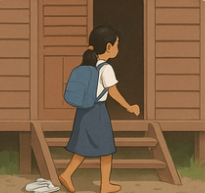
    Sophea is ten years old. She lives in a village in Cambodia. After school, she walks home. At home, she takes off her shoes and says hello to her family.
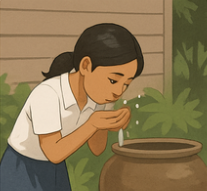
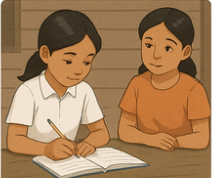
    She changes her clothes and washes her hands and face. Then she takes her school bag and opens her books. Sophea sits at the table or outside near the house. She does her homework. She writes and reads. Sometimes she asks her cousin or aunt for help.
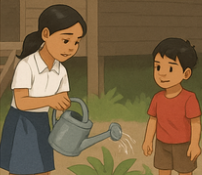
    After homework, she puts her books back in her bag. Then she helps at home. She waters the plants or plays with her little brother. In the evening, she eats dinner with her family.
    —————————————


    Vocabulary:

    • A village: A small place where people live.
    • To take off shoes: To remove your shoes.
    • To change clothes: To put on new clothes.
    • School bag: A bag for books and school things.
    • A cousin: The child of your uncle or aunt.
    • To water plants: To give water to plants.
    • Dinner: The meal you eat in the evening.

      #################

    True, false?

    1. Sophea is ten years old.
    2. Sophea lives in a city in Cambodia.
    3. After school, Sophea takes a bus home.
    4. Sophea takes off her shoes when she gets home.
    5. Sophea eats lunch with her family in the evening.
    6. Sophea does her homework outside near the house.
    7. Sophea asks her cousin or aunt for help with homework.
    8. Sophea has a sister who helps her with homework.
    9. Sophea waters the plants after homework.
    10. Sophea plays with her little brother in the evening.

      ————————————
    1. Sophea is ten years old.
    2. Sophea lives in a city in Cambodia.
    3. After school, Sophea takes a bus home.
    4. Sophea takes off her shoes when she gets home.
    5. Sophea eats lunch with her family in the evening.
    6. Sophea does her homework outside near the house.
    7. Sophea asks her cousin or aunt for help with homework.
    8. Sophea has a sister who helps her with homework.
    9. Sophea waters the plants after homework.
    10. Sophea plays with her little brother in the evening.

    ______________________

    True: 1,4,6,7,9,10


    #########################

    Ooooops, something went wrong, find the correct definitions:

    1. A village
      a. A bag for school things
    2. To take off shoes
      b. A small place where people live
    3. To change clothes
      c. To remove your shoes from your feet
    4. School bag
      d. To put on new clothes
    5. A cousin
      e. The meal you eat in the evening
    6. To water plants
      f. To give plants water
    7. Dinner
      g. The child of your uncle or aunt
    8. A home
      h. To clean your hands with water and soap
    9. To wash hands
      i. A place where you live with your family
    10. To read
      j. To look at words and understand them


      _____________________
      Answers:

      A villageb. A small place where people live
      To take off shoesc. To remove your shoes from your feet
      To change clothesd. To put on new clothes
      School baga. A bag for school things
      A cousing. The child of your uncle or aunt
      To water plantsf. To give plants water
      Dinnere. The meal you eat in the evening
      A homei. A place where you live with your family
      To wash handsh. To clean your hands with water and soap
      To readj. To look at words and understand them

    #####################

    Answer these questions (have a look at present simple first):

    1. How old is Sophea?
    2. Where does Sophea live?
    3. What does Sophea do after school?
    4. What does Sophea do when she gets home?
    5. Who does Sophea say hello to when she gets home?
    6. What does Sophea do after changing her clothes?
    7. Where does Sophea do her homework?
    8. Who helps Sophea with her homework?
    9. What does Sophea do after finishing her homework?
    10. What does Sophea do in the evening?
      ————————–

    Answers

    a. She takes off her shoes and says hello to her family.
    b. She puts her books back in her bag and helps at home.
    c. She lives in a village in Cambodia.
    d. She eats dinner with her family.
    e. She is ten years old.
    f. Sometimes her cousin or aunt helps her.
    g. She does her homework at the table or outside near the house.
    h. She washes her hands and face.
    i. She walks home.
    j. She says hello to her family.

    __________________________________

    Answers:

    1. How old is Sophea? – e. She is ten years old.
    2. Where does Sophea live? – c. She lives in a village in Cambodia.
    3. What does Sophea do after school? – i. She walks home.
    4. What does Sophea do when she gets home? – a. She takes off her shoes and says hello to her family.
    5. Who does Sophea say hello to when she gets home? – j. She says hello to her family.
    6. What does Sophea do after changing her clothes? – h. She washes her hands and face.
    7. Where does Sophea do her homework? – g. She does her homework at the table or outside near the house.
    8. Who helps Sophea with her homework? – f. Sometimes her cousin or aunt helps her.
    9. What does Sophea do after finishing her homework? – b. She puts her books back in her bag and helps at home.
    10. What does Sophea do in the evening? – d. She eats dinner with her family.

    ###################

    Ooooops, what is the correct sentence?

    1. after home school Sophea walks
    2. her She takes shoes.off
    3. her Sophea clothes at changes home
    4. does outside homework her She
    5. the Sophea plants water helps
    6. with dinner She eats family.
      ———————
    1. Sophea walks home after school.
    2. She takes off her shoes.
    3. Sophea changes her clothes at home.
    4. She does her homework outside.
    5. Sophea helps water the plants.
    6. She eats dinner with family.

    ######################


    Interview with Sophea
    (Link – how to form questions in present simple)

    1. What is your name?
    My name is Sophea.

    2. How old are you?
    I am ten years old.

    3. Where do you live?
    I live in a village.

    4. What do you do after school?
    I walk home after school.

    5. Who helps you with your homework?
    My cousin or aunt helps me.

    6. What do you do in the evening?
    I eat dinner with my family.


    Interview with Oum about Sophea

    1. Do you know Sophea?
    Yes, she is my friend.

    2. How old is Sophea?
    She is ten years old.

    3. Where does Sophea live?
    She lives in a village.

    4. What does Sophea do after school?
    She walks home.

    5. Does Sophea do her homework?
    Yes, she does her homework.

    6. Who helps Sophea at home?
    Her cousin or aunt helps her.

    #######################

    Form questions to which the words underlined are the answer
    (Link – how to form questions in present simple)


    1. She puts her books back in her bag.
    a) She
    b) her books
    c) in her bag

    2) Sophea sits at the table out in the garden.
    a) Sophea
    b) at the table out in the garden

    3) She plays in the garden in the evening.

    a) She
    b) plays
    c) in the garden
    d) in the evening
    ————————–

    Answers:
    Who puts her books back?
    What does she put back?
    Where does she put her books?

    Who sits at the table out in the garden?
    Where does Sophea sit?

    Who plays in the garden in the evening?
    What does she do in the garden?
    Where does she play?
    When does she play in the garden?

    ###################

    Fill in, complete:

    She eats ___________with her family.

    Sophea is ten __________old.

    She lives in a small ___________.

    She walks home after her _____________.

    She __________ her shoes.

    She says hello to her __________.

    She changes clothes and ___________her face.

    She does her homework __________.

    Her ___________ or aunt helps her.

    She __________the plants at home.

    ———————————–

    Answers:

    1. She eats dinner with her family.
    2. Sophea is ten years old.
    3. She lives in a small village.
    4. She walks home after her school.
    5. She takes off her shoes.
    6. She says hello to her family.
    7. She changes clothes and washes her face.
    8. She does her homework at the table or outside near the house.
    9. Her cousin or aunt helps her.
    10. She waters the plants at home.


    ###########################
    REWRITE THE STORY – follow instructions below:


    Sophea is ten years old.

    She lives in a village in Cambodia.

    After school, she walks home.

    At home, she takes off her shoes and says hello to her family.

    She eats dinner with her family.

    Sophea is ten years old.

    She lives in a small village.

    She walks home after her school.

    She takes off her shoes.

    She says hello to her family.

    She changes clothes and washes her face.

    She does her homework at the table or outside near the house.

    Her cousin or aunt helps her.

    She changes her clothes and washes her hands and face.

    Then she takes her school bag and opens her books.

    Sophea sits at the table or outside near the house.

    She does her homework. She writes and reads.

    Sometimes she asks her cousin or aunt for help.

    After homework, she puts her books back in her bag.

    Then she helps at home.

    She waters the plants or plays with her little brother.

    In the evening, she eats dinner with her family.
    —————————

    >>>>>>>YOU ARE SOPHEA;
    >>>>>>>YOU TELL YOUR STORY –
    >>>>>>>make all changes necessary:

    I am ten years old.

    I live in a village in Cambodia.

    After School, I walk……………………..

    ________________________________

    Correct version:


    I am ten years old.
    I live in a village in Cambodia.
    After school, I walk home.
    At home, I take off my shoes and say hello to my family.
    I change my clothes and wash my hands and face.
    Then I take my school bag and open my books.
    I sit at the table or outside near the house.
    I do my homework.
    I write and read.
    Sometimes I ask my cousin or aunt for help.
    After homework, I put my books back in my bag.
    Then I help at home.
    I water the plants or play with my little brother.
    In the evening, I eat dinner with my family.

    a speedy version:

  • Sareth: serving drinks, smiles, and great memories (A2, present simple)

    A friendly bartender who mixes skill, speed, and a warm welcome to give every guest a special experience.

    My name is Sareth, and I work as a bartender in a hotel. I believe I am a great bartender because I am friendly and approachable. When guests arrive at the bar, I always greet them with a warm smile and make them feel welcome. I like to create a relaxed and happy atmosphere where people can enjoy their time.

    I know a lot about drinks, such as cocktails, beers, and wines. If a guest is not sure what to order, I can recommend something they will enjoy. I listen carefully to their order and make sure I prepare the drink exactly as they want it.

    I work quickly and stay organized. Even during busy times, I can manage many orders at once and still keep the bar clean. I like to talk to customers, make them laugh, and keep the mood lively.

    I also serve drinks responsibly. If a guest has had enough, I know how to stop serving politely. I am good at solving problems and making sure guests leave happy.

    I pay attention to small details, like the garnish, the glass, and the way the drink looks. I work well with my team, and together we give the best service possible. For me, being a great bartender means more than making drinks—it means creating a special experience for every guest.
    _____________________

    Vocabs:


    to tell (told) – to say something to someone so they know it.

    memories – things you remember from the past.

    a bartender – a person who makes and serves drinks in a bar.

    skill – something you can do well because you learned it.

    an experience – something you do or feel that teaches you something.

    to believe (believed) – to think something is true.

    to be friendly (was/were) – to be kind and nice to people.

    to be approachable (was/were) – to be easy for people to talk to.

    to greet somebody (greeted) – to say hello to someone when you meet them.

    to feel welcome (felt) – to feel happy and accepted in a place.

    a relaxed atmosphere – a place that feels calm and comfortable.

    to enjoy time (enjoyed) – to like what you are doing.

    to order something (ordered) – to ask for food or drinks in a restaurant or bar.

    to recommend (recommended) – to tell someone they should try something.

    carefully – doing something with a lot of attention so you do not make mistakes.

    exactly – in a way that is 100% correct or the same as you wanted.

    to stay organized (stayed) – to keep things neat and in order.

    a busy time – a time when there are many things to do.

    to manage orders (managed) – to control and take care of many requests from customers.

    at once – at the same time.

    a customer – a person who buys something from a shop or business.

    a lively mood – a feeling of fun and energy in a place.

    to serve drinks responsibly (served) – to give drinks in a safe way, not giving too much alcohol.

    politely – in a kind and respectful way.

    to solve a problem (solved) – to find an answer to something difficult.

    to pay attention (paid) – to watch or listen carefully.

    garnish – small food or decoration you put on a dish or drink to make it look nice.

    to mean (meant) – to want to say or show something.

    ##################

    Multiple choice, one answer correct:

    part 1: 1-13

    part 2: 14-20


    1. What is a bartender?
      a) A person who cooks food
      b) A person who makes and serves drinks
      c) A person who cleans the bar
    2. What does „to tell“ mean?
      a) To say something to someone
      b) To listen carefully
      c) To eat food
    3. What are memories?
      a) Things you see now
      b) Things you forget quickly
      c) Things you remember from the past
    4. What does „to recommend“ mean?
      a) To suggest something to someone
      b) To buy something
      c) To clean the table
    5. What does „carefully“ mean?
      a) Doing something with attention to avoid mistakes
      b) Doing something very fast
      c) Doing something without thinking
    6. What is a customer?
      a) A person who buys something
      b) A person who cooks food
      c) A person who makes drinks
    7. What does „to greet somebody“ mean?
      a) To say goodbye
      b) To say hello when you meet someone
      c) To ignore someone
    8. What is a skill?
      a) Something you can do well
      b) Something you don’t like
      c) Something you see in a movie
    9. What does „to feel welcome“ mean?
      a) To feel happy and accepted
      b) To feel sad and alone
      c) To feel hungry
    10. What is a lively mood?
      a) A feeling of fun and energy
      b) A feeling of sleepiness
      c) A feeling of being bored
    11. What does „to order something“ mean?
      a) To clean the dishes
      b) To ask for food or drinks
      c) To cook food
    12. What does „to serve drinks responsibly“ mean?
      a) To stop serving drinks
      b) To give drinks carefully, not too much
      c) To give drinks very fast
    13. What is garnish?
      a) Food decoration on a dish or drink
      b) A type of drink
      c) A place to sit
    14. What does „to solve a problem“ mean?
      a) To forget about something
      b) To create a problem
      c) To find an answer to something difficult
    15. What does „exactly“ mean?
      a) Almost correct
      b) Not correct at all
      c) 100% correct or the same
    16. What does „to pay attention“ mean?
      a) To ignore what is happening
      b) To watch or listen carefully
      c) To talk loudly
    17. What is a relaxed atmosphere?
      a) A place that is very noisy
      b) A place that feels calm and comfortable
      c) A place that is scary
    18. What does „to manage orders“ mean?
      a) To take care of many requests from customers
      b) To make drinks
      c) To ignore customers
    19. What does „politely“ mean?
      a) In a rude way
      b) In a kind and respectful way
      c) In a fast way
    20. What does „to be friendly“ mean?
      a) To be angry
      b) To be kind and nice to people
      c) To be quiet

    ______________________
    Answers:

    1 b, 2 a, 3 c, 4 a, 5 a, 6 a, 7 b, 8 a, 9 a,
    10 a, 11 b, 12 b, 13 a, 14 c, 15 c, 16 b,
    17 b, 18 a, 19 b, 20 b

    ###############

    Multiple choice, one answer correct:


    1. A ______ makes and serves drinks in a bar.
      a) cook
      b) bartender
      c) driver
    2. When you meet someone, you ______ them politely.
      a) greet
      b) run
      c) eat
    3. Memories are things you ______ from the past.
      a) forget
      b) remember
      c) lose
    4. A good bartender knows how to ______ drinks.
      a) make
      b) clean
      c) write
    5. To serve drinks responsibly means to give drinks ______.
      a) quickly
      b) carefully
      c) loudly
    6. A customer is a person who ______ something.
      a) buys
      b) sells
      c) cooks
    7. To recommend means to ______ something to someone.
      a) hide
      b) suggest
      c) destroy
    8. When you pay attention, you ______ carefully.
      a) watch
      b) sleep
      c) run
    9. A lively mood means the place is full of ______.
      a) sleepiness
      b) energy
      c) silence
    10. To solve a problem means to find an ______.
      a) answer
      b) question
      c) mistake
    11. Garnish is a small decoration on food or ______.
      a) drink
      b) chair
      c) table
    12. When a place is relaxed, it feels ______ and calm.
      a) noisy
      b) scary
      c) comfortable
    13. To manage orders means to take care of many ______.
      a) cars
      b) books
      c) requests
    14. Being friendly means being ______ and kind.
      a) rude
      b) angry
      c) nice
    15. When you order something, you ask for food or ______.
      a) drinks
      b) clothes
      c) money
    16. To tell means to ______ something to someone.
      a) listen
      b) say
      c) eat
    17. Carefully means doing something with a lot of ______.
      a) speed
      b) attention
      c) noise
    18. Exactly means something is 100% ______.
      a) wrong
      b) late
      c) correct
    19. Politely means doing something in a ______ way.
      a) kind
      b) rude
      c) loud
    20. To feel welcome means to feel ______ and happy.
      a) sad
      b) hungry
      c) accepted

    Answers :
    1 b, 2 a, 3 b, 4 a, 5 b, 6 a, 7 b, 8 a,
    9 b, 10 a, 11 a, 12 c, 13 c, 14 c, 15 a,
    16 b, 17 b, 18 c, 19 a, 20 c


    _______________________

    Match the word to the definition:


    Words:

    1. memories
    2. bartender
    3. skill
    4. experience
    5. believe
    6. be friendly
    7. greet somebody
    8. feel welcome
    9. order something
    10. recommend
    11. stay organized
    12. busy time
    13. customer
    14. lively mood
    15. politely
    16. solve a problem

    Definitions:

    A. To say hello or welcome someone.
    B. A person who buys things or uses services.
    C. To think something is true.
    D. To give advice or suggest something to someone.
    E. The ability to do something well.
    F. A person who serves drinks in a bar.
    G. To ask for food, drink, or something you want.
    H. To make someone feel happy and comfortable in a place.
    I. To fix or find an answer to a problem.
    J. The past things you remember.
    K. A time when many people come and the place is full of activity.
    L. Doing something with respect and kindness.
    M. To be kind and nice to others.
    N. To keep things neat and in order.
    O. A happy and active feeling in a place.
    P. To do something in a polite way.


    ______________________

    Answers:
    1 J, 2 F, 3 E, 4 O, 5 C, 6 M, 7 A, 8 H, 9 G, 10 D,
    11 N, 12 K, 13 B, 14 O, 15 P, 16 I

    #################


    True or false :

    1. Sareth always greets customers with a smile.
    2. He knows many different drinks and can suggest the best one.
    3. Sareth works slowly because he likes to take his time.
    4. He listens carefully to what customers want.
    5. Sareth never talks to customers.
    6. He keeps the bar clean and organized during busy times.
    7. Sareth serves drinks to customers even if they are very drunk.
    8. He can handle many orders at the same time.
    9. Sareth pays attention to small details like decoration on drinks.
    10. He ignores problems and does not solve them.
    11. Sareth works well with other staff members in the bar.
    12. He makes the place feel friendly and welcoming for everyone.

    ______________________

    True: 1,2,4,6,8,9,11,12

    ################

    Fill in, words below:

    customers – greets – staff – serves – enjoy – organized – responsibly – skills – busy

    Sareth is a great bartender who works in a __________ bar.
    He is friendly and always __________ customers with a smile.
    He listens carefully and knows many __________ about drinks.
    Sareth can recommend the best drinks and __________ them quickly.
    He stays __________ even at busy times and pays attention to details like drink garnishes.
    Sareth talks politely with __________ and helps solve problems.
    He also knows when to serve drinks __________.
    Because of his experience and good attitude, customers feel welcome and __________ a lively atmosphere.
    Sareth works well with other __________ to give great service.


    ___________________
    Correct version:

    #######################

    Interview with Sareth, complete, words below:

    garnishes – wines – customers – busy – listen – smile – carefully – welcome – stay – responsibly – service


    1. Q: What do you do as a bartender?
      A: I serve drinks and talk with __________.
    2. Q: Are you friendly to customers?
      A: Yes, I am always friendly and __________.
    3. Q: Do you know many drinks?
      A: Yes, I know a lot about cocktails, beers, and __________.
    4. Q: How do you help customers choose drinks?
      A: I __________ to them and recommend drinks they like.
    5. Q: Do you work fast when the bar is busy?
      A: Yes, I work quickly and __________ organized.
    6. Q: Do you pay attention to small details?
      A: Yes, I pay attention to drink presentation and __________.
    7. Q: Do you talk with customers?
      A: Yes, I like to talk and create a good mood.
    8. Q: Do you serve drinks __________?
      A: Yes, I stop serving when customers have too much.
    9. Q: How do you solve problems in the bar?
      A: I listen ___________ and help customers politely.
    10. Q: Do you work well with other staff?
      A: Yes, teamwork is important to give good __________.
    11. Q: What do you do during __________ times?
      A: I manage many orders at once and stay calm.
    12. Q: Why do customers like your bar?
      A: Because I make them feel __________ and happy.

    ___________________

    Correct version:

    ##############

  • Shinta Mani Foundation – another role model – Mr. Dul Hing

    ……..graduating with a business degree,
    :

    ____be DUL HING____

    (useful links at the end of the page)

    From a Small Village to a Big Success

    This is the story of Dul Hing. He is a young man from a poor village. His father died when he was young. He wanted to go to university, but his family had no money.

    Then, the Shinta Mani Foundation gave him a student loan. This helped him study.

    He worked in hotels and studied hard. He graduated with a business degree. Now, he works at a five-star hotel. He is the manager of the spa.

    Hing’s life shows what is possible with help and hard work.
    —————–

    Vocabulary:

    • Village: A small group of houses in the countryside, not a city.
    • Success: When you do something well or achieve what you wanted.
    • Poor: Having little or no money, things, or food.
    • A loan: Money that you borrow and need to pay back later.
    • To study: To learn something, usually in school or by reading.
    • To graduate: To finish your studies at a school or university and get a certificate or degree.
    • A business degree: A certificate or title you get after studying business in university.
    • A spa: A place where people go to relax, often with massages, hot baths, and other treatments.

      #######################

    True/False?

    1. Dul Hing is from a poor village.

    2. Dul Hing’s father is still alive.

    3. Dul Hing wanted to study at a university.

    4. Dul Hing was given a job by the Shinta Mani Foundation.

    5. Dul Hing graduated with a business degree.

    6. Dul Hing works at a restaurant in a five-star hotel.‘

    7. Dul Hing is the manager of the spa at the hotel.

    ———————————————

    1. Dul Hing is from a poor village. (True)
    2. Dul Hing’s father is still alive. (False)
    3. Dul Hing wanted to study at a university. (True)
    4. Dul Hing was given a job by the Shinta Mani Foundation. (False)
    5. Dul Hing graduated with a business degree. (True)
    6. Dul Hing works at a restaurant in a five-star hotel. (False)
    7. Dul Hing is the manager of the spa at the hotel. (True)

    ####################

    Answer

    1. Write a sentence about his family.
    2. Write a sentence about his father.
    3. Write a sentence about what he wanted to do.
    4. Write a sentence about who helped him.
    5. Write a sentence about what he studied.
    6. Write a sentence about his job now.

    #####################

    Complete the story:

    From a Small _________ to a Big Success

    This is the story of Dul Hing. He is a young man from a _________ village. His father died when he was _________. He wanted to go to _________, but his family had no _________.

    Then, the Shinta Mani Foundation gave him a student _________ This helped him _________.

    He worked in hotels and _________ hard. He graduated with a business _________. Now, he _________ at a five-star hotel. He is the manager of the _________.

    Hing’s life shows what is _________ with help and hard work.
    #######################


    Interview with Dul Hing

    1. Q: Where are you from?
    A: I am from a small village.

    2. Q: What was your life like as a child?
    A: My family was poor, and my father died when I was young.

    3. Q: What did you want to do when you were young?
    A: I wanted to study at a university.

    4. Q: Was it easy to go to school?
    A: No, it was hard because we had no money.

    5. Q: Who helped you?
    A: The Shinta Mani Foundation gave me a student loan.

    6. Q: What did you study?
    A: I studied business.

    7. Q: Did you finish your studies?
    A: Yes, I graduated with a business degree.

    8. Q: Where do you work now?
    A: I work at a five-star hotel.

    9. Q: What is your job at the hotel?
    A: I am the manager of the spa.

    10. Q: How do you feel about your life now?
    A: I am happy and proud. My dream came true.


    ####################

    An interview with Sochea, a friend of Dul Hing, talking about him


    1. Q: Who is Dul Hing?
    A: He is my good friend.

    2. Q: Where is he from?
    A: He is from a small village.

    3. Q: Was his family rich?
    A: No, his family was poor.

    4. Q: What happened to his father?
    A: His father died when he was young.

    5. Q: What did he want to do?
    A: He wanted to study at a university.

    6. Q: Who helped him go to school?
    A: The Shinta Mani Foundation helped him.

    7. Q: What did he study?
    A: He studied business.

    8. Q: Did he graduate?
    A: Yes, he graduated with a business degree.

    9. Q: Where does he work now?
    A: He works at a five-star hotel.

    10. Q: What is his job there?
    A: He is the manager of the spa. I am very proud of him.


    ######################

    Find words in text, then, which phrase are we looking for?

    __________________________

    Story adapted from https://www.facebook.com/ShintaManiFoundation

    Useful links:

    1. Listen to text => copy and paste text into https://ttsmp3.com/

    2. Past tense simple:
    https://learnenglish.britishcouncil.org/grammar/english-grammar-reference/past-simple

    https://www.ef.com/wwen/english-resources/english-grammar/simple-past-tense/