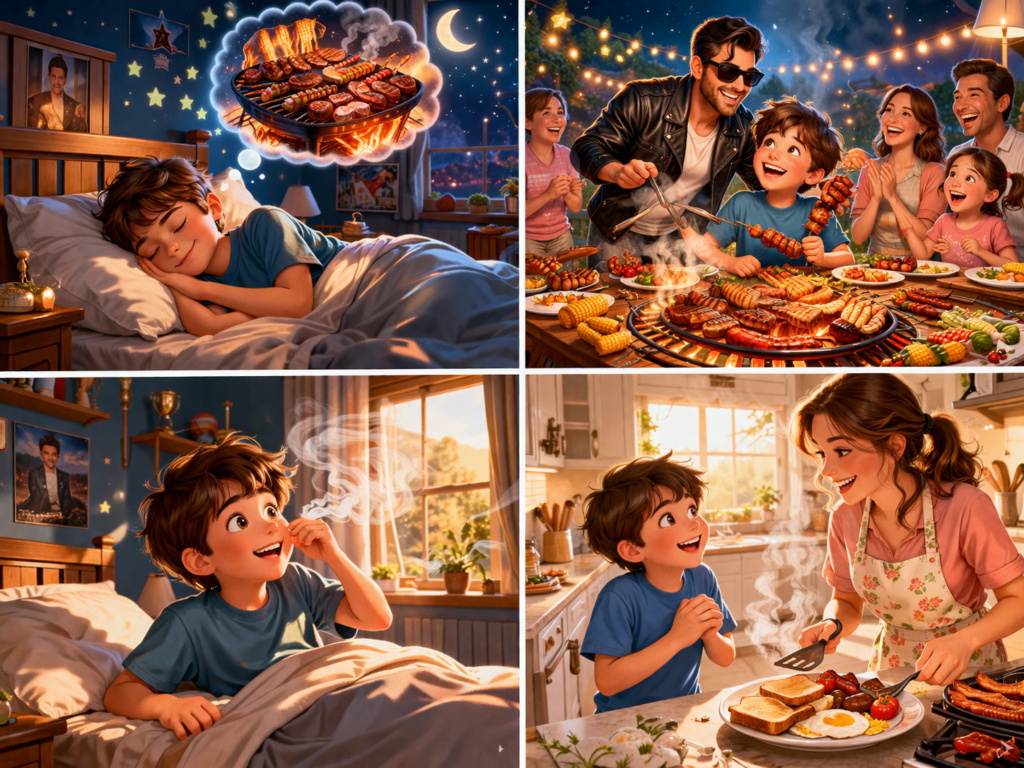
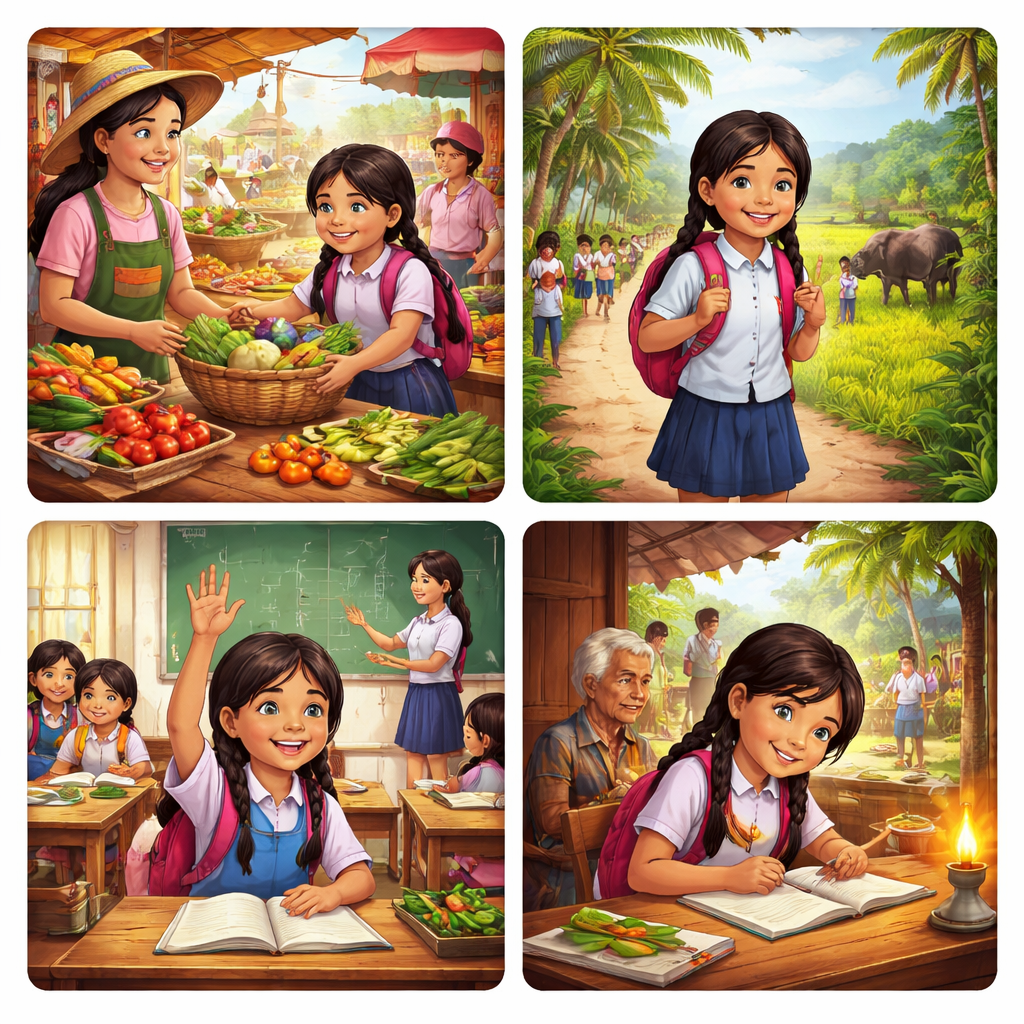
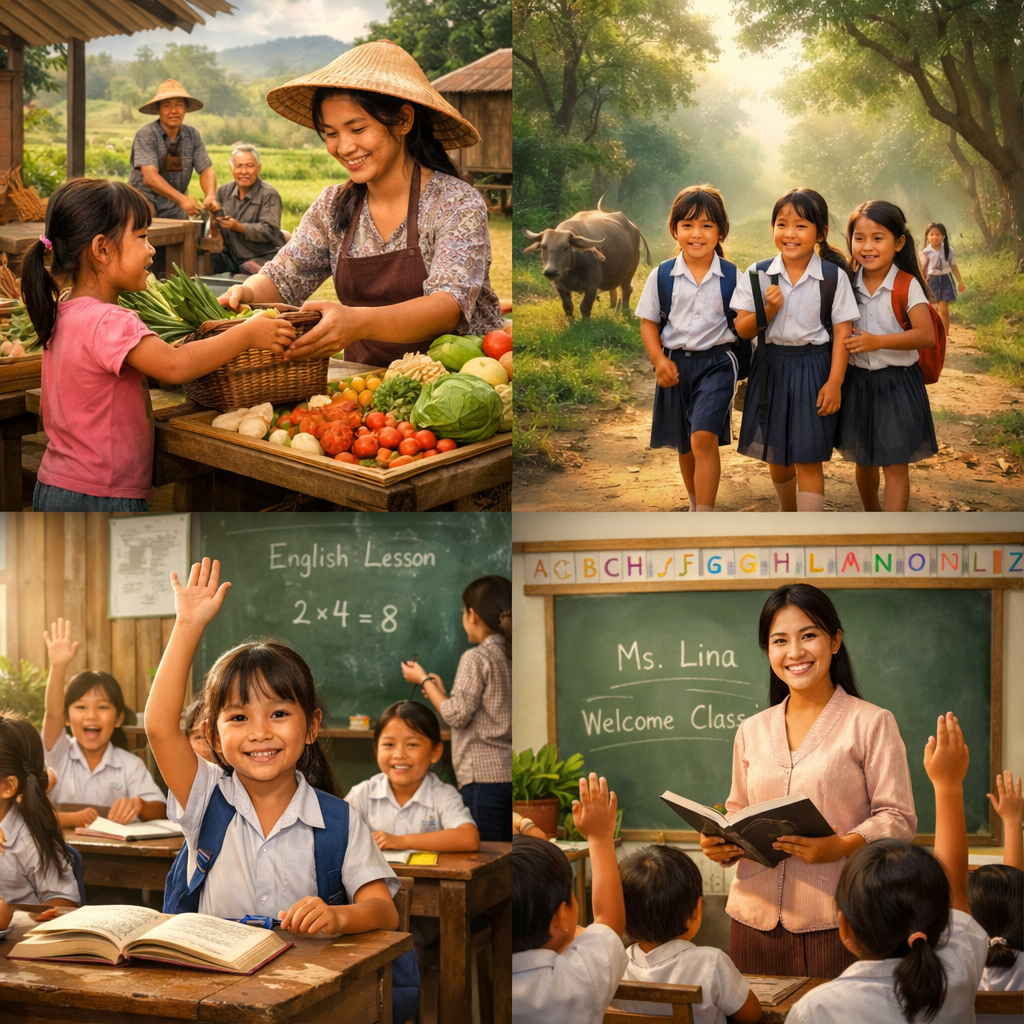
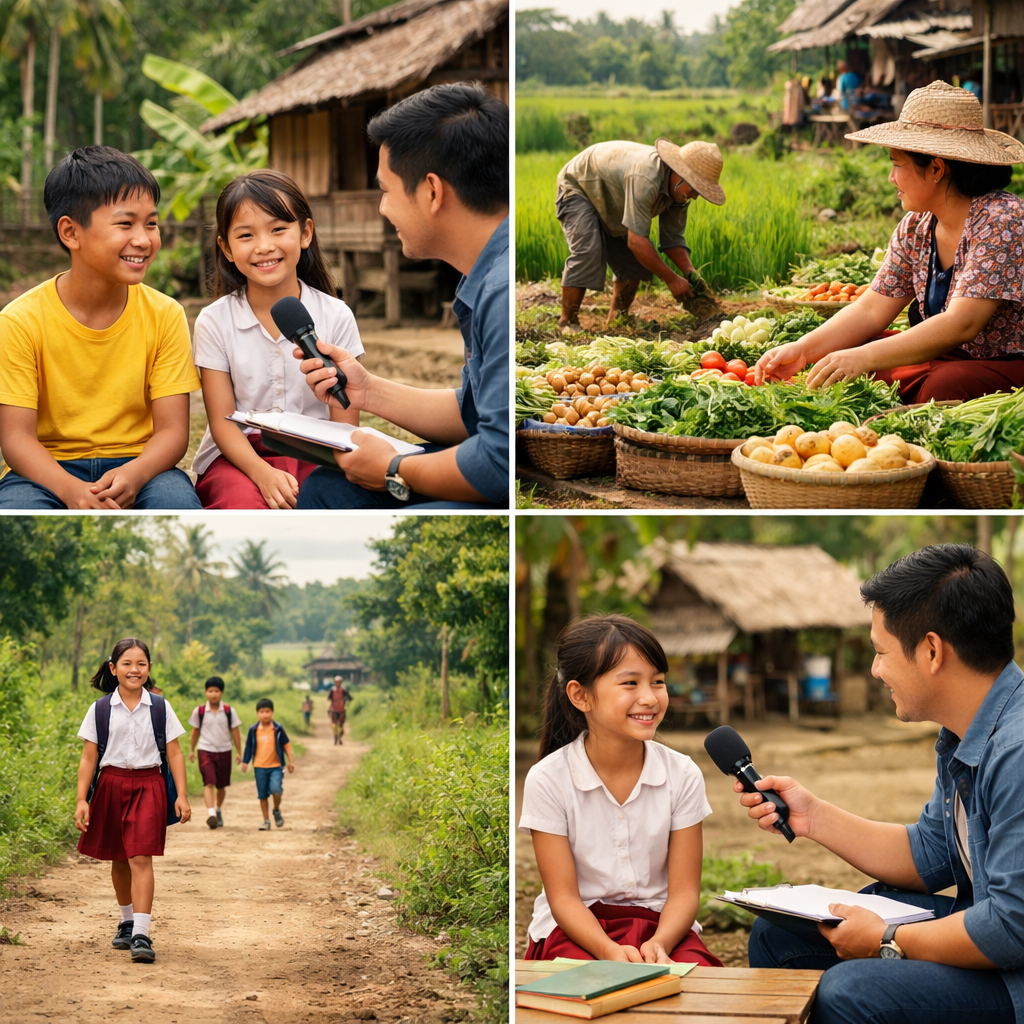
A strange dream, a quiet UFO, and a smell that stays in the bedroom
Vocabulary:
a lemon – a yellow fruit, sour taste
a secret – something you do not tell other people
the sky – the blue space above us
listening comprehension – understanding what you hear
a strange dream – a dream that is unusual or different
a smell – something you feel with your nose
to stay – to be in one place, not go away
a bedroom – a room where you sleep
to sleep – to rest at night with your eyes closed
to be dark – no light
to be quiet – no noise
a creature – a living being (person, animal, or alien)
to smile – to show happiness with your face
to take someone’s hand – to hold someone’s hand
a UFO – a flying object from space (unknown)
a planet – a big round object in space (like Earth)
to smell – to feel a scent with your nose
strange – not normal, unusual
a soft light – light that is not strong or bright
to feel safe – to feel okay, not afraid
to feel sleepy – to feel tired, want to sleep
to take back – to bring someone to where they were before
to wake up – to stop sleeping
a light smell – a weak, not strong smell
##################
LISTEN ONLY, DO NOT LOOK AT TEXTS
Listen to the story, then do the following exercises below (full text at the end of the exercise)
________________________
True or false:
The UFO is dark and loud.
The boy sleeps in his bedroom at night.
The creatures take the boy to a car.
The boy feels happy and safe with the creatures.
His room is bright and noisy.
On the planet, the air smells like smoke.
Small green creatures come into his room.
The boy sleeps in the sky at night.
On the planet, the air smells like lemon.
The creatures take the boy to a UFO.
Red animals come into his room.
The UFO is bright and quiet.
His room is dark and quiet.
The boy feels scared [to feel afraid] and angry with the creatures.
_____________________
True: 2,4,7,9,10,12,13
##################
(a) or (b)?
1
(a) The room is dark and quiet. (b) The room is full of light.
2
(a) Green creatures come into the room. (b) Red creatures come into the room.
3
(a) The creatures leave the boy alone. (b) The creatures take the boy’s hand.
4
(a) They go to a train station. (b) They go to a UFO.
5
(a) The UFO is bright and quiet. (b) The UFO is loud and dark.
6
(a) The boy feels scared. (b) The boy feels safe.
7
(a) The air smells like smoke. (b) The air smells like lemon.
8
(a) The boy wakes up in the garden. (b) The boy wakes up in his bed.
9
(a) They play games together. (b) They work all night.
10
(a) The boy feels happy. (b) The boy feels angry.
11
(a) The boy feels sleepy. (b) The boy feels energetic [full of energy, active, and not tired.].
12
(a) He smells smoke in his room. (b) He smells a light lemon smell.
_________________________
Answers:
1a,2a,3b,4b,5a,6b,7b,8b,9a,10a,11a,12b
##################
Listen and complete the following text – dictation, if necessary click on
A boy sleeps in his __________ at night. His room is dark and quiet. Small green __________ come into his room. They smile and take his hand. They __________him to a UFO. The UFO is bright and quiet. They fly to their __________. The air smells like lemon. The boy sees strange trees and soft__________. The creatures show him their home. They play games and __________. The boy feels happy and safe. After some time, he feels __________. They take him back to his bed. In the morning, he __________ up. He is not sure if it was a dream. He smells a light __________ smell.
##################
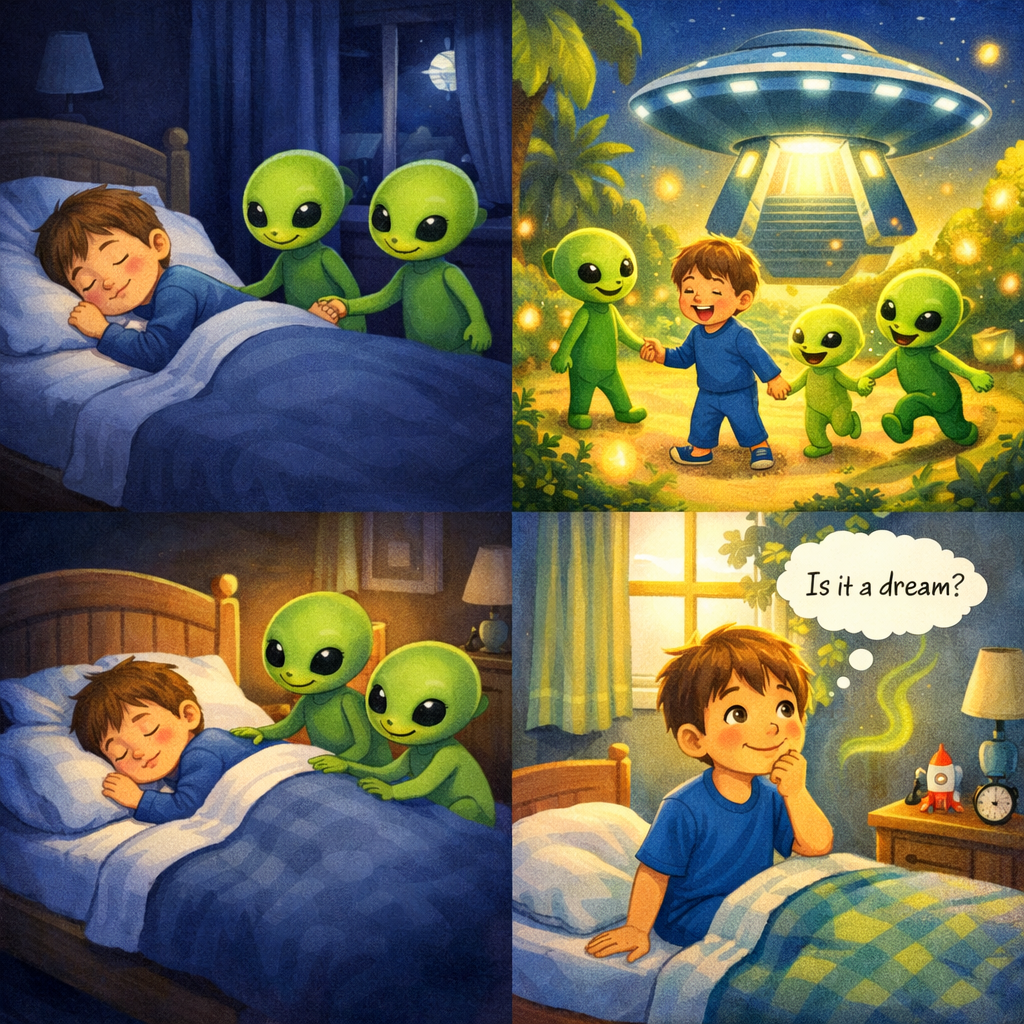
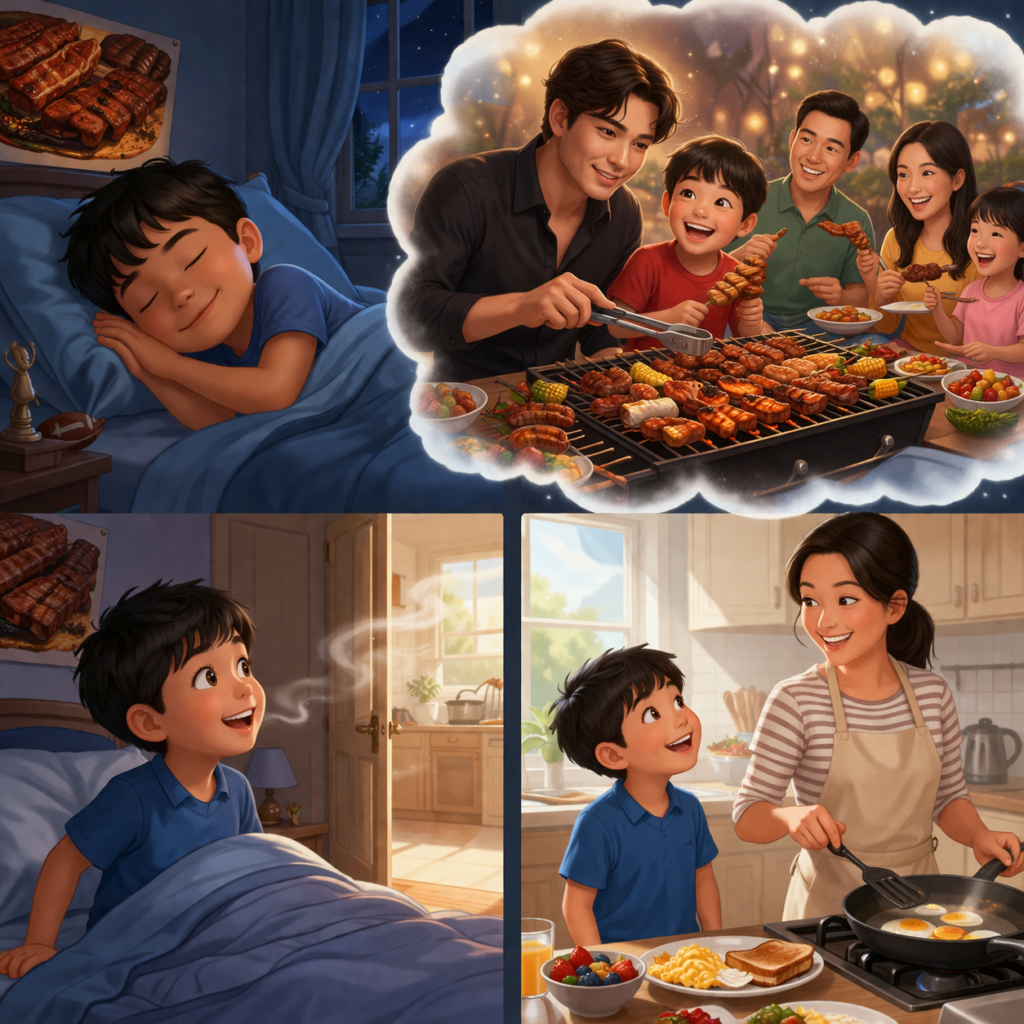
A young boy sleeps at night. His room is dark and quiet. Small green creatures come into his room. They smile and take his hand. They go with him to a UFO. The UFO is bright and quiet.
They fly to their planet. The air smells like lemon. The boy sees strange trees and soft lights. The creatures show him their home. They play games with him. They laugh and have fun. The boy feels happy and safe.
After some time, he feels sleepy. The creatures take him back to his bed.
In the morning, the boy wakes up. He looks around his room. Everything is normal. He asks, “Is it a dream?” Then he smells a light lemon smell. He smiles and thinks about the night.
Listen and complete the following text – dictation, if necessary click on
Ben is a __________. One morning, he wakes up late and _________ nervous. He gets ready quickly and runs to school. He _________just in time for the lesson. The teacher starts the lesson in the _________. Ben feels proud but also a _________ worried. The other students notice something _________. Ben is wearing two different _________. The students _________ in class. Ben feels shy for a moment. Then he _________to laugh too. The situation becomes very _________ for everyone.
———————————–
Correct version:
Ben is a student. One morning, he wakes up late and feels nervous. He gets ready quickly and runs to school. He arrives just in time for the lesson. The teacher starts the lesson in the classroom. Ben feels proud but also a little worried. The other students notice something funny. Ben is wearing two different shoes. The students laugh in class. Ben feels shy for a moment. Then he starts to laugh too. The situation becomes very funny for everyone.
################
ORIGINAL STORY
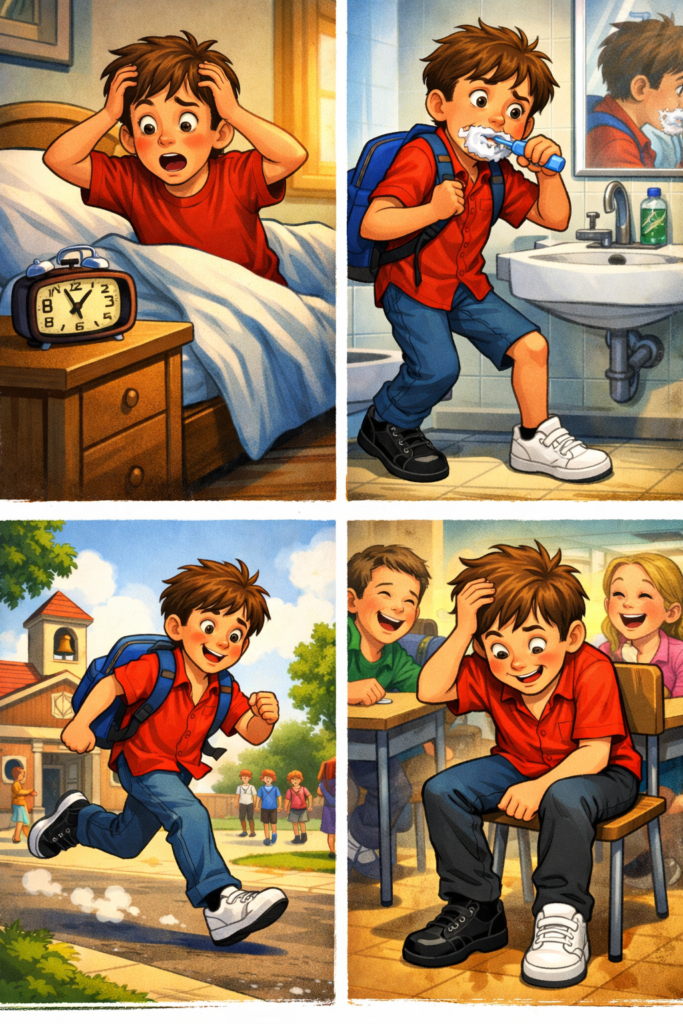
Ben is a student. He is often late for school. One morning, he wakes up very late. He looks at the clock and feels nervous.
Ben runs to the bathroom. He brushes his teeth very fast. He puts on his clothes quickly, but something is wrong. He does not see it.
Ben takes his bag and runs to school. He runs fast and arrives just in time. He sits in the classroom and feels proud.
The teacher starts the lesson. Ben looks at his friends. They look at Ben and smile. Some students laugh.
Ben looks down at his clothes. He has two different shoes. One shoe is black, and one shoe is white.
Ben feels surprised and a little shy. Then he laughs too. Now the day is funny for everyone.
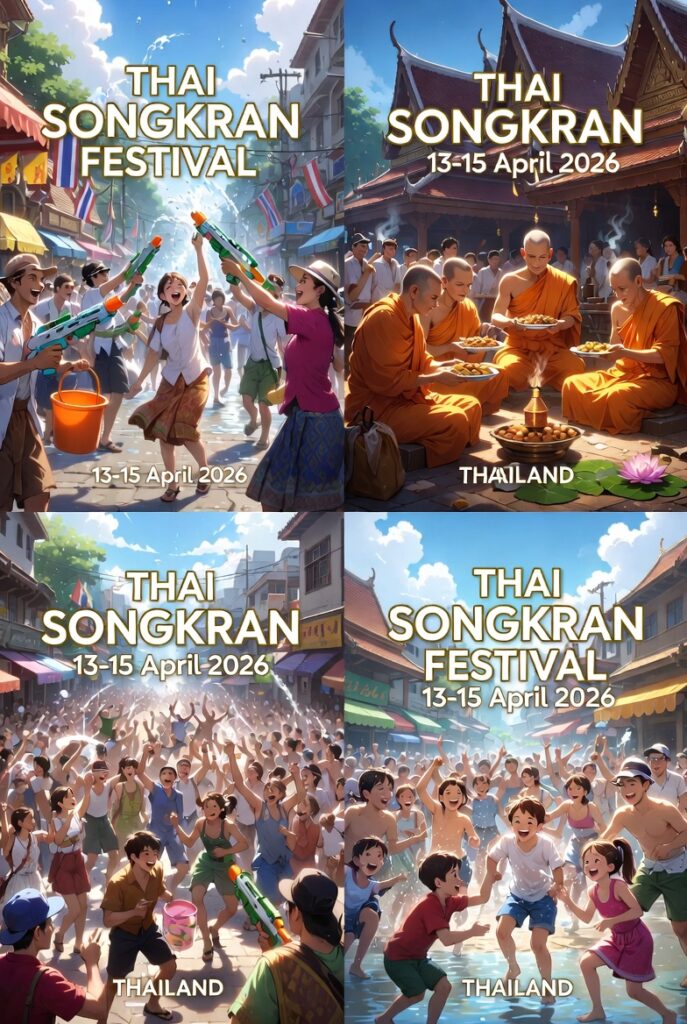
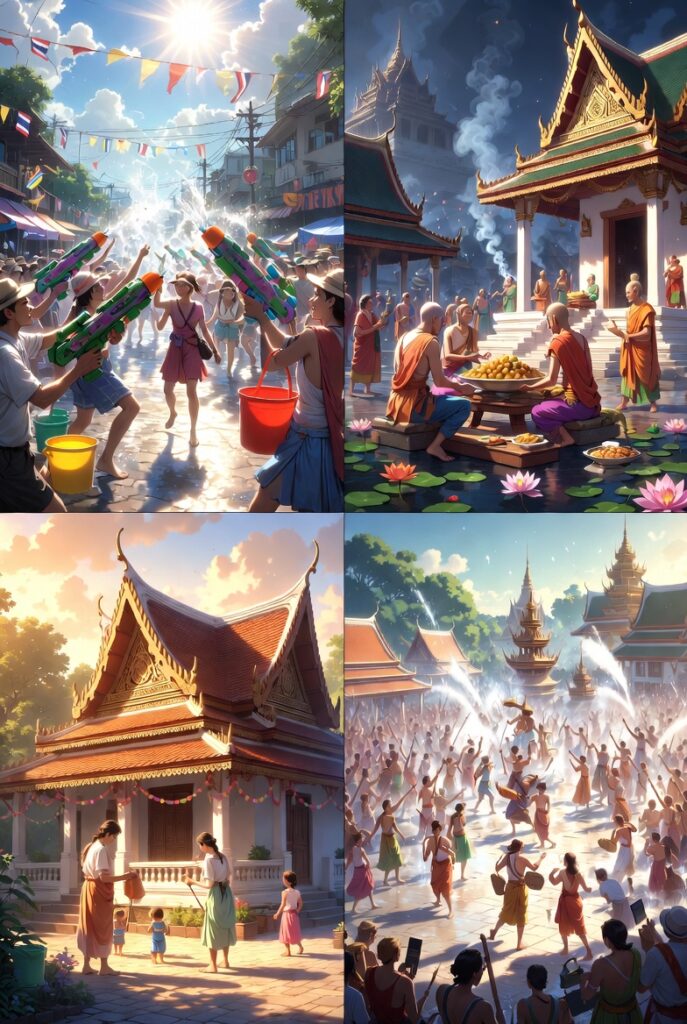
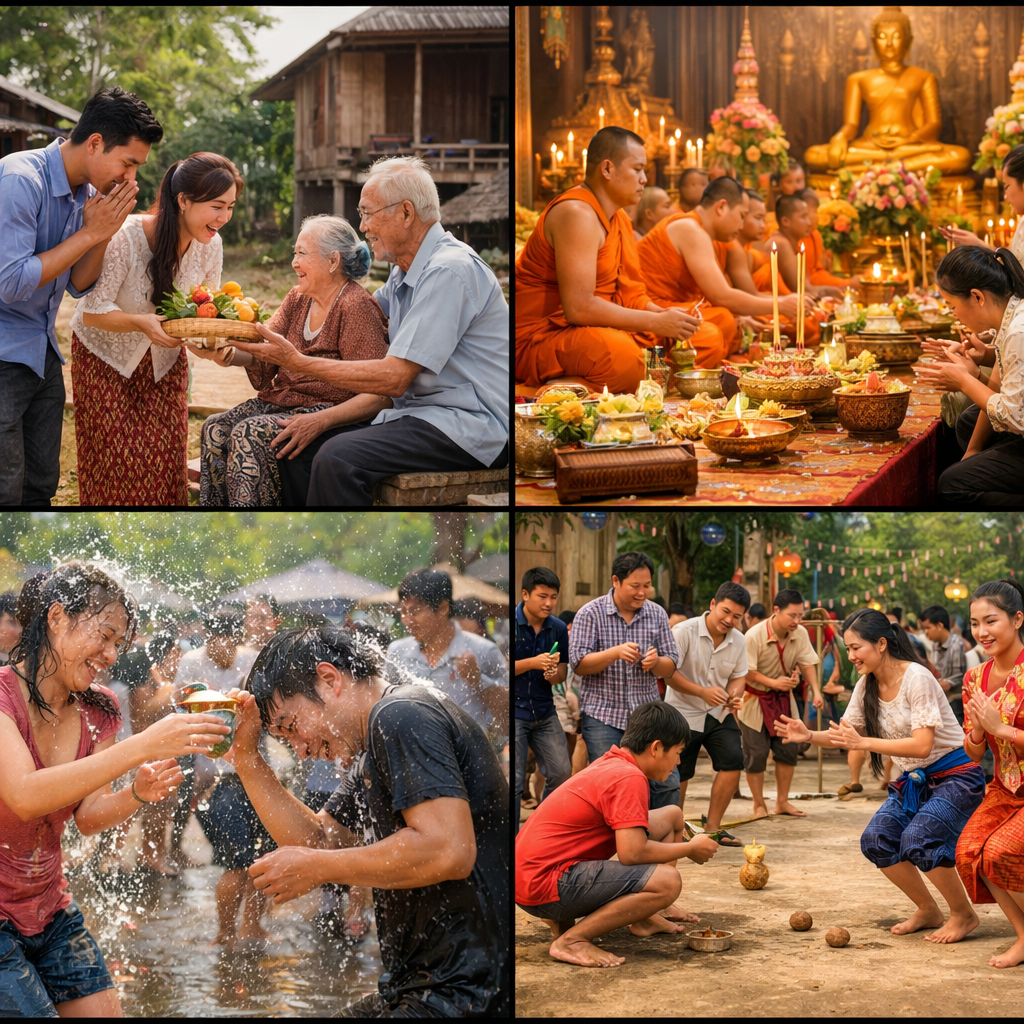
Thai New Year, Songkran Festival, takes place from 13 to 15 April 2026 in Thailand. It is an important festival for Thai people. It marks the traditional Thai New Year. People celebrate it with joy and energy. The festival is famous as a water festival. People splash water on each other in streets and public places. This action shows cleaning and new beginnings. It is celebrated across the country in cities and villages.
Families visit temples and make merit. They give food to monks and pray for good luck. Many people wear colorful clothes. Children and adults play with water guns. The weather is hot, so water feels refreshing. People clean their homes before the festival begins. Songkran creates happiness in communities. People enjoy spending time with their families during this holiday.
Many people travel back to their hometowns. Streets are busy with traffic and celebrations. Music and dancing happen in many places. Tourists also join the festival and enjoy the fun. Shops and markets stay open in many areas. Hotels and guesthouses are full during the festival.
Songkran shows respect for family and tradition. It brings people together in unity. Water symbolises purity and renewal in Thai culture. Communities organize events and cultural shows. People start celebrations early in the morning. Overall, Songkran is a joyful festival that connects people and shares happiness every year in Thailand. It is one of the most important festivals in Thailand.
Tourists visit Thailand during Songkran. They learn about Thai culture and traditions. They take photos and join water games. Local people welcome visitors with smiles. The festival helps the economy and tourism. Many roads close for safety. Police and volunteers help control crowds. Everyone stays careful but still enjoys the festival together. People feel happy and celebrate with joy every day together.
_________________________
Vocabulary:
a celebration: a happy event where people meet and enjoy something
to take place: to happen
to mark something: to show that something is important or special
joy: a very happy feeling
to splash water: to throw water on someone or something
cleaning: making something clean
to celebrate: to do something happy for a special day or event
to make merit: to do good things in Buddhism for good luck
a monk: a religious man who lives in a temple
to pray for luck: to ask for good things to happen in the future
to wear colorful clothes: to put on clothes with many bright colors
an adult: a grown-up person
to feel refreshing: to feel cool and nice
a community: a group of people living in one area
to enjoy: to like something and feel happy about it
to spend time with one’s family: to be with family and do things together
traffic: cars, buses, and other vehicles on the road
to join: to take part in something with others
to show respect for something: to act politely and honor something
purity: being clean and pure
renewal: a new start or becoming new again
an event: something that happens, often special
to be joyful: to feel very happy
to connect people: to bring people together
to share something: to give or enjoy something with others
to close for safety: to stop using a road or place to keep people safe
a volunteer: a person who helps without getting money
to control crowds: to manage many people in a safe way
to stay careful: to act in a safe and not risky way
###################
Match words to definitions:
Words:
a celebration
to take place
to mark something
joy
to splash water
cleaning
to celebrate
to make merit
a monk
to pray for luck
to wear colorful clothes
an adult
to feel refreshing
a community
to enjoy
to spend time with one’s family
traffic
to join
to show respect for something
purity
renewal
an event
to be joyful
to connect people
to share something
to close for safety
a volunteer
to control crowds
to stay careful
Definitions:
A. to feel very happy B. to manage many people in a safe way C. to happen D. a happy feeling E. to give or enjoy something with others F. a very happy event where people meet and enjoy something G. to throw water on someone or something H. to act politely and honor something I. to show that something is important or special J. to take part in something with others K. a religious man who lives in a temple L. a group of people living in one area M. to feel cool and nice N. to become new again or have a new start O. a grown-up person P. to ask for good things to happen in the future Q. to do something happy for a special day or event R. cars, buses, and other vehicles on the road S. to make something clean T. to be with family and do things together U. to do good things in Buddhism for good luck V. to put on clothes with many bright colors W. a person who helps without getting money X. to act in a happy way Y. to stop using a road or place to keep people safe Z. being clean and pure
a very happy event where people meet and enjoy something
to manage many people in a safe way
to put on clothes with many bright colors
to feel very happy
to take part in something with others
to show that something is important or special
a group of people living in one area
to throw water on someone or something
to act politely and honor something
to happen
to ask for good things to happen in the future
to make something clean
cars, buses, and other vehicles on the road
a religious man who lives in a temple
to be with family and do things together
Words:
A. to take place B. a community C. to spend time with one’s family D. traffic E. a celebration F. to show respect for something G. to join H. to control crowds I. cleaning J. joy K. to splash water L. a monk M. to wear colorful clothes N. to mark something O. to pray for luck
What do people do during Songkran? ________________
Why do people visit temples? ________________
Do you stay in the temple during Songkran? ________________
What do you do in the temple? ________________
Do many people come to the temple? ________________
How do people show respect to monks? ________________
What clothes do people wear? ________________
Is Songkran a happy festival? ________________
Do families stay together during Songkran? ________________
What is the meaning of Songkran for you? ________________
—————————————
Answers:
A. It shows renewal, respect, and happiness. B. It happens in April. C. They offer food and water and pray. D. I remain in the temple. E. They make merit and pray for good luck. F. Songkran means the Thai New Year festival. G. It brings joy to everyone. H. They put on colorful clothes. I. I pray and teach kindness. J. Many visitors arrive to make merit. K. They spend time with family. L. They splash water and visit temples.
1. Interviewer: What is Songkran? Monk: Songkran means the Thai New Year festival.
2. Interviewer: When does Songkran take place? Monk: It happens in April.
3. Interviewer: What do people do during Songkran? Monk: They splash water and visit temples.
4. Interviewer: Why do people visit temples? Monk: They make merit and pray for good luck.
5. Interviewer: Do you stay in the temple during Songkran? Monk: I remain in the temple.
6. Interviewer: What do you do in the temple? Monk: I pray and teach kindness.
7. Interviewer: Do many people come to the temple? Monk: Many visitors arrive to make merit.
8. Interviewer: How do people show respect to monks? Monk: They offer food and water and pray.
9. Interviewer: What clothes do people wear? Monk: They put on colorful clothes.
10. Interviewer: Is Songkran a happy festival? Monk: It brings joy to everyone.
11. Interviewer: Do families stay together during Songkran? Monk: They spend time with family.
12. Interviewer: What is the meaning of Songkran for you? Monk: It shows renewal, respect, and happiness.
####################
Final test – fill in 😉
Songkran is the Thai New Year __________ It __________ place from 13 to 15 April every year. People __________ water on each other during the festival. Many people visit temples to make __________ and pray for luck. __________ live in temples and teach people about kindness. Families spend __________ together during Songkran. People wear __________ clothes and enjoy the celebrations. Traffic becomes heavy because many __________ travel. The festival shows respect, __________, and renewal. Songkran connects people and strengthens the __________.
__________________________
Correct version:
Songkran is the Thai New Year festival. It takes place from 13 to 15 April every year. People splash water on each other during the festival. Many people visit temples to make merit and pray for luck. Monks live in temples and teach people about kindness. Families spend time together during Songkran. People wear colorful clothes and enjoy the celebrations. Traffic becomes heavy because many people travel. The festival shows respect, joy, and renewal. Songkran connects people and strengthens the community.
A traditional Cambodian festival of family, faith, fun, and new hope for the year ahead
Khmer New Year
Khmer New Year is a big festival in Cambodia. It is also called “Chaul Chnam Thmey.” People celebrate it in April every year. The festival usually lasts for three days. It is one of the most important holidays in the country.
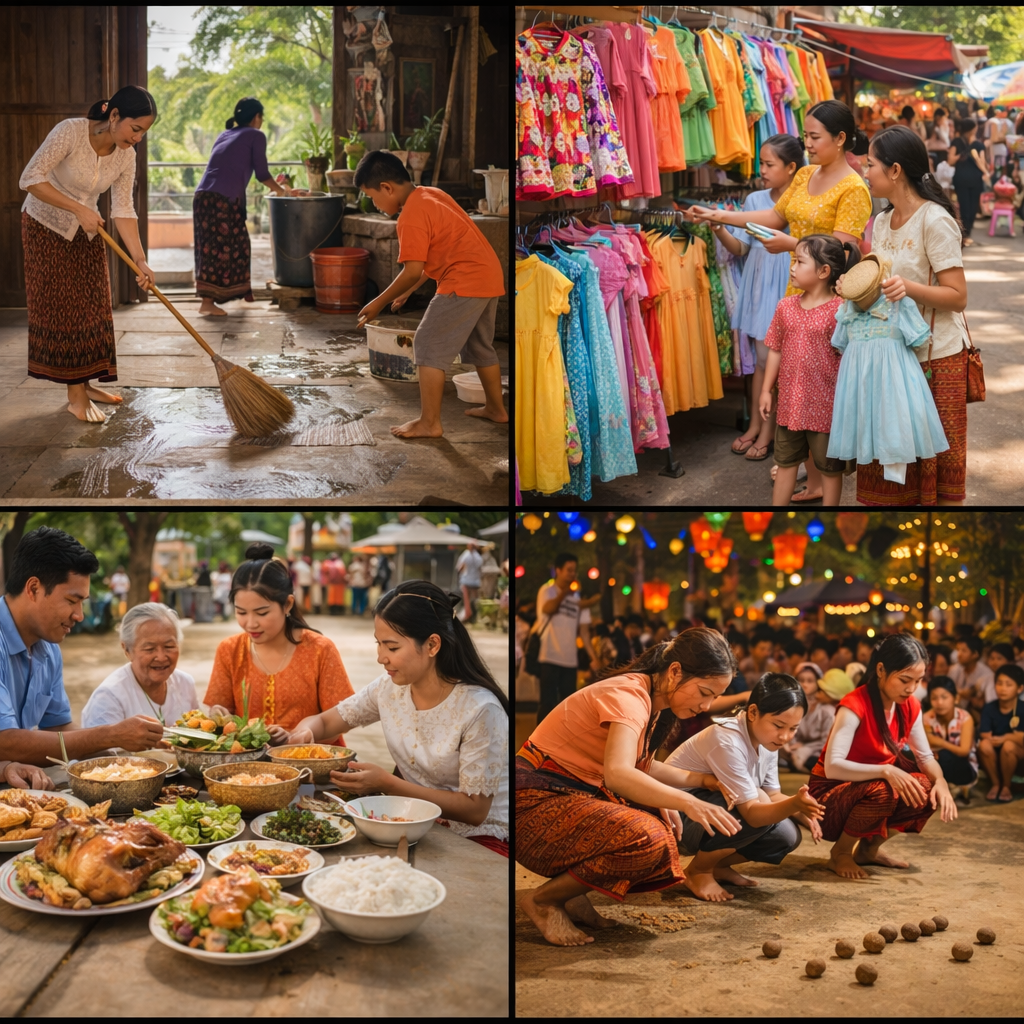
Before the New Year, people clean their houses. They wash floors, walls, and clothes. They believe cleaning brings good luck. Many people also buy new clothes for the festival.
During Khmer New Year, many people travel to their home towns. They visit their parents, grandparents, and relatives. Families spend time together and talk. People are happy to meet each other again.
People also go to the temple during the festival. They pray and give food to monks. They light candles and incense. They listen to prayers and sit quietly. They hope for good health and peace in the new year.
There are many traditional games during Khmer New Year. Children and young people play simple games in villages and towns. One popular game is “Bos Angkunh.” People also dance and listen to music in groups. These activities make the festival fun.
Water is also part of the celebration. People gently throw water on friends and family. This shows good wishes and happiness for the new year. People laugh and smile during this activity.
Food is very important in the festival. Families cook special meals at home. They share food with relatives and guests. They also give food to monks at the temple.
Khmer New Year is a happy time for all Cambodian people. It brings family, tradition, and hope for a new year.
_____________________
Vocabulary:
joyful – very happy
faith – strong belief in religion or God
hope – a good feeling that something will be better
the year ahead – the next year
to celebrate – to do something happy for a special day
to last for 3 days – to continue for three days
to clean – to make something not dirty
to wash floors – to clean the ground with water
to believe – to think something is true
to bring good luck – to give good things or good fortune
a hometown – the town where you were born or grew up
a relative – a family member
a monk – a religious man who lives in a temple
to light a candle – to make a candle start burning
incense – something that burns and smells nice in a temple
quietly – without noise
health – being not sick
an activity – something people do
gently – softly, not hard
to share food – to give food to others and eat together
a monk – (same as above) a religious man in a temple
###############
Match with definitions:
Words
1 joyful 2 incense 3 to clean 4 quietly 5 a monk 6 hope 7 to wash floors 8 health 9 a relative 10 to celebrate 11 gently 12 to believe 13 to share food 14 a hometown 15 to bring good luck 16 an activity 17 to light a candle 18 to last for 3 days 19 faith 20 the year ahead
Definitions
A to make something not dirty B strong belief in religion or God C a family member D to continue for three days E the next year F to think something is true G something people do H a good feeling that something will be better I to clean the ground with water J to give food to others and eat together K to do something happy for a special day L a religious man in a temple M to give good things or good fortune N very happy O without noise P softly, not hard Q something that burns and smells nice in a temple R to make a candle start burning S being not sick T the town where you were born or grew up
1 very happy 2 something that burns and smells nice in a temple 3 to make something not dirty 4 without noise 5 a religious man in a temple 6 a good feeling that something will be better 7 to do something happy for a special day 8 being not sick 9 a family member 10 softly, not hard 11 to think something is true 12 the town where you were born or grew up 13 to give good things or good fortune 14 something people do 15 the next year
Word:
A hope B gently C incense D to clean E a relative F to celebrate G quietly H a monk I health J joyful K an activity L a hometown M to bring good luck N to believe O the year ahead
Cambodia / in / festival / big / New / Khmer / is / a / Year
usually / in / April / every / it / year / happens
for / lasts / days / three / the / festival
go / the / people / to / their / home / festival / towns / during
clean / people / their / the / houses / before / New / Year
the / go / people / to / the / temple / during / festival
relatives / food / families / and / share / with / their / guests
the / monks / give / people / food / to / at / temple
children / play / traditional / the / games / during / Khmer / festival
gently / people / throw / water / on / each / other
__________________________
Correct sentences:
Khmer New Year is a big festival in Cambodia.
It usually happens in April every year.
The festival lasts for three days.
People go to their home towns during the festival.
People clean their houses before the New Year.
People go to the temple during the festival.
Families share food with their relatives and guests.
People give food to monks at the temple.
Children play traditional games during the Khmer festival.
People gently throw water on each other.
##################
Find the word that does not belong:
monk – temple – splash – incense
celebrate – drink – splash – water
banana – Cambodia – festival – April
tidy – clean – sleep – wash
school – temple – monk – incense
friends – family – carrot – relatives
joyful – sad – celebrate – happy
rice – food – water – airplane
village – house – computer – hometown
give – throw – pencil – splash
______________________
Correct answers:
1. monk – temple – splash – incense
👉 Does NOT belong: splash Why: monk, temple, incense are related to religion and the temple. Splash is an action with water.
2. water – celebrate – drink – splash
👉 Does NOT belong: celebrate Why: water, drink, splash are physical actions or water-related. Celebrate is a general festival activity, not a physical action with water.
3. banana – Cambodia – festival – April
👉 Does NOT belong: banana Why: Cambodia, festival, April are about place, event, and time. Banana is food.
4. clean – wash – sleep – tidy
👉 Does NOT belong: sleep Why: clean, wash, tidy are about making things clean. Sleep is resting.
5. school – temple – monk – incense
👉 Does NOT belong: school Why: temple, monk, incense are about religion. School is about education.
6. friends – family – carrot – relatives
👉 Does NOT belong: carrot Why: friends, family, relatives are people groups. Carrot is a vegetable.
7. joyful – sad – celebrate – happy
👉 Does NOT belong: sad Why: joyful, happy, celebrate are positive/festival-related. Sad is negative.
8. rice – food – water – airplane
👉 Does NOT belong: airplane Why: rice, food, water are basic food/drink. Airplane is transport.
9. village – house – computer – hometown
👉 Does NOT belong: computer Why: village, house, hometown are places. Computer is technology.
10. give – throw – pencil – splash
👉 Does NOT belong: pencil Why: give, throw, splash are actions. Pencil is an object.
#################
Give short answers:
What is Khmer New Year?
Where is it celebrated?
When does it happen every year?
How long does the festival last?
Why do people clean their houses before New Year?
Who do people visit during the festival?
Where do people go to pray?
What do people give to monks at the temple?
Which place do people visit for prayers and offerings?
How do people feel during Khmer New Year?
Do people travel to their home towns? (Yes/No)
Do families spend time together? (Yes/No)
What game do children play during the festival?
What do people do with water during the festival?
Who do people share food with?
Where do people celebrate with family?
Why is Khmer New Year a happy time?
Which tradition includes visiting temples and praying?
How many days does the festival last?
Do people work or rest during Khmer New Year? (Yes/No)
______________________
Correct version:
What is Khmer New Year? Khmer festival
Where is it celebrated? Cambodia
When does it happen every year? April
How long does the festival last? three days
Why do people clean their houses before New Year? good luck
Who do people visit during the festival? family / relatives
Where do people go to pray? temple
What do people give to monks at the temple? food
Which place do people visit for prayers and offerings? temple
How do people feel during Khmer New Year? happy
Do people travel to their home towns? (Yes/No) Yes
Do families spend time together? (Yes/No) Yes
What game do children play during the festival? traditional games
What do people do with water during the festival? splash water
Who do people share food with? relatives / guests
Where do people celebrate with family? home towns
Why is Khmer New Year a happy time? family / festival / celebration
Which tradition includes visiting temples and praying? temple visit / praying
How many days does the festival last? three
Do people work or rest during Khmer New Year? (Yes/No) rest
##################
Matching Exercise:
Questions:
What is your name and your role in the temple during Khmer New Year?
Where do you live and spend most of your time?
What happens at your temple during Khmer New Year?
How do people arrive at the temple during the festival?
What kinds of things do people bring with them?
What do you do with the visitors during Khmer New Year?
Why do many people go to the temple during this festival?
How do people show respect to monks?
What do you do to help people during the New Year?
What do children usually do when they come to the temple?
How do you feel during Khmer New Year?
What do you wish for all people after the festival?
Answers
A. I feel very happy because many people come together. B. I stay in a temple in Cambodia and spend most of my time there. C. They offer food to monks and sit quietly during prayers. D. I give blessings and pray for their health and happiness. E. They travel with their families and bring food and offerings. F. I am Venerable Sovan, and I work as a monk in the temple. G. I pray with them and give blessings for the new year. H. They look for good luck, peace, and a happy new year. I. They join traditional games and spend time with their families. J. They carry food, drinks, and small gifts for the monks. K. I hope they have good health, peace, and a good year ahead. L. Many people come to the temple to pray, give food, and join celebrations.
What is your name and your role in the temple during Khmer New Year? My name is Venerable Sovan, and I work as a monk in the temple.
Where do you live and spend most of your time? I stay in a temple in Cambodia and spend most of my time there.
What happens at your temple during Khmer New Year? Many people come to the temple to pray, give food, and join celebrations.
How do people arrive at the temple during the festival? They travel with their families and bring food and offerings.
What kinds of things do people bring with them? They carry food, drinks, and small gifts for the monks.
What do you do with the visitors during Khmer New Year? I pray with them and give blessings for the new year.
Why do many people go to the temple during this festival? They look for good luck, peace, and a happy new year.
How do people show respect to monks? They offer food to monks and sit quietly during prayers.
What do you do to help people during the New Year? I give blessings and pray for their health and happiness.
What do children usually do when they come to the temple? They join traditional games and spend time with their families.
How do you feel during Khmer New Year? I feel very happy because many people come together.
What do you wish for all people after the festival? I hope they have good health, peace, and a good year ahead.
######################
Final test – fill in:
Khmer New Year is a big __________ in Cambodia. It is also __________ Chaul Chnam Thmey. The festival usually happens in April every __________. It lasts for __________ days. People clean their __________ before the New Year. They believe cleaning brings good __________. Many people __________ to their home towns. They visit their families and __________. People __________ to the temple during the festival. They pray and give food to __________. Children play __________ games in villages. People gently throw __________ on each other. Families __________food and enjoy time together. Khmer New Year is a happy __________ for everyone.
————————————– Correct version:
Khmer New Year is a big festival in Cambodia. It is also called Chaul Chnam Thmey. The festival usually happens in April every year. It lasts for three days. People clean their houses before the New Year. They believe cleaning brings good luck. Many people travel to their home towns. They visit their families and relatives. People go to the temple during the festival. They pray and give food to monks. Children play traditional games in villages. People gently throw water on each other. Families share food and enjoy time together. Khmer New Year is a happy time for everyone.
listening comprehension: you listen and understand
to feel scared: you feel afraid
to be scared: you are afraid
crunch: a sound like crack when you step on something
leaves (one leaf): green parts of a tree
a sound: something you hear
to hold one’s arm: to take someone’s arm with your hand
to beat fast (heart): the heart goes very fast
to flap: to move wings up and down
a bat: a small animal that flies at night
to be quiet: no sound
maybe: not sure, it can be yes or no
##############
LISTEN ONLY, DO NOT LOOK AT TEXTS
Listen to the story, then do the following exercises below (full text at the end of the exercise)
##############
True is:
(a) The boy and the girl walk home. (b) The boy and the girl walk to school.
(a) It is night. It is dark. (b) It is day. It is bright.
(a) They go into a big street with many cars. (b) They go into a small street with many trees.
(a) “I am excited,” says the girl. (b) “I am scared,” says the girl.
(a) They walk slowly. (b) They walk quickly.
(a) The girl lets go of his arm. (b) The girl holds his arm.
(a) There are no lights. (b) There are many lights.
(a) They keep walking. (b) They stop.
(a) A bat flies over them. (b) A bird flies over them.
(a) They hear a sound. (b) They hear nothing.
(a) “Run now,” says the boy. (b) “It is okay,” says the boy.
(a) They walk slowly. (b) They run fast.
___________________ Correct Answers:
1a, 2a, 3b, 4b, 5a, 6b, 7a, 8b, 9a, 10a, 11b, 12b
#############
(a) or (b)?
Do the boy and the girl walk (a) to school or (b) home?
Is it (a) day or (b) night?
Are there (a) lights or (b) no lights?
Is the street (a) small or (b) big?
Is the girl (a) scared or (b) happy?
Does the boy say (a) “It is okay” or (b) “Run now”?
Do they walk (a) slowly or (b) fast?
Does a (a) bird or (b) bat fly over them?
Do they (a) stop or (b) keep running?
Does the girl (a) hold his arm or (b) let go of his arm?
_________________
Answers: 1b, 2b, 3b, 4a, 5a, 6a, 7b, 8b, 9a, 10a
#############
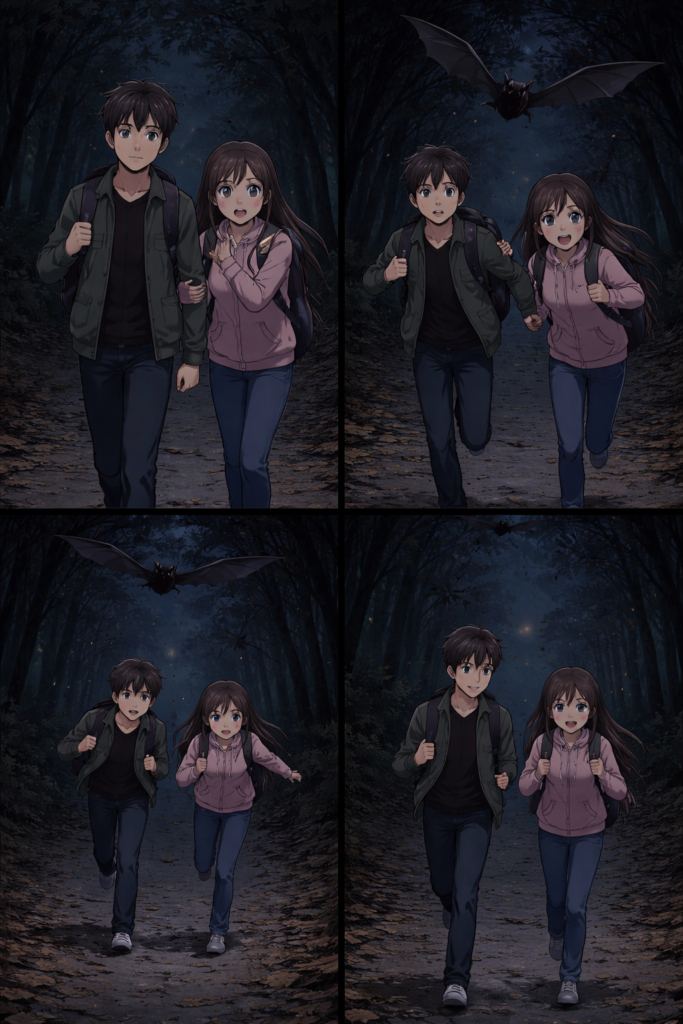
A dark street
The boy and the girl walk home.
It is night. It is dark.
They go into a small street with many trees. There are no lights.
“I am scared,” says the girl.
“It is okay,” says the boy.
They walk.
Crunch.
They stop.
“What is that?” she says.
“Leaves,” he says.
They walk again.
They hear a sound.
The girl holds his arm. Their hearts beat fast.
“Let’s go,” he says.
They walk fast.
Flap!
A bat flies over them.
“Aaa!” says the girl.
“It is just a bat,” says the boy.
They stop.
It is quiet.
Crunch.
They look back.
Flap!
Another bat flies out.
They run.
They run fast.
They do not stop.
Maybe more bats are there.
#####################
#####################
Listen to the story and fill in, if necessary click on
The boy and the girl __________ home at night. The street is small and dark. There are many __________. There are no lights.
The girl feels __________. The boy feels calm. They walk __________. They hear a sound on the ground. It is leaves. They continue __________.
Suddenly, a bat flies over them. The girl is __________. They run fast. Another __________ flies near them. They do not stop. They keep ___________. The street is quiet again. They are __________.
————————————–
Full version:
The boy and the girl walk home at night. The street is small and dark. There are many trees. There are no lights.
The girl feels scared. The boy feels calm. They walk slowly. They hear a sound on the ground. It is leaves. They continue walking.
Suddenly, a bat flies over them. The girl is frightened. They run fast. Another bat flies near them. They do not stop. They keep running. The street is quiet again. They are safe.
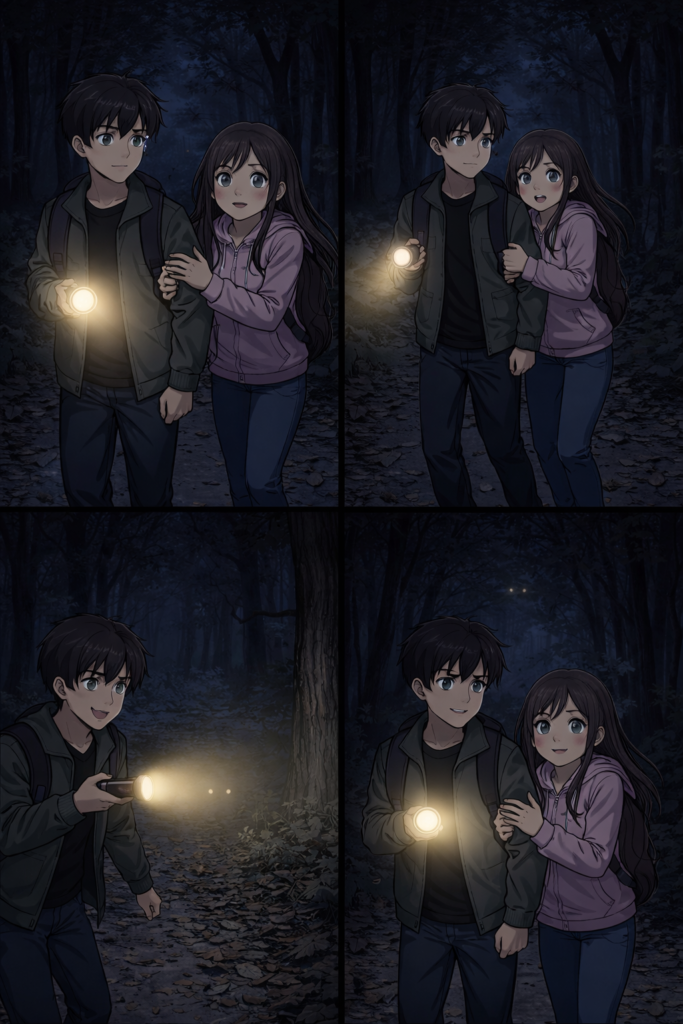
Tom is a boy. Anna is a girl. They walk in the woods at night. It is very dark. The trees are tall and quiet. The wind is cold. Tom has a torch. The light is small, but it helps them see the path.
Anna feels scared. She hears a soft sound. “Did you hear that?” she asks. Tom looks around, but he sees nothing. They walk slowly. The leaves move under their feet.
Suddenly, the torch light shakes. It goes left, then right. A shadow moves behind a tree. Tom stops. Anna holds his arm. They are very still.
The sound comes again. Step… step… step…
“Who is there?” Tom says. No answer.
The torch light shows two small eyes in the dark. They shine like stars. Anna gasps.
Then, a small animal runs away. It is only a fox.
Tom and Anna laugh a little, but their hearts still beat fast.
a statue → a big figure of a person or animal (stone or metal)
a guard → a person who watches a place and keeps it safe
something strange → something not normal, a little different
to check paintings → to look at paintings to see if they are okay
to be quiet → to make no noise
to hear a noise → to hear a sound
to move one’s head → to turn or change the position of your head
to be surprised → to feel something new or unexpected
to smile → to show you are happy with your face
to close one’s eyes → to shut your eyes
to laugh → to make a happy sound (ha ha)
to be sure → to know something is true
LISTEN ONLY, DO NOT LOOK AT TEXTS
Listen to the story, then do the following exercises below (full text at the end of the exercise):
##############
LISTEN ONLY
True or false:
Anna hears a noise.
Anna works in a school.
The statue smiles at Anna.
The boss believes Anna.
The museum is quiet at night.
Anna runs through the museum.
She checks the paintings and statues.
The statue moves its head.
Anna works in a museum.
The noise comes from a door.
Anna tells her boss in the morning.
Anna laughs when she sees the statue.
She is a night guard.
The museum is very loud at night.
The statue talks to Anna.
Anna walks through the rooms.
The statue runs fast.
Anna is sure the statue is normal.
The noise comes from a statue.
She works in the morning.
____________________________
True: 1,3,5,7,8,9,11,13,16,19
####################
LISTEN ONLY
Which one is correct?
Does Anna work in a school or in a museum?
Is she a manager or a night guard?
Is the museum noisy or quiet at night?
Does Anna check paintings and statues or books and computers?
Does she run through the rooms or walk through the rooms?
Does Anna see a light or hear a noise?
Does the noise come from a statue or a door?
Does the statue move its head or its arms?
Does the statue frown or smile at Anna?
Does Anna tell her boss in the morning or in the evening?
Is Anna bored or surprised when the statue moves?
Does Anna close her eyes or laugh when she sees the statue?
Does the boss laugh at her or believe Anna?
Does the statue talk to Anna or stay silent?
Does the statue walk slowly or run fast?
Is Anna not sure or sure about the statue?
Does Anna work at night or in the morning?
Does she feel happy or surprised in the museum?
Does the museum have paintings or computers?
Does Anna like her job or dislike her job?
__________________ Correct answers:
Does Anna work in a school or in a museum? – museum
Is she a manager or a night guard? – night guard
Is the museum noisy or quiet at night? – quiet
Does Anna check paintings and statues or books and computers? – paintings and statues
Does she run through the rooms or walk through the rooms? – walk
Does Anna see a light or hear a noise? – hear a noise
Does the noise come from a statue or a door? – statue
Does the statue move its head or its arms? – head
Does the statue frown or smile at Anna? – smile
Does Anna tell her boss in the morning or in the evening? – morning
Is Anna bored or surprised when the statue moves? – surprised
Does Anna close her eyes or laugh when she sees the statue? – close her eyes
Does the boss laugh at her or believe Anna? – laugh
Does the statue talk to Anna or stay silent? – stay silent
Does the statue walk slowly or run fast? – slowly
Is Anna not sure or sure about the statue? – not sure
Does Anna work at night or in the morning? – at night
Does she feel happy or surprised in the museum? – surprised
Does the museum have paintings or computers? – paintings
Does Anna like her job or dislike her job? – like
###################
LISTEN ONLY
What is Anna’s job?
a) Night guard
b) Teacher
Where does Anna work?
a) School
b) Museum
When does Anna walk through the rooms?
a) At night
b) During the day
What does Anna hear one night?
a) Music
b) A noise
Where does the noise come from?
a) A statue
b) A door
What does the statue do?
a) Runs fast
b) Moves its head
How does Anna feel when she sees the statue move?
a) Surprised
b) Bored
What does Anna do after she sees the statue move?
a) Shouts
b) Closes her eyes
When does Anna tell her boss about the statue?
a) In the evening
b) In the morning
What does the boss say?
a) It is only a statue
b) He believes her
Does Anna check paintings and statues or books?
a) Paintings and statues
b) Books
Is the museum quiet or noisy at night?
a) Noisy
b) Quiet
Does the statue smile or frown at Anna?
a) Smile
b) Frown
Does Anna walk or run through the museum?
a) Run
b) Walk
Is Anna sure or not sure about the statue?
a) Not sure
b) Sure
Does Anna work during the day or at night?
a) During the day
b) At night
Does the statue stay silent or talk to Anna?
a) Talk
b) Stay silent
Does the statue move slowly or fast?
a) Fast
b) Slowly
Does Anna feel happy or surprised in the museum?
a) Happy
b) Surprised
Does the boss laugh or believe Anna?
a) Believe
b) Laugh
_________________________
Correct answers:
a, 2. b, 3. a, 4. b, 5. a, 6. b, 7. a, 8. b, 9. b, 10. a, 11. a, 12. b, 13. a, 14. b, 15. a, 16. b, 17. b, 18. b, 19. b, 20. b
#############
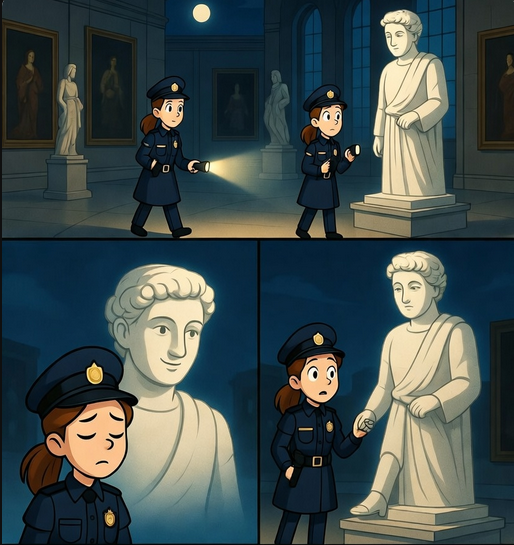
Anna works in a museum. She is a night guard. Every evening, she walks through the rooms and checks the paintings and statues. The museum is very quiet at night.
One night, Anna hears a noise. She stops and listens. The noise comes from a big statue. It is a statue of a man.
Anna looks at the statue. At first, nothing happens. Then, the statue moves its head. Anna is very surprised. She cannot speak.
The statue looks at Anna and smiles. Then it walks slowly across the room.
Anna closes her eyes. When she opens them again, the statue is still. It does not move.
In the morning, Anna tells her boss. He laughs and says, “It is only a statue.”
Lina is a teacher now, remembering her time when she was 10
There is a present simple A1 version, Lina as a child => link
###############
Lina was a 10-year-old girl. She lived in a small village in Southeast Asia. She lived with her parents and grandparents. Her father was a farmer. Her mother sold vegetables and fruits at the morning market.
Lina woke up early every day. She helped her mother prepare food and carry things. Then she walked to school. The walk was long, but she liked it. She saw trees, animals, and her friends.
At school, Lina was happy. She loved learning. Her favorite subjects were Maths and English. She listened to her teacher and worked hard. She also played with her friends during breaks.
After school, Lina walked home. She helped her family again. In the evening, she did her homework and studied.
Lina wanted to be a teacher one day. She wanted to help young children in her village learn and have a better life.
And she has lived her dream – SHE IS A TEACHER NOW.
________________________
Vocabulary:
to remember: to keep something in your mind and not forget it
to dream of something: to want something very much in the future
a village: a small place where people live, smaller than a town
grandparents: the parents of your mother or father
to sell vegetables: to give vegetables to people for money
morning market: a place where people buy and sell things in the morning
to wake up: to stop sleeping
to prepare food: to make food ready to eat
to carry things: to hold and take things from one place to another
a favorite subject: the school subject you like best
to listen to somebody: to hear and pay attention to someone
to work hard: to do a lot of work with effort
a break (school): a short time to rest at school
to study: to learn and read for school
to have a better life: to live in a happier and easier way
###################
Verbs in text, regular and irregular:
Infinitive
Past
A1 Definition
be
was / were
to exist; to be something
live
lived
to have a home in a place
sell
sold
to give something for money
wake up
woke up
to stop sleeping
help
helped
to do something for someone
prepare
prepared
to get something ready
carry
carried
to hold and take something
walk
walked
to move on your feet
like
liked
to think something is good
see
saw
to use your eyes
love
loved
to like something very much
listen
listened
to hear and pay attention
work
worked
to do a job or task
play
played
to have fun or do a game
do
did
to make or finish something
study
studied
to learn about something
want
wanted
to wish for something
learn
learned
to get knowledge or skill
have
had
to own or get something
###############
Basics in past simple:
Past Simple – Regular Verbs
Rules:
Most verbs: add -ed play → played
Verbs ending in -e: add -d live → lived
Verbs ending in consonant + y: change y to i and add -ed study → studied
Short verbs ending in vowel + consonant: double the final consonant and add -ed stop → stopped
Use: The past simple is used to talk about finished actions in the past.
################
Match the words with the definitions:
to dream of something
a village
grandparents
to sell vegetables
morning market
to wake up
to prepare food
to carry things
a favorite subject
to listen to somebody
to work hard
a break (school)
to study
to have a better life
Definitions:
A. to stop sleeping B. to give vegetables to people for money C. to hear and pay attention to someone D. the parents of your mother or father E. to want something very much in the future F. to make food ready to eat G. a small place where people live, smaller than a town H. a short time to rest at school I. to hold and take things from one place to another J. a place where people buy and sell things in the morning K. to do a lot of work with effort L. the school subject you like best M. to learn and read for school N. to live in a happier and easier way
a place where people buy and sell things in the morning
to do a lot of work with effort
to want something very much in the future
to hear and pay attention to someone
a small place where people live, smaller than a town
to learn and read for school
the school subject you like best
to give vegetables to people for money
Words:
a. to study b. to wake up c. to carry things d. grandparents e. to work hard f. a village g. to prepare food h. to sell vegetables i. to listen to somebody j. a break (school) k. to dream of something l. a favorite subject m. morning market n. to have a better life
To carry things means to take things from one place to another.
To work hard means to do very little work.
A favorite subject is the subject you like best.
To dream of something means to not want anything.
A morning market happens at night.
Grandparents are your mother’s or father’s parents.
To prepare food means to make food ready to eat.
To wake up means to start sleeping.
To study means to learn for school.
To sell vegetables means to buy vegetables.
To listen to somebody means to ignore them.
A break at school is time to rest.
A village is a small place where people live.
To have a better life means to live in a worse way.
_____________________
True: 1,3,6,7,9,12,13
#################
True or false:
Lina went to school by bus.
Her favorite subjects were Maths and English.
She lived in a small village in Southeast Asia.
Lina wanted to be a doctor.
Lina walked to school every day.
She never helped her family.
Lina became a teacher in the end.
Her mother worked in a school.
Lina was a 10-year-old girl.
She lived only with her parents.
She did not like learning.
Her father was a farmer.
Lina lived in a big city.
She liked the walk to school.
_______________________
True: 2,3,5,7,9,12,14
#################
Short answers, past simple, basics:
Example Sentence
Yes
No
I learned letters.
Yes, I did.
No, I didn’t.
You read signs.
Yes, you did.
No, you didn’t.
He spoke English.
Yes, he did.
No, he didn’t.
She watched TV.
Yes, she did.
No, she didn’t.
It helped me.
Yes, it did.
No, it didn’t.
We used an app.
Yes, we did.
No, we didn’t.
You read words.
Yes, you did.
No, you didn’t.
They made mistakes.
Yes, they did.
No, they didn’t.
Questions (Past Simple)
Question
Yes
No
Did I learn letters?
Yes, I did.
No, I didn’t.
Did you read signs?
Yes, you did.
No, you didn’t.
Did he speak English?
Yes, he did.
No, he didn’t.
Did she watch TV?
Yes, she did.
No, she didn’t.
Did it help me?
Yes, it did.
No, it didn’t.
Did we use an app?
Yes, we did.
No, we didn’t.
Did you read words?
Yes, you did.
No, you didn’t.
Did they make mistakes?
Yes, they did.
No, they didn’t.
Was / Were
Question
Yes
No
Was I happy?
Yes, I was.
No, I wasn’t.
Were you happy?
Yes, you were.
No, you weren’t.
Was he happy?
Yes, he was.
No, he wasn’t.
Was she happy?
Yes, she was.
No, she wasn’t.
Was it good?
Yes, it was.
No, it wasn’t.
Were we happy?
Yes, we were.
No, we weren’t.
Were you happy?
Yes, you were.
No, you weren’t.
Were they happy?
Yes, they were.
No, they weren’t.
#################
Give short answers:
Lina became a doctor.
YOU WRITE: Yes, she did.
Lina was a 10-year-old girl.
She played with her friends during breaks.
Lina did not go to school.
Her favorite subjects Maths and English were.
She woke up late every day.
Lina lived with her parents and grandparents.
Lina was unhappy at school.
She helped her mother in the morning.
The walk to school was long.
Her favorite subjects History and Art were.
Her father was a teacher.
In the evening, she did her homework.
Lina lived alone.
She was happy at school.
The school was very close to her house.
She hated Maths and English.
Her mother sold vegetables and fruits.
Lina woke up early every day.
Lina was 15 years old.
_______________________
Correct version:
Lina became a doctor. – No, she didn’t.
Lina was a 10-year-old girl. – Yes, she was.
She played with her friends during breaks. – Yes, she did.
Lina did not go to school. – No, she didn’t.
Her favorite subjects Maths and English were. – Yes, they were.
She woke up late every day. – No, she didn’t.
Lina lived with her parents and grandparents. – Yes, she did.
Lina was unhappy at school. – No, she wasn’t.
She helped her mother in the morning. – Yes, she did.
The walk to school was long. – Yes, it was.
Her favorite subjects History and Art were. – No, they weren’t.
Her father was a teacher. – No, he wasn’t.
In the evening, she did her homework. – Yes, she did.
Lina lived alone. – No, she didn’t.
She was happy at school. – Yes, she was.
The school was very close to her house. – No, it wasn’t.
She hated Maths and English. – No, she didn’t.
Her mother sold vegetables and fruits. – Yes, she did.
Lina woke up early every day. – Yes, she did.
Lina was 15 years old. – No, she wasn’t.
#################
Short answers, if false, provide short answer and then the corrected version:
Did Lina play with her teachers during breaks?
YOU WRITE: No, she didn’t. She played with her friends during breaks.
Did she help carry things for her mother?
Did Lina ride a car to school?
Did she help her father sell fruits at the market?
Were two of Lina’s favorite subjects Maths and English?
Did Lina love learning at school?
Did she spend all her time away from her family?
Did Lina see animals and friends on her way to school?
Was Lina 10 years old?
Did Lina walk to school every day?
Was Lina’s father a teacher?
Did Lina dislike learning at school?
Did her mother sell vegetables and fruits at the morning market?
Was her favorite subject Science only?
Did she help her mother prepare food?
Did Lina live in a big city?
Were her favorite subjects Science and History?
Did she want to be a teacher in the future?
Did she sleep all morning?
Did Lina become a teacher in the end?
_______________________
Correct version:
Did Lina play with her teachers during breaks? – No, she didn’t.
Did she help carry things for her mother? – Yes, she did.
Did Lina ride a car to school? – No, she didn’t. She walked to school every day.
Did she help her father sell fruits at the market? – No, she didn’t. Her mother sold fruits and vegetables at the market.
Were two of Lina’s favorite subjects Maths and English? – Yes, they were.
Did Lina love learning at school? – Yes, she did.
Did she spend all her time away from her family? – No, she didn’t. She helped her family at home every day.
Did Lina see animals and friends on her way to school? – Yes, she did.
Was Lina 10 years old? – Yes, she was.
Did Lina walk to school every day? – Yes, she did.
Was Lina’s father a teacher? – No, he wasn’t. He was a farmer.
Did Lina dislike learning at school? – No, she didn’t. She loved learning at school.
Did her mother sell vegetables and fruits at the morning market? – Yes, she did.
Was her favorite subject Science only? – No, it wasn’t. Her favorite subjects were Maths and English.
Did she help her mother prepare food? – Yes, she did.
Did Lina live in a big city? – No, she didn’t. She lived in a small village.
Were her favorite subjects Science and History? – No, they weren’t. Her favorite subjects were Maths and English.
Did she want to be a teacher in the future? – Yes, she did.
Did she sleep all morning? – No, she didn’t. She woke up early every day.
Did Lina become a teacher in the end? – Yes, she did.
#################
Fill in:
Lina was ______ years old.
She lived in a small ______ in Southeast Asia.
Her father worked as a ______.
Her mother sold ______ and ______ at the morning market.
Lina walked to ______ every day.
She helped her mother prepare ______ and carry ______.
Lina’s favorite subjects were ______ and ______.
In the evening, Lina did her ______ and studied.
She wanted to be a ______ in the future.
She wanted to help ______ in her village.
Lina woke up ______ every day.
On her way to school, she saw ______ and ______.
She played with her ______ during school breaks.
Her father worked hard as a ______.
————————————- Correct version:
Lina was 10 years old.
She lived in a small village in Southeast Asia.
Her father worked as a farmer.
Her mother soldvegetables and fruits at the morning market.
Lina walked to school every day.
She helped her mother prepare food and carry things.
Lina’s favorite subjects wereMaths and English.
In the evening, Lina did her homework and studied.
She wanted to be a teacher in the future.
She wanted to help young children in her village.
Lina woke upearly every day.
On her way to school, she sawtrees and animals.
She played with her friends during school breaks.
Her father worked hard as a farmer.
#################
#################
Past simple – basics
Personal Pronoun
Verb (Past)
Object
I
ate
apples
You
ate
apples
He
ate
apples
She
ate
apples
It
ate
apples
We
ate
apples
You (plural)
ate
apples
They
ate
apples
I
played
football
You
played
football
He
played
football
She
played
football
It
played
football
We
played
football
You (plural)
played
football
They
played
football
Personal Pronoun
Verb (Past Negative)
Object
I
did not eat
apples
You
did not eat
apples
He
did not eat
apples
She
did not eat
apples
It
did not eat
apples
We
did not eat
apples
You (plural)
did not eat
apples
They
did not eat
apples
I
did not play
football
You
did not play
football
He
did not play
football
She
did not play
football
It
did not play
football
We
did not play
football
You (plural)
did not play
football
They
did not play
football
Did + Pronoun
Verb
Object
Did I
eat
apples?
Did you
eat
apples?
Did he
eat
apples?
Did she
eat
apples?
Did it
eat
apples?
Did we
eat
apples?
Did you
eat
apples?
Did they
eat
apples?
Did I
play
football?
Did you
play
football?
Did he
play
football?
Did she
play
football?
Did it
play
football?
Did we
play
football?
Did you
play
football?
Did they
play
football?
Didn’t + Pronoun
Verb
Object
Didn’t I
eat
apples?
Didn’t you
eat
apples?
Didn’t he
eat
apples?
Didn’t she
eat
apples?
Didn’t it
eat
apples?
Didn’t we
eat
apples?
Didn’t you
eat
apples?
Didn’t they
eat
apples?
Didn’t I
play
football?
Didn’t you
play
football?
Didn’t he
play
football?
Didn’t she
play
football?
Didn’t it
play
football?
Didn’t we
play
football?
Didn’t you
play
football?
Didn’t they
play
football?
Forms of ‚to be‘
Personal Pronoun
Positive
Negative
Question
I
I was happy.
I was not happy.
Was I happy?
You (singular)
You were excited.
You were not excited.
Were you excited?
He
He was at home.
He was not at home.
Was he at home?
She
She was tired.
She was not tired.
Was she tired?
It
It was cold.
It was not cold.
Was it cold?
We
We were at the party.
We were not at the party.
Were we at the party?
You (plural)
You were friends.
You were not friends.
Were you friends?
They
They were in the garden.
They were not in the garden.
Were they in the garden?
##############
Rewrite as shown below:
Lina was 10 years old.
YOU WRITE: a) Lina was not 10 years old. b) Was Lina 10 years old? c) Wasn’t Lina 10 years old?
She lived in a small village in Southeast Asia.
Her father worked as a farmer.
Her mother sold vegetables and fruits at the morning market.
Lina woke up early every day.
She helped her mother prepare food and carry things.
Lina walked to school and saw trees, animals, and friends.
Her favorite subjects were Maths and English.
Lina wanted to be a teacher in the future.
She played with her friends during school breaks.
______________________
Correct version:
Lina was 10 years old. a) Lina was not 10 years old. b) Was Lina 10 years old? c) Wasn’t Lina 10 years old?
She lived in a small village in Southeast Asia. a) She did not live in a small village in Southeast Asia. b) Did she live in a small village in Southeast Asia? c) Didn’t she live in a small village in Southeast Asia?
Her father worked as a farmer. a) Her father did not work as a farmer. b) Did her father work as a farmer? c) Didn’t her father work as a farmer?
Her mother sold vegetables and fruits at the morning market. a) Her mother did not sell vegetables and fruits at the morning market. b) Did her mother sell vegetables and fruits at the morning market? c) Didn’t her mother sell vegetables and fruits at the morning market?
Lina woke up early every day. a) Lina did not wake up early every day. b) Did Lina wake up early every day? c) Didn’t Lina wake up early every day?
She helped her mother prepare food and carry things. a) She did not help her mother prepare food and carry things. b) Did she help her mother prepare food and carry things? c) Didn’t she help her mother prepare food and carry things?
Lina walked to school and saw trees, animals, and friends. a) Lina did not walk to school and see trees, animals, and friends. b) Did Lina walk to school and see trees, animals, and friends? c) Didn’t Lina walk to school and see trees, animals, and friends?
Her favorite subjects were Maths and English. a) Her favorite subjects were not Maths and English. b) Were her favorite subjects Maths and English? c) Weren’t her favorite subjects Maths and English?
Lina wanted to be a teacher in the future. a) Lina did not want to be a teacher in the future. b) Did Lina want to be a teacher in the future? c) Didn’t Lina want to be a teacher in the future? ___end of audio___
She played with her friends during school breaks. a) She did not play with her friends during school breaks. b) Did she play with her friends during school breaks? c) Didn’t she play with her friends during school breaks?
################
Form questions to which the word/s given is/are the correct answer:
Her mother sold vegetables and fruits at the morning market. a) Her mother: b) Her: c) sold vegetables and fruits at the morning market: d) vegetables and fruits: e) at the morning market:
Lina woke up early every day. a) Lina: b) woke up early every day: c) early: d) every day:
She helped her mother. a) She: b) helped her mother prepare food : c) her mother: d) her:
Lina walke to school with her friends. a) Lina: b) walked to school with her friends: c) to school: d) with her friends: e) her:
Lina wanted to be a teacher in the future. a) Lina: b) wanted to be a teacher in the future: c) a teacher: d) in the future:
____________________
Correct version:
Her mother sold vegetables and fruits at the morning market. a) Her mother: Who sold vegetables and fruits at the morning market? b) Her: Whose mother sold vegetables and fruits at the morning market? c) sold vegetables and fruits at the morning market: What did her mother do at the morning market? d) vegetables and fruits: What did her mother sell? e) at the morning market: Where did her mother sell vegetables and fruits?
Lina woke up early every day. a) Lina: Who woke up early every day? b) woke up early every day: What did Lina do every day? c) early: When did Lina wake up every day? d) every day: How often did Lina wake up early?
She helped her mother. a) She: Who helped her mother? b) helped her mother prepare food: What did she do? c) her mother: Who did she help? d) her: Whose mother did she help?
Lina walked to school with her friends. a) Lina: Who walked to school with friends? b) walked to school with her friends: What did Lina do? c) to school: Where did Lina walk to? d) with her friends: Who did Lina walk with? e) her: With whose friends did she walk to school?
Lina wanted to be a teacher in the future. a) Lina: Who wanted to be a teacher? b) wanted to be a teacher in the future: What did Lina want to do? c) a teacher: What did Lina want to be? d) in the future: When did Lina want to be a teacher?
##############
Complete:
Interviewer: Hello, Lina! Can you tell us about your childhood?
Lina: Hello! Yes, I can.
Interviewer: How old were you when you were a ____________? Lina: I was 10 years old.
Interviewer: Where did you live? Lina: I lived in a small _____________ in Southeast Asia.
Interviewer: Who did you live with? Lina: I lived with my parents and ______________.
Interviewer: What did your father do? Lina: My father worked as a ___________.
Interviewer: What did your mother do? Lina: My mother ______________vegetables and fruits at the morning market.
Interviewer: How did you help your mother? Lina: I helped her prepare food and ____________ things.
Interviewer: How did you go to school? Lina: I _______________ to school every day.
Interviewer: What did you see on your way to school? Lina: I saw trees, animals, and my ______________.
Interviewer: When did you wake up? Lina: I woke up ___________ every day.
Interviewer: Which subjects did you like best? Lina: My ___________ subjects were Maths and English.
Interviewer: Why did you like learning? Lina: I loved learning because it was________________.
Interviewer: Who did you play with at school? Lina: I played with my friends during school ______________.
Interviewer: What did you want to be when you were a child? Lina: I wanted to be a ______________ in the future.
Interviewer: Why did you want to be a teacher? Lina: I wanted to help children in my _____________ learn.
Interviewer: How did you spend your evenings? Lina: I did my _____________ and studied in the evening.
a young girl learns, helps her family, and dreams of becoming a teacher
There is a past simple A1 version, Lina as a teacher, and her memories => link
##############
Lina is a 10-year-old girl. She lives in a small village in Southeast Asia. She lives with her parents and grandparents. Her father is a farmer. Her mother sells vegetables and fruits at the morning market.
Lina wakes up early every day. She helps her mother prepare food and carry things. Then she walks to school. The walk is long, but she likes it. She sees trees, animals, and her friends.
At school, Lina is happy. She loves learning. Her favorite subjects are Maths and English. She listens to her teacher and works hard. She also plays with her friends during breaks.
After school, Lina walks home. She helps her family again. In the evening, she does her homework and studies.
Lina wants to be a teacher one day. She wants to help young children in her village learn and have a better life.
_____________________
Vocabulary:
to dream of something: to want something very much in the future
a village: a small place where people live, smaller than a town
grandparents: the parents of your mother or father
to sell vegetables: to give vegetables to people for money
morning market: a place where people buy and sell things in the morning
to wake up: to stop sleeping
to prepare food: to make food ready to eat
to carry things: to hold and take things from one place to another
a favorite subject: the school subject you like best
to listen to somebody: to hear and pay attention to someone
to work hard: to do a lot of work with effort
a break (school): a short time to rest at school
to study: to learn and read for school
to have a better life: to live in a happier and easier way
###############
Match the words with the definitions:
to dream of something
a village
grandparents
to sell vegetables
morning market
to wake up
to prepare food
to carry things
a favorite subject
to listen to somebody
to work hard
a break (school)
to study
to have a better life
Definitions:
A. to stop sleeping B. to give vegetables to people for money C. to hear and pay attention to someone D. the parents of your mother or father E. to want something very much in the future F. to make food ready to eat G. a small place where people live, smaller than a town H. a short time to rest at school I. to hold and take things from one place to another J. a place where people buy and sell things in the morning K. to do a lot of work with effort L. the school subject you like best M. to learn and read for school N. to live in a happier and easier way
############### Find words that match the definitions below:
Definitions:
to hold and take things from one place to another
to live in a happier and easier way
to stop sleeping
a short time to rest at school
to make food ready to eat
the parents of your mother or father
a place where people buy and sell things in the morning
to do a lot of work with effort
to want something very much in the future
to hear and pay attention to someone
a small place where people live, smaller than a town
to learn and read for school
the school subject you like best
to give vegetables to people for money
Words:
a. to study b. to wake up c. to carry things d. grandparents e. to work hard f. a village g. to prepare food h. to sell vegetables i. to listen to somebody j. a break (school) k. to dream of something l. a favorite subject m. morning market n. to have a better life
To carry things means to take things from one place to another.
To work hard means to do very little work.
A favorite subject is the subject you like best.
To dream of something means to not want anything.
A morning market happens at night.
Grandparents are your mother’s or father’s parents.
To prepare food means to make food ready to eat.
To wake up means to start sleeping.
To study means to learn for school.
To sell vegetables means to buy vegetables.
To listen to somebody means to ignore them.
A break at school is time to rest.
A village is a small place where people live.
To have a better life means to live in a worse way.
_____________________
True: 1,3,6,7,9,12,13
###############
True or false:
Lina is 10 years old.
She lives in a big city.
Her father is a farmer.
Her mother sells vegetables at the night market.
Lina helps her mother prepare food and carry things.
Lina walks a short distance to school.
She likes seeing trees and animals on her way to school.
Lina does not like learning at school.
Her favorite subjects are Maths and English.
She ignores her teacher in class.
Lina wants to be a doctor one day.
She wants to help children in her village.
Lina plays with her friends during school breaks.
In the evening, Lina does her homework and studies.
______________________
True: 1,3,5,7,9,12,13,14
###############
Short answers, basics:
Example Sentence
Yes
No
I learn the alphabet.
Yes, I do.
No, I don’t.
You read signs.
Yes, you do.
No, you don’t.
He practices speaking.
Yes, he does.
No, he doesn’t.
She watches cartoons.
Yes, she does.
No, she doesn’t.
It helps us learn English.
Yes, it does.
No, it doesn’t.
We use apps like Duolingo.
Yes, we do.
No, we don’t.
You read labels.
Yes, you do.
No, you don’t.
They make mistakes sometimes.
Yes, they do.
No, they don’t.
Question
Yes
No
Do I learn the alphabet?
Yes, I do.
No, I don’t.
Do you read signs?
Yes, you do.
No, you don’t.
Does he practice speaking?
Yes, he does.
No, he doesn’t.
Does she watch cartoons?
Yes, she does.
No, she doesn’t.
Does it help us learn English?
Yes, it does.
No, it doesn’t.
Do we use apps like Duolingo?
Yes, we do.
No, we don’t.
Do you read labels?
Yes, you do.
No, you don’t.
Do they make mistakes sometimes?
Yes, they do.
No, they don’t.
Question
Yes
No
Am I big?
Yes, I am.
No, I am not.
Are you big?
Yes, you are.
No, you aren’t.
Is he big?
Yes, he is.
No, he isn’t.
Is she big?
Yes, she is.
No, she isn’t.
Is it big?
Yes, it is.
No, it isn’t.
Are we big?
Yes, we are.
No, we aren’t.
Are you big?
Yes, you are.
No, you aren’t.
Are they big?
Yes, they are.
No, they aren’t.
###############
Give short answers:
Lina walks to school and sees trees, animals, and friends.
YOU WRITE: Yes, she does.
Lina rides a car to school.
Lina wakes up early every day.
Her favorite subject is Science only.
She helps her mother prepare food and carry things.
Lina plays only and does not study in the evening.
Lina loves learning at school.
Lina lives in a big city.
Her father works as a farmer.
One of Lina’s favorite subjects is Maths.
She spends all her time away from her family.
Lina is 10 years old.
Two of Lina’s favorite subjects are Maths and English.
She wants to be a teacher and help children in her village.
Her mother sells vegetables and fruits at the morning market.
Lina sees buildings and traffic on her way to school.
She wants to be a doctor.
Lina sleeps all morning.
Lina lives in a small village in Southeast Asia.
She helps her father sell fruits at the market.
Lina dislikes learning at school.
__________________
Correct version:
Lina walks to school and sees trees, animals, and friends. Yes, she does.
Lina rides a car to school. No, she doesn’t.
Lina wakes up early every day. Yes, she does.
Her favorite subject is Science only. No, it isn’t.
She helps her mother prepare food and carry things. Yes, she does.
Lina plays only and does not study in the evening. No, she doesn’t.
Lina loves learning at school. Yes, she does.
Lina lives in a big city. No, she doesn’t.
Her father works as a farmer. Yes, he does.
One of Lina’s favorite subjects is Maths. Yes, it is.
She spends all her time away from her family. No, she doesn’t.
Lina is 10 years old. Yes, she is.
Two of Lina’s favorite subjects are Maths and English. Yes, they are.
She wants to be a teacher and help children in her village. Yes, she does.
Her mother sells vegetables and fruits at the morning market. Yes, she does.
Lina sees buildings and traffic on her way to school. No, she doesn’t.
She wants to be a doctor. No, she doesn’t.
Lina sleeps all morning. No, she doesn’t.
Lina lives in a small village in Southeast Asia. Yes, she does.
She helps her father sell fruits at the market. No, she doesn’t.
Lina dislikes learning at school. No, she doesn’t.
###############
Short answers, if false, provide short answer and then the corrected version:
Does Lina wake up late every day?
YOU WRITE: No, she doesn’t. She wakes up early every day.
Does Lina play with her friends during breaks?
Does she help carry things for her mother?
Does Lina ride a car to school?
Does she help her father sell fruits at the market?
Are two of Lina’s favorite subjects Maths and English?
Does Lina love learning at school?
Does she spend all her time away from her family?
Does Lina see animals and friends on her way to school?
Is Lina 10 years old?
Does Lina walk to school every day?
Is Lina’s father a teacher?
Does Lina dislike learning at school?
Does her mother sell vegetables and fruits at the morning market?
Is her favorite subject Science only?
Does she help her mother prepare food?
Does Lina live in a big city?
Are her favorite subjects Science and History?
Does she want to be a teacher in the future?
Does she sleep all morning?
_______________________
Correct answers:
Does Lina wake up late every day? No, she doesn’t. She wakes up early every day.
Does Lina play with her friends during breaks? Yes, she does.
Does she help carry things for her mother? Yes, she does.
Does Lina ride a car to school? No, she doesn’t. She walks to school every day.
Does she help her father sell fruits at the market? No, she doesn’t. She helps her mother sell vegetables and fruits.
Are two of Lina’s favorite subjects Maths and English? Yes, they are.
Does Lina love learning at school? Yes, she does.
Does she spend all her time away from her family? No, she doesn’t. She helps her family at home.
Does Lina see animals and friends on her way to school? Yes, she does.
Is Lina 10 years old? Yes, she is.
Does Lina walk to school every day? Yes, she does.
Is Lina’s father a teacher? No, he isn’t. He is a farmer.
Does Lina dislike learning at school? No, she doesn’t. She loves learning at school.
Does her mother sell vegetables and fruits at the morning market? Yes, she does.
Is her favorite subject Science only? No, it isn’t. Her favorite subjects are Maths and English.
Does she help her mother prepare food? Yes, she does.
Does Lina live in a big city? No, she doesn’t. She lives in a small village in Southeast Asia.
Are her favorite subjects Science and History? No, they aren’t. Her favorite subjects are Maths and English.
Does she want to be a teacher in the future? Yes, she does.
Does she sleep all morning? No, she doesn’t. She wakes up early every day.
###############
Fill in:
Lina is ______ years old.
She lives in a small ______ in Southeast Asia.
Her father works as a ______.
Her mother sells ______ and ______ at the morning market.
Lina walks to ______ every day.
She helps her mother prepare ______ and carry ______.
Lina’s favorite subjects are ______ and ______.
In the evening, Lina does her ______ and studies.
She wants to be a ______ in the future.
She wants to help ______ in her village.
Lina wakes up ______ every day.
On her way to school, she sees ______ and ______.
She plays with her ______ during school breaks.
Her father works hard as a ______.
——————————— Correct answers:
Lina is 10 years old.
She lives in a small village in Southeast Asia.
Her father works as a farmer.
Her mother sells vegetables and fruits at the morning market.
Lina walks to school every day.
She helps her mother prepare food and carry things.
Lina’s favorite subjects are Maths and English.
In the evening, Lina does her homework and studies.
She wants to be a teacher in the future.
She wants to help children in her village.
Lina wakes up early every day.
On her way to school, she sees trees and animals.
She plays with her friends during school breaks.
Her father works hard as a farmer.
###############
Basics of present simple:
Personal Pronoun
am / is / are
I
am
8 years old
You
are
8 years old
He
is
8 years old
She
is
8 years old
It
is
8 years old
We
are
8 years old
You (plural)
are
8 years old
They
are
8 years old
Personal Pronoun
am not / is not / are not
I
am not
8 years old
You
are not
8 years old
He
is not
8 years old
She
is not
8 years old
It
is not
8 years old
We
are not
8 years old
You (plural)
are not
8 years old
They
are not
8 years old
Question:
Question Word
Personal Pronoun
Am
I
8 years old?
Are
you
8 years old?
Is
he
8 years old?
Is
she
8 years old?
Is
it
8 years old?
Are
we
8 years old?
Are
you (plural)
8 years old?
Are
they
8 years old?
Statement:
Personal Pronoun
Verb
I
like
ice cream
You
like
ice cream
He
likes
ice cream
She
likes
ice cream
It
likes
ice cream
We
like
ice cream
You (plural)
like
ice cream
They
like
ice cream
Negation:
Personal Pronoun
Verb (negative)
I
do not like
ice cream
You
do not like
ice cream
He
does not like
ice cream
She
does not like
ice cream
It
does not like
ice cream
We
do not like
ice cream
You (plural)
do not like
ice cream
They
do not like
ice cream
Question:
Do / Does
Personal Pronoun
Verb
Sugar?
Do
I
like
sugar?
Do
you
like
sugar?
Does
he
like
sugar?
Does
she
like
sugar?
Does
it
like
sugar?
Do
we
like
sugar?
Do
you (plural)
like
sugar?
Do
they
like
sugar?
###############
Rewrite as shown below:
Lina is 10 years old.
YOU WRITE: a) Lina is not 10 years old. b) Is Lina 10 years old? c) Isn’t Lina 10 years old?
She lives in a small village in Southeast Asia.
Her father works as a farmer.
Her mother sells vegetables and fruits at the morning market.
Lina wakes up early every day.
She helps her mother prepare food and carry things.
Lina walks to school and sees trees, animals, and friends.
Her favorite subjects are Maths and English.
Lina wants to be a teacher in the future.
She plays with her friends during school breaks.
_____________________ Correct answers:
Lina is 10 years old. a) Lina is not 10 years old. b) Is Lina 10 years old? c) Isn’t Lina 10 years old?
She lives in a small village in Southeast Asia. a) She does not live in a small village in Southeast Asia. b) Does she live in a small village in Southeast Asia? c) Doesn’t she live in a small village in Southeast Asia?
Her father works as a farmer. a) Her father does not work as a farmer. b) Does her father work as a farmer? c) Doesn’t her father work as a farmer?
Her mother sells vegetables and fruits at the morning market. a) Her mother does not sell vegetables and fruits at the morning market. b) Does her mother sell vegetables and fruits at the morning market? c) Doesn’t her mother sell vegetables and fruits at the morning market?
Lina wakes up early every day. a) Lina does not wake up early every day. b) Does Lina wake up early every day? c) Doesn’t Lina wake up early every day?
She helps her mother prepare food and carry things. a) She does not help her mother prepare food and carry things. b) Does she help her mother prepare food and carry things? c) Doesn’t she help her mother prepare food and carry things?
Lina walks to school and sees trees, animals, and friends. a) Lina does not walk to school and see trees, animals, and friends. b) Does Lina walk to school and see trees, animals, and friends? c) Doesn’t Lina walk to school and see trees, animals, and friends?
Her favorite subjects are Maths and English. a) Her favorite subjects are not Maths and English. b) Are her favorite subjects Maths and English? c) Aren’t her favorite subjects Maths and English?
Lina wants to be a teacher in the future. a) Lina does not want to be a teacher in the future. b) Does Lina want to be a teacher in the future? c) Doesn’t Lina want to be a teacher in the future? __end of audio__
She plays with her friends during school breaks. a) She does not play with her friends during school breaks. b) Does she play with her friends during school breaks? c) Doesn’t she play with her friends during school breaks?
###############
Form questions to which the word/s given is/are the correct answer:
Her mother sells vegetables and fruits at the morning market. a) Her mother: b) Her: c) sells vegetables and fruits at the morning market: d) vegetables and fruits: e) at the morning market:
Lina wakes up early every day. a) Lina: b) wakes up early every day: c) early: d) every day:
She helps her mother. a) She: b) helps her mother prepare food : c) her mother: d) her:
Lina walks to school with her friends. a) Lina: b) walks to school with her friends: c) to school: d) with her friends: e) her:
Lina wants to be a teacher in the future. a) Lina: b) wants to be a teacher in the future: c) a teacher: d) in the future:
_____________________________
Answers:
1. Her mother sells vegetables and fruits at the morning market.
a) Her mother: Who sells vegetables and fruits at the morning market?
b) Her: Whose mother sells vegetables and fruits at the morning market?
c) sells vegetables and fruits at the morning market: What does her mother do at the morning market?
d) vegetables and fruits: What does her mother sell at the morning market?
e) at the morning market: Where does her mother sell vegetables and fruits?
2. Lina wakes up early every day.
a) Lina: Who wakes up early every day?
b) wakes up early every day: What does Lina do every day?
c) early: When does Lina wake up every day?
d) every day: When does Lina wake up early?
3. She helps her mother.
a) She: Who helps her mother prepare food?
b) helps her mother prepare food: What does she do ?
c) her mother: Who does she help prepare food?
d) her: Whose mother does she help prepare food?
4. Lina walks to school with her friends.
a) Lina: Who walks to school with her friends?
b) walks to school with her friends: What does Lina do?
c) to school: Where does Lina walk with her friends to?
d) with her friends: Who does Lina walk to school with?
e) her: Whose friends does Lina walk with to school?
5. Lina wants to be a teacher in the future.
a) Lina: Who wants to be a teacher in the future?
b) wants to be a teacher in the future: What does Lina want to do in the future?
c) a teacher: What does Lina want to be in the future?
d) in the future: When does Lina want to be a teacher?
################
Rewrite story as shown below:
I am Lina. I am 10 years old. I live in a small village in Southeast Asia with my parents and grandparents. My father is a farmer. My mother sells vegetables and fruits at the morning market. I wake up early every day. I help my mother prepare food and carry things. I walk to school. I like the walk. I see trees, animals, and my friends. I love learning. My favorite subjects are Maths and English. After school, I help my family. I do my homework and study. I want to be a teacher one day.
Rewrite, make all changes necessary:
She is Lina. She is 10 years old. She lives in a small village in Southeast Asia with her ……………………
__________________
Correct version:
She is Lina. She is 10 years old. She lives in a small village in Southeast Asia with her parents and grandparents. Her father is a farmer. Her mother sells vegetables and fruits at the morning market. She wakes up early every day. She helps her mother prepare food and carry things. She walks to school. She likes the walk. She sees trees, animals, and her friends. She loves learning. Her favorite subjects are Maths and English. After school, she helps her family. She does her homework and studies. She wants to be a teacher one day.
##############
Interview with Lina:
Interviewer: Hello! What is your name? Lina: My name is Lina.
Interviewer: How old are you? Lina: I am 10 years old.
Interviewer: Where do you live? Lina: I live in a small village in Southeast Asia.
Interviewer: Who do you live with? Lina: I live with my parents and grandparents.
Interviewer: What does your father do? Lina: My father is a farmer.
Interviewer: Does your mother work at home or in a market? Lina: She works at the morning market.
Interviewer: What does your mother sell? Lina: She sells vegetables and fruits.
Interviewer: When do you wake up every day? Lina: I wake up early every day.
Interviewer: How do you go to school? Lina: I walk to school.
Interviewer: Which subjects do you like the most, Maths or English? Lina: I like both Maths and English.
Interviewer: What do you do after school? Lina: I help my family and do my homework.
Interviewer: Why do you want to be a teacher? Lina: I want to help children in my village learn.
===================
Rewrite the exact interview with Lina’s friend as shown below, make all changes necessary:
Interviewer: Hello, Salas. What is your friend’s name Salas: Her name is Lina.
Interviewer: How old is she? Salas: She is 10 years old.
Interviewer:……………………..
===================
Full version:
Interviewer: Hello, Salas. What is your friend’s name? Salas: Her name is Lina.
Interviewer: How old is she? Salas: She is 10 years old.
Interviewer: Where does she live? Salas: She lives in a small village in Southeast Asia.
Interviewer: Who does she live with? Salas: She lives with her parents and grandparents.
Interviewer: What does her father do? Salas: Her father is a farmer.
Interviewer: What does her mother do? Salas: Her mother sells vegetables and fruits at the morning market.
Interviewer: What time does she wake up every day? Salas: She wakes up early every day.
Interviewer: How does she go to school? Salas: She walks to school.
Interviewer: What are her favorite subjects? Salas: Her favorite subjects are Maths and English.
Interviewer: What does she do after school? Salas: She helps her family and does her homework.
Interviewer: Does she like learning? Salas: Yes, she loves learning.
Interviewer: What does she want to be in the future? Salas: She wants to be a teacher.