Lina is a teacher now, remembering her time when she was 10
There is a present simple A1 version, Lina as a child => link
###############
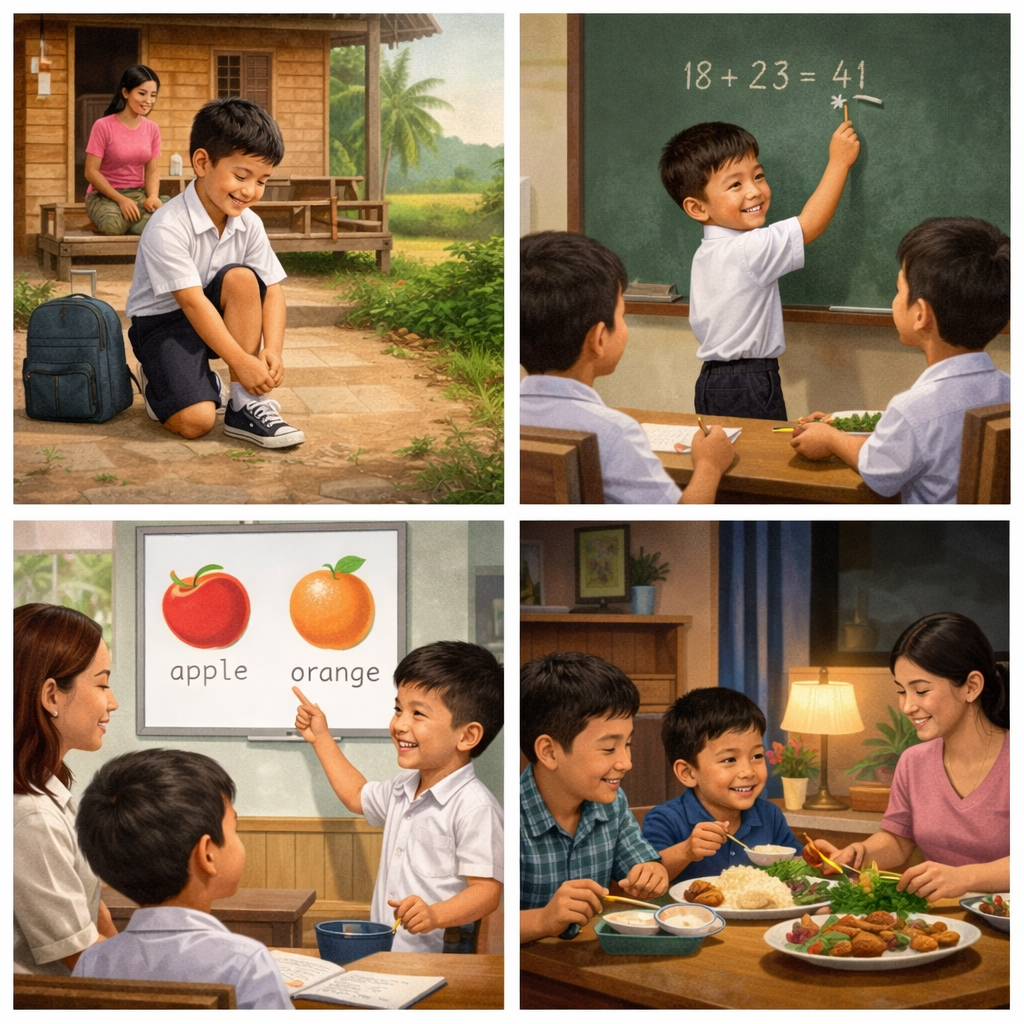
Lina was a 10-year-old girl. She lived in a small village in Southeast Asia. She lived with her parents and grandparents. Her father was a farmer. Her mother sold vegetables and fruits at the morning market.
Lina woke up early every day. She helped her mother prepare food and carry things. Then she walked to school. The walk was long, but she liked it. She saw trees, animals, and her friends.
At school, Lina was happy. She loved learning. Her favorite subjects were Maths and English. She listened to her teacher and worked hard. She also played with her friends during breaks.
After school, Lina walked home. She helped her family again. In the evening, she did her homework and studied.
Lina wanted to be a teacher one day. She wanted to help young children in her village learn and have a better life.
And she has lived her dream – SHE IS A TEACHER NOW.
________________________
Vocabulary:
to remember: to keep something in your mind and not forget it
to dream of something: to want something very much in the future
a village: a small place where people live, smaller than a town
grandparents: the parents of your mother or father
to sell vegetables: to give vegetables to people for money
morning market: a place where people buy and sell things in the morning
to wake up: to stop sleeping
to prepare food: to make food ready to eat
to carry things: to hold and take things from one place to another
a favorite subject: the school subject you like best
to listen to somebody: to hear and pay attention to someone
to work hard: to do a lot of work with effort
a break (school): a short time to rest at school
to study: to learn and read for school
to have a better life: to live in a happier and easier way
###################
Verbs in text, regular and irregular:
Infinitive
Past
A1 Definition
be
was / were
to exist; to be something
live
lived
to have a home in a place
sell
sold
to give something for money
wake up
woke up
to stop sleeping
help
helped
to do something for someone
prepare
prepared
to get something ready
carry
carried
to hold and take something
walk
walked
to move on your feet
like
liked
to think something is good
see
saw
to use your eyes
love
loved
to like something very much
listen
listened
to hear and pay attention
work
worked
to do a job or task
play
played
to have fun or do a game
do
did
to make or finish something
study
studied
to learn about something
want
wanted
to wish for something
learn
learned
to get knowledge or skill
have
had
to own or get something
###############
Basics in past simple:
Past Simple – Regular Verbs
Rules:
Most verbs: add -ed play → played
Verbs ending in -e: add -d live → lived
Verbs ending in consonant + y: change y to i and add -ed study → studied
Short verbs ending in vowel + consonant: double the final consonant and add -ed stop → stopped
Use: The past simple is used to talk about finished actions in the past.
################
Match the words with the definitions:
to dream of something
a village
grandparents
to sell vegetables
morning market
to wake up
to prepare food
to carry things
a favorite subject
to listen to somebody
to work hard
a break (school)
to study
to have a better life
Definitions:
A. to stop sleeping B. to give vegetables to people for money C. to hear and pay attention to someone D. the parents of your mother or father E. to want something very much in the future F. to make food ready to eat G. a small place where people live, smaller than a town H. a short time to rest at school I. to hold and take things from one place to another J. a place where people buy and sell things in the morning K. to do a lot of work with effort L. the school subject you like best M. to learn and read for school N. to live in a happier and easier way
a place where people buy and sell things in the morning
to do a lot of work with effort
to want something very much in the future
to hear and pay attention to someone
a small place where people live, smaller than a town
to learn and read for school
the school subject you like best
to give vegetables to people for money
Words:
a. to study b. to wake up c. to carry things d. grandparents e. to work hard f. a village g. to prepare food h. to sell vegetables i. to listen to somebody j. a break (school) k. to dream of something l. a favorite subject m. morning market n. to have a better life
To carry things means to take things from one place to another.
To work hard means to do very little work.
A favorite subject is the subject you like best.
To dream of something means to not want anything.
A morning market happens at night.
Grandparents are your mother’s or father’s parents.
To prepare food means to make food ready to eat.
To wake up means to start sleeping.
To study means to learn for school.
To sell vegetables means to buy vegetables.
To listen to somebody means to ignore them.
A break at school is time to rest.
A village is a small place where people live.
To have a better life means to live in a worse way.
_____________________
True: 1,3,6,7,9,12,13
#################
True or false:
Lina went to school by bus.
Her favorite subjects were Maths and English.
She lived in a small village in Southeast Asia.
Lina wanted to be a doctor.
Lina walked to school every day.
She never helped her family.
Lina became a teacher in the end.
Her mother worked in a school.
Lina was a 10-year-old girl.
She lived only with her parents.
She did not like learning.
Her father was a farmer.
Lina lived in a big city.
She liked the walk to school.
_______________________
True: 2,3,5,7,9,12,14
#################
Short answers, past simple, basics:
Example Sentence
Yes
No
I learned letters.
Yes, I did.
No, I didn’t.
You read signs.
Yes, you did.
No, you didn’t.
He spoke English.
Yes, he did.
No, he didn’t.
She watched TV.
Yes, she did.
No, she didn’t.
It helped me.
Yes, it did.
No, it didn’t.
We used an app.
Yes, we did.
No, we didn’t.
You read words.
Yes, you did.
No, you didn’t.
They made mistakes.
Yes, they did.
No, they didn’t.
Questions (Past Simple)
Question
Yes
No
Did I learn letters?
Yes, I did.
No, I didn’t.
Did you read signs?
Yes, you did.
No, you didn’t.
Did he speak English?
Yes, he did.
No, he didn’t.
Did she watch TV?
Yes, she did.
No, she didn’t.
Did it help me?
Yes, it did.
No, it didn’t.
Did we use an app?
Yes, we did.
No, we didn’t.
Did you read words?
Yes, you did.
No, you didn’t.
Did they make mistakes?
Yes, they did.
No, they didn’t.
Was / Were
Question
Yes
No
Was I happy?
Yes, I was.
No, I wasn’t.
Were you happy?
Yes, you were.
No, you weren’t.
Was he happy?
Yes, he was.
No, he wasn’t.
Was she happy?
Yes, she was.
No, she wasn’t.
Was it good?
Yes, it was.
No, it wasn’t.
Were we happy?
Yes, we were.
No, we weren’t.
Were you happy?
Yes, you were.
No, you weren’t.
Were they happy?
Yes, they were.
No, they weren’t.
#################
Give short answers:
Lina became a doctor.
YOU WRITE: Yes, she did.
Lina was a 10-year-old girl.
She played with her friends during breaks.
Lina did not go to school.
Her favorite subjects Maths and English were.
She woke up late every day.
Lina lived with her parents and grandparents.
Lina was unhappy at school.
She helped her mother in the morning.
The walk to school was long.
Her favorite subjects History and Art were.
Her father was a teacher.
In the evening, she did her homework.
Lina lived alone.
She was happy at school.
The school was very close to her house.
She hated Maths and English.
Her mother sold vegetables and fruits.
Lina woke up early every day.
Lina was 15 years old.
_______________________
Correct version:
Lina became a doctor. – No, she didn’t.
Lina was a 10-year-old girl. – Yes, she was.
She played with her friends during breaks. – Yes, she did.
Lina did not go to school. – No, she didn’t.
Her favorite subjects Maths and English were. – Yes, they were.
She woke up late every day. – No, she didn’t.
Lina lived with her parents and grandparents. – Yes, she did.
Lina was unhappy at school. – No, she wasn’t.
She helped her mother in the morning. – Yes, she did.
The walk to school was long. – Yes, it was.
Her favorite subjects History and Art were. – No, they weren’t.
Her father was a teacher. – No, he wasn’t.
In the evening, she did her homework. – Yes, she did.
Lina lived alone. – No, she didn’t.
She was happy at school. – Yes, she was.
The school was very close to her house. – No, it wasn’t.
She hated Maths and English. – No, she didn’t.
Her mother sold vegetables and fruits. – Yes, she did.
Lina woke up early every day. – Yes, she did.
Lina was 15 years old. – No, she wasn’t.
#################
Short answers, if false, provide short answer and then the corrected version:
Did Lina play with her teachers during breaks?
YOU WRITE: No, she didn’t. She played with her friends during breaks.
Did she help carry things for her mother?
Did Lina ride a car to school?
Did she help her father sell fruits at the market?
Were two of Lina’s favorite subjects Maths and English?
Did Lina love learning at school?
Did she spend all her time away from her family?
Did Lina see animals and friends on her way to school?
Was Lina 10 years old?
Did Lina walk to school every day?
Was Lina’s father a teacher?
Did Lina dislike learning at school?
Did her mother sell vegetables and fruits at the morning market?
Was her favorite subject Science only?
Did she help her mother prepare food?
Did Lina live in a big city?
Were her favorite subjects Science and History?
Did she want to be a teacher in the future?
Did she sleep all morning?
Did Lina become a teacher in the end?
_______________________
Correct version:
Did Lina play with her teachers during breaks? – No, she didn’t.
Did she help carry things for her mother? – Yes, she did.
Did Lina ride a car to school? – No, she didn’t. She walked to school every day.
Did she help her father sell fruits at the market? – No, she didn’t. Her mother sold fruits and vegetables at the market.
Were two of Lina’s favorite subjects Maths and English? – Yes, they were.
Did Lina love learning at school? – Yes, she did.
Did she spend all her time away from her family? – No, she didn’t. She helped her family at home every day.
Did Lina see animals and friends on her way to school? – Yes, she did.
Was Lina 10 years old? – Yes, she was.
Did Lina walk to school every day? – Yes, she did.
Was Lina’s father a teacher? – No, he wasn’t. He was a farmer.
Did Lina dislike learning at school? – No, she didn’t. She loved learning at school.
Did her mother sell vegetables and fruits at the morning market? – Yes, she did.
Was her favorite subject Science only? – No, it wasn’t. Her favorite subjects were Maths and English.
Did she help her mother prepare food? – Yes, she did.
Did Lina live in a big city? – No, she didn’t. She lived in a small village.
Were her favorite subjects Science and History? – No, they weren’t. Her favorite subjects were Maths and English.
Did she want to be a teacher in the future? – Yes, she did.
Did she sleep all morning? – No, she didn’t. She woke up early every day.
Did Lina become a teacher in the end? – Yes, she did.
#################
Fill in:
Lina was ______ years old.
She lived in a small ______ in Southeast Asia.
Her father worked as a ______.
Her mother sold ______ and ______ at the morning market.
Lina walked to ______ every day.
She helped her mother prepare ______ and carry ______.
Lina’s favorite subjects were ______ and ______.
In the evening, Lina did her ______ and studied.
She wanted to be a ______ in the future.
She wanted to help ______ in her village.
Lina woke up ______ every day.
On her way to school, she saw ______ and ______.
She played with her ______ during school breaks.
Her father worked hard as a ______.
————————————- Correct version:
Lina was 10 years old.
She lived in a small village in Southeast Asia.
Her father worked as a farmer.
Her mother soldvegetables and fruits at the morning market.
Lina walked to school every day.
She helped her mother prepare food and carry things.
Lina’s favorite subjects wereMaths and English.
In the evening, Lina did her homework and studied.
She wanted to be a teacher in the future.
She wanted to help young children in her village.
Lina woke upearly every day.
On her way to school, she sawtrees and animals.
She played with her friends during school breaks.
Her father worked hard as a farmer.
#################
#################
Past simple – basics
Personal Pronoun
Verb (Past)
Object
I
ate
apples
You
ate
apples
He
ate
apples
She
ate
apples
It
ate
apples
We
ate
apples
You (plural)
ate
apples
They
ate
apples
I
played
football
You
played
football
He
played
football
She
played
football
It
played
football
We
played
football
You (plural)
played
football
They
played
football
Personal Pronoun
Verb (Past Negative)
Object
I
did not eat
apples
You
did not eat
apples
He
did not eat
apples
She
did not eat
apples
It
did not eat
apples
We
did not eat
apples
You (plural)
did not eat
apples
They
did not eat
apples
I
did not play
football
You
did not play
football
He
did not play
football
She
did not play
football
It
did not play
football
We
did not play
football
You (plural)
did not play
football
They
did not play
football
Did + Pronoun
Verb
Object
Did I
eat
apples?
Did you
eat
apples?
Did he
eat
apples?
Did she
eat
apples?
Did it
eat
apples?
Did we
eat
apples?
Did you
eat
apples?
Did they
eat
apples?
Did I
play
football?
Did you
play
football?
Did he
play
football?
Did she
play
football?
Did it
play
football?
Did we
play
football?
Did you
play
football?
Did they
play
football?
Didn’t + Pronoun
Verb
Object
Didn’t I
eat
apples?
Didn’t you
eat
apples?
Didn’t he
eat
apples?
Didn’t she
eat
apples?
Didn’t it
eat
apples?
Didn’t we
eat
apples?
Didn’t you
eat
apples?
Didn’t they
eat
apples?
Didn’t I
play
football?
Didn’t you
play
football?
Didn’t he
play
football?
Didn’t she
play
football?
Didn’t it
play
football?
Didn’t we
play
football?
Didn’t you
play
football?
Didn’t they
play
football?
Forms of ‚to be‘
Personal Pronoun
Positive
Negative
Question
I
I was happy.
I was not happy.
Was I happy?
You (singular)
You were excited.
You were not excited.
Were you excited?
He
He was at home.
He was not at home.
Was he at home?
She
She was tired.
She was not tired.
Was she tired?
It
It was cold.
It was not cold.
Was it cold?
We
We were at the party.
We were not at the party.
Were we at the party?
You (plural)
You were friends.
You were not friends.
Were you friends?
They
They were in the garden.
They were not in the garden.
Were they in the garden?
##############
Rewrite as shown below:
Lina was 10 years old.
YOU WRITE: a) Lina was not 10 years old. b) Was Lina 10 years old? c) Wasn’t Lina 10 years old?
She lived in a small village in Southeast Asia.
Her father worked as a farmer.
Her mother sold vegetables and fruits at the morning market.
Lina woke up early every day.
She helped her mother prepare food and carry things.
Lina walked to school and saw trees, animals, and friends.
Her favorite subjects were Maths and English.
Lina wanted to be a teacher in the future.
She played with her friends during school breaks.
______________________
Correct version:
Lina was 10 years old. a) Lina was not 10 years old. b) Was Lina 10 years old? c) Wasn’t Lina 10 years old?
She lived in a small village in Southeast Asia. a) She did not live in a small village in Southeast Asia. b) Did she live in a small village in Southeast Asia? c) Didn’t she live in a small village in Southeast Asia?
Her father worked as a farmer. a) Her father did not work as a farmer. b) Did her father work as a farmer? c) Didn’t her father work as a farmer?
Her mother sold vegetables and fruits at the morning market. a) Her mother did not sell vegetables and fruits at the morning market. b) Did her mother sell vegetables and fruits at the morning market? c) Didn’t her mother sell vegetables and fruits at the morning market?
Lina woke up early every day. a) Lina did not wake up early every day. b) Did Lina wake up early every day? c) Didn’t Lina wake up early every day?
She helped her mother prepare food and carry things. a) She did not help her mother prepare food and carry things. b) Did she help her mother prepare food and carry things? c) Didn’t she help her mother prepare food and carry things?
Lina walked to school and saw trees, animals, and friends. a) Lina did not walk to school and see trees, animals, and friends. b) Did Lina walk to school and see trees, animals, and friends? c) Didn’t Lina walk to school and see trees, animals, and friends?
Her favorite subjects were Maths and English. a) Her favorite subjects were not Maths and English. b) Were her favorite subjects Maths and English? c) Weren’t her favorite subjects Maths and English?
Lina wanted to be a teacher in the future. a) Lina did not want to be a teacher in the future. b) Did Lina want to be a teacher in the future? c) Didn’t Lina want to be a teacher in the future? ___end of audio___
She played with her friends during school breaks. a) She did not play with her friends during school breaks. b) Did she play with her friends during school breaks? c) Didn’t she play with her friends during school breaks?
################
Form questions to which the word/s given is/are the correct answer:
Her mother sold vegetables and fruits at the morning market. a) Her mother: b) Her: c) sold vegetables and fruits at the morning market: d) vegetables and fruits: e) at the morning market:
Lina woke up early every day. a) Lina: b) woke up early every day: c) early: d) every day:
She helped her mother. a) She: b) helped her mother prepare food : c) her mother: d) her:
Lina walke to school with her friends. a) Lina: b) walked to school with her friends: c) to school: d) with her friends: e) her:
Lina wanted to be a teacher in the future. a) Lina: b) wanted to be a teacher in the future: c) a teacher: d) in the future:
____________________
Correct version:
Her mother sold vegetables and fruits at the morning market. a) Her mother: Who sold vegetables and fruits at the morning market? b) Her: Whose mother sold vegetables and fruits at the morning market? c) sold vegetables and fruits at the morning market: What did her mother do at the morning market? d) vegetables and fruits: What did her mother sell? e) at the morning market: Where did her mother sell vegetables and fruits?
Lina woke up early every day. a) Lina: Who woke up early every day? b) woke up early every day: What did Lina do every day? c) early: When did Lina wake up every day? d) every day: How often did Lina wake up early?
She helped her mother. a) She: Who helped her mother? b) helped her mother prepare food: What did she do? c) her mother: Who did she help? d) her: Whose mother did she help?
Lina walked to school with her friends. a) Lina: Who walked to school with friends? b) walked to school with her friends: What did Lina do? c) to school: Where did Lina walk to? d) with her friends: Who did Lina walk with? e) her: With whose friends did she walk to school?
Lina wanted to be a teacher in the future. a) Lina: Who wanted to be a teacher? b) wanted to be a teacher in the future: What did Lina want to do? c) a teacher: What did Lina want to be? d) in the future: When did Lina want to be a teacher?
##############
Complete:
Interviewer: Hello, Lina! Can you tell us about your childhood?
Lina: Hello! Yes, I can.
Interviewer: How old were you when you were a ____________? Lina: I was 10 years old.
Interviewer: Where did you live? Lina: I lived in a small _____________ in Southeast Asia.
Interviewer: Who did you live with? Lina: I lived with my parents and ______________.
Interviewer: What did your father do? Lina: My father worked as a ___________.
Interviewer: What did your mother do? Lina: My mother ______________vegetables and fruits at the morning market.
Interviewer: How did you help your mother? Lina: I helped her prepare food and ____________ things.
Interviewer: How did you go to school? Lina: I _______________ to school every day.
Interviewer: What did you see on your way to school? Lina: I saw trees, animals, and my ______________.
Interviewer: When did you wake up? Lina: I woke up ___________ every day.
Interviewer: Which subjects did you like best? Lina: My ___________ subjects were Maths and English.
Interviewer: Why did you like learning? Lina: I loved learning because it was________________.
Interviewer: Who did you play with at school? Lina: I played with my friends during school ______________.
Interviewer: What did you want to be when you were a child? Lina: I wanted to be a ______________ in the future.
Interviewer: Why did you want to be a teacher? Lina: I wanted to help children in my _____________ learn.
Interviewer: How did you spend your evenings? Lina: I did my _____________ and studied in the evening.
a young girl learns, helps her family, and dreams of becoming a teacher
There is a past simple A1 version, Lina as a teacher, and her memories => link
##############
Lina is a 10-year-old girl. She lives in a small village in Southeast Asia. She lives with her parents and grandparents. Her father is a farmer. Her mother sells vegetables and fruits at the morning market.
Lina wakes up early every day. She helps her mother prepare food and carry things. Then she walks to school. The walk is long, but she likes it. She sees trees, animals, and her friends.
At school, Lina is happy. She loves learning. Her favorite subjects are Maths and English. She listens to her teacher and works hard. She also plays with her friends during breaks.
After school, Lina walks home. She helps her family again. In the evening, she does her homework and studies.
Lina wants to be a teacher one day. She wants to help young children in her village learn and have a better life.
_____________________
Vocabulary:
to dream of something: to want something very much in the future
a village: a small place where people live, smaller than a town
grandparents: the parents of your mother or father
to sell vegetables: to give vegetables to people for money
morning market: a place where people buy and sell things in the morning
to wake up: to stop sleeping
to prepare food: to make food ready to eat
to carry things: to hold and take things from one place to another
a favorite subject: the school subject you like best
to listen to somebody: to hear and pay attention to someone
to work hard: to do a lot of work with effort
a break (school): a short time to rest at school
to study: to learn and read for school
to have a better life: to live in a happier and easier way
###############
Match the words with the definitions:
to dream of something
a village
grandparents
to sell vegetables
morning market
to wake up
to prepare food
to carry things
a favorite subject
to listen to somebody
to work hard
a break (school)
to study
to have a better life
Definitions:
A. to stop sleeping B. to give vegetables to people for money C. to hear and pay attention to someone D. the parents of your mother or father E. to want something very much in the future F. to make food ready to eat G. a small place where people live, smaller than a town H. a short time to rest at school I. to hold and take things from one place to another J. a place where people buy and sell things in the morning K. to do a lot of work with effort L. the school subject you like best M. to learn and read for school N. to live in a happier and easier way
############### Find words that match the definitions below:
Definitions:
to hold and take things from one place to another
to live in a happier and easier way
to stop sleeping
a short time to rest at school
to make food ready to eat
the parents of your mother or father
a place where people buy and sell things in the morning
to do a lot of work with effort
to want something very much in the future
to hear and pay attention to someone
a small place where people live, smaller than a town
to learn and read for school
the school subject you like best
to give vegetables to people for money
Words:
a. to study b. to wake up c. to carry things d. grandparents e. to work hard f. a village g. to prepare food h. to sell vegetables i. to listen to somebody j. a break (school) k. to dream of something l. a favorite subject m. morning market n. to have a better life
To carry things means to take things from one place to another.
To work hard means to do very little work.
A favorite subject is the subject you like best.
To dream of something means to not want anything.
A morning market happens at night.
Grandparents are your mother’s or father’s parents.
To prepare food means to make food ready to eat.
To wake up means to start sleeping.
To study means to learn for school.
To sell vegetables means to buy vegetables.
To listen to somebody means to ignore them.
A break at school is time to rest.
A village is a small place where people live.
To have a better life means to live in a worse way.
_____________________
True: 1,3,6,7,9,12,13
###############
True or false:
Lina is 10 years old.
She lives in a big city.
Her father is a farmer.
Her mother sells vegetables at the night market.
Lina helps her mother prepare food and carry things.
Lina walks a short distance to school.
She likes seeing trees and animals on her way to school.
Lina does not like learning at school.
Her favorite subjects are Maths and English.
She ignores her teacher in class.
Lina wants to be a doctor one day.
She wants to help children in her village.
Lina plays with her friends during school breaks.
In the evening, Lina does her homework and studies.
______________________
True: 1,3,5,7,9,12,13,14
###############
Short answers, basics:
Example Sentence
Yes
No
I learn the alphabet.
Yes, I do.
No, I don’t.
You read signs.
Yes, you do.
No, you don’t.
He practices speaking.
Yes, he does.
No, he doesn’t.
She watches cartoons.
Yes, she does.
No, she doesn’t.
It helps us learn English.
Yes, it does.
No, it doesn’t.
We use apps like Duolingo.
Yes, we do.
No, we don’t.
You read labels.
Yes, you do.
No, you don’t.
They make mistakes sometimes.
Yes, they do.
No, they don’t.
Question
Yes
No
Do I learn the alphabet?
Yes, I do.
No, I don’t.
Do you read signs?
Yes, you do.
No, you don’t.
Does he practice speaking?
Yes, he does.
No, he doesn’t.
Does she watch cartoons?
Yes, she does.
No, she doesn’t.
Does it help us learn English?
Yes, it does.
No, it doesn’t.
Do we use apps like Duolingo?
Yes, we do.
No, we don’t.
Do you read labels?
Yes, you do.
No, you don’t.
Do they make mistakes sometimes?
Yes, they do.
No, they don’t.
Question
Yes
No
Am I big?
Yes, I am.
No, I am not.
Are you big?
Yes, you are.
No, you aren’t.
Is he big?
Yes, he is.
No, he isn’t.
Is she big?
Yes, she is.
No, she isn’t.
Is it big?
Yes, it is.
No, it isn’t.
Are we big?
Yes, we are.
No, we aren’t.
Are you big?
Yes, you are.
No, you aren’t.
Are they big?
Yes, they are.
No, they aren’t.
###############
Give short answers:
Lina walks to school and sees trees, animals, and friends.
YOU WRITE: Yes, she does.
Lina rides a car to school.
Lina wakes up early every day.
Her favorite subject is Science only.
She helps her mother prepare food and carry things.
Lina plays only and does not study in the evening.
Lina loves learning at school.
Lina lives in a big city.
Her father works as a farmer.
One of Lina’s favorite subjects is Maths.
She spends all her time away from her family.
Lina is 10 years old.
Two of Lina’s favorite subjects are Maths and English.
She wants to be a teacher and help children in her village.
Her mother sells vegetables and fruits at the morning market.
Lina sees buildings and traffic on her way to school.
She wants to be a doctor.
Lina sleeps all morning.
Lina lives in a small village in Southeast Asia.
She helps her father sell fruits at the market.
Lina dislikes learning at school.
__________________
Correct version:
Lina walks to school and sees trees, animals, and friends. Yes, she does.
Lina rides a car to school. No, she doesn’t.
Lina wakes up early every day. Yes, she does.
Her favorite subject is Science only. No, it isn’t.
She helps her mother prepare food and carry things. Yes, she does.
Lina plays only and does not study in the evening. No, she doesn’t.
Lina loves learning at school. Yes, she does.
Lina lives in a big city. No, she doesn’t.
Her father works as a farmer. Yes, he does.
One of Lina’s favorite subjects is Maths. Yes, it is.
She spends all her time away from her family. No, she doesn’t.
Lina is 10 years old. Yes, she is.
Two of Lina’s favorite subjects are Maths and English. Yes, they are.
She wants to be a teacher and help children in her village. Yes, she does.
Her mother sells vegetables and fruits at the morning market. Yes, she does.
Lina sees buildings and traffic on her way to school. No, she doesn’t.
She wants to be a doctor. No, she doesn’t.
Lina sleeps all morning. No, she doesn’t.
Lina lives in a small village in Southeast Asia. Yes, she does.
She helps her father sell fruits at the market. No, she doesn’t.
Lina dislikes learning at school. No, she doesn’t.
###############
Short answers, if false, provide short answer and then the corrected version:
Does Lina wake up late every day?
YOU WRITE: No, she doesn’t. She wakes up early every day.
Does Lina play with her friends during breaks?
Does she help carry things for her mother?
Does Lina ride a car to school?
Does she help her father sell fruits at the market?
Are two of Lina’s favorite subjects Maths and English?
Does Lina love learning at school?
Does she spend all her time away from her family?
Does Lina see animals and friends on her way to school?
Is Lina 10 years old?
Does Lina walk to school every day?
Is Lina’s father a teacher?
Does Lina dislike learning at school?
Does her mother sell vegetables and fruits at the morning market?
Is her favorite subject Science only?
Does she help her mother prepare food?
Does Lina live in a big city?
Are her favorite subjects Science and History?
Does she want to be a teacher in the future?
Does she sleep all morning?
_______________________
Correct answers:
Does Lina wake up late every day? No, she doesn’t. She wakes up early every day.
Does Lina play with her friends during breaks? Yes, she does.
Does she help carry things for her mother? Yes, she does.
Does Lina ride a car to school? No, she doesn’t. She walks to school every day.
Does she help her father sell fruits at the market? No, she doesn’t. She helps her mother sell vegetables and fruits.
Are two of Lina’s favorite subjects Maths and English? Yes, they are.
Does Lina love learning at school? Yes, she does.
Does she spend all her time away from her family? No, she doesn’t. She helps her family at home.
Does Lina see animals and friends on her way to school? Yes, she does.
Is Lina 10 years old? Yes, she is.
Does Lina walk to school every day? Yes, she does.
Is Lina’s father a teacher? No, he isn’t. He is a farmer.
Does Lina dislike learning at school? No, she doesn’t. She loves learning at school.
Does her mother sell vegetables and fruits at the morning market? Yes, she does.
Is her favorite subject Science only? No, it isn’t. Her favorite subjects are Maths and English.
Does she help her mother prepare food? Yes, she does.
Does Lina live in a big city? No, she doesn’t. She lives in a small village in Southeast Asia.
Are her favorite subjects Science and History? No, they aren’t. Her favorite subjects are Maths and English.
Does she want to be a teacher in the future? Yes, she does.
Does she sleep all morning? No, she doesn’t. She wakes up early every day.
###############
Fill in:
Lina is ______ years old.
She lives in a small ______ in Southeast Asia.
Her father works as a ______.
Her mother sells ______ and ______ at the morning market.
Lina walks to ______ every day.
She helps her mother prepare ______ and carry ______.
Lina’s favorite subjects are ______ and ______.
In the evening, Lina does her ______ and studies.
She wants to be a ______ in the future.
She wants to help ______ in her village.
Lina wakes up ______ every day.
On her way to school, she sees ______ and ______.
She plays with her ______ during school breaks.
Her father works hard as a ______.
——————————— Correct answers:
Lina is 10 years old.
She lives in a small village in Southeast Asia.
Her father works as a farmer.
Her mother sells vegetables and fruits at the morning market.
Lina walks to school every day.
She helps her mother prepare food and carry things.
Lina’s favorite subjects are Maths and English.
In the evening, Lina does her homework and studies.
She wants to be a teacher in the future.
She wants to help children in her village.
Lina wakes up early every day.
On her way to school, she sees trees and animals.
She plays with her friends during school breaks.
Her father works hard as a farmer.
###############
Basics of present simple:
Personal Pronoun
am / is / are
I
am
8 years old
You
are
8 years old
He
is
8 years old
She
is
8 years old
It
is
8 years old
We
are
8 years old
You (plural)
are
8 years old
They
are
8 years old
Personal Pronoun
am not / is not / are not
I
am not
8 years old
You
are not
8 years old
He
is not
8 years old
She
is not
8 years old
It
is not
8 years old
We
are not
8 years old
You (plural)
are not
8 years old
They
are not
8 years old
Question:
Question Word
Personal Pronoun
Am
I
8 years old?
Are
you
8 years old?
Is
he
8 years old?
Is
she
8 years old?
Is
it
8 years old?
Are
we
8 years old?
Are
you (plural)
8 years old?
Are
they
8 years old?
Statement:
Personal Pronoun
Verb
I
like
ice cream
You
like
ice cream
He
likes
ice cream
She
likes
ice cream
It
likes
ice cream
We
like
ice cream
You (plural)
like
ice cream
They
like
ice cream
Negation:
Personal Pronoun
Verb (negative)
I
do not like
ice cream
You
do not like
ice cream
He
does not like
ice cream
She
does not like
ice cream
It
does not like
ice cream
We
do not like
ice cream
You (plural)
do not like
ice cream
They
do not like
ice cream
Question:
Do / Does
Personal Pronoun
Verb
Sugar?
Do
I
like
sugar?
Do
you
like
sugar?
Does
he
like
sugar?
Does
she
like
sugar?
Does
it
like
sugar?
Do
we
like
sugar?
Do
you (plural)
like
sugar?
Do
they
like
sugar?
###############
Rewrite as shown below:
Lina is 10 years old.
YOU WRITE: a) Lina is not 10 years old. b) Is Lina 10 years old? c) Isn’t Lina 10 years old?
She lives in a small village in Southeast Asia.
Her father works as a farmer.
Her mother sells vegetables and fruits at the morning market.
Lina wakes up early every day.
She helps her mother prepare food and carry things.
Lina walks to school and sees trees, animals, and friends.
Her favorite subjects are Maths and English.
Lina wants to be a teacher in the future.
She plays with her friends during school breaks.
_____________________ Correct answers:
Lina is 10 years old. a) Lina is not 10 years old. b) Is Lina 10 years old? c) Isn’t Lina 10 years old?
She lives in a small village in Southeast Asia. a) She does not live in a small village in Southeast Asia. b) Does she live in a small village in Southeast Asia? c) Doesn’t she live in a small village in Southeast Asia?
Her father works as a farmer. a) Her father does not work as a farmer. b) Does her father work as a farmer? c) Doesn’t her father work as a farmer?
Her mother sells vegetables and fruits at the morning market. a) Her mother does not sell vegetables and fruits at the morning market. b) Does her mother sell vegetables and fruits at the morning market? c) Doesn’t her mother sell vegetables and fruits at the morning market?
Lina wakes up early every day. a) Lina does not wake up early every day. b) Does Lina wake up early every day? c) Doesn’t Lina wake up early every day?
She helps her mother prepare food and carry things. a) She does not help her mother prepare food and carry things. b) Does she help her mother prepare food and carry things? c) Doesn’t she help her mother prepare food and carry things?
Lina walks to school and sees trees, animals, and friends. a) Lina does not walk to school and see trees, animals, and friends. b) Does Lina walk to school and see trees, animals, and friends? c) Doesn’t Lina walk to school and see trees, animals, and friends?
Her favorite subjects are Maths and English. a) Her favorite subjects are not Maths and English. b) Are her favorite subjects Maths and English? c) Aren’t her favorite subjects Maths and English?
Lina wants to be a teacher in the future. a) Lina does not want to be a teacher in the future. b) Does Lina want to be a teacher in the future? c) Doesn’t Lina want to be a teacher in the future? __end of audio__
She plays with her friends during school breaks. a) She does not play with her friends during school breaks. b) Does she play with her friends during school breaks? c) Doesn’t she play with her friends during school breaks?
###############
Form questions to which the word/s given is/are the correct answer:
Her mother sells vegetables and fruits at the morning market. a) Her mother: b) Her: c) sells vegetables and fruits at the morning market: d) vegetables and fruits: e) at the morning market:
Lina wakes up early every day. a) Lina: b) wakes up early every day: c) early: d) every day:
She helps her mother. a) She: b) helps her mother prepare food : c) her mother: d) her:
Lina walks to school with her friends. a) Lina: b) walks to school with her friends: c) to school: d) with her friends: e) her:
Lina wants to be a teacher in the future. a) Lina: b) wants to be a teacher in the future: c) a teacher: d) in the future:
_____________________________
Answers:
1. Her mother sells vegetables and fruits at the morning market.
a) Her mother: Who sells vegetables and fruits at the morning market?
b) Her: Whose mother sells vegetables and fruits at the morning market?
c) sells vegetables and fruits at the morning market: What does her mother do at the morning market?
d) vegetables and fruits: What does her mother sell at the morning market?
e) at the morning market: Where does her mother sell vegetables and fruits?
2. Lina wakes up early every day.
a) Lina: Who wakes up early every day?
b) wakes up early every day: What does Lina do every day?
c) early: When does Lina wake up every day?
d) every day: When does Lina wake up early?
3. She helps her mother.
a) She: Who helps her mother prepare food?
b) helps her mother prepare food: What does she do ?
c) her mother: Who does she help prepare food?
d) her: Whose mother does she help prepare food?
4. Lina walks to school with her friends.
a) Lina: Who walks to school with her friends?
b) walks to school with her friends: What does Lina do?
c) to school: Where does Lina walk with her friends to?
d) with her friends: Who does Lina walk to school with?
e) her: Whose friends does Lina walk with to school?
5. Lina wants to be a teacher in the future.
a) Lina: Who wants to be a teacher in the future?
b) wants to be a teacher in the future: What does Lina want to do in the future?
c) a teacher: What does Lina want to be in the future?
d) in the future: When does Lina want to be a teacher?
################
Rewrite story as shown below:
I am Lina. I am 10 years old. I live in a small village in Southeast Asia with my parents and grandparents. My father is a farmer. My mother sells vegetables and fruits at the morning market. I wake up early every day. I help my mother prepare food and carry things. I walk to school. I like the walk. I see trees, animals, and my friends. I love learning. My favorite subjects are Maths and English. After school, I help my family. I do my homework and study. I want to be a teacher one day.
Rewrite, make all changes necessary:
She is Lina. She is 10 years old. She lives in a small village in Southeast Asia with her ……………………
__________________
Correct version:
She is Lina. She is 10 years old. She lives in a small village in Southeast Asia with her parents and grandparents. Her father is a farmer. Her mother sells vegetables and fruits at the morning market. She wakes up early every day. She helps her mother prepare food and carry things. She walks to school. She likes the walk. She sees trees, animals, and her friends. She loves learning. Her favorite subjects are Maths and English. After school, she helps her family. She does her homework and studies. She wants to be a teacher one day.
##############
Interview with Lina:
Interviewer: Hello! What is your name? Lina: My name is Lina.
Interviewer: How old are you? Lina: I am 10 years old.
Interviewer: Where do you live? Lina: I live in a small village in Southeast Asia.
Interviewer: Who do you live with? Lina: I live with my parents and grandparents.
Interviewer: What does your father do? Lina: My father is a farmer.
Interviewer: Does your mother work at home or in a market? Lina: She works at the morning market.
Interviewer: What does your mother sell? Lina: She sells vegetables and fruits.
Interviewer: When do you wake up every day? Lina: I wake up early every day.
Interviewer: How do you go to school? Lina: I walk to school.
Interviewer: Which subjects do you like the most, Maths or English? Lina: I like both Maths and English.
Interviewer: What do you do after school? Lina: I help my family and do my homework.
Interviewer: Why do you want to be a teacher? Lina: I want to help children in my village learn.
===================
Rewrite the exact interview with Lina’s friend as shown below, make all changes necessary:
Interviewer: Hello, Salas. What is your friend’s name Salas: Her name is Lina.
Interviewer: How old is she? Salas: She is 10 years old.
Interviewer:……………………..
===================
Full version:
Interviewer: Hello, Salas. What is your friend’s name? Salas: Her name is Lina.
Interviewer: How old is she? Salas: She is 10 years old.
Interviewer: Where does she live? Salas: She lives in a small village in Southeast Asia.
Interviewer: Who does she live with? Salas: She lives with her parents and grandparents.
Interviewer: What does her father do? Salas: Her father is a farmer.
Interviewer: What does her mother do? Salas: Her mother sells vegetables and fruits at the morning market.
Interviewer: What time does she wake up every day? Salas: She wakes up early every day.
Interviewer: How does she go to school? Salas: She walks to school.
Interviewer: What are her favorite subjects? Salas: Her favorite subjects are Maths and English.
Interviewer: What does she do after school? Salas: She helps her family and does her homework.
Interviewer: Does she like learning? Salas: Yes, she loves learning.
Interviewer: What does she want to be in the future? Salas: She wants to be a teacher.
from bell boy to hotel manager – what a role model
Sam, looking back at a great career, is telling us about his life in tourism and hospitality business.
I started my career as a bell boy. I learned hotel work, helped guests, and worked in a team. I worked hard and was responsible.
Then I worked at the front desk. I was a receptionist and concierge. I spoke with guests every day. I helped them with questions and problems. I used English to talk with international guests. I gave clear information and was polite.
Later, I became a hotel manager. I managed two hotels in Southeast Asia. I ran daily work, led teams, and made sure service was good.
I stayed calm, listened carefully, made good decisions, and focused on guest satisfaction.
______________________-
Vocabulary:
a bell boy – a hotel worker who carries guests’ bags.
a role model – a person you want to be like.
to look back at a career – to think about your work in the past.
hospitality business – jobs with hotels, restaurants, or helping guests.
to be responsible – to do your work carefully and correctly.
front desk – the place in a hotel where guests check in.
a receptionist – a worker who greets guests and helps them at the front desk.
a concierge – a hotel worker who helps guests with questions and plans.
to give information – to tell people facts or answers.
to be polite – to use kind and good manners.
to run daily work – to manage the work every day.
to make sure – to check and be certain something is right.
to stay calm – to not get angry or nervous.
to listen carefully – to pay attention when someone talks.
to make good decisions – to choose the right actions.
to focus on something – to pay attention to one thing.
guest satisfaction – when guests are happy with the service.
################
Verbs in text, regular and irregular verbs:
Infinitive (to…)
Past
Definition
to start
started
to begin something
to learn
learned
to get knowledge or skills
to help
helped
to do something for someone
to work
worked
to do a job or activity
to be
was / were
to exist; to have a state or quality
to speak
spoke
to talk
to use
used
to do something with a tool or skill
to give
gave
to give something to someone
to become
became
to start being something
to manage
managed
to organize or control something
to run
ran
to manage or lead something
to lead
led
to guide a group of people
to make
made
to do or create something
to stay
stayed
to remain in a place or state
to listen
listened
to pay attention to sounds or someone speaking
to focus
focused
to pay attention to one thing
################
Match the words with the correct definition:
Words:
a bell boy
a role model
to look back at a career
hospitality business
to be responsible
front desk
a receptionist
a concierge
to give information
to be polite
to run daily work
to make sure
to stay calm
to listen carefully
to make good decisions
to focus on something
guest satisfaction
Definitions
A. to check and be certain something is right B. a hotel worker who carries guests’ bags C. a worker who greets guests and helps them at the front desk D. to think about your work in the past E. a hotel worker who helps guests with questions and plans F. jobs with hotels, restaurants, or helping guests G. to pay attention to one thing H. when guests are happy with the service I. to choose the right actions J. a person you want to be like K. to manage the work every day L. to pay attention when someone talks M. to use kind and good manners N. the place in a hotel where guests check in O. to do your work carefully and correctly P. to tell people facts or answers Q. to not get angry or nervous
a worker who greets guests and helps them at the front desk
a hotel worker who helps guests with questions and plans
to tell people facts or answers
to use kind and good manners
to manage the work every day
to check and be certain something is right
to not get angry or nervous
to pay attention when someone talks
to choose the right actions
to pay attention to one thing
when guests are happy with the service
Words:
A. to focus on something B. a receptionist C. to be responsible D. guest satisfaction E. a bell boy F. to stay calm G. to make good decisions H. a concierge I. front desk J. to listen carefully K. a role model L. to give information M. to run daily work N. hospitality business O. to be polite P. to look back at a career Q. to make sure
To give information means to hide facts or answers.
A bell boy carries guests’ bags in a hotel.
To make good decisions means to ignore [to not pay attention to something] problems.
Front desk is the place where guests check in.
To focus on something means to pay attention to many things at once.
To stay calm means to not get angry or nervous.
To be responsible means to do your work carefully.
A role model is someone you want to be like.
Guest satisfaction means guests are unhappy with the service.
A concierge only cleans hotel rooms.
To look back at a career means to think about your work in the past.
To run daily work means to skip [to not do something you usually do] work every day.
To be polite means to use bad manners.
A receptionist greets guests and helps them at the front desk.
____________________ True: 2,4,6,7,8,11,14
##############
True or false:
Sam led teams as a hotel manager.
He never helped guests with problems.
Sam focused on guest satisfaction every day.
Sam learned hotel work while he was a bell boy.
He was often rude [saying or doing things in a bad or unkind way] and did not give clear information.
At the front desk, Sam answered questions from guests.
Sam worked alone and never with a team.
He gave clear information and was polite to guests.
Sam worked only in restaurants, not hotels.
He made good decisions during his work.
Sam did not listen carefully to guests.
He helped guests and worked in a team.
Sam ignored guest satisfaction during his work.
He managed hotels in Europe, not Southeast Asia.
_______________________ True: 1,3,4,6,8,10,12
#################
Basics in past simple:
Personal Pronoun
Verb (Past)
Object
I
ate
apples
You
ate
apples
He
ate
apples
She
ate
apples
It
ate
apples
We
ate
apples
You (plural)
ate
apples
They
ate
apples
I
played
football
You
played
football
He
played
football
She
played
football
It
played
football
We
played
football
You (plural)
played
football
They
played
football
Personal Pronoun
Verb (Past Negative)
Object
I
did not eat
apples
You
did not eat
apples
He
did not eat
apples
She
did not eat
apples
It
did not eat
apples
We
did not eat
apples
You (plural)
did not eat
apples
They
did not eat
apples
I
did not play
football
You
did not play
football
He
did not play
football
She
did not play
football
It
did not play
football
We
did not play
football
You (plural)
did not play
football
They
did not play
football
Did + Pronoun
Verb
Object
Did I
eat
apples?
Did you
eat
apples?
Did he
eat
apples?
Did she
eat
apples?
Did it
eat
apples?
Did we
eat
apples?
Did you
eat
apples?
Did they
eat
apples?
Did I
play
football?
Did you
play
football?
Did he
play
football?
Did she
play
football?
Did it
play
football?
Did we
play
football?
Did you
play
football?
Did they
play
football?
Didn’t + Pronoun
Verb
Object
Didn’t I
eat
apples?
Didn’t you
eat
apples?
Didn’t he
eat
apples?
Didn’t she
eat
apples?
Didn’t it
eat
apples?
Didn’t we
eat
apples?
Didn’t you
eat
apples?
Didn’t they
eat
apples?
Didn’t I
play
football?
Didn’t you
play
football?
Didn’t he
play
football?
Didn’t she
play
football?
Didn’t it
play
football?
Didn’t we
play
football?
Didn’t you
play
football?
Didn’t they
play
football?
Forms of ‚to be‘
Personal Pronoun
Positive
Negative
Question
I
I was happy.
I was not happy.
Was I happy?
You (singular)
You were excited.
You were not excited.
Were you excited?
He
He was at home.
He was not at home.
Was he at home?
She
She was tired.
She was not tired.
Was she tired?
It
It was cold.
It was not cold.
Was it cold?
We
We were at the party.
We were not at the party.
Were we at the party?
You (plural)
You were friends.
You were not friends.
Were you friends?
They
They were in the garden.
They were not in the garden.
Were they in the garden?
################
Rewrite as (a) questions, and (b) negations:
He learned hotel work.
YOU WRITE: a) Did he learn hotel work? b) He didn’t learn hotel work.
Sam was a bell boy.
Sam helped guests.
He worked in a team.
Sam was a receptionist.
He spoke with guests.
Sam helped with problems.
He used English.
Sam gave information.
He was polite.
Sam became a hotel manager.
He managed two hotels.
Sam ran daily work.
He focused on guest satisfaction.
___________________
Correct answers:
He learned hotel work. a) Did he learn hotel work? b) He didn’t learn hotel work.
Sam was a bell boy. a) Was Sam a bell boy? b) Sam wasn’t a bell boy.
Sam helped guests. a) Did Sam help guests? b) Sam didn’t help guests.
He worked in a team. a) Did he work in a team? b) He didn’t work in a team.
Sam was a receptionist. a) Was Sam a receptionist? b) Sam wasn’t a receptionist.
He spoke with guests. a) Did he speak with guests? b) He didn’t speak with guests.
Sam helped with problems. a) Did Sam help with problems? b) Sam didn’t help with problems.
He used English. a) Did he use English? b) He didn’t use English.
Sam gave information. a) Did Sam give information? b) Sam didn’t give information.
He was polite. a) Was he polite? b) He wasn’t polite.
Sam became a hotel manager. a) Did Sam become a hotel manager? b) Sam didn’t become a hotel manager.
He managed two hotels. a) Did he manage two hotels? b) He didn’t manage two hotels.
Sam ran daily work. a) Did Sam run daily work? b) Sam didn’t run daily work.
He focused on guest satisfaction. a) Did he focus on guest satisfaction? b) He didn’t focus on guest satisfaction.
##############
Form questions to which the word/s given is/are the answer:
He helped guests every day. a) He: b) helped guests every day: c) guests d) every day
Sam worked hard yesterday. a) Sam: b) worked hard yesterday: c) hard: d) yesterday:
He spoke English every day. a) He: b) spoke English every day: c) English: d) every day:
Sam learned hotel work last year. a) Sam: b) learned hotel work last years: c) hotel work: d) hotel: e) last year: f) last:
He used English in class. a) He: b) used English in class: c) English: d) in class:
He was a manager in a big city. a) He: b) was a manager in a city: c) a manager: d) in a big city: e) big: _____________________
Correct questions:
1. He helped guests every day. a) Who helped guests every day? b) What did he do every day? c) Who did he help? d) When did he help guests?
2. Sam worked hard yesterday. a) Who worked hard yesterday? b) What did Sam do yesterday? c) How did Sam work? d) When did Sam work hard?
3. He spoke English every day. a) Who spoke English every day? b) What did he do every day? c) What (language) did he speak every day? d) When did he speak English?
4. Sam learned hotel work last year. a) Who learned hotel work last year? b) What did Sam do last year? c) What did Sam learn? d) Which work did Sam learn? e) When did Sam learn hotel work? f) Which year did Sam learn hotel work?
5. He used English in class. a) Who used English in class? b) What did he do in class? c) What language did he use? d) Where did he use English?
6. He was a manager in a big city. a) Who was a manager in a big city? b) What did he do in a big city? c) What was he? d) Where was he a manager? e) What kind of city was it?
################
Short answers in past simple:
Question
Short Answer (Yes/Positive)
Short Answer (No/Negative)
Did she check reservations?
Yes, she did.
No, she didn’t.
Did she give keys to guests?
Yes, she did.
No, she didn’t.
Did she talk to many guests?
Yes, she did.
No, she didn’t.
Was she happy?
Yes, she was.
No, she wasn’t.
Were the guests satisfied?
Yes, they were.
No, they weren’t.
################
Sam ran a restaurant, not a hotel.
YOU WRITE: No, he din’t.
He used English to talk with international guests.
Sam helped guests.
Sam started his career as a bell boy.
He worked in a team.
Sam used Spanish at work.
Sam became a hotel manager.
Sam started his career as a chef.
Sam gave clear information to guests.
He spoke Frnech with guests.
He learned hotel work.
Sam ignored guest satisfaction.
Sam spoke with guests every day.
Sam worked alone.
He managed only one hotel.
He helped guests.
________________________ Answers:
Sam ran a restaurant, not a hotel. No, he didn’t.
He used English to talk with international guests. Yes, he did.
Sam helped guests. Yes, he did.
Sam started his career as a bell boy. Yes, he did.
He worked in a team. Yes, he did.
Sam used Spanish at work. No, he didn’t.
Sam became a hotel manager. Yes, he did.
Sam started his career as a chef. No, he didn’t.
Sam gave clear information to guests. Yes, he did.
He spoke French with guests. No, he didn’t.
He learned hotel work. Yes, he did.
Sam ignored guest satisfaction. No, he didn’t.
Sam spoke with guests every day. Yes, he did.
Sam worked alone. No, he didn’t.
He managed only one hotel. No, he didn’t.
He helped guests. Yes, he did.
################### Give questions, then short answer, followed by correct answer:
Sam started his career as a chef.
YOU WRITE: Did he start his career as a chef? No, he din’t. He started his career as a bellboy.
He helped only friends.
Sam was rude to guests.
He spoke only with managers.
Sam used French at work.
He managed only one hotel.
Sam ran a restaurant, not a hotel.
He ignored guest satisfaction.
Sam gave wrong information to guests.
He focused on cleaning rooms all day.
Sam left hotel work after one year.
Sam was late for every meeting.
______________________
Correct answers:
1. Sam started his career as a chef. Did he start his career as a chef? No, he didn’t. He started his career as a bell boy.
2. He helped only friends. Did he help only friends? No, he didn’t. He helped guests.
3. Sam was rude to guests. Was Sam rude to guests? No, he wasn’t. He was polite to guests.
4. He spoke only with managers. Did he speak only with managers? No, he didn’t. He spoke with guests every day.
5. Sam used French at work. Did Sam use French at work? No, he didn’t. He used English at work.
6. He managed only one hotel. Did he manage only one hotel? No, he didn’t. He managed two hotels.
7. Sam ran a restaurant, not a hotel. Did Sam run a restaurant, not a hotel? No, he didn’t. He ran hotels.
8. He ignored guest satisfaction. Did he ignore guest satisfaction? No, he didn’t. He focused on guest satisfaction.
9. Sam gave wrong information to guests. Did Sam give wrong information to guests? No, he didn’t. He gave clear information to guests.
10. He focused on cleaning rooms all day. Did he focus on cleaning rooms all day? No, he didn’t. He focused on guest satisfaction.
11. Sam left hotel work after one year. Did Sam leave hotel work after one year? No, he didn’t. He stayed in the hotel business for many years.
12. Sam was late for every meeting. Was Sam late for every meeting? No, he wasn’t. He always was on time.
###############
Interview, complete, words below:
guests – hotel work – focused – front desk – later – two – career – concierge – team – clear – language – was
1. Q: Who did you start your __________ as? A: I started as a bell boy.
2. Q: What did you do as a bell boy? A: I learned __________ and helped guests.
3. Q: Who did you work with? A: I worked in a__________.
4. Q: Where did you work after being a bell boy? A: I worked at the__________.
5. Q: What jobs did you do at the front desk? A: I was a receptionist and a __________.
6. Q: Who did you speak with every day? A: I spoke with __________ every day.
7. Q: What __________did you use with guests? A: I used English.
8. Q: How did you give information to guests? A: I gave ___________ information.
9. Q: Were you polite to guests? A: Yes, I __________ polite.
10. Q: What job did you do __________ in your career? A: I became a hotel manager.
11. Q: How many hotels did you manage? A: I managed __________ hotels.
12. Q: Why was your work important? A: I __________ on guest satisfaction.
——————— Correct version:
1. Q: Who did you start your career as? A: I started as a bell boy.
2. Q: What did you do as a bell boy? A: I learned hotel work and helped guests.
3. Q: Who did you work with? A: I worked in a team.
4. Q: Where did you work after being a bell boy? A: I worked at the front desk.
5. Q: What jobs did you do at the front desk? A: I was a receptionist and a concierge.
6. Q: Who did you speak with every day? A: I spoke with guests every day.
7. Q: What language did you use with guests? A: I used English.
8. Q: How did you give information to guests? A: I gave clear information.
9. Q: Were you polite to guests? A: Yes, I was polite.
10. Q: What job did you do later in your career? A: I became a hotel manager.
11. Q: How many hotels did you manage? A: I managed two hotels.
12. Q: Why was your work important? A: I focused on guest satisfaction.
Global Dental Relief is an organization. It helps children with dental care. It works in countries like Cambodia. The team visits small villages where people do not have a dentist.
Every year, the organization comes to Cambodia. The dentists and team set up a clinic. They work in schools or community places. Many children come to the clinic. Some children have tooth pain. Some children have never seen a dentist.
The dentists check the children’s teeth. They clean the teeth and fix problems. They take out bad teeth if needed. They also teach children how to brush their teeth. They show how to keep teeth clean every day.
At one clinic this year, more than 1,000 children get care. The clinic is busy. The team works all day to help many children. The children feel better after treatment. They can eat food without pain. They can sleep and study better.
This help is important because many families cannot go to a dentist. Dental care is far away or costs too much. Without help, children can have pain and infection. This can affect their health and daily life.
Global Dental Relief helps children stay healthy. The visits happen every year, so more children can get care and learn good habits for their teeth.
__________________
Vocabulary:
global: about the whole world
dental: about teeth
relief: help to stop pain or problems
dental care: help to keep teeth clean and healthy
a volunteer: a person who works for free to help
a dentist: a doctor for teeth
to treat teeth (a tooth): to fix a tooth
pain: a bad feeling in the body
healthy habits: good things we do every day to stay healthy
a village: a small place where people live
to set up a clinic: to make a place to help people with health
a community place: a place where people in the area meet
to check the teeth: to look at the teeth to see problems
to take out a tooth: to remove a tooth
to brush the teeth: to clean the teeth with a toothbrush
to get care: to receive help for health
a treatment: care to fix a health problem
an infection: a sickness in the body
to affect one’s health: to change how healthy a person is
to stay healthy: to keep the body well
a habit: something we do often every day
##################
Match the words with the correct definitions:
global
dental
relief
dental care
a volunteer
a dentist
to treat teeth
pain
healthy habits
a village
to set up a clinic
a community place
to check the teeth
to take out a tooth
to brush the teeth
to get care
a treatment
an infection
to affect one’s health
to stay healthy
a habit
Definitions:
a. a small place where people live b. to fix a tooth c. a doctor for teeth d. something we do often every day e. help to keep teeth clean and healthy f. a place where people in the area meet g. to look at the teeth to see problems h. a person who works for free to help i. a bad feeling in the body j. help to stop pain or problems k. to clean the teeth with a toothbrush l. to remove a tooth m. care to fix a health problem n. to keep the body well o. about the whole world p. to receive help for health q. a sickness in the body r. to make a place to help people with health s. about teeth t. to change how healthy a person is u. good things we do every day to stay healthy
Earth Hour is a special day for the Earth. It happens every year. In 2026, Earth Hour is on 28 March. People all around the world take part. They turn off the lights for one hour. The hour is from 8:30 pm to 9:30 pm.
Earth Hour is important. It helps people think about the planet. The Earth needs help. There is pollution in the air and water. There is also too much plastic. Many animals are in danger. When people turn off the lights, they remember the Earth.
Many people take part in Earth Hour. Families stay at home and turn off the lights. Some people light a candle. Others sit together and talk. Children can learn about nature and animals. It is a quiet and peaceful hour.
Earth Hour is a simple action, but it is very good. One hour can help people think and change. People can save energy and protect the Earth. We all live on the same planet. We must care for it. Earth Hour helps us remember this.
_________________________-
Vocabulary:
to take part in something → to join an activity
to turn off the light → to make the light go dark
pollution → dirty air, water, or land
to be in danger → not safe
to remember → to keep something in your mind
to stay at home → to be at home, not go out
to light a candle → to make a candle burn
peaceful → calm and quiet
to change (people) → to become different
to care for something → to look after something, keep it safe
###################
Match the words with the correct definitions:
Words:
A. to take part in something B. to turn off the light C. pollution D. to be in danger E. to remember F. to stay at home G. to light a candle H. peaceful I. to change (people) J. to care for something
dirty air, water, or land : __________________________
to keep something in your mind : __________________________
calm and quiet : __________________________
to make the light go dark : __________________________
to join an activity : __________________________
to be at home, not go out : __________________________
to make a candle burn : __________________________
to look after something, keep it safe : __________________________
not safe : __________________________
Words: A. to take part in something B. to turn off the light C. pollution D. to be in danger E. to remember F. to stay at home G. to light a candle H. peaceful I. to change (people) J. to care for something
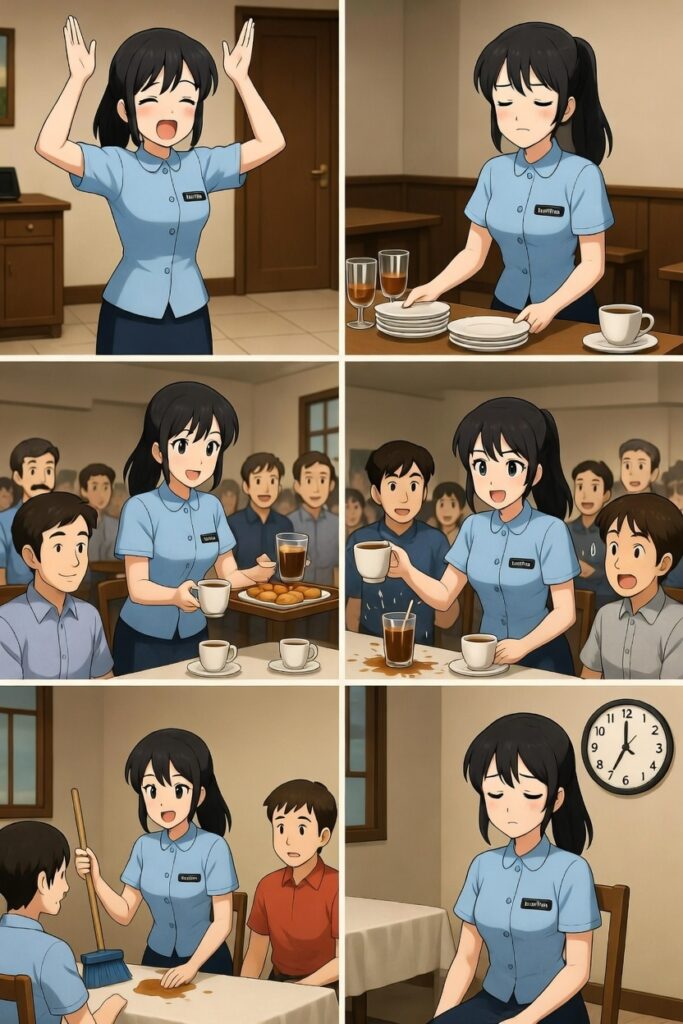
My name is Kunthea. I am a young woman from Cambodia. I work in a big hotel. I am a waitress. I like my job, but some days are very busy.
My work starts at 7 a.m. I put on my uniform and go to the restaurant. I clean the tables and put plates and glasses on them. Everything must look nice for the guests.
Many guests come for breakfast. They say “Good morning” and “Thank you.” I bring coffee and food. Sometimes many guests need help. I must work fast.
Sometimes guests are unhappy. I say “Sorry” and try to help. In the afternoon it is quiet. I clean and talk with my friends. At the end of the day, I am tired but happy.
_____________________
Vocabulary:
young – not old; a small age
a waitress – a woman who gives food and drinks in a restaurant
a waiter – a man who gives food and drinks in a restaurant
to be busy – to have a lot of work or things to do
to start at 7 – to begin work or an activity at 7 o’clock
to put on a uniform – to wear special clothes for work
to clean a table – to make the table free from dirt or food
to put glasses on a table – to put cups for drinks on the table
to look nice – to be clean and good to see
to work fast – to do work quickly
unhappy – not happy; feeling sad or angry
to try to help – to do your best to make someone better or comfortable
to be quiet – to make no noise; to be calm
to be tired – to feel weak or need rest
##################
Match the word with the correct definition:
Words:
young
a waitress
a waiter
to be busy
to start at 7
to put on a uniform
to clean a table
to put glasses on a table
to look nice
to work fast
unhappy
to try to help
to be quiet
to be tired
Definitions (shuffled): A. to do work quickly B. not happy; feeling sad or angry C. to put cups for drinks on the table D. to begin work or an activity at 7 o’clock E. a woman who gives food and drinks in a restaurant F. not old; a small age G. to make no noise; to be calm H. a man who gives food and drinks in a restaurant I. to wear special clothes for work J. to feel weak or need rest K. to have a lot of work or things to do L. to do your best to make someone better or comfortable M. to be clean and good to see N. to make the table free from dirt or food
A waitress is a woman who gives food and drinks in a restaurant. (T)
To be busy means to have a lot of work or things to do. (T)
To put on a uniform means to wear pajamas at work. (F) True is: To put on a uniform means to wear special clothes for work.
Unhappy means feeling very happy and excited. (F) True is: Unhappy means not happy; feeling sad or angry.
To clean a table means to make the table free from dirt or food. (T)
To work fast means to do work slowly. (F) True is: To work fast means to do work quickly.
Young means not old; a small age. (T)
To start at 7 means to begin work or an activity at 7 o’clock. (T)
To be tired means to feel weak or need rest. (T)
To look nice means to be dirty and messy. (F) True is: To look nice means to be clean and good to see.
A waiter is a man who gives food and drinks in a restaurant. (T)
To try to help means to do your best to make someone better or comfortable. (T)
#################
True or false:
Kunthea is a young woman from Cambodia.
She works as a chef in a hotel.
Her work day starts at 7 a.m.
She puts on pajamas before going to work.
She cleans the tables and puts plates and glasses on them.
Many guests come in the evening for breakfast.
Some guests are very friendly and say “Good morning.”
She walks a little when the restaurant is busy.
Sometimes guests are unhappy with the food or service.
She ignores guests when they are unhappy.
In the afternoon, the restaurant is quiet.
At the end of the day, she feels proud and happy.
She does not talk with her colleagues at work.
She never carries plates or drinks to the tables.
_______________________
False: 2,4,6,8,10,13,14
_______________________
Correct answers:
Kunthea is a young woman from Cambodia. (T)
She works as a chef in a hotel. (F) True is: She works as a waitress in a hotel.
Her work day starts at 7 a.m. (T)
She puts on pajamas before going to work. (F) True is: She puts on her uniform before going to work.
She cleans the tables and puts plates and glasses on them. (T)
Many guests come in the evening for breakfast. (F) True is: Many guests come in the morning for breakfast.
Some guests are very friendly and say “Good morning.” (T)
She walks a little when the restaurant is busy. (F) True is: She walks a lot when the restaurant is busy.
Sometimes guests are unhappy with the food or service. (T)
She ignores guests when they are unhappy. (F) True is: She listens and tries to help guests when they are unhappy.
In the afternoon, the restaurant is quiet. (T)
At the end of the day, she feels proud and happy. (T)
She does not talk with her colleagues at work. (F) True is: She talks with her colleagues in the afternoon.
She never carries plates or drinks to the tables. (F) True is: She carries plates and drinks to the tables.
##############
Answer in a complete sentence:
Is her name Sochea or Kunthea?
YOU WRITE: Her name is Kunthea.
Does she work in a small hotel or a big hotel?
Is she a waitress or a chef?
Does her work start at 7 a.m. or 9 a.m.?
Does she put on a uniform or pajamas?
Does she clean the tables or the floors first?
Does she put glasses and plates on the tables or on the floor?
Do guests come in the morning or in the afternoon for breakfast?
Do some guests say “Good morning” or “Good night”?
Does she walk a little or a lot when the restaurant is busy?
Does she ignore unhappy guests or try to help them?
Is the restaurant quiet in the afternoon or in the morning?
Does she talk with her colleagues or sit alone?
At the end of the day, does she feel tired but happy or bored?
________________________
Correct answers:
Is her name Sochea or Kunthea? Her name is Kunthea.
Does she work in a small hotel or a big hotel? She works in a big hotel.
Is she a waitress or a chef? She is a waitress.
Does her work start at 7 a.m. or 9 a.m.? Her work starts at 7 a.m.
Does she put on a uniform or pajamas? She puts on a uniform.
Does she clean the tables or the floors first? She cleans the tables first.
Does she put glasses and plates on the tables or on the floor? She puts glasses and plates on the tables.
Do guests come in the morning or in the afternoon for breakfast? Guests come in the morning for breakfast.
Do some guests say “Good morning” or “Good night”? Some guests say “Good morning.”
Does she walk a little or a lot when the restaurant is busy? She walks a lot when the restaurant is busy.
Does she ignore unhappy guests or try to help them? She tries to help unhappy guests.
Is the restaurant quiet in the afternoon or in the morning? The restaurant is quiet in the afternoon.
Does she talk with her colleagues or sit alone? She talks with her colleagues.
At the end of the day, does she feel tired but happy or bored? At the end of the day, she feels tired but happy.
#################
Fill in, use proper form of verb:
Kunthea __________ (be) a young woman from Cambodia.
She __________ (work) as a waitress in a big hotel.
Her work day __________ (start) at 7 a.m.
She __________ (put) on a uniform before going to the restaurant.
She __________ (clean) the tables and puts plates and glasses on them.
Many guests__________ (come) in the morning for breakfast.
Some guests __________ (be) very friendly and say “Good morning.”
She __________ (carry) plates and drinks to the tables when it is busy.
Sometimes guests __________ (be) unhappy with the food or service.
She __________ (talk) with her colleagues in the afternoon.
At the end of the day, she __________ (feel) tired but proud and happy.
She never __________ (help) guests when they have problems.
_____________________
Correct version:
Kunthea is a young woman from Cambodia.
She works as a waitress in a big hotel.
Her work day starts at 7 a.m.
She puts on a uniform before going to the restaurant.
She cleans the tables and puts plates and glasses on them.
Many guests come in the morning for breakfast.
Some guests are very friendly and say “Good morning.”
She carries plates and drinks to the tables when it is busy.
Sometimes guests are unhappy with the food or service.
She talks with her colleagues in the afternoon.
At the end of the day, she feels tired but proud and happy.
She never helps guests when they have problems.
#################
Basics of present simple:
Personal Pronoun
am / is / are
I
am
8 years old
You
are
8 years old
He
is
8 years old
She
is
8 years old
It
is
8 years old
We
are
8 years old
You (plural)
are
8 years old
They
are
8 years old
Personal Pronoun
am not / is not / are not
I
am not
8 years old
You
are not
8 years old
He
is not
8 years old
She
is not
8 years old
It
is not
8 years old
We
are not
8 years old
You (plural)
are not
8 years old
They
are not
8 years old
Question:
Question Word
Personal Pronoun
Am
I
8 years old?
Are
you
8 years old?
Is
he
8 years old?
Is
she
8 years old?
Is
it
8 years old?
Are
we
8 years old?
Are
you (plural)
8 years old?
Are
they
8 years old?
Statement:
Personal Pronoun
Verb
I
like
ice cream
You
like
ice cream
He
likes
ice cream
She
likes
ice cream
It
likes
ice cream
We
like
ice cream
You (plural)
like
ice cream
They
like
ice cream
Negation:
Personal Pronoun
Verb (negative)
I
do not like
ice cream
You
do not like
ice cream
He
does not like
ice cream
She
does not like
ice cream
It
does not like
ice cream
We
do not like
ice cream
You (plural)
do not like
ice cream
They
do not like
ice cream
Question:
Do / Does
Personal Pronoun
Verb
Sugar?
Do
I
like
sugar?
Do
you
like
sugar?
Does
he
like
sugar?
Does
she
like
sugar?
Does
it
like
sugar?
Do
we
like
sugar?
Do
you (plural)
like
sugar?
Do
they
like
sugar?
################
Form a) negation b) question c) negative question as shown in sentence 1:
She talks with colleagues in the afternoon.
a) She doesn’t talk with colleagues in the afternoon. b) Does she talk with colleagues in the afternoon? c) Doesn’t she talk with colleagues in the afternoon?
She wears a uniform.
Some guests are unhappy.
Kunthea is from Cambodia.
Guests come in the morning for breakfast.
She carries plates and drinks.
She feels tired but happy at the end of the day.
Some guests say “Good morning.”
Her work starts at 7 a.m.
She cleans the tables.
She is a waitress in a big hotel.
She helps guests when they have problems.
______________________
Correct version:
She talks with colleagues in the afternoon. a) She doesn’t talk with colleagues in the afternoon. b) Does she talk with colleagues in the afternoon? c) Doesn’t she talk with colleagues in the afternoon?
She wears a uniform. a) She doesn’t wear a uniform. b) Does she wear a uniform? c) Doesn’t she wear a uniform?
Some guests are unhappy. a) Some guests are not unhappy. b) Are some guests unhappy? c) Aren’t some guests unhappy?
Kunthea is from Cambodia. a) Kunthea is not from Cambodia. b) Is Kunthea from Cambodia? c) Isn’t Kunthea from Cambodia?
Guests come in the morning for breakfast. a) Guests do not come in the morning for breakfast. b) Do guests come in the morning for breakfast? c) Don’t guests come in the morning for breakfast?
She carries plates and drinks. a) She doesn’t carry plates and drinks. b) Does she carry plates and drinks? c) Doesn’t she carry plates and drinks?
She feels tired but happy at the end of the day. a) She doesn’t feel tired but happy at the end of the day. b) Does she feel tired but happy at the end of the day? c) Doesn’t she feel tired but happy at the end of the day?
Some guests say “Good morning.” a) Some guests don’t say “Good morning.” b) Do some guests say “Good morning”? c) Don’t some guests say “Good morning”?
Her work starts at 7 a.m. a) Her work does not start at 7 a.m. b) Does her work start at 7 a.m.? c) Doesn’t her work start at 7 a.m.?
She cleans the tables. a) She doesn’t clean the tables. b) Does she clean the tables? c) Doesn’t she clean the tables?
She is a waitress in a big hotel. a) She is not a waitress in a big hotel. b) Is she a waitress in a big hotel? c) Isn’t she a waitress in a big hotel?
She helps guests when they have problems. a) She doesn’t help guests when they have problems. b) Does she help guests when they have problems? c) Doesn’t she help guests when they have problems?
################
Short answers, basics:
Example Sentence
Yes
No
I learn the alphabet.
Yes, I do.
No, I don’t.
You read signs.
Yes, you do.
No, you don’t.
He practices speaking.
Yes, he does.
No, he doesn’t.
She watches cartoons.
Yes, she does.
No, she doesn’t.
It helps us learn English.
Yes, it does.
No, it doesn’t.
We use apps like Duolingo.
Yes, we do.
No, we don’t.
You read labels.
Yes, you do.
No, you don’t.
They make mistakes sometimes.
Yes, they do.
No, they don’t.
Question
Yes
No
Do I learn the alphabet?
Yes, I do.
No, I don’t.
Do you read signs?
Yes, you do.
No, you don’t.
Does he practice speaking?
Yes, he does.
No, he doesn’t.
Does she watch cartoons?
Yes, she does.
No, she doesn’t.
Does it help us learn English?
Yes, it does.
No, it doesn’t.
Do we use apps like Duolingo?
Yes, we do.
No, we don’t.
Do you read labels?
Yes, you do.
No, you don’t.
Do they make mistakes sometimes?
Yes, they do.
No, they don’t.
Question
Yes
No
Am I big?
Yes, I am.
No, I am not.
Are you big?
Yes, you are.
No, you aren’t.
Is he big?
Yes, he is.
No, he isn’t.
Is she big?
Yes, she is.
No, she isn’t.
Is it big?
Yes, it is.
No, it isn’t.
Are we big?
Yes, we are.
No, we aren’t.
Are you big?
Yes, you are.
No, you aren’t.
Are they big?
Yes, they are.
No, they aren’t.
####################
Give short answers:
She puts plates and glasses on the tables.
YOU WRITE: Yes, she does.
Guests eat dinner in the restaurant.
Kunthea is from Cambodia.
She wears pajamas to work.
She talks with her colleagues in the afternoon.
She carries coffee and food to the guests.
Guests come in the evening for breakfast.
She is a waitress.
She cleans the tables.
She goes to the supermarket for work.
Guests come in the afternoon for breakfast.
She carries plates and drinks to the tables.
Her work starts at 7 a.m.
Some guests say “Good morning.”
She is a chef in a hotel.
Guests drink coffee in the morning.
She puts plates and glasses on the floor.
She puts on a uniform.
Guests say “Thank you.”
Some guests are unhappy with the food.
_________________________
Correct version:
She puts plates and glasses on the tables. – Yes, she does.
Guests eat dinner in the restaurant. – No, they don’t.
Kunthea is from Cambodia. – Yes, she is.
She wears pajamas to work. – No, she doesn’t.
She talks with her colleagues in the afternoon. – Yes, she does.
She carries coffee and food to the guests. – Yes, she does.
Guests come in the evening for breakfast. – No, they don’t.
She is a waitress. – Yes, she is.
She cleans the tables. – Yes, she does.
She goes to the supermarket for work. – No, she doesn’t.
Guests come in the afternoon for breakfast. – No, they don’t.
She carries plates and drinks to the tables. – Yes, she does.
Her work starts at 7 a.m. – Yes, it does.
Some guests say “Good morning.” – Yes, they do.
She is a chef in a hotel. – No, she isn’t.
Guests drink coffee in the morning. – No, they don’t.
She puts plates and glasses on the floor. – No, she doesn’t.
She puts on a uniform. – Yes, she does.
Guests say “Thank you.” – Yes, they do.
Some guests are unhappy with the food. – No, they aren’t.
################
Rewrite as shown in 1.:
Do guests eat dinner in the restaurant?
YOU WRITE: No, they don’t. They eat breakfast in the restaurant.
Does she wear pajamas to work?
Does she work in a small restaurant?
Does she go to the supermarket for work?
Do guests come in the evening for breakfast?
Do guests come in the afternoon for breakfast?
Is she a chef in a hotel?
Does she put plates and glasses on the floor?
Are some guests always unhappy?
Does she carry food only in the morning?
________________________
Correct version:
Do guests eat dinner in the restaurant? – No, they don’t. They eat breakfast in the restaurant.
Does she wear pajamas to work? – No, she doesn’t. She wears a uniform.
Does she work in a small restaurant? – No, she doesn’t. She works in a big hotel.
Does she go to the supermarket for work? – No, she doesn’t. She goes to the restaurant.
Do guests come in the evening for breakfast? – No, they don’t. They come in the morning.
Do guests come in the afternoon for breakfast? – No, they don’t. They come in the morning.
Is she a chef in a hotel? – No, she isn’t. She is a waitress.
Does she put plates and glasses on the floor? – No, she doesn’t. She puts them on the tables.
Are some guests always unhappy? – No, they aren’t. Sometimes a guest is unhappy.
Does she carry food only in the morning? – No, she doesn’t. She carries food all day when the restaurant is busy.
#################
Interview with Kunthea
1. Q: Who are you? A: I am Kunthea.
2. Q: Where do you come from? A: I come from Cambodia.
3. Q: What job do you do? A: I am a waitress.
4. Q: Where do you work? A: I work in a big hotel.
5. Q: When does your work start? A: My work starts at 7 a.m.
6. Q: Why do you like your job? A: I like my job because I meet friendly guests.
7. Q: How do you go to work? A: I go to work by walking.
8. Q: What do you do first at work? A: I put on my uniform and clean the tables.
9. Q: What do you put on the tables? A: I put plates, glasses, and cutlery on the tables.
10. Q: How do guests greet you? A: Guests say “Good morning” and “Thank you.”
11. Q: What do you do when guests need help? A: I listen and bring them food or drinks.
12. Q: When is the restaurant quiet? A: The restaurant is quiet in the afternoon.
13. Q: Who do you talk to at work? A: I talk to my colleagues.
14. Q: How do you feel at the end of the day? A: I feel tired, but I feel proud and happy.
##################
Interview with her friend, about Kunthea, fill in:
1. Q: Who is she? A: She is Kunthea.
2. Q: Where does she come from? A: She __________ (come) from Cambodia.
3. Q: What job does she do? A: She __________ (be) a waitress.
4. Q: Where does she work? A: She __________ (work) in a big hotel.
5. Q: When does her work start? A: Her work __________ (start) at 7 a.m.
6. Q: Why does she like her job? A: She __________ (like) her job because she __________ (meet) friendly guests.
7. Q: How does she go to work? A: She __________ (go) to work by walking.
8. Q: What does she do first at work? A: She __________ (put) on her uniform and __________ (clean) the tables.
9. Q: What does she put on the tables? A: She __________ (put) plates, glasses, and cutlery [the knives, forks, and spoons that you use to eat] on the tables.
10. Q: How do guests greet her? A: Guests __________ (say) “Good morning” and “Thank you.”
11. Q: What does she do when guests need help? A: She __________ (listen) and __________ (bring) them food or drinks.
12. Q: When is the restaurant quiet? A: The restaurant __________ (be) quiet in the afternoon.
13. Q: Who does she talk to at work? A: She __________ (talk) to her colleagues.
14. Q: How does she feel at the end of the day? A: She __________ (feel) tired, but she __________ (feel) proud and happy.
###################
Correct version:
1. Q: Who is she? A: She is Kunthea.
2. Q: Where does she come from? A: She comes from Cambodia.
3. Q: What job does she do? A: She is a waitress.
4. Q: Where does she work? A: She works in a big hotel.
5. Q: When does her work start? A: Her work starts at 7 a.m.
6. Q: Why does she like her job? A: She likes her job because she meets friendly guests.
7. Q: How does she go to work? A: She goes to work by walking.
8. Q: What does she do first at work? A: She puts on her uniform and cleans the tables.
9. Q: What does she put on the tables? A: She puts plates, glasses, and cutlery on the tables.
10. Q: How do guests greet her? A: Guests say “Good morning” and “Thank you.”
11. Q: What does she do when guests need help? A: She listens and brings them food or drinks.
12. Q: When is the restaurant quiet? A: The restaurant is quiet in the afternoon.
13. Q: Who does she talk to at work? A: She talks to her colleagues.
14. Q: How does she feel at the end of the day? A: She feels tired, but she feels proud and happy.
###################
Rewrite the sentences in the 3rd person singular, as shown, make all changes necessary:
My name is Kunthea.
YOU WRITE: Her name is Kunthea.
I am a young woman from Cambodia.
I work in a big hotel.
I am a waitress.
I like my job, but some days are busy.
My work starts at 7 a.m.
I put on my uniform and clean the tables.
I put plates and glasses on the tables.
Many guests come for breakfast and say “Good morning” and “Thank you.”
Sometimes guests are unhappy, and I try to help them.
At the end of the day, I am tired but happy.
_______________________
Correct version:
Her name is Kunthea.
She is a young woman from Cambodia.
She works in a big hotel.
She is a waitress.
She likes her job, but some days are busy.
Her work starts at 7 a.m.
She puts on her uniform and cleans the tables.
She puts plates and glasses on the tables.
Many guests come for breakfast and say “Good morning” and “Thank you.”
Sometimes guests are unhappy, and she tries to help them.
Water is very important for life. People, animals, and plants need water every day. We drink water to live and stay healthy. Our bodies need water.
We use water for many things. We drink it and cook with it. We wash our hands with water. We wash food, clothes, and our homes with water.
Water is also important for animals and plants. Fish live in rivers and lakes. Plants need water to grow.
We must keep water clean. Dirty water can make people and animals sick. We should not throw trash in rivers or lakes. We should use water carefully.
Clean water helps people, animals, and plants live. We must take care of water every day.
__________________________
Vocabulary:
to be important – something is needed or very useful
an animal – a living thing that is not a person or a plant
a plant – a living thing that grows in the ground, like a tree or flower
to drink – to put water or another liquid in your mouth and swallow
to stay healthy – to be strong and not get sick
to cook – to make food ready to eat with heat
to wash hands – to clean your hands with water and soap
food – something we eat to live
clothes – what we wear on our body
a river – a long line of water that moves on the ground
a lake – a big area of water that does not move much
to need – to want something to live or be okay
to grow – to become bigger or taller
to keep water clean – to stop water from being dirty
dirty water – water that is not clean
to make sick – to make someone feel bad or ill
to throw trash into a river – to put rubbish in the river
to use carefully – to not waste or break something
to take care of water – to keep water clean and safe
#############
Word-definition match exercise:
Words:
to be important
an animal
a plant
to drink
to stay healthy
to cook
to wash hands
food
clothes
a river
Definitions:
A. A living thing that grows in the ground, like a tree or flower B. Something we eat to live C. To clean your hands with water and soap D. What we wear on our body E. To put water or another liquid in your mouth and swallow F. Something is needed or very useful G. To be strong and not get sick H. A living thing that is not a person or a plant I. To make food ready to eat with heat J. A long line of water that moves on the ground
Water is important for people, animals, and plants.
We only need water for cooking.
Dirty water can make people and animals sick.
Clothes grow in rivers.
We should keep water clean.
We can drink water to stay healthy.
Rivers and lakes are homes for animals and plants.
We should throw trash into rivers.
Water is not needed for plants to grow.
We use water to wash hands, food, and clothes.
_______________________
True: 1,3,5,6,7,10
#################
Basics – present simple
Negation:
Personal Pronoun
Verb (negative)
I
do not like
ice cream
You
do not like
ice cream
He
does not like
ice cream
She
does not like
ice cream
It
does not like
ice cream
We
do not like
ice cream
You (plural)
do not like
ice cream
They
do not like
ice cream
Questions:
Do / Does
Personal Pronoun
Verb
Sugar?
Do
I
like
sugar?
Do
you
like
sugar?
Does
he
like
sugar?
Does
she
like
sugar?
Does
it
like
sugar?
Do
we
like
sugar?
Do
you (plural)
like
sugar?
Do
they
like
sugar?
‚to be‘ – basics:
Personal Pronoun
am / is / are
I
am
8 years old
You
are
8 years old
He
is
8 years old
She
is
8 years old
It
is
8 years old
We
are
8 years old
You (plural)
are
8 years old
They
are
8 years old
Negation:
Personal Pronoun
am not / is not / are not
I
am not
8 years old
You
are not
8 years old
He
is not
8 years old
She
is not
8 years old
It
is not
8 years old
We
are not
8 years old
You (plural)
are not
8 years old
They
are not
8 years old
Questions:
Question Word
Personal Pronoun
Am
I
8 years old?
Are
you
8 years old?
Is
he
8 years old?
Is
she
8 years old?
Is
it
8 years old?
Are
we
8 years old?
Are
you (plural)
8 years old?
Are
they
8 years old?
Make the following statements negative:
People live without water.
Animals live without water.
Plants grow without water.
We use water only for drinking.
Dirty water is healthy for people.
Throw trash into rivers and lakes.
Clothes grow in rivers.
Rivers and lakes have no animals or plants.
Water is unimportant for life.
Keep water dirty is good.
______________________________
Correct answer:
People do not live without water.
Animals do not live without water.
Plants do not grow without water.
We do not use water only for drinking.
Dirty water does not make people healthy.
We do not throw trash into rivers and lakes.
Clothes do not grow in rivers.
Rivers and lakes do not have no animals or plants.
Water does not become unimportant for life.
We do not keep water dirty.
################
Rewrite as a question:
Water helps life.
YOU WRITE: Does water help life?
People want water every day.
Animals drink water to live.
Plants grow with water.
We drink water to feel strong.
We make food with water.
We clean our hands with water.
Rivers and lakes have fish and plants.
Dirty water can make people ill.
We take care of water.
______________________
Correct version:
Does water help life?
Do people want water every day?
Do animals drink water to live?
Do plants grow with water?
Do we drink water to feel strong?
Do we make food with water?
Do we clean our hands with water?
Do rivers and lakes have fish and plants?
Can dirty water make people ill?
Do we take care of water?
################
Fill in, verb in correct form:
Water __________ (be) important for people.
An animal __________ (need) water to live.
Plants __________ (grow) with water.
A child __________ (drink) water every day.
Farmers __________ (use) water to cook food.
We __________ (wash) our hands with water.
Rivers __________ (have) fish and animals.
A tree __________ (grow) with water.
Dirty water __________ (can) make people sick.
Families __________ (keep) water clean.
______________________ Correct version:
Water is important for people.
An animal needs water to live.
Plants grow with water.
A child drinks water every day.
Farmers use water to cook food.
We wash our hands with water.
Rivers have fish and animals.
A tree grows with water.
Dirty water can make people sick.
Families keep water clean.
################
Fill in, words below:
clothes – full of – people – carefully – grow – drink – live – fish – cook – dirty
Water is needed by all __________.
Animals drink water to__________.
Plants need water to __________ tall.
We use water to ___________ food every day.
People wash __________ with water.
Rivers have many animals and __________.
Lakes are __________ water.
__________ water can make animals sick.
We __________ water to stay strong.
Families use water ___________.
——————————–
Correct version:
Water is needed by all people.
Animals drink water to live.
Plants need water to grow tall.
We use water to cook food every day.
People wash clothes with water.
Rivers have many animals and fish.
Lakes are full of water.
Dirty water can make animals sick.
We drink water to stay strong.
Families use water carefully.
################
What is the full sentence?
1. life / important / water / for / very / is 2. cook / we / food / use / water / to 3. to / healthy / water / stay / people / drink 4. wash / clothes / and / with / hands / we / water 5. lakes / have / and / animals / rivers / fish / and 6. grow / with / plants / water 7. can / make / water / people / dirty / sick 8. keep / families / water / clean / should 9. drink / live / to / animals / water 10. need / day / water / every / people
_______________________
Correct sentences:
Water is very important for life.
We use water to cook food.
People drink water to stay healthy.
We wash hands and clothes with water.
Rivers and lakes have animals and fish.
Plants grow with water.
Dirty water can make people sick.
Families should keep water clean.
Animals drink water to live.
People need water every day.
##################
Dialogue:
1. Q: What is very important for life? A: Water is very important for life.
2. Q: Who needs water every day? A: People need water every day.
Sokha is nine years old. He lives in Siem Reap with his mother, father, and little brother. He is a happy boy and likes school very much.
Every day, he wakes up at six o’clock. He washes his face and brushes his teeth. He eats breakfast with his family. He eats rice, eggs, or fruit. Then he puts on his school uniform and goes to school.
School starts at seven o’clock. He studies math, Khmer, and science. He likes math best. At twelve o’clock, he eats lunch with his friends.
After school, he learns English and computers. In the evening, he does homework and eats dinner. He goes to bed at eight thirty.
_____________________
Vocabulary:
NGO (Non-Governmental Organization) – an organization that is not part of the government [ a group of people who run a country. They make rules and laws ]
to wake up – to stop sleeping
to wash – to clean with water
a face – the front part of your head (eyes, nose, mouth)
to brush teeth – to clean your teeth with a toothbrush
a tooth – one white thing in your mouth
to eat breakfast – to eat food in the morning
an egg – food from a chicken
to put on a uniform – to wear school or work clothes
to study math – to learn about numbers
science – learning about the world and nature
to eat lunch – to eat food in the middle of the day
to learn computers – to learn how to use a computer
#################
Match the words with the correct definitions.
Words
to wake up
a tooth
to eat lunch
to wash
science
to put on a uniform
an egg
to brush teeth
to study math
to learn computers
to eat breakfast
a face
Definitions (Random Order)
A. to learn about numbers B. to stop sleeping C. to clean your teeth with a toothbrush D. food from a chicken E. to eat food in the morning F. to clean with water G. learning about the world and nature H. the front part of your head I. one white thing in your mouth J. to learn how to use a computer K. to eat food in the middle of the day L. to wear school or work clothes
to wake up – to stop sleeping a tooth – one white thing in your mouth to eat lunch – to eat food in the middle of the day to wash – to clean with water science – learning about the world and nature to put on a uniform – to wear school or work clothes an egg – food from a chicken to brush teeth – to clean your teeth with a toothbrush to study math – to learn about numbers to learn computers – to learn how to use a computer to eat breakfast – to eat food in the morning a face – the front part of your head
##################
True or false:
Sokha reads a little in the evening.
He eats lunch at home with his family.
School starts at seven o’clock.
He has a little sister.
Sometimes he eats fish or chicken for lunch.
Sokha likes math very much.
He goes to bed at ten o’clock.
Sokha wakes up at six o’clock every morning.
He never helps his mother at home.
After school, Sokha learns English and computers.
He eats breakfast with his family.
Sokha does not like learning new things.
He studies music at school every day.
He lives in Phnom Penh.
____________________________
True: 1,3,5,6,8,10,11,
____________________________
Correct version:
Sokha reads a little in the evening.
He eats lunch at home with his family. True is: He eats lunch at school.
School starts at seven o’clock.
He has a little sister. True is: He has a little brother.
Sometimes he eats fish or chicken for lunch.
Sokha likes math very much.
He goes to bed at ten o’clock. True is: He goes to bed at eight thirty.
Sokha wakes up at six o’clock every morning.
He never helps his mother at home. True is: He helps his mother at home.
After school, Sokha learns English and computers.
He eats breakfast with his family.
Sokha does not like learning new things. True is: He likes learning new things.
He studies music at school every day. True is: Sometimes he learns music and dance.
He lives in Phnom Penh. True is: He lives in Siem Reap.
################
Fill in, words below:
science – learns – mother – dinner – likes – friends – wakes up – does – puts on – brushes
Sokha is nine years old. He lives in Siem Reap with his __________, father, and little brother. He is a happy boy and __________ school. Every morning, he __________ at six o’clock. He washes his face, __________ his teeth, and eats breakfast with his family. He __________ his school uniform and goes to school. He studies math, Khmer, and __________. At twelve o’clock, he eats lunch with his __________. After school, he __________ English and computers. In the evening, he __________ his homework, helps his mother, eats __________, reads a little, and goes to bed.
—————————————–
Correct version:
Sokha is nine years old. He lives in Siem Reap with his mother, father, and little brother. He is a happy boy and likes school. Every morning, he wakes up at six o’clock. He washes his face, brushes his teeth, and eats breakfast with his family. He puts on his school uniform and goes to school. He studies math, Khmer, and science. At twelve o’clock, he eats lunch with his friends. After school, he learns English and computers. In the evening, he does his homework, helps his mother, eats dinner, reads a little, and goes to bed.
###################
Negation:
Personal Pronoun
Verb (negative)
I
do not like
ice cream
You
do not like
ice cream
He
does not like
ice cream
She
does not like
ice cream
It
does not like
ice cream
We
do not like
ice cream
You (plural)
do not like
ice cream
They
do not like
ice cream
Questions:
Do / Does
Personal Pronoun
Verb
Sugar?
Do
I
like
sugar?
Do
you
like
sugar?
Does
he
like
sugar?
Does
she
like
sugar?
Does
it
like
sugar?
Do
we
like
sugar?
Do
you (plural)
like
sugar?
Do
they
like
sugar?
‚to be‘ – basics:
Personal Pronoun
am / is / are
I
am
8 years old
You
are
8 years old
He
is
8 years old
She
is
8 years old
It
is
8 years old
We
are
8 years old
You (plural)
are
8 years old
They
are
8 years old
Negation:
Personal Pronoun
am not / is not / are not
I
am not
8 years old
You
are not
8 years old
He
is not
8 years old
She
is not
8 years old
It
is not
8 years old
We
are not
8 years old
You (plural)
are not
8 years old
They
are not
8 years old
Questions:
Question Word
Personal Pronoun
Am
I
8 years old?
Are
you
8 years old?
Is
he
8 years old?
Is
she
8 years old?
Is
it
8 years old?
Are
we
8 years old?
Are
you (plural)
8 years old?
Are
they
8 years old?
###################
Rewrite as shown in statement 1:
Sokha is nine years old.
YOU WRITE: Negation: Sokha is not nine years old. Question: Is Sokha nin years old?
He lives in Siem Reap with his mother, father, and little brother.
He wakes up at six o’clock,
He eats breakfast.
He studies math, Khmer, and science.
After school, he learns English and computers.
In the evening, he does his homework.
He helps his mother.
They eat dinner,
Sokha and her brother read a little.
She goes to bed at 9pm.
_________________________
Correct answers:
Sokha is nine years old. Negation: Sokha is not nine years old. Question: Is Sokha nine years old?
He lives in Siem Reap with his mother, father, and little brother. Negation: He does not live in Siem Reap with his mother, father, and little brother. Question: Does he live in Siem Reap with his mother, father, and little brother?
He wakes up at six o’clock. Negation: He does not wake up at six o’clock. Question: Does he wake up at six o’clock?
He eats breakfast. Negation: He does not eat breakfast. Question: Does he eat breakfast?
He studies math, Khmer, and science. Negation: He does not study math, Khmer, and science. Question: Does he study math, Khmer, and science?
After school, he learns English and computers. Negation: After school, he does not learn English and computers. Question: After school, does he learn English and computers?
In the evening, he does his homework. Negation: In the evening, he does not do his homework. Question: In the evening, does he do his homework?
He helps his mother. Negation: He does not help his mother. Question: Does he help his mother?
They eat dinner. Negation: They do not eat dinner. Question: Do they eat dinner?
Sokha and his brother read a little. Negation: Sokha and his brother do not read a little. Question: Do Sokha and his brother read a little?
He goes to bed at nine o’clock. Negation: He does not go to bed at nine o’clock. Question: Does he go to bed at nine o’clock?
##################
Unscramble the sentences:
his / brushes / face / and / his / he / teeth / washes →
school / he / English / after / learns →
breakfast / morning / eats / he / the / in →
school / science / at / he / math / and / studies →
little / his / and / read / Sokha / brother →
nine / goes / at / he / bed / to / o’clock →
Answers
He washes his face and brushes his teeth.
After school, he learns English.
He eats breakfast in the morning.
He studies math and science at school.
Sokha and his little brother read.
He goes to bed at nine o’clock.
################
Match question to answer
Questions
What is your name?
How old are you?
Where do you live?
Who do you live with?
What time do you wake up?
What do you eat for breakfast?
What subjects do you study at school?
What do you do after school?
Who do you sit with at lunch?
What do you do before you go to bed?
Answers
A. I eat rice, eggs, or fruit for breakfast. B. I do my homework, help my mother, eat dinner, and read a little before I go to bed. C. I am nine years old. D. I live in Siem Reap. E. I study math, Khmer, and science. F. I sit with my friends at lunch. G. I learn English and computers after school. H. My name is Sokha. I. I live with my mother, father, and little brother. J. I wake up at six o’clock.
Two goats live near a river. One goat is big. One goat is small.
There is a small bridge over the river. Only one goat can walk on it at a time.
One day, the big goat walks on the bridge. At the same time, the small goat walks from the other side. They meet in the middle.
The big goat says, “Move! I am big and strong.” The small goat says, “Please do not be proud. We can both cross.”
Both goats are proud. They push each other.
They lose balance and fall into the cold river. Splash!
They swim to the shore. They are wet and cold.
The lesson: Never be proud.
____________________________
Vocabulary:
to be proud – to feel very good about yourself, sometimes too much.
a goat – a small farm animal with horns and a beard.
to get wet – to have water on your body or clothes.
a river – a long, flowing body of water.
a bridge – a structure over water or a road that people can walk on.
one at a time – only one person or thing moves before the next one.
to meet in the middle – to come to the center from two sides.
to be strong – to have a lot of power or muscles.
both – the two people or things together.
to lose balance – to fall or almost fall because you are not stable.
to fall into the river – to drop into the river by accident.
to swim to the shore – to move in the water with your arms and legs until you reach land.
#############
Word match to definition
Words:
to be proud
a goat
to get wet
a river
a bridge
one at a time
to meet in the middle
to be strong
both
to lose balance
to fall into the river
to swim to the shore
Definitions (random order): A. To move in the water with your arms and legs until you reach land. B. Only one person or thing moves before the next one. C. To feel very good about yourself. D. Two people or things together. E. A long, flowing body of water. F. A small farm animal with horns and a beard. G. To drop into the river by accident. H. A structure over water or a road that people can walk on. I. To have water on your body or clothes. J. To come to the center from two sides. K. To fall or almost fall because you are not stable. L. To have a lot of power or muscles.
to be proud – to feel very good about yourself a goat – a small farm animal with horns and a beard to get wet – to have water on your body or clothes a river – a long, flowing body of water a bridge – a structure over water or a road that people can walk on one at a time – only one person or thing moves before the next one to meet in the middle – to come to the center from two sides to be strong – to have a lot of power or muscles both – two people or things together to lose balance – to fall or almost fall because you are not stable to fall into the river – to drop into the river by accident to swim to the shore – to move in the water with your arms and legs until you reach land
################
True or false?
A goat is a small farm animal with horns.
To be proud means to feel sad about yourself.
One at a time means only one person moves before the next.
A river is dry land.
To get wet means to stay dry.
Both means only one person or thing.
To meet in the middle means to come to the center from two sides.
To be strong means to have a lot of power or muscles.
To lose balance means to stay very still.
To swim to the shore means to move in the water to reach land.
A bridge is a structure you can walk on over water or a road.
To fall into the river means to jump safely into the river.
To get wet means to feel dry.
Both means two people or things together.
___________________________
True: 1,3,7,8,10,11,14 ______________________
Correct version:
A goat is a small farm animal with horns. – T
To be proud means to feel sad about yourself. – F – True is: To be proud means to feel very good about yourself.
One at a time means only one person moves before the next. – T
A river is dry land. – F – True is: A river is a long, flowing body of water.
To get wet means to stay dry. – F – True is: To get wet means to have water on your body or clothes.
Both means only one person or thing. – F – True is: Both means two people or things together.
To meet in the middle means to come to the center from two sides. – T
To be strong means to have a lot of power or muscles. – T
To lose balance means to stay very still. – F – True is: To lose balance means to fall or almost fall because you are not stable.
To swim to the shore means to move in the water to reach land. – T
A bridge is a structure you can walk on over water or a road. – T
To fall into the river means to jump safely into the river. – F – True is: To fall into the river means to drop into the river by accident.
To get wet means to feel dry. – F – True is: To get wet means to have water on your body or clothes.
Both means two people or things together. – T
##############
Fill in, words below:
goat – middle – Another – shore – river – push – big – bridge – walks – on
Two goats live near a __________.
One goat is __________.
__________ goat is small.
A small __________ goes over the river.
Only one __________ can walk on the bridge at a time.
The big goat walks __________ the bridge.
The small goat __________ from the other side.
In the __________, they meet.
Both __________ each other.
They fall into the cold river and swim to the __________.
___________________
Correct version:
Two goats live near a river.
One goat is big.
Another goat is small.
A small bridge goes over the river.
Only one goat can walk on the bridge at a time.
The big goat walks on the bridge.
The small goat walks from the other side.
In the middle, they meet.
Both push each other.
They fall into the cold river and swim to the shore.
###############
Put the words in order:
two / the/ goats / near / river / the / live
one / on/ goat / big / left / side / is /the
small / the/ goat / right / side / walks / the / on
the / a / small / goes / over / river / bridge
the / big / goat / walks / on / bridge
of / bridge / in / the / they / meet / middle / the
river / both / the / goats / push / each / other / into
______________________
Correct answers:
The two goats live near the river.
One big goat is on the left side.
The small goat walks on the right side.
A small bridge goes over the river.
The big goat walks on the bridge.
They meet in the middle of the bridge.
Both goats push each other into river.
##############
Rewrite the dialogue, match question and answer:
Questions:
Where do the goats live?
How many goats are there?
Is one goat big or small?
Is the other goat big or small?
What do the goats do on the bridge?
Do the goats meet in the middle?
Are the goats proud?
What happens when they push each other?
Do they get wet?
What do the goats do after they fall?
Randomized Answers:
A. One goat is big. B. Yes, they get wet. C. They walk on the bridge. D. Yes, both goats are proud. E. The goats live near the river. F. Two goats. G. They swim to the shore. H. The other goat is small. I. Yes, they meet in the middle. J. They fall into the cold river.