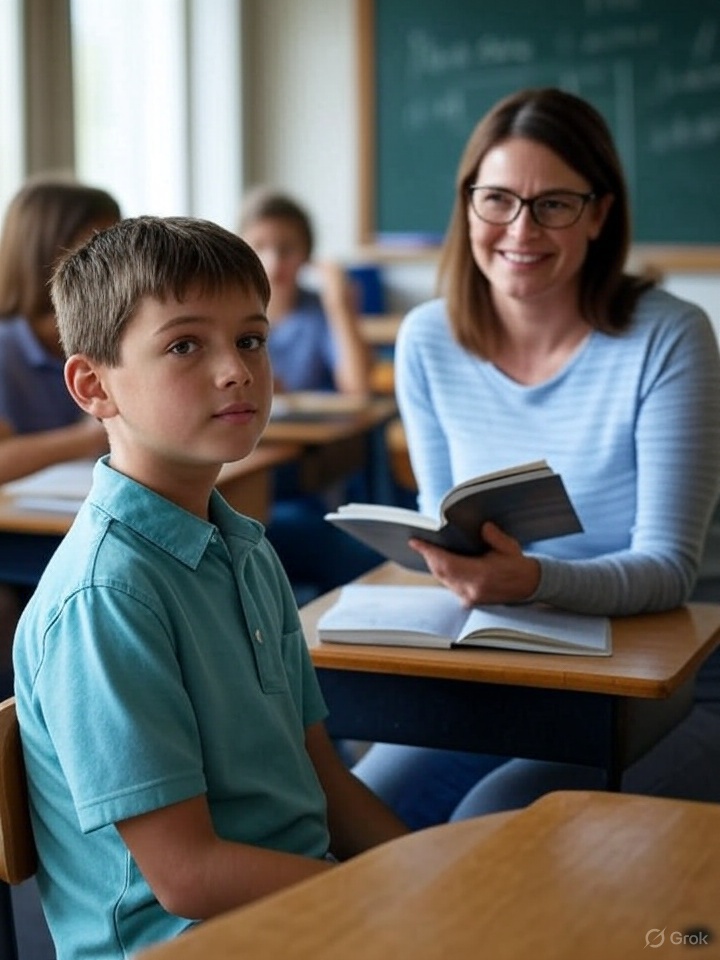
[My name is Oum. I am twelve years old. I am from Siem Reap. I like football and pizza. I don’t like spiders. I don’t like homework. My dream is to be a teacher. I want to travel to Paris one day.]
____________________
Now you talk to Oum:
Your name is Oum. You are twelve years old. You are from Siem Reap.
You like football and pizza. You don’t like spiders. You don’t like homework.
Your dream is to be a teacher. You want to travel to Paris one day. ##################
Now you talk about Oum:
Her name is Oum. She is twelve years old. She is from Siem Reap.
She likes football and pizza. She doesn’t like spiders. She doesn’t like homework.
Her dream is to be a teacher. She wants to travel to Paris one day. ############### Simple statements:
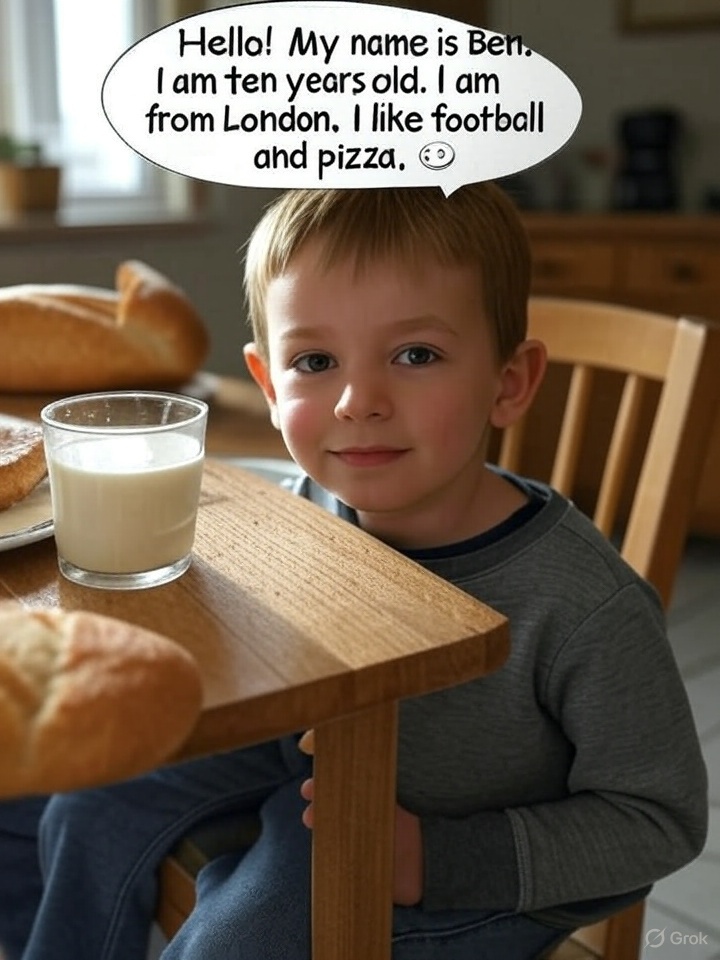
I am Ben. I wake up at 7 o’clock. I wash my face and hands. I brush my teeth. I eat bread and milk for breakfast. I put on my clothes. I go to school. I am happy.
Word List – simple explanations
to wake up = open your eyes in the morning
to wash = make your hands or face clean
face = the front part of your head
hands = what you use to touch things
to brush = clean with a brush
teeth = in your mouth, you brush them (singular: tooth)
breakfast = the first meal in the morning
clothes = what you wear
happy = not sad, you smile
Exercises
Exercise 1: Fill in the blanks
I ______ at 7 o’clock.
I wash my ______ and ______.
I brush my ______.
I eat ______ and milk.
I put on my ______.
Exercise 2: Answer the questions
What time does Ben wake up?
What does Ben wash in the morning?
What does Ben brush?
What does Ben eat for breakfast?
Is Ben happy?
Exercise 3: True or False
Ben wakes up at 8 o’clock.
Ben washes his face and hands.
Ben brushes his teeth.
Ben eats pizza for breakfast.
Ben is happy.
Exercise 4: Put the sentences in the correct order (1–5).
I eat bread and milk.
I put on my clothes.
I wake up at 7 o’clock.
I brush my teeth.
I go to school.
Exercise 5: Match the words with definitions
Words (numbers):
brush
breakfast
clothes
wash
teeth
Definitions (letters):
a) what you wear b) the first meal in the morning c) clean with a brush d) make your hands or face clean e) in your mouth, you brush them
Exercise 6: Write about YOUR morning Write 5 sentences.
I wake up at ______.
I wash my ______.
I brush my ______.
I eat ______ for breakfast.
I put on my ______.
✅ Answers
Exercise 1: 1 → wake up 2 → face, hands 3 → teeth 4 → bread 5 → clothes
Exercise 2: 1 → 7 o’clock 2 → face and hands 3 → teeth 4 → bread and milk 5 → Yes, Ben is happy
Exercise 4 (order): 1 → I wake up at 7 o’clock 2 → I wash my face and hands 3 → I brush my teeth 4 → I eat bread and milk 5 → I put on my clothes 6 → I go to school
Exercise 5: 1 → c 2 → b 3 → a 4 → d 5 → e
Exercise 6: (open)
################### I am Ben. I wake up at 7 o’clock. I wash my face and hands. I brush my teeth. I eat bread and milk for breakfast. I put on my clothes. I go to school. I am happy. ____________________ Forms of the verb ‚to be‘:
singular: I am a teacher. You are a teacher. He is a teacher. She is a teacher. It is a teacher.
plural: We are teachers. You are teachers. They are teachers #################
You: Your name is Ben. You wake up at 7 o’clock. You wash your face and hands. You brush your teeth. You eat bread and milk for breakfast. You put on your clothes. You go to school. You are happy. _______________
He: His name is Ben. He wakes up at 7 o’clock. He washes his face and hands. He brushes his teeth. He eats bread and milk for breakfast. He puts on his clothes. He goes to school. He is happy _______________
She: Her name is Ann. She wakes up at 7 o’clock. She washes her face and hands. She brushes her teeth. She eats bread and milk for breakfast. She puts on her clothes. She goes to school. She is happy.
_______________
We: Our names are Ben and Ann. We wake up at 7 o’clock. We wash our faces and hands. We brush our teeth. We eat bread and milk for breakfast. We put on our clothes. We go to school. We are happy. ________________
You (plural): Yournames are Ben and Ann. You wake up at 7 o’clock. You wash your faces and hands. You brush your teeth. You eat bread and milk for breakfast. You put on your clothes. You go to school. You are happy.
_________________
They: Their names are Ben and Ann. They wake up at 7 o’clock. They wash their faces and hands. They brush their teeth. They eat bread and milk for breakfast. They put on their clothes. They go to school. They are happy. #############
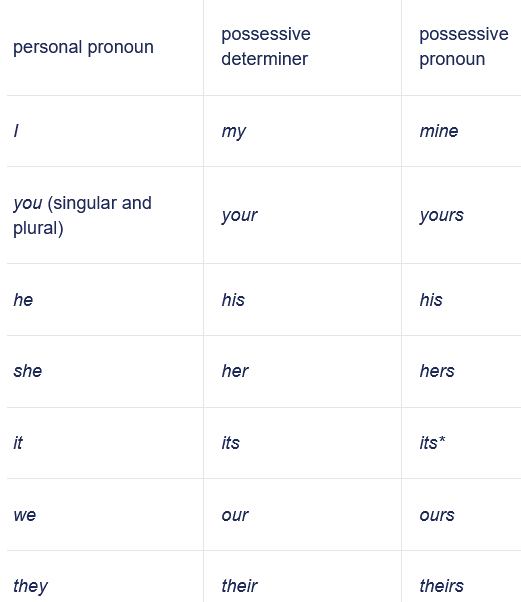
She ______ a house. It is ______. It is ______ house.
I ______ a house. It is ______. It is ______ house.
They ______ a house. It is ______. It is ______ house.
He ______ a house. It is ______. It is ______ house.
We ______ a house. It is ______. It is ______ house.
You ______ a house. It is ______. It is ______ house.
He ______ a house. It is ______. It is ______ house.
She ______ a house. It is ______. It is ______ house.
You ______ a house. It is ______. It is ______ house.
We ______ a house. It is ______. It is ______ house.
___________________
Answers:
She has a house. It is hers. It is her house.
I have a house. It is mine. It is my house.
They have a house. It is theirs. It is their house.
He has a house. It is his. It is his house.
We have a house. It is ours. It is our house.
You have a house. It is yours. It is your house.
He has a house. It is his. It is his house.
She has a house. It is hers. It is her house.
You have a house. It is yours. It is your house.
We have a house. It is ours. It is our house. ______________________
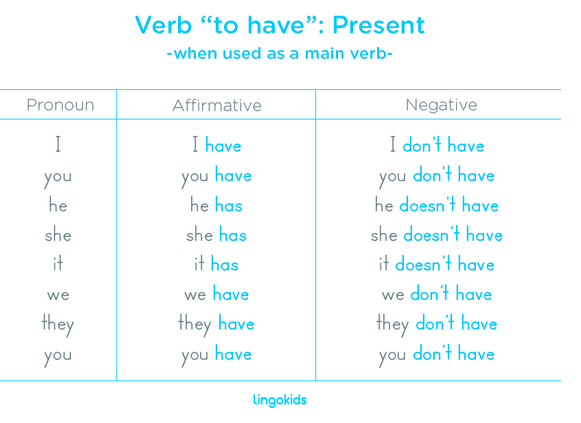
Negative sentences: fill in:
She _doesn’t _have_ a house. It is not _hers_. It is not _her_ house. I ______ ______ a house. It is not ______. It is not ______ house. They ______ ______ a house. It is not ______. It is not ______ house. He ______ ______ a house. It is not ______. It is not ______ house. We ______ ______ a house. It is not ______. It is not ______ house. You ______ ______ a house. It is not ______. It is not ______ house. He ______ ______ a house. It is not ______. It is not ______ house. She ______ ______ a house. It is not ______. It is not ______ house. You ______ ______ a house. It is not ______. It is not ______ house. We ______ ______ a house. It is not ______. It is not ______ house. ____________________-
Answers:
She does not have a house. It is not hers. It is not her house.
I do not have a house. It is not mine. It is not my house.
They do not have a house. It is not theirs. It is not their house.
He does not have a house. It is not his. It is not his house.
We do not have a house. It is not ours. It is not our house.
You do not have a house. It is not yours. It is not your house.
He does not have a house. It is not his. It is not his house.
She does not have a house. It is not hers. It is not her house.
You do not have a house. It is not yours. It is not your house.
We do not have a house. It is not ours. It is not our house.
I am Ben. I wake up at 7 o’clock. I eat bread and milk. Then I go to school. I play football with my friends. After school I go home. I eat pizza with my family. I am happy. _________________
to wake up = open your eyes in the morning
to eat = put food in your mouth
bread = food, white or brown, you can eat it with butter
milk = white drink from a cow
to play football = kick a ball with your feet, with friends
a friend = a person you like
home = the place where you live
a family = mother, father, sister, brother … people who live together
Tom: “Hi! Have you got a pet?” Anna: “Yes! I have got a cat. And you?” Tom: “No, I haven’t got a pet. But I have got a bike.” Anna: “Have you got a bike?” Tom: “Yes! I have got a red bike.”
Then they meet Sam. Tom: “Hi Sam! Have you got a dog?” Sam: “No, I haven’t got a dog. But I have got a hamster.”
In the playground, they meet Lily. Tom: “Hi Lily! Have you got a ball?” Lily: “Yes, I have got a blue ball. Have you got a ball?” Tom: “No, I haven’t got a ball.” Anna: “Have you got a doll?” Lily: “Yes, I have got a doll. Have you got a doll, Sam?” Sam: “No, I haven’t got a doll.”
Then Tom sees his teacher. Tom: “Have you got a dog, Mr. Brown?” Mr. Brown: “Yes, I have got a dog. And I have got a cat too!”
####################
Exercise 1 – Fill in the blanks
Complete the sentences with have got / haven’t got / Have you got:
Tom: “___ a pet?”
Anna: “Yes, ___ a cat.”
Tom: “No, ___ a pet. But ___ a bike.”
Anna: “___ a bike?”
Tom: “Yes! ___ a red bike.”
Tom: “Hi Sam! ___ a dog?”
Sam: “No, ___ a dog. But ___ a hamster.”
Tom: “Hi Lily! ___ a ball?”
Lily: “Yes, ___ a blue ball. ___ you got a doll?”
Sam: “No, ___ a doll.”
Answers :
Have you got
I have got
I haven’t got / I have got
Have you got
I have got
Have you got
I haven’t got / I have got
Have you got
I have got / Have
I haven’t got
################
Exercise 2 – Matching
Match the person to what they have got:
Tom → a ___
Anna → a ___
Sam → a ___
Lily → a ___
Options: a) blue ball b) hamster c) cat d) red bike ____________________
Answers – Exercise 2: 1 → d (red bike) 2 → c (cat) 3 → b (hamster) 4 → a (blue ball)
###############
Exercise 3 – Make your own story
Complete 10 dialogues using Have you got / I have got / I haven’t got:
A: “___ a pet?” B: “Yes, ___ a cat.”
A: “___ a bike?” B: “No, ___ a bike.”
A: “___ a ball?” B: “Yes, ___ a ball.”
A: “___ a doll?” B: “No, ___ a doll.”
A: “___ a hamster?” B: “Yes, ___ a hamster.”
A: “___ a kite?” B: “No, ___ a kite.”
A: “___ a pencil?” B: “Yes, ___ a pencil.”
A: “___ a notebook?” B: “No, ___ a notebook.”
A: “___ a dog?” B: “Yes, ___ a dog.”
A: “___ a toy car?” B: “No, ___ a toy car.”
Answers – Exercise 3:
Have you got / I have got
Have you got / I haven’t got
Have you got / I have got
Have you got / I haven’t got
Have you got / I have got
Have you got / I haven’t got
Have you got / I have got
Have you got / I haven’t got
Have you got / I have got
Have you got / I haven’t got
A: “Have you got a pet?” B: “Yes, I have got a cat.”
A: “Have you got a bike?” B: “No, I haven’t got a bike.”
A: “Have you got a ball?” B: “Yes, I have got a ball.”
A: “Have you got a doll?” B: “No, I haven’t got a doll.”
A: “Have you got a hamster?” B: “Yes, I have got a hamster.”
A: “Have you got a kite?” B: “No, I haven’t got a kite.”
A: “Have you got a pencil?” B: “Yes, I have got a pencil.”
A: “Have you got a notebook?” B: “No, I haven’t got a notebook.”
A: “Have you got a dog?” B: “Yes, I have got a dog.”
A: “Have you got a toy car?” B: “No, I haven’t got a toy car.”
######################
Have or has?
Here is the updated version with pet instead of ruler:
_______ Tom and Susan got a dog? No, they _______n’t got a dog. _______ Susan got a dog? No, she _______n’t got a dog. _______ Tom got a dog? Yes, he _______ got a dog. But his neighbours _______n’t got a dog.
_______ Tom and Susan got a pet? No, they _______n’t got a pet. _______ Susan got a pet? No, she _______n’t got a pet. _______ Tom got a pet? Yes, he _______ got a pet. But his neighbours _______n’t got a pet.
_______Tom and Susan got a notebook? No, they _______n’t got a notebook. _______ Susan got a notebook? No, she _______n’t got a notebook. _______ Tom got a notebook? Yes, he _______ got a notebook. But his neighbours _______n’t got a notebook.
_______Tom and Susan got a toy car? No, they _______n’t got a toy car. _______ Susan got a toy car? No, she _______n’t got a toy car. ________Tom got a toy car? Yes, he _______ got a toy car. But his neighbours _______n’t got a toy car.
_______ Tom and Susan got a ball? No, they _______ n’t got a ball. _______ Susan got a ball? No, she _______ n’t got a ball. _______ Tom got a ball? Yes, he _______ got a ball. But his neighbours _______ n’t got a ball.
——————————-
Full version:
Have Tom and Susan got a dog? No, they haven’t got a dog. Has Susan got a dog? No, she hasn’t got a dog. Has Tom got a dog? Yes, he has got a dog. But his neighbours haven’t got a dog.
Have Tom and Susan got a pet? No, they haven’t got a pet. Has Susan got a pet? No, she hasn’t got a pet. Has Tom got a pet? Yes, he has got a pet. But his neighbours haven’t got a pet.
Have Tom and Susan got a notebook? No, they haven’t got a notebook. Has Susan got a notebook? No, she hasn’t got a notebook. Has Tom got a notebook? Yes, he has got a notebook. But his neighbours haven’t got a notebook.
Have Tom and Susan got a toy car? No, they haven’t got a toy car. Has Susan got a toy car? No, she hasn’t got a toy car. Has Tom got a toy car? Yes, he has got a toy car. But his neighbours haven’t got a toy car.
Have Tom and Susan got a ball? No, they haven’t got a ball. Has Susan got a ball? No, she hasn’t got a ball. Has Tom got a ball? Yes, he has got a ball. But his neighbours haven’t got a ball.
Does your elbow connect your leg to your foot? No, it doesn’t!
Does your nose help you smell? ____________
Does your thumb help you breathe? ____________
Do your eyes help you see? ____________
Do your fingers help you hear? ____________
Does your mouth help you talk and eat? ____________
Does your hair help you see better? ____________
Does your back help you smell? ____________
Do your legs help you walk and run? ____________
Do your feet help you chew food? ____________
Does your chest protect your heart and lungs? ____________
Does your neck connect your head to your body? ____________
Does your stomach help you talk? ____________
Do your ears help you hear sounds? ____________
Does your mouth protect your heart? ____________
Do your toes help you balance when you stand? ____________
Does your shoulder help you taste? ____________
Do your teeth help you chew food? ____________
Does your neck help you pick up things? ____________
_________________
Answers:
Do your knees help your legs bend? Yes, they do.
Does your elbow connect your leg to your foot? No, it doesn’t.
Does your nose help you smell? Yes, it does.
Does your thumb help you breathe? No, it doesn’t.
Do your eyes help you see? Yes, they do.
Do your fingers help you hear? No, they don’t.
Does your mouth help you talk and eat? Yes, it does.
Does your hair help you see better? No, it doesn’t.
Does your back help you smell? No, it doesn’t.
Do your legs help you walk and run? Yes, they do.
Do your feet help you chew food? No, they don’t.
Does your chest protect your heart and lungs? Yes, it does.
Does your neck connect your head to your body? Yes, it does.
Does your stomach help you talk? No, it doesn’t.
Do your ears help you hear sounds? Yes, they do.
Does your mouth protect your heart? No, it doesn’t.
Do your toes help you balance when you stand? Yes, they do.
Does your shoulder help you taste? No, it doesn’t.
Do your teeth help you chew food? Yes, they do.
Does your neck help you pick up things? No, it doesn’t.
##################
Match each body part to the correct function:
Body parts:
eyes
ears
nose
mouth
teeth
neck
shoulders
arms
elbows
hands
fingers
chest
stomach
legs
Functions:
a. help you hear b. help you chew c. help you see d. connects your head to your body e. help you walk and run f. help you hold things g. helps you smell h. help you bend your arm i. help you eat and talk j. protect your heart and lungs k. help you pick up small things l. connect your arms to your body m. between your shoulder and hand n. helps you digest food _________________ Answers: 1c, 2a, 3g, 4i, 5b, 6d, 7l, 8m, 9h, 10f, 11k, 12j, 13n, 14e ###############
Action commands:
Touch your nose.
Show your ears.
Move your fingers.
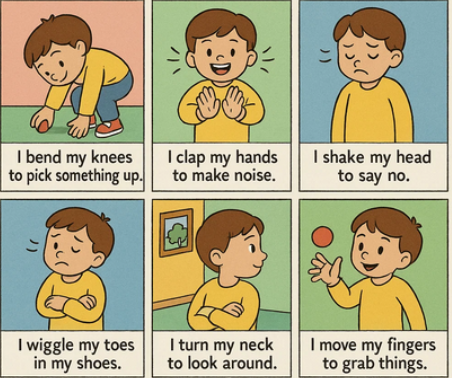
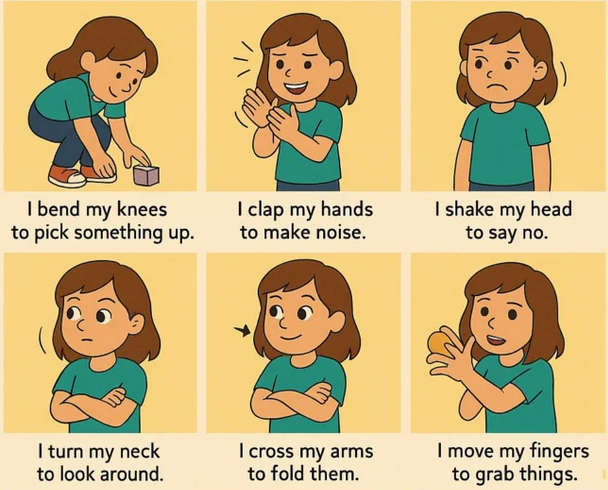
Bend your knees.
Raise your hand.
Shake your head.
Wiggle your toes.
Turn your neck.
Clap your hands.
Touch your shoulders.
Point with your thumb.
Cross your arms.
###############
My Day with Tommy
Tommy is my little brother. Today, we play together.
“Tommy, touch your nose!” I say. Tommy touches his nose and laughs.
“Show your ears!” I say. Tommy shows his ears.
“Move your fingers!” I say. Tommy moves his fingers fast.
“Bend your knees!” I say. Tommy bends his knees and jumps.
“Raise your hand!” I say. Tommy raises his hand high.
“Shake your head!” I say. Tommy shakes his head left and right.
“Wiggle your toes!” I say. Tommy wiggles his toes in his shoes.
“Turn your neck!” I say. Tommy turns his neck slowly.
“Clap your hands!” I say. Tommy claps his hands loud.
“Touch your shoulders!” I say. Tommy touches his shoulders.
“Point with your thumb!” I say. Tommy points with his thumb to the sun.
“Cross your arms!” I say. Tommy crosses his arms and smiles.
We have fun! Tommy learns all the body parts today.
###################
Gap-fill exercise:
I ______ my knees to pick something up.. a) bend b) clap c) wiggle
I ______ my hands to make noise. a) wiggle b) clap c) turn
I ______ my head to say no. a) shake b) point c) cross
I ______ my toes in my shoes. a) raise b) wiggle c) bend
I ______ my neck to look around. a) touch b) turn c) move
I ______ my fingers to grab things. a) clap b) bend c) move
I ______ my arms to fold them. a) cross b) bend c) wiggle
I ______ my hand to ask a question. a) raise b) wiggle c) shake
I ______ my thumb to point. a) move b) point c) wiggle
I ______ my knees to sit down. a) bend b) clap c) shake
I ______ my head to say yes. a) shake b) nod c) cross
I ______ my fingers to write. a) move b) raise c) bend
wave – walks – mouth – teeth – knees – arms – fingers – hears __________________ One sunny morning, Anna wakes up and opens her eyes. She stretches her __________ and legs. She gets out of bed and __________ to the window. She looks outside with her eyes and _________ birds with her ears. She smiles with her __________ and brushes her __________. Then she puts on her shoes and wiggles her toes.
Outside, Anna meets her friend Tom. They __________ their hands and say hello. They walk to the park. In the park, they kick a ball with their feet, throw it with their hands, and catch it with their __________. They sit on the grass, bend their __________, and rest their backs. The sun is warm on their faces, and they feel happy.
____________________-
Full version:
One sunny morning, Anna wakes up and opens her eyes. She stretches her arms and legs. She gets out of bed and walks to the window. She looks outside with her eyes and hears birds with her ears. She smiles with her mouth and brushes her teeth. Then she puts on her shoes and wiggles her toes.
Outside, Anna meets her friend Tom. They wave their hands and say hello. They walk to the park. In the park, they kick a ball with their feet, throw it with their hands, and catch it with their fingers. They sit on the grass, bend their knees, and rest their backs. The sun is warm on their faces, and they feel happy.
############ Another body-story:
I have a body. My body is strong, healthy, and active. I have a head. On my head, I have bright eyes, a small nose, a smiling mouth, and ears. I use my eyes to see, my ears to hear, my nose to smell, and my mouth to talk and eat.
I have a neck and broad shoulders. I have two arms. At the end of my arms, I have hands and fingers. I use my hands to write, draw, touch, and hold things.
I have a chest and a stomach. My legs are long and strong. At the end of my legs, I have feet and toes. I use my legs and feet to walk, run, jump, and explore.
All my body parts are important. They help me move, play, feel, and enjoy life every day!
Vocabulary:
head – the top part of your body
eyes – i use them to see
nose – i use it to smell
mouth – i use it to eat and talk
ears – i use them to hear
neck – connects the head and the body
shoulders – the top part of the arms
arms – i use them to lift and carry
hands – i use them to write, draw, and touch
fingers – at the end of hands
chest – front part of the body, above the stomach
stomach – i use it to digest food
legs – i use them to walk, run, and jump
feet – at the end of legs, i use them to stand and walk
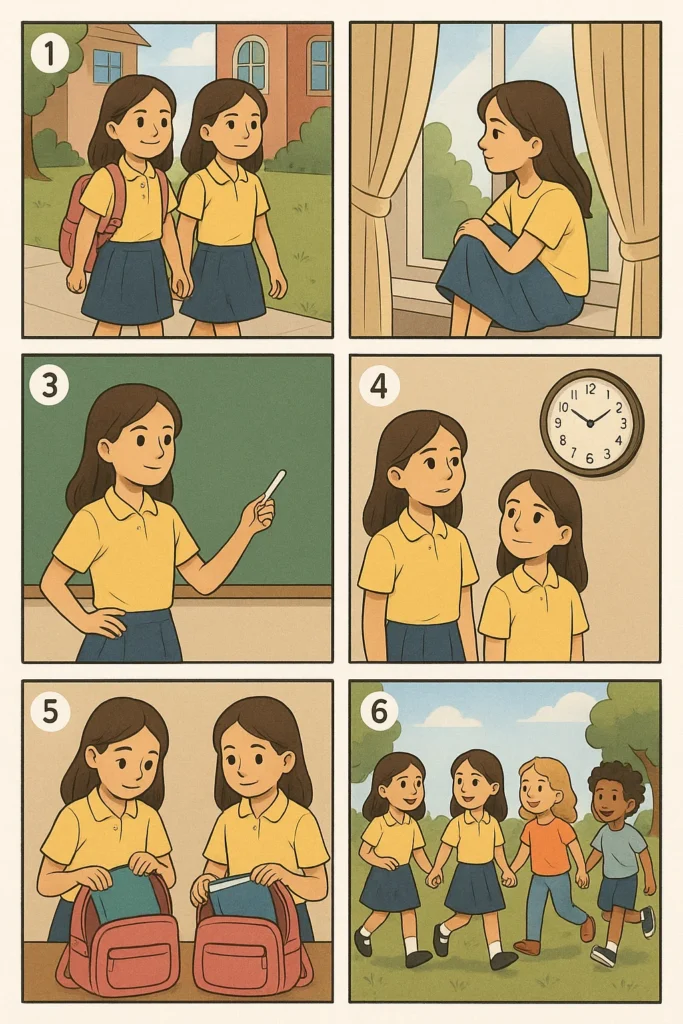
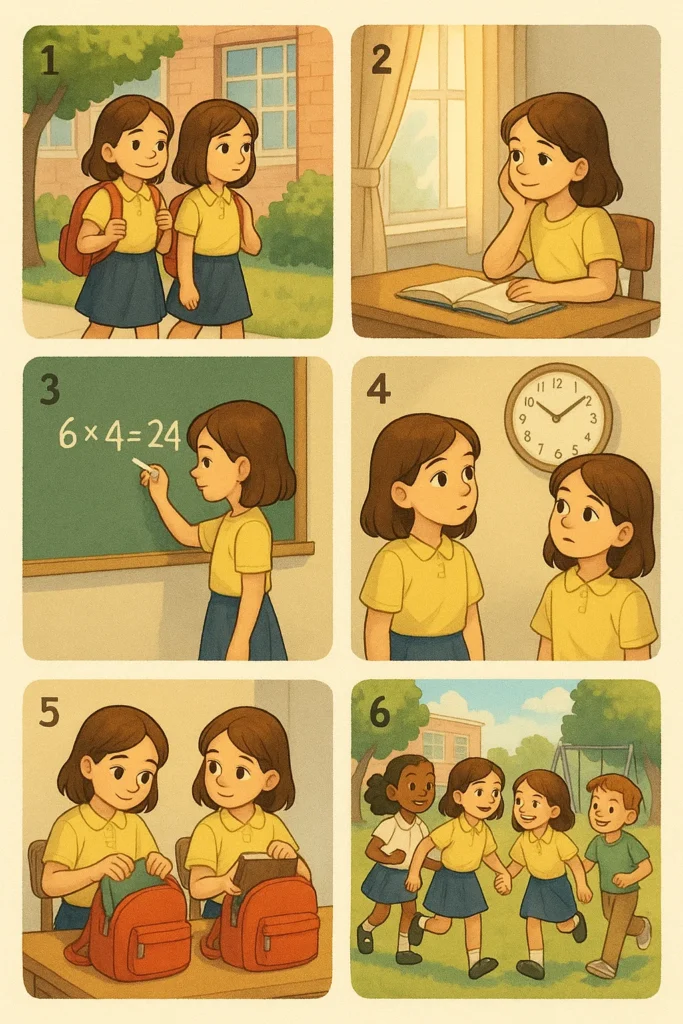
Lara and Mia are twins. They go to school together every day. In the morning, they walk through the __________ of their classroom. They put their schoolbags on the floor. Inside the bags, they have books, a __________, and whiteboard markers.
Lara sits near the ______________. She looks outside and sees the __________. Mia sits near the board. The teacher writes on the board with markers and cleans it with an __________.
Sometimes, the teacher uses the __________. It shows pictures and videos. The __________ makes the sound louder so the class can hear well. Lara and Mia sit at their desks on__________. They read books and use their tablets.
They look at the __________ to see the time. When it is break time, they stand up and put their books back in the __________. They walk on the floor to the door.
Lara and Mia go outside. They smile and play with their friends. They like school because they __________ many things every day.
____________________
what it sounds like when a person from India reads the text:
Lara and Mia are twins. They go to school together every day. In the morning, they walk through the door of their classroom. They put their schoolbags on the floor. Inside the bags, they have books, a tablet, and whiteboard markers.
Lara sits near the window. She looks outside and sees the playground. Mia sits near the board. The teacher writes on the board with markers and cleans it with an eraser.
Sometimes, the teacher uses the projector. It shows pictures and videos. The sound system makes the sound louder so the class can hear well. Lara and Mia sit at their desks on chairs. They read books and use their tablets.
They look at the clock to see the time. When it is break time, they stand up and put their books back in the schoolbag. They walk on the floor to the door.
Lara and Mia go outside. They smile and play with their friends. They like school because they learn many things every day.
#####################
True or false?
Lara looks outside and sees the playground.
2. Lara and Mia go to school every day.
3. They sit at their desks on chairs.
4. The teacher writes on the board with pencils.
5. Mia sits near the window.
6. The projector shows pictures and videos.
7. The sound system makes the sound quieter.
8. Lara sits near the board.
9. They put their schoolbags on the floor.
10. They play outside at break time.
11. The teacher cleans the board with an eraser.
12. Lara and Mia walk to school through the playground.
13. They read books and use their tablets in class.
14. The clock shows the day of the week.
15. They leave the classroom through the door.
__________________________
True:1, 2, 3, 6, 9, 10, 11, 13, 15
####################
Gap fill exercise, one answer correct:
Lara and Mia sit on a ________________. a) chair b) door c) schoolbag
They work on their ________________. a) chairs b) windows c) desks
Lara likes to sit near the ________________. a) window b) board c) door
Mia sits near the ________________. a) floor b) board c) clock
The teacher writes on the board with ________________. a) whiteboard markers b) books c) chairs
The teacher cleans the board with an ________________. a) tablet b) eraser c) schoolbag
Sometimes, the ________________ shows pictures and videos. a) projector b) floor c) sound system
The ________________ makes the teacher’s voice louder. a) door b) clock c) sound system
Lara and Mia put their ________________ on the floor. a) whiteboard markers b) tablets c) schoolbags
When the bell rings, they look at the ________________. a) clock b) window c) board
The ________________ is a table to work on. a) chair b) desk c) floor
They sit on ________________ to learn. a) books b) chairs c) tablets
The ________________ is used to go in or out. a) door b) window c) clock
The ________________ are something you read and study. a) board b) books c) eraser
The ________________ shows the time. a) clock b) door c) tablet
Short answers, e.g. ‚Yes, he does!‘, or ‚No, they don’t!‘
Does the teacher write on the board with pencils? >>> No, he/she doesn’t!
Do Lara and Mia sit on the floor?
Does the projector show pictures and videos?
Does Mia sit near the door?
Do they read books outside the classroom?
Do Lara and Mia leave the classroom through the door?
Does the sound system make the teacher’s voice quieter?
Do Mia and Lara put their schoolbags on the desk?
Does the teacher clean the board with chalk?
Do Lara and Mia use tablets to play games all day?
Does the clock show the day of the week?
Do Lara and Mia walk on the floor?
Do they use whiteboard markers to write?
Does the teacher clean the board with a tablet?
Does Lara sit near the window?
Does the sound system make the sound quieter? ___________________
Answers:
Does the teacher write on the board with pencils? No, she doesn’t.
2. Do Lara and Mia sit on the floor? No, they don’t.
3. Does the projector show pictures and videos? Yes, it does.
4. Does Mia sit near the door? No, she doesn’t.
5. Do they read books outside the classroom? No, they don’t.
6. Do Lara and Mia leave the classroom through the door? Yes, they do.
7. Does the sound system make the teacher’s voice quieter? No, it doesn’t.
8. Do Mia and Lara put their schoolbags on the desk? No, they don’t.
9. Does the teacher clean the board with chalk? No, she doesn’t.
10. Do Lara and Mia use tablets to play games all day? No, they don’t.
11. Does the clock show the day of the week? No, it doesn’t.
12. Do Lara and Mia walk on the floor? Yes, they do.
13. Do they use whiteboard markers to write? No, they don’t.
14. Does the teacher clean the board with a tablet? No, she doesn’t.
15. Does Lara sit near the window? Yes, she does.
16. Does the sound system make the sound quieter? No, it doesn’t. ##############
Match question and answer:
Questions:
Where do Lara and Mia walk in the morning? __d__
What do they put on the floor? _____
What is inside their schoolbags? _____
Where does Lara sit? _____
Where does Mia sit? _____
What does the teacher write on the board with? _____
What does the teacher clean the board with? _____
What does the projector show? _____
What does the sound system do? _____
What do Lara and Mia do at their desks? _____
What do they look at to see the time? _____
What do Lara and Mia do at break time? _____
Answers:
a) They put their schoolbags on the floor. b) Lara sits near the window. c) The projector shows pictures and videos. d) They walk through the door of their classroom. e) Mia sits near the board. f) They read books and use their tablets. g) The teacher writes with markers. h) The teacher cleans the board with an eraser. i) The sound system makes the sound louder. j) They look at the clock. k) They smile and play with their friends. l) Inside the schoolbags are books, a tablet, and whiteboard markers.
Where do Lara and Mia walk in the morning? — They walk through the door of their classroom.
2. What do they put on the floor? — They put their schoolbags on the floor.
3. What is inside their schoolbags? — Inside the schoolbags are books, a tablet, and whiteboard markers.
4. Where does Lara sit? — Lara sits near the window.
5. Where does Mia sit? — Mia sits near the board.
6. What does the teacher write on the board with? — The teacher writes with markers.
7. What does the teacher clean the board with? — The teacher cleans the board with an eraser.
8. What does the projector show? — The projector shows pictures and videos.
9. What does the sound system do? — The sound system makes the sound louder.
10. What do Lara and Mia do at their desks? — They read books and use their tablets.
11. What do they look at to see the time? — They look at the clock.
12. What do Lara and Mia do at break time? — They smile and play with their friends.
####################
Find the correct question/s for the word/s given:
part 1: 1-12
1. Lara sits near the window. >>>near the window a) Who sits near the window? b) What does she do near the window? c) Where does she sit? >>>CORRECT
2. They put their schoolbags on the floor. >>>on the floor a) Where do they put their schoolbags? b) What do they put on the floor? c) Who puts the schoolbags?
3. The teacher writes on the board with markers. >>>with markers a) How does the teacher write on the board? b) What does the teacher write with? c) Where does the teacher write?
4. Mia sits near the board. >>>Mia a) Who sits near the board? b) What does Mia do? c) Where does Mia sit?
5. The projector shows pictures and videos. >>>pictures and videos a) What does the projector show? b) Where does the projector show pictures? c) Who uses the projector?
6. They look at the clock to see the time. >>>the clock a) What do they look at to see the time? b) Where do they look? c) Who looks at the clock?
7. They smile and play with their friends. >>>with their friends a) Who do they play with? b) What do they do with their friends? c) Where do they smile?
8. The sound system makes the sound louder. >>>makes the sound louder a) How does the sound system make the sound? b) What does the sound system do? c) Where is the sound system?
9. Lara and Mia walk through the door. >>> through the door a) Where do Lara and Mia walk through? b) How do Lara and Mia walk? c) Who walks through the door?
10. They read books and use their tablets. >>> theirtablets a) What do they use to read? b) What do they use besides books? c) Who uses tablets?
11. The teacher cleans the board with an eraser. >>>with an eraser a) How does the teacher clean the board? b) What does the teacher clean the board with? c) Who cleans the board?
12. They put their books back in the schoolbag. >>>back in the schoolbag a) Where do they put their books? b) What do they put in the schoolbag? c) Who puts the books in the schoolbag?
part 2: 13-20
13. The classroom has desks and chairs. >>>desks and chairs a) Who uses the chairs? b) Where are the desks? c) What does the classroom have?
14. They sit at their desks on chairs. >>>at their desks a) Where do they sit? b) What do they sit on? c) Who sits at their desks?
15. The whiteboard markers are in the bag. >>>in the bag a) Who has the bag? b) What is in the bag? c) Where are the whiteboard markers?
16. The playground is outside the window. >>>outside the window a) Where is the playground? b) What is outside the window? c) Who looks outside the window?
17. They walk on the floor to the door. >>>on the floor a) Where do they walk? b) What do they walk on? c) Who walks on the floor?
18. The teacher uses the projector sometimes. >>>sometimes a) How often does the teacher use the projector? b) What does the teacher use? c)When/How often does the teacher use the projector?
19. They look at the clock to see the time. >>>see the time a) What do they look at? b) Why do they look at the clock? c) Who looks at the clock?
20. They like school because they learn many things. >>>because they learn many things a) What do they learn? b) Why do they like school? c) Who likes school?
Answers
1 c, 2 a, 3 b, 4 a, 5 a, 6 a, 7 a, 8 b, 9 a, 10 b, 11 b, 12 a, 13 c, 14 a, 15 c, 16 a, 17 b, 18 c, 19 b, 20 b
##############
Interview with Mia, fill in, words below:
tablet – cleans – every day – schoolbag – twin – board – projector – floor.- learn
_________________________
1. What is your name? My name is Mia.
2. Do you have a brother or sister? Yes, I have a _________ sister. Her name is Lara.
3. Do you go to school every day? Yes, we go to school __________.
4. What do you put on the floor in the classroom? We put our schoolbags on the __________
5. What do you have inside your schoolbag? I have books, a __________, and whiteboard markers inside my schoolbag.
6. Where do you sit in the classroom? I sit near the __________.
7. What does the teacher do with the markers? The teacher writes on the board with markers and __________ the board with an eraser.
8. Does the teacher use the projector? Yes, sometimes the teacher uses the __________ to show pictures and videos.
9. What do you do when it is break time? When it is break time, I stand up, put my books back in the __________, and walk to the door.
10. Do you like school? Yes, I like school because I ___________ many things every day.
__________________
Full version:
1. What is your name? My name is Mia.
2. Do you have a brother or sister? Yes, I have a twin sister. Her name is Lara.
3. Do you go to school every day? Yes, we go to school every day.
4. What do you put on the floor in the classroom? We put our schoolbags on the floor.
5. What do you have inside your schoolbag? I have books, a tablet, and whiteboard markers inside my schoolbag.
6. Where do you sit in the classroom? I sit near the board.
7. What does the teacher do with the markers? The teacher writes on the board with markers and cleans the board with an eraser.
8. Does the teacher use the projector? Yes, sometimes the teacher uses the projector to show pictures and videos.
9. What do you do when it is break time? When it is break time, I stand up, put my books back in the schoolbag, and walk to the door.
10. Do you like school? Yes, I like school because I learn many things every day.
#####################
Interview with Lara, fill in, words below
eraser – clock – window – new – playground – louder. – morning – read – sometimes – break
___________________________
1. What time do you go to school? I go to school in the __________.
2. Who do you sit next to in the classroom? I sit next to the __________.
3. What do you like to see outside the window? I like to see the __________.
4. What do you do with your tablet at school? I use my tablet to ________ and learn.
5. How does the teacher clean the board? The teacher uses an __________ to clean the board.
6. When does the teacher use the projector? The teacher uses the projector __________.
7. What helps the class hear better when the projector is on? The sound system makes the sound __________
8. What do you do when the__________ shows break time? I stand up and put my books back in my bag.
9. Where do you go during _________ time? I go outside to play with my friends.
10. What do you like about learning at school? I like learning __________ things every day.
_____________________
Full version:
1. What time do you go to school? I go to school in the morning.
2. Who do you sit next to in the classroom? I sit next to the window.
3. What do you like to see outside the window? I like to see the playground.
4. What do you do with your tablet at school? I use my tablet to read and learn.
5. How does the teacher clean the board? The teacher uses an eraser to clean the board.
6. When does the teacher use the projector? The teacher uses the projector sometimes.
7. What helps the class hear better when the projector is on? The sound system makes the sound louder.
8. What do you do when the clock shows break time? I stand up and put my books back in my bag.
9. Where do you go during break time? I go outside to play with my friends.
10. What do you like about learning at school? I like learning new things every day.
How Mia and her twin sister spend their afternoons and evenings together
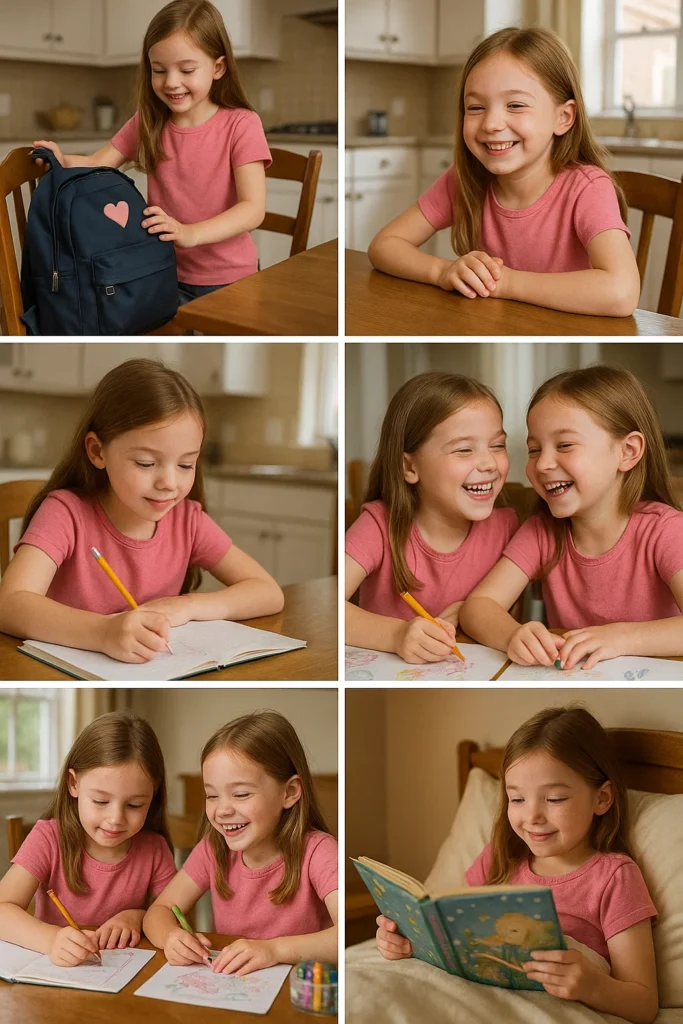
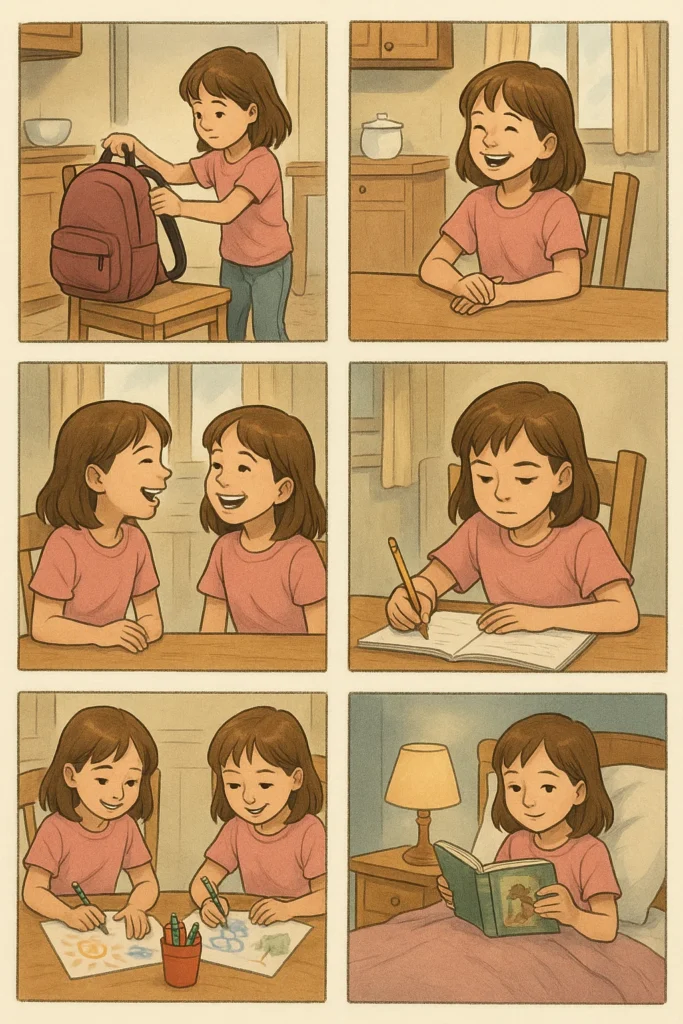
Mia is a young girl. She has a twin sister. They go to the same primary school. Every day, Mia comes home from school at 3 o’clock. First, she takes off her school bag and puts it on the chair. Then, she goes to the bathroom and washes her hands and face.
After that, Mia sits at the kitchen table. Her mother gives her a small snack. Mia eats the snack and drinks some water. She talks with her sister about their day at school. They laugh and have fun.
Next, Mia does her homework. She writes in her notebook and reads her books. Sometimes, her sister helps her. They finish the homework together.
When the homework is done, Mia plays with her sister. They play with dolls or draw pictures. Sometimes, they go outside and play in the garden. Mia loves to play with her sister.
At 7 o’clock, Mia has dinner with her family. After dinner, she takes a bath and puts on her pajamas. Then, Mia reads a storybook or listens to a story. At 8 o’clock, Mia goes to bed and falls asleep. _______________________
Vocabulary:
an adventure – a fun or exciting experience. a twin sister – a girl born at the same time as another girl. to spend an afternoon – to do something during the afternoon. to take off – to remove something. a school bag – a bag for carrying school things. a chair – something you sit on. a bathroom – a room to wash and clean. to wash – to clean with water. a kitchen – a room where people cook food. a snack – a small amount of food between meals. to laugh – to make a happy sound when funny. a notebook – a book for writing. sometimes – not every time, but now and then. to finish – to complete something. a doll – a small toy that looks like a person. to draw a picture – to make a picture with a pencil. to take a bath – to wash your body in water. to put on pajamas – to wear clothes for sleeping. a storybook – a book with stories for children. to fall asleep – to start sleeping.
##################
Multiple choice, one answer correct:
1. What is an adventure? a) A fun or exciting experience b) A boring day c) A quiet place
2. Who is a twin sister? a) A teacher at school b) A girl born at the same time as another girl c) A friend from another city
3. What does it mean to spend an afternoon? a) To sleep all day b) To eat breakfast c) To do something during the afternoon
4. What does it mean to take off something? a) To wash it b) To put it on c) To remove it
5. What is a school bag? a) A bag for shopping b) A bag for carrying school things c) A bag for food
6. What is a chair? a) Something you write with b) Something you sleep on c) Something you sit on
7. What is a bathroom? a) A place to eat b) A place to play c) A room to wash and clean
8. What does it mean to wash? a) To eat food b) To clean with water c) To play outside
9. What is a kitchen? a) A room to study b) A room where people cook food c) A place to sleep
10. What is a snack? a) A small amount of food between meals b) A type of drink c) A big meal
11. What does it mean to laugh? a) To cry b) To make a happy sound when funny c) To shout
12. What is a notebook? a) A toy b) A book for writing c) A book for reading only
13. What does sometimes mean? a) Always b) Never c) Not every time, but now and then
14. What does it mean to finish something? a) To forget it b) To stop and complete it c) To start it
15. What is a doll? a) A pet animal b) A small toy that looks like a person c) A type of food
16. What does it mean to draw a picture? a) To make a picture with a pencil b) To write words c) To sing a song
17. What does it mean to take a bath? a) To eat dinner b) To sleep c) To wash your body in water
18. What does it mean to put on pajamas? a) To wear clothes for sleeping b) To wear shoes c) To wear a hat
19. What is a storybook? a) A book with numbers b) A dictionary c) A book with stories for children
20. What does it mean to fall asleep? a) To eat breakfast b) To start sleeping c) To wake up
____________________ Answers: 1 a, 2 b, 3 c, 4 c, 5 b, 6 c, 7 c, 8 b, 9 b, 10 a, 11 b, 12 b, 13 c, 14 b, 15 b, 16 a, 17 c, 18 a, 19 c, 20 b ################
Complete, one answer correct:
Mia takes off her _______ when she comes home. (a) school bag, (b) doll, (c) notebook
She puts her school bag on a _______. (a) chair, (b) kitchen, (c) bathroom
Mia goes to the _______ to wash her hands and face. (a) bedroom, (b) bathroom, (c) kitchen
After washing, Mia sits at the _______ table. (a) bathroom, (b) kitchen, (c) school
Her mother gives her a small _______ to eat. (a) snack, (b) storybook, (c) adventure
Mia likes to _______ with her sister when they talk. (a) finish, (b) laugh, (c) draw
Mia does her homework in her _______. (a) pajamas, (b) notebook, (c) doll
Sometimes her sister helps her to _______ her homework. (a) finish, (b) fall asleep, (c) take off
Mia and her sister like to play with a _______. (a) chair, (b) doll, (c) snack
They also like to _______ pictures together. (a) take a bath, (b) draw, (c) spend
At 7 o’clock, Mia takes a _______. (a) snack, (b) bath, (c) storybook
She puts on her _______ before going to bed. (a) pajamas, (b) school bag, (c) notebook
Mia reads a _______ before she falls asleep. (a) chair (b) snack, (c) storybook
Mia likes to _______ in the afternoon after school. (a) spend, (b) wash, (c) laugh
At 8 o’clock, Mia goes to bed and _______. (a) draws, (b) falls asleep, (c) finishes
______________________________________
Answers: 1 a, 2 a, 3 b, 4 b, 5 a, 6 b, 7 b, 8 a, 9 b, 10 b, 11 b, 12 a, 13 c, 14 c, 15 b ####################
Answers:
Mia takes off her school bag when she comes home.
She puts her school bag on a chair.
Mia goes to the bathroom to wash her hands and face.
After washing, Mia sits at the kitchen table.
Her mother gives her a small snack to eat.
Mia likes to laugh with her sister when they talk.
Mia does her homework in her notebook.
Sometimes her sister helps her to finish her homework.
Mia and her sister like to play with a doll.
They also like to draw pictures together.
At 7 o’clock, Mia takes a bath.
She puts on her pajamas before going to bed.
Mia reads a storybook before she falls asleep.
Mia likes to laugh in the afternoon after school.
At 8 o’clock, Mia goes to bed and falls asleep.
#################
Match word – definition:
Words:
an adventure
a twin sister
to spend an afternoon
to take off
a school bag
a chair
a bathroom
to wash
a kitchen
a snack
to laugh
a notebook
sometimes
to finish
a doll
to draw a picture
to take a bath
to put on pajamas
a storybook
to fall asleep
Definitions:
a) a seat for one person b) to take off clothes or something you wear c) a book with stories for children d) a small meal or food eaten between meals e) to rest your body and mind by sleeping f) two girls born at the same time g) to make a picture with a pen or pencil h) a bag for carrying school things i) to clean yourself with water j) to spend time doing something in the afternoon k) to put on clothes for sleeping l) now and then; not always m) a room where you wash yourself n) a toy that looks like a small person o) to smile and make sounds because something is funny p) to wash your whole body with water q) to complete something r) a room where food is made and eaten s) an exciting or unusual experience t) a book to write or draw in _______________________________ Answers: 1 s, 2 f, 3 j, 4 b, 5 h, 6 a, 7 m, 8 i, 9 r, 10 d, 11 o, 12 t, 13 l, 14 q, 15 n, 16 g, 17 p, 18 k, 19 c, 20 e
#######################
Fill in, complete, words below:
bath – plays – home – snack – storybook – dolls – asleep -twin
Mia is a young girl. She has a __________ sister. They go to the same school. Every day, Mia comes __________ at 3 o’clock. She takes off her school bag and washes her hands and face. Mia eats a small __________and talks with her sister. Then, she does her homework. After homework, Mia __________ with her sister. They like __________ and drawing. At 7 o’clock, Mia has dinner. After dinner, she takes a __________ and puts on pajamas. Mia reads a __________ before she goes to bed. At 8 o’clock, she falls _________. ################
Correct version:
Mia is a young girl. She has a twin sister. They go to the same school. Every day, Mia comes home at 3 o’clock. She takes off her school bag and washes her hands and face. Mia eats a small snack and talks with her sister. Then, she does her homework. After homework, Mia plays with her sister. They like dolls and drawing. At 7 o’clock, Mia has dinner. After dinner, she takes a bath and puts on pajamas. Mia reads a storybook before she goes to bed. At 8 o’clock, she falls asleep.